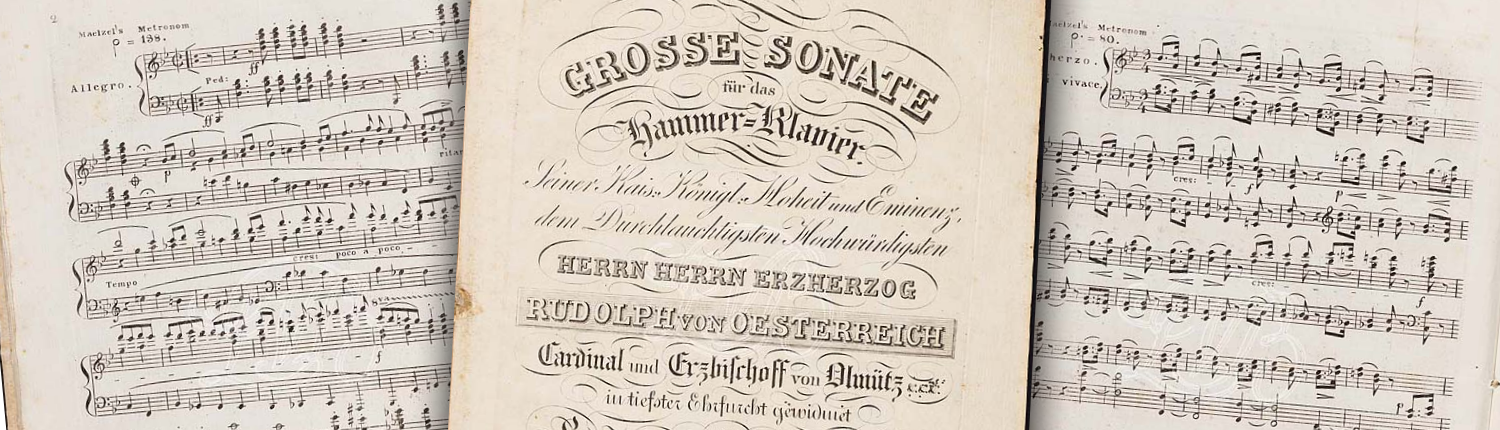
Opus 106 Sonata in B flat major for piano
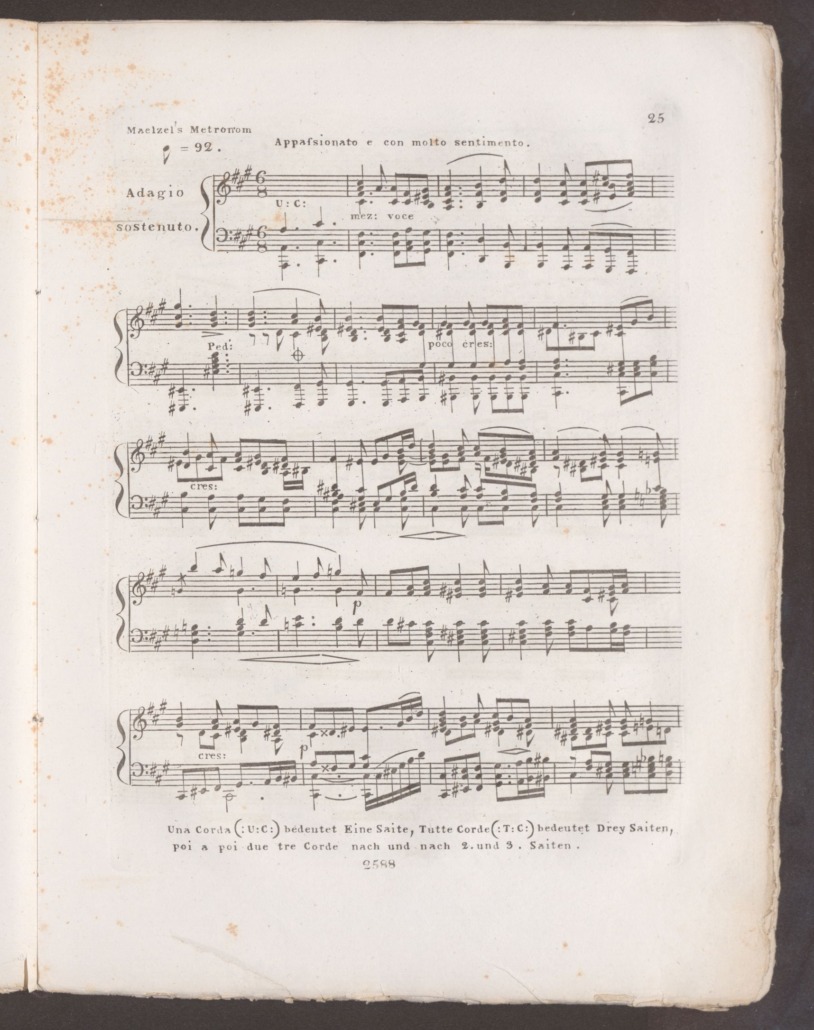
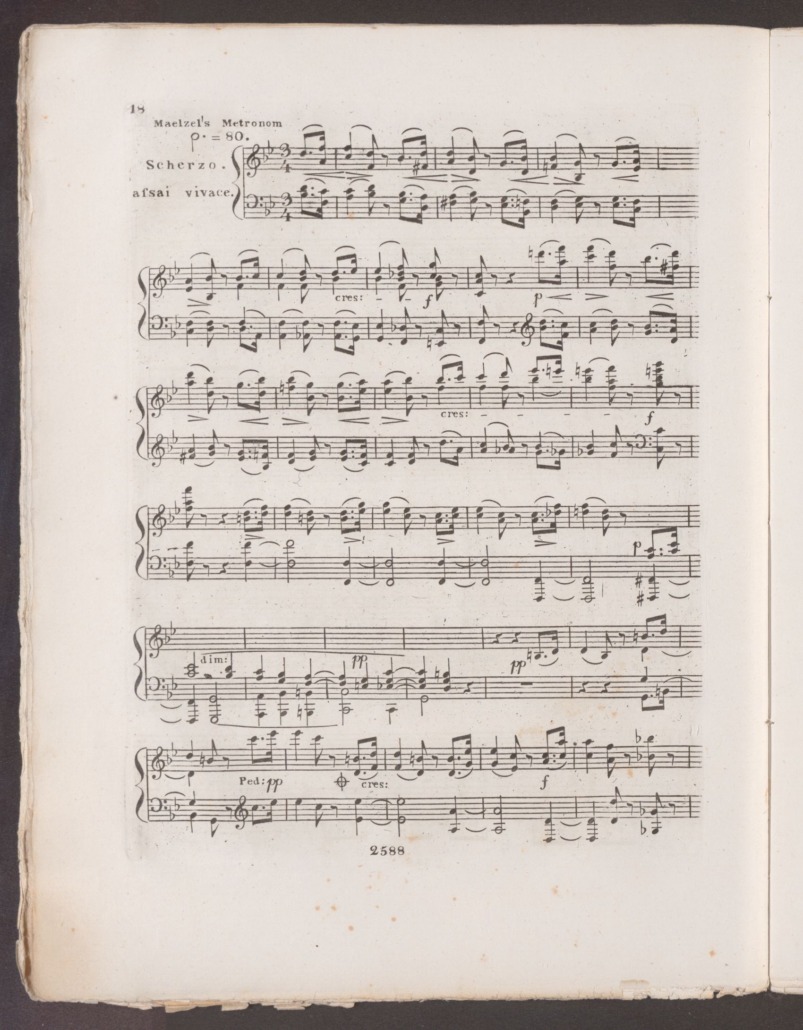
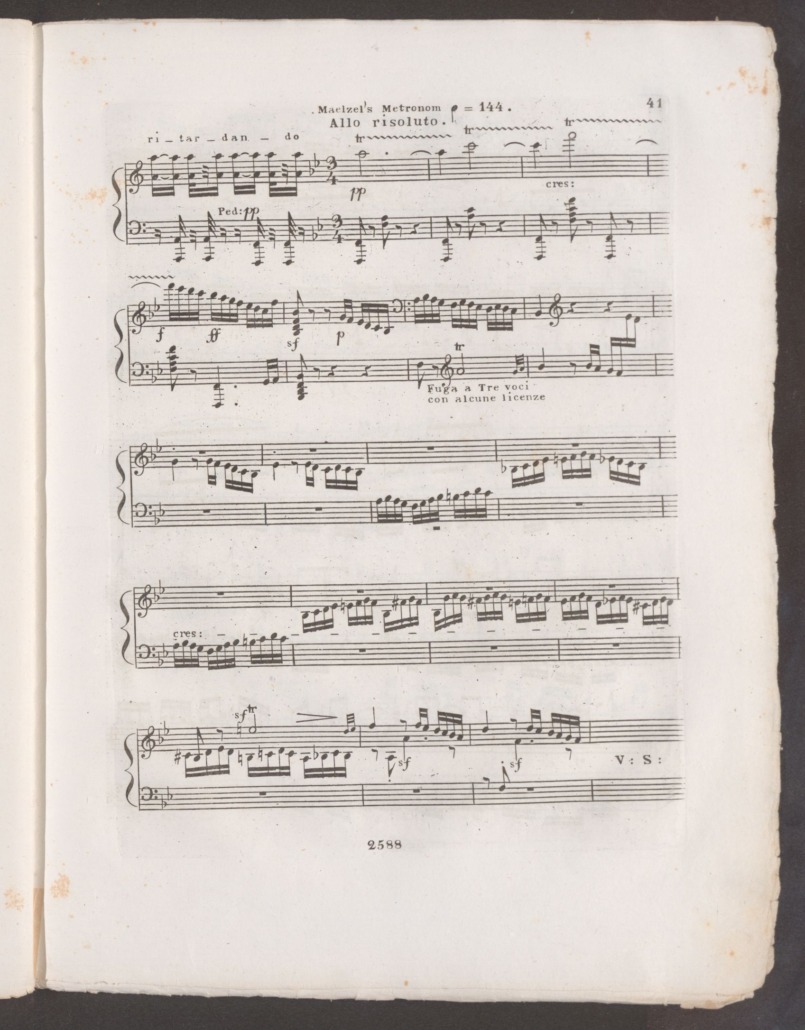
I) Allegro – II) Scherzo – Assai vivace – III) Adagio sostenuto. Appassionato con molto sentimento – IV) Largo – Allegro risoluto – Fuga a tre voci
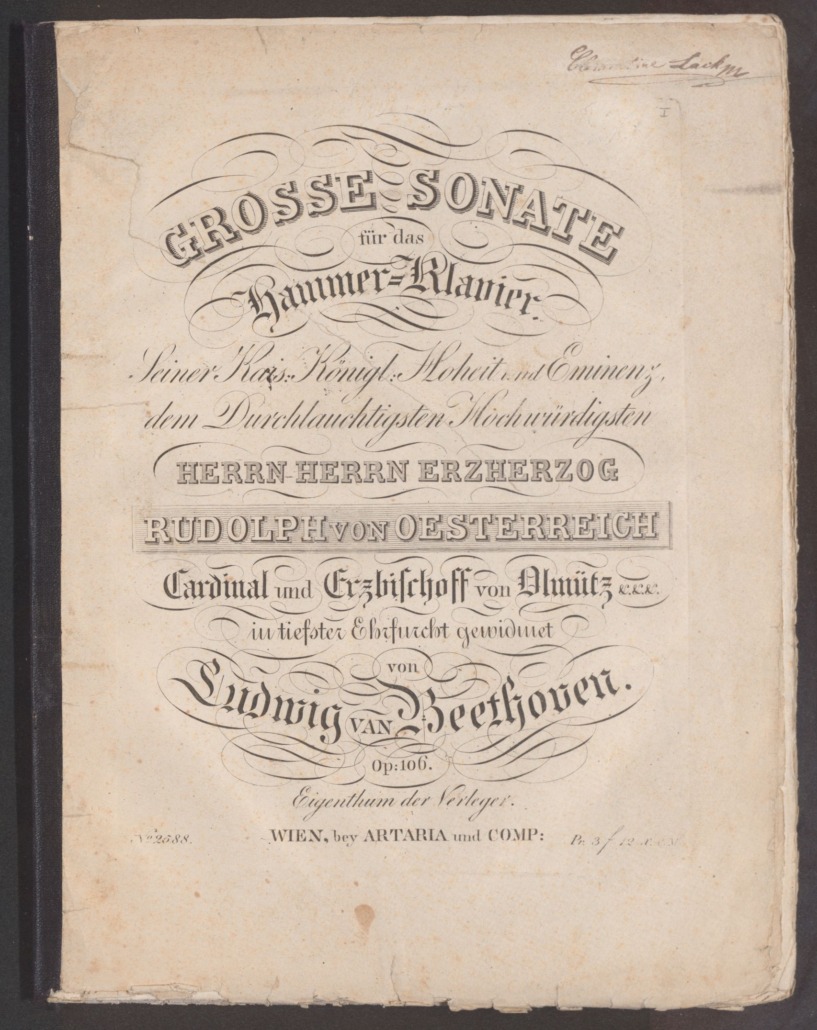
OPUS 106 – Sonata in B-flat major for piano, Op. 106, dedicated to Archduke Rudolf of Austria, composed between 2 November 1817 and March 1819, published in Vienna by Artaria in two editions, respectively with French and German titles, September 1819. A third edition, in London, appeared in the autumn of the same year, published by The Regent’s Harmonic Institution, Lower Saloon, Argyll Rooms. GA no. 152 (Series 16/29) – B. 106 – KH. 106 – L. IV, p. 30 – Nottebohm 106 – Thayer 215
The original manuscript is lost. An entire chapter of Nottebohm is devoted to the sketches.
Composed during a rather unhappy period in Beethoven’s life, due to poor health and financial difficulties, this sonata, undoubtedly one of his major works, bears the imprint of both determination and sorrow. Its overall structure is rigorously classical, yet it incorporates the most perfected forms of the genre, elevating them into a grand architectural design that is, in itself, a work of art. Spiritually, the work faithfully reflects the varied and often conflicting moods of the composer at the time of its composition. Yet a higher inspiration tempers and harmonizes the whole.
The first and fundamental theme of the opening movement, originally intended for a cantata for Archduke Rudolf that was never written, presents itself as an impetuous command, whose hammering recalls that of the Great Fugue, Op. 133. In its second part, however, it flows with a smooth, almost sweet lyricism (see, for other examples of this contrast, the opening of the Sonata Op. 90 in E minor, also for piano, and the Quartet Op. 127 in E-flat major, particularly for a certain flowing affinity).
A highly developed transitional episode, in three distinct elements, leads to the second theme, also divided into three parts: the first derived from elements of the initial theme and the transitional episode; the second consisting of a phrase that becomes increasingly fluid in its motion; and the final part marked by a clear melodic line. A bright and cheerful cadenza closes the exposition.
The development begins with an extension of the final phrase of the exposition, followed by a fugue based on the first theme. After a brief reappearance of the final melody of the second theme, another fugal episode leads to the recapitulation, which unfolds with several variations from the exposition and is followed by a coda, in which the two principles—the terminal melodic line of the second theme and the initial rhythmic figure of the first—are again placed in contrast, ultimately resolving in a gradual diminution of the rhythmic element, fading away pianissimo.
The determined character of this first movement is succeeded by the imaginative page of the Scherzo, which develops in the first two sections from a short motif rhythmically derived from the impulse of the first movement’s initial theme. Its continuous insistence is, in itself, one of Beethoven’s characteristic gestures. “A whirling caprice of the spirit,” says Rolland, “in which fanfares of slightly hoarse and veiled horns respond like calls across the countryside.”
The Trio is more tranquil in character and unfolds in four symmetrical waves over a single phrase, moving from key to key, in major and minor, with developments in canon. An episode in Presto, beginning pianissimo and detached, is repeated three times in a continuously intensifying crescendo, followed by a kind of furious cadenza in Prestissimo that leads back to the first section, which, however, ultimately diverges from the model to conclude with inventive originality in form, tonal aspects, and dynamic shading.
The sketches of the fundamental elements of the Adagio sostenuto also date from the summer of 1818.
But the composer devoted himself to the composition and elaboration later: in the autumn at Mödling and in the early months of winter in Vienna. The first section expresses, in a restrained form, a desolate feeling into which the note of an alien sweetness from another melody is inserted twice, very close to what would later become the “Benedictus” of the Missa Solemnis. The first phrase recurs, gradually becoming more expressive, lyrically expanded, and richly ornamented.
A second fundamental element then arises: like a higher voice, calm, solemn, commanding, yet softened by a certain comforting gentleness, almost pastoral. Upon these two “principles” unfolds, with richness and variety of alternations, contrasts, and returns, the entire subsequent section, always in a warm atmosphere of spiritual passion; concluding in the slow fading together, in both the bass and treble, of the major chord notes, like a reconciliation achieved in a world of higher understanding and contemplation beyond all human disturbance.
The Largo that opens the fourth movement might be described as an improvisation or a grand cadenza, a relaxation after the gravity of the Adagio, and at the same time a kind of psychological-musical transition to the following fugue, as in the Finale of the Ninth Symphony, encompassing the entire instrumental section preceding the entry of the voices. Formal analyses and spiritual interpretations of the powerful fugue that follows, simultaneously joyful and determined, have been made by D’Indy, Busoni, and Rolland, who highlighted the varied character of the episodes, as well as the multiple artifices and ingenious devices.
At one point, an episode in D major appears like a prayer, again approaching the Missa Solemnis (Dona pacem) to come, interweaving with the main theme and giving rise to another powerful fugal section. The conclusion is made more energetic by the rhythmic drive of the last bars, corresponding to the general sense of “joy in strength” already expressed in the first movement.
According to Schering, the Sonata is inspired by Schiller’s Joan of Arc. In the first movement, corresponding to the Prologue, Scene IV, it reflects Joan’s first monologue, Farewell, mountains. The second movement, corresponding to Act IV, Scene I, represents her second monologue, first part, The arms repose. The third movement continues with the second part of the monologue, O sweet drone of the shepherd, I wish I had never exchanged you for the sword!. In the fourth movement, the Largo corresponds to Act IV, Scenes VI and VIII, in which Joan meets her sisters Margaret and Louise and then rushes out of the church. The Allegro fugue depicts Joan wandering, tormented by remorse, undergoing an inner struggle, culminating in her final liberation and victory.
[By Biamonti Giovanni – Catalogo cronologico e tematico delle opere di Beethoven comprese quelle inedite e gli abbozzi non utilizzati, Torino, ILTE 1968]
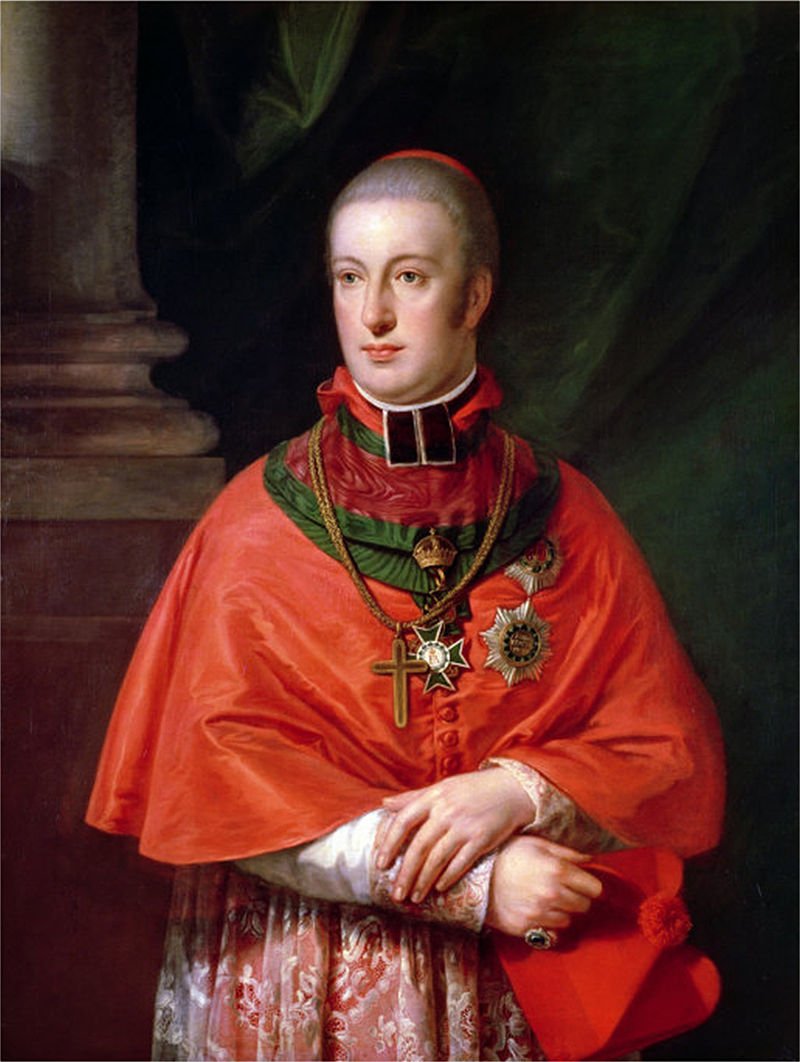
Official title: Opus 106 Sonate (B-dur) für Klavier Widmung: Erzherzog Rudolph von Österreich NGA VII/4 AGA 152 = Serie 16/29 Beiname: Hammerklaviersonate (nach dem deutschen Titel der Wiener Originalausgabe)
Origin and publication: Sketched between November/December 1817 and the summer of 1818 in Vienna. The manuscript of the first two movements bore the autograph date “17 April 1818”. In mid-May 1818, Beethoven asked Ferdinand Ries to find a publisher in London; a model for engraving probably went to London in January 1819. It is not known when the copy for the engraver of the Viennese edition became available. The original Viennese edition was published by Artaria in September 1819.
The London edition followed in December of the same year. The first mention of the composition appears in a letter from Beethoven of May 1818 addressed to Ries in London: „ich wünschte, daß sie sähen folgende 2 Werke, eine große Solo Sonate für Klawier [Op. 106] und eine von mir selbst umgeschaffene Klawier Sonate f!l in ein Quintett für 2 Violin 2 Bratschen 1 Violonschell [Op. 104 nach dem Klaviertrio Op. 1 Nr. 3] an einen Verleger in London anzubringen“ (BGA 1258).
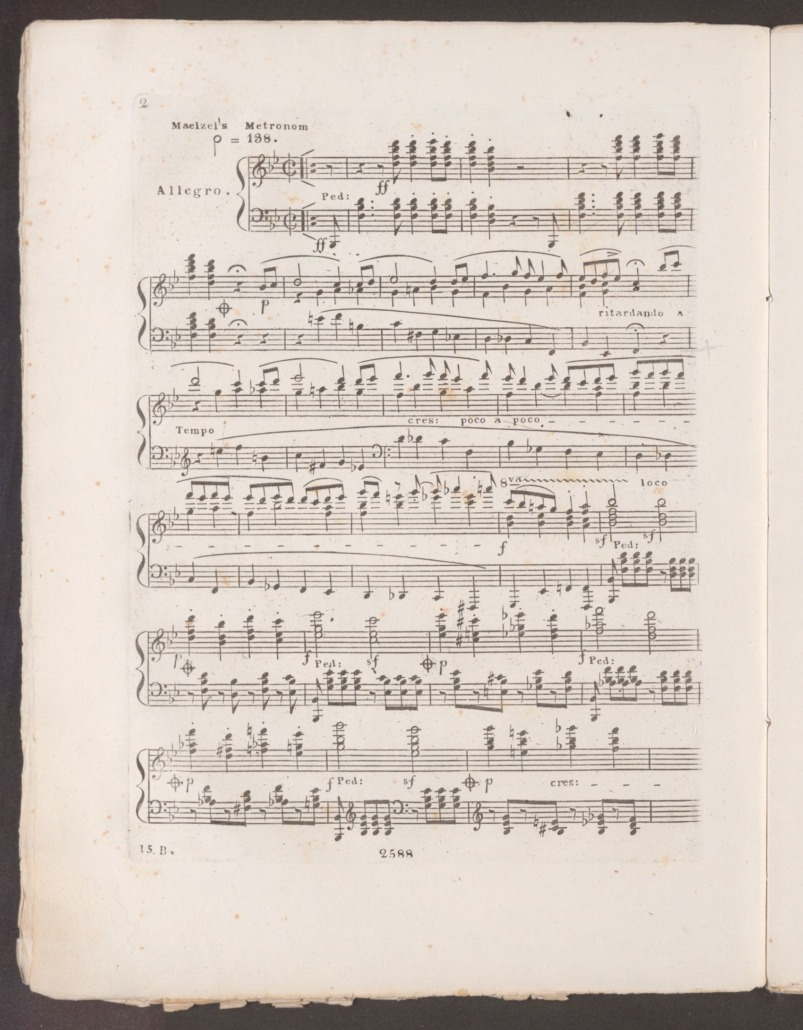
On 30 January 1819 Beethoven wrote: „sie werden das arrangirte 5-tett u. die Sonate schon erhalten haben, machen sie nur, daß beyde werke besonders das 5-tett so gleich gesto[chen] werden, mit der Sonate kann es schon etwas langsamer gehen doch wünsche ich[,] daß sie wenigstens innerhalb 2 oder längstes [3] Monathen erscheine, ihren von ihnen erwähnten frühem Brief erhielt ich nicht, daher ich keinen Anstand nahm beyde werke hier auch zu verschachern Nb: d.h. bloß für Deutschland, Es wird unterdeßen ebenfalls 3 Monathe bis die Sonate hier erscheint […] die tempos nach Maelzel’s Metronom bey der Sonate erhalten sie mit nächster Post; DeSmidt. Courier bey dem Fürst paul Esterhazi hat das 5-tett u. die Sonate mitgenommen“ (BGA 1285).
Beethoven initially considered March/April 1819 as the date of publication. On 3 March he wrote to Archduke Rudolf: „ich füge hier 2 Stücke bey, worauf geschrieben, daß ich Sie vor dem Namentage I.K.H. [Ihrer Kaiserlichen Hoheit; der Namenstag fiel auf den 17. April] voriges Jahr schon geschrieben habe, aber Mißmuth u. so manche traurige Umstände meine damalige so üble Gesundheit hatten mich so Muhtloß gemacht, daß ich mich gar nur mit der grösten Ängstlichkeit u. Befangenheit I.K.H. nähern konnte […] Zuden 2 Stücke[n] von meiner Handschrift an I.K.H. Namenstag geschrieben sind noch 2 andere gekommen, wovon das leztere ein großes Fugato, so daß es eine große Sonate aus macht, welche nun bald erscheinen wird“ (BGA 1292).
On 8 March he reported to Ries: „in der Sonate müßen sich schrecklich viele Fehler befinden, künftigen Postag erhalten sie das verzeichniß, alles wurde geschwinde geschrieben, mein Copist schlemmer wird schon alt“ (BGA 1294). The announced list of errors followed on 19 March, enumerating more than 100 corrections in both the Viennese and London editions. Beethoven wrote: „unbegreiflich ist es mir, wie sich in die Abschrift der Sonate so viele Fehler einfmden konnten, die Eile mag mit schuld haben, u. daß der Copist sie nicht selbst sondern von einem ändern Copiren ließe, erst beym durchspielen des hiesigen abgeschriebenen Exemplars fanden sich die Fehler, manche sind auch vieleicht schon früher corrigirt worden” (BGA 1295). Ries, who presumably corrected the errors in the copy for the engraver, also clarified and revised the musical text.
Dedication: see Opus 58. First performance unknown. On 10 December 1819 Joseph Karl Bernard reported to Beethoven that the day before it had been agreed „daß Sie am heil. Weihnachtstagen oder an einem ändern Tag eine Akademie geben sollen“ and that, among other news, „Ihre neue Sonate von Ihnen gespielt“ (BKh 1 p. 131). The concert did not take place. Carl Czerny played the sonata privately at the beginning of February 1824 (BKh 5 p. 133).
The sketches will be featured in an article specially created for the Beethovenian Music Research Center, www.lvbeethoven.org

The orchestral version of the sonata Opus 106
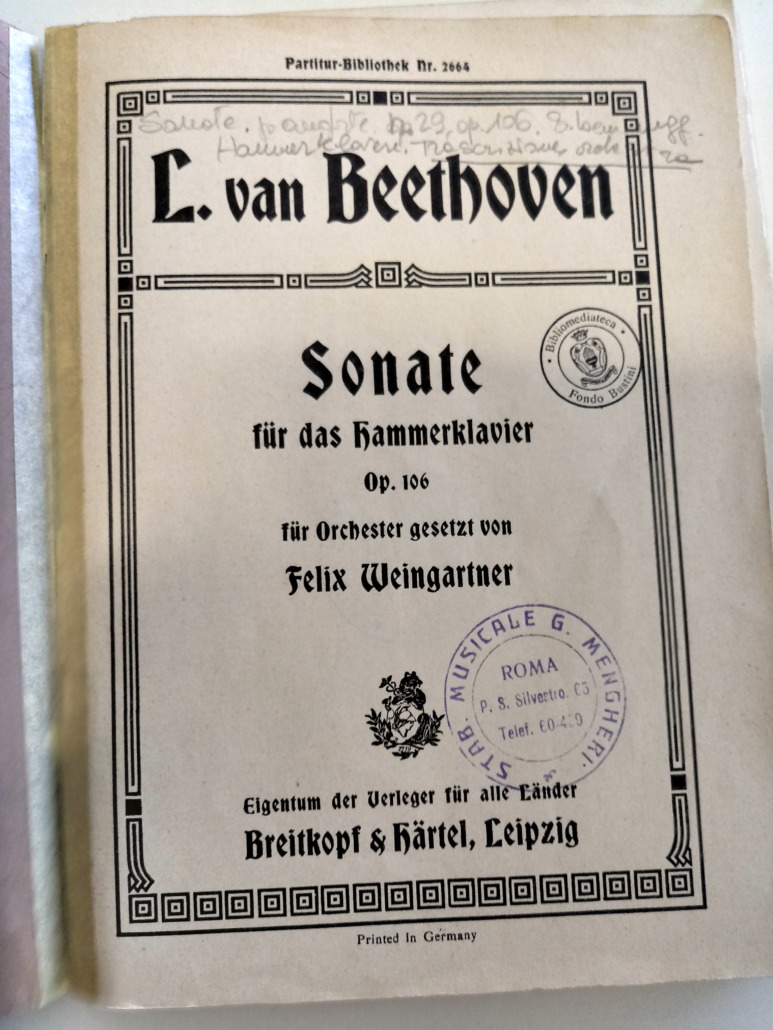
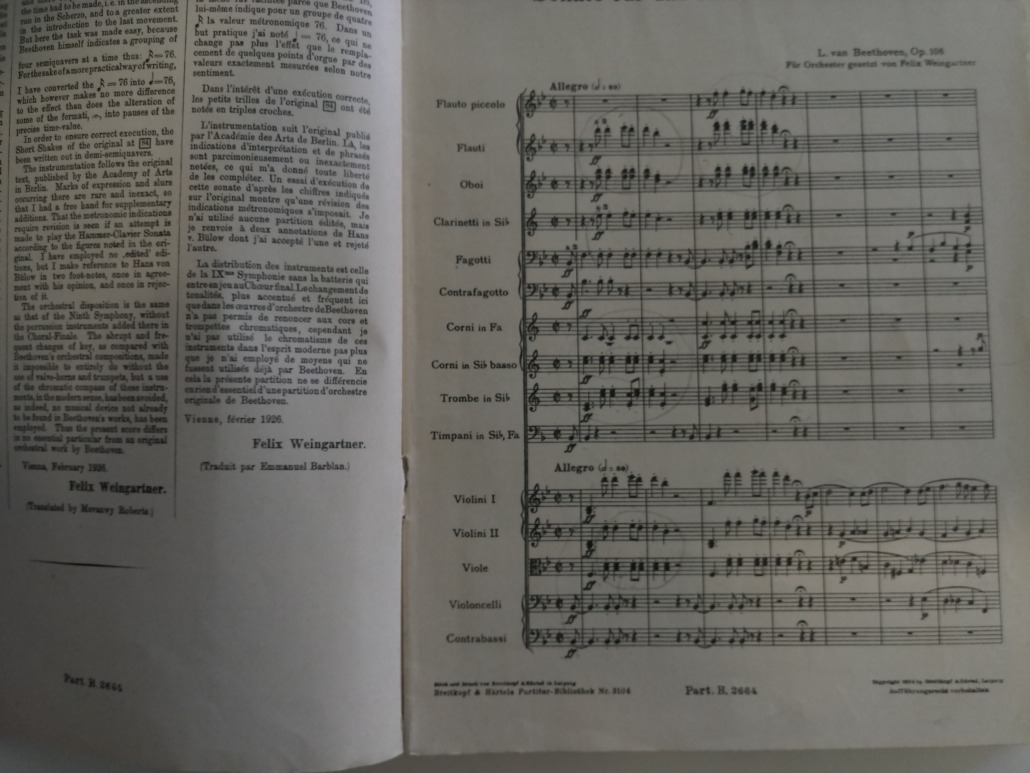
n 1926, the conductor and composer Felix Weingartner created an interesting orchestral transcription of the sonata; here is a recording taken from a rare LP from the 1950s.
Although I am not an expert on Beethoven recordings strictu sensu, in my wanderings through Ludwig’s discography—especially in search of oddities, curiosities, paraphrases, and the like, almost like creating a Wunderkammer in the style of Rudolf II of Habsburg—I was familiar with the orchestral transcription of the Piano Sonata Opus 106 that Felix Weingartner made in his time. If my information is not incomplete, I believe that only two or three CD labels have issued the very old recording from the 1930s. The first is by Pearl, B000027QHN, which can be found here: http://www.amazon.it…f/dp/B000027QHN. The second is a recent Naxos release, 0636943191323, available here: http://www.naxos.com…m_code=8.110913. The third is an EMI Japan edition, also using the same recording.
However, all these performances, including the numerous ones found on YouTube (for example: http://www.youtube.com/watch?v=X4LqEnF1TiA), date back to the famous recording that the composer made between 1925 and 1930. I understand that this transcription was made for the complete symphonies that Weingartner conducted with the old London Philharmonic Orchestra (which was reformed some time later) and that the score was published by B&H in 1926. A copy can be found here: http://www.worldcat….r=brief_results. Is it possible that no one has performed it since then? The two CDs are derived from a 78 RPM Columbia vinyl, probably from 1928–1930, which Columbia reissued in 1953.
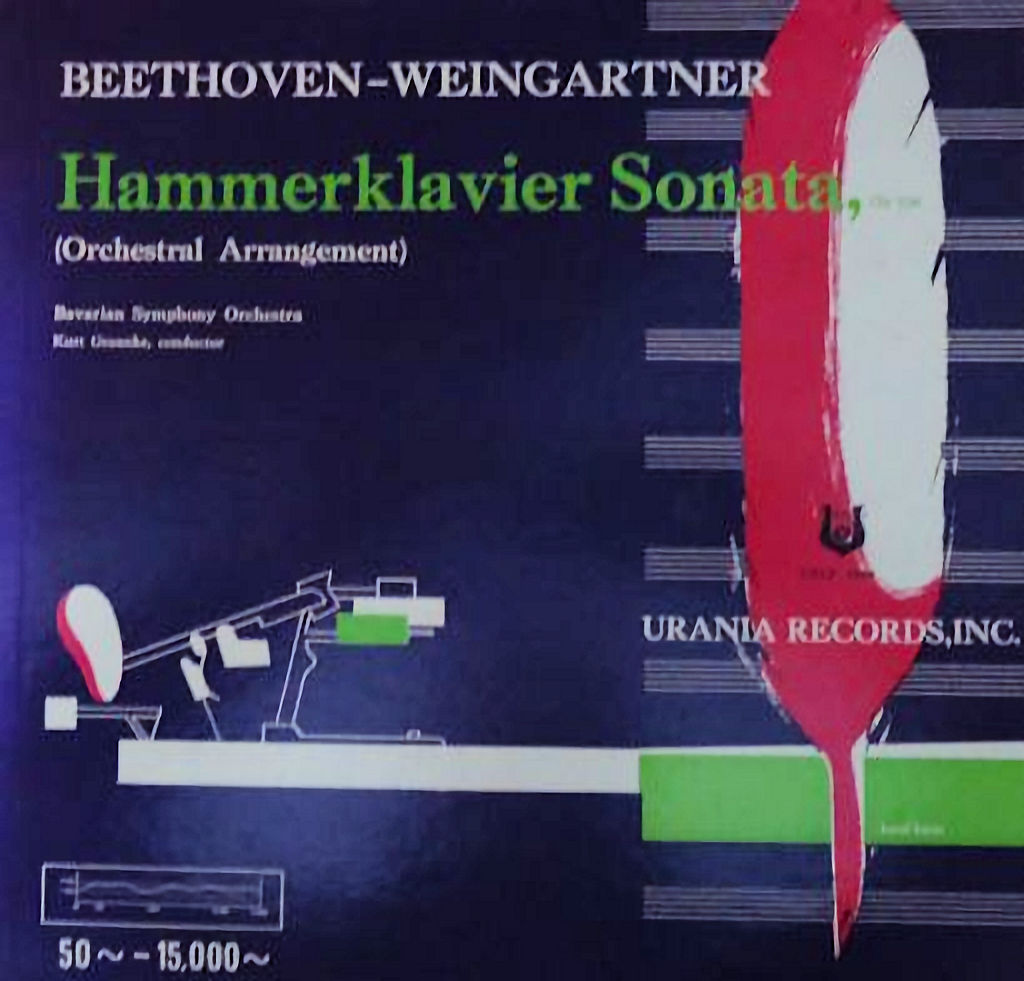
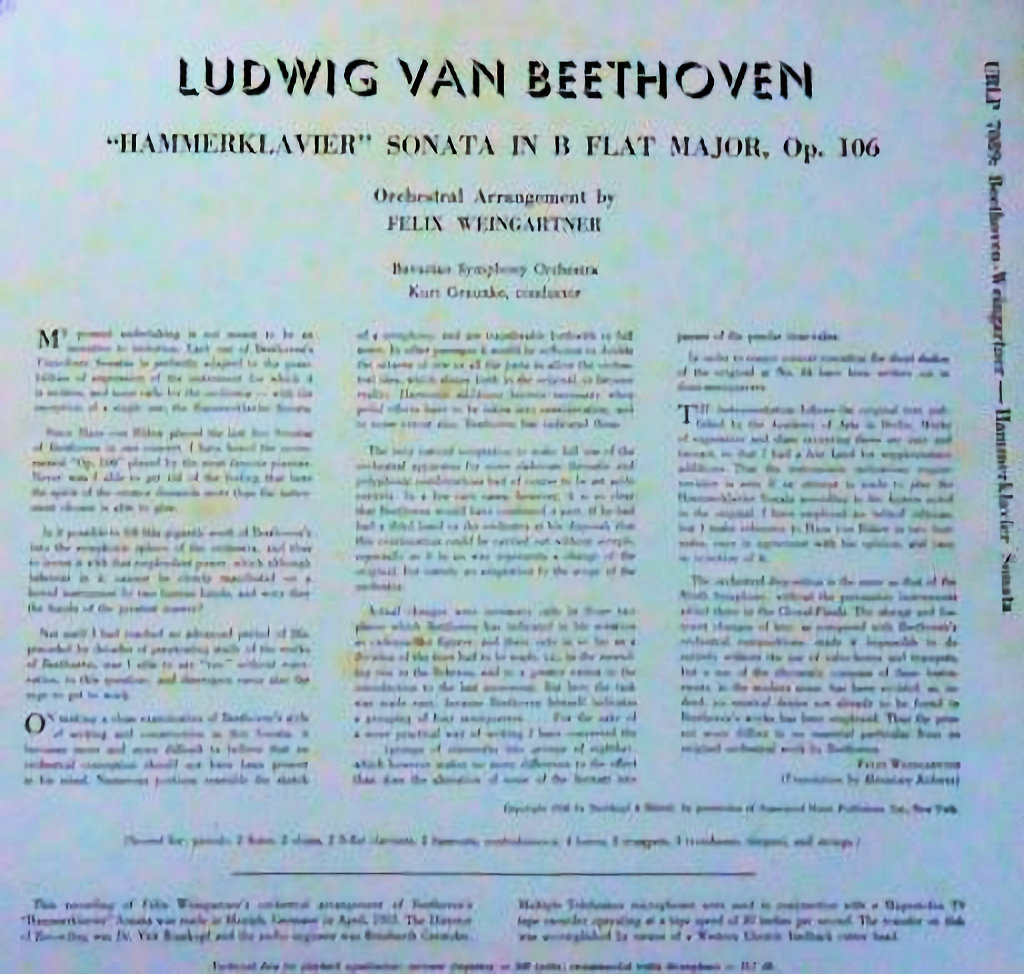
Suddenly, here is a recording that was unknown to me: I obtained a rare LP from Urania Records, URLP 7089, with the sonata conducted by Kurt Graunke leading the Bavarian Symphony Orchestra (year 1953 as well). I am attaching on the forum, with links below, the front and back covers. Certainly, I have recovered about twenty years of history… but what about after that? Who knows more? Finally, I will make the sonata recorded on this LP available on the website once I have confirmed that no one holds the copyright anymore (which I did in 2108 without any doubt).