
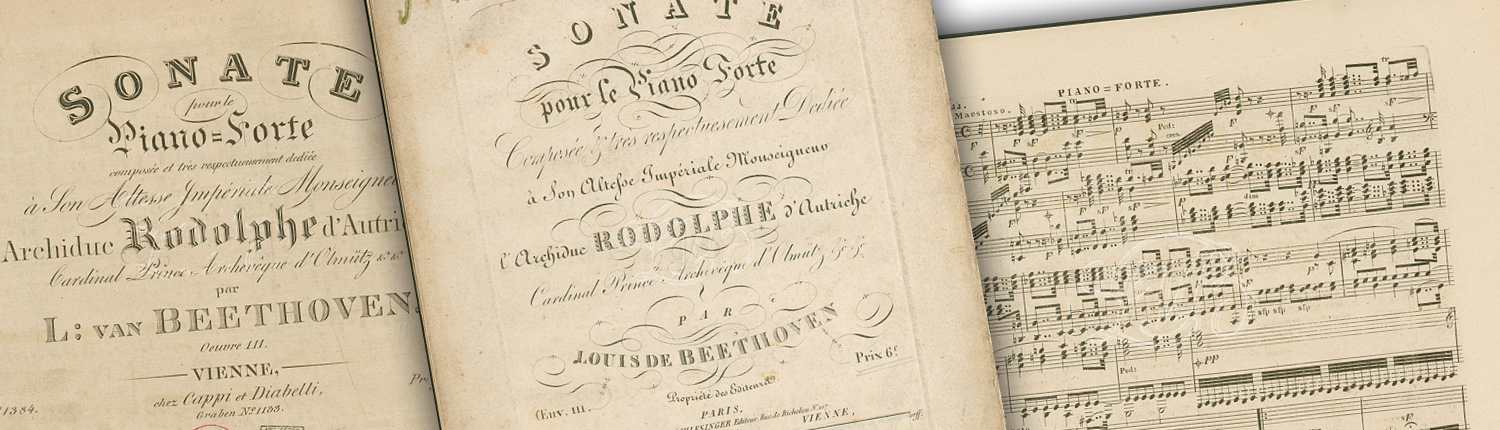
Opus 111 Sonata in C minor for Piano
I) Maestoso – Allegro con brio ed appassionato II) Arietta – Adagio molto semplice e cantabile
OPUS 111 – Sonata in C minor for piano, op. 111, dedicated to Archduke Rudolf of Austria, 1821 – spring 1822, published in Paris and Berlin, Schlesinger, 1822. GA. no. 155 (series 16/32) – B. 111 – KH. 111 – L. IV, p. 85 – N. 111- T. 230.
An original manuscript of the first movement (dated January 13, 1822), with many modifications, is preserved in the Beethovenhaus; another (neat copy) of the entire work, with the same date, is held in the Deutsche Staatsbibliothek in Berlin. The copy, with numerous corrections, delivered to the publisher for printing (Bodmer Collection at the Beethovenhaus, M. U., 158/54) is from the spring of 1822.
Sketches communicated by Nottebohm. The theme of the first movement already appeared in a notebook from 1801-1802, as a draft for an Andante, after that of the first movement of the Sonata Op. 30 No. 1 for piano and violin. It is then again briefly mentioned as the Finale of a second Sonata, which was never completed, and which was supposed to have as its first movement the Allegro con brio and as its second the Adagio referred to in No. 758.
In its definitive form, it became the foundation of the present sonata. We say “foundation” because fundamental structural analogies also link it to the initial Maestoso and the Arietta that forms the second and final movement. The Maestoso, with its apocalyptic crescendo, introducing the Allegro, is a tragic preamble compared to which the corresponding pages of the Pathetique and the Sonata in D minor Op. 31 No. 2 pale in comparison. “It has been believed that the tempestuous introduction in the score of Dardanus by Sacchini (Act II, Scene IV) is similar to this beginning,” writes Prod’homme.
“They are indeed the same notes. But Sacchini does not develop any further from this formula. On the other hand, it is possible that Beethoven encountered the work of the Italian master, either in Bonn or Vienna, which was performed in Versailles and Paris from 1784.” The Allegro is full of restless agitation, where only the second thematic element — which D’Indy notes as related to the second theme of the Finale of Sonata Op. 27 No. 2 (the Moonlight) — brings a note of relative relaxation; but it is soon overwhelmed by the first element, which leads stormily to the conclusion of the section.
In the development, brief as are all the developments in the later sonatas, the initial theme once again presents its interrogations; the recapitulation appears more dramatic. At the end of it, the same theme resumes its hammering, calming only at the cadence; however, the tireless movement of the bass beneath the melodic phrase still expresses, despite the major key, a sense of unease.
The Arietta is one of those “discoveries of simplicity” full of meaning, like the theme of joy in the Ninth Symphony, and marks the arrival of a serenity made of sweetness and assurance. The five variations follow the same expressive line: no agitated or passionate complications; only a progressive intensification of a singular feeling.
The first three are united in a fundamental character of absolute fidelity to the scheme, both in rhythm and harmony, with colorations that do not alter the original physiognomy.
What distinguishes them is only the progressive vibration of the movement: undulating, with an almost rocking sweetness in the first (and yet, in the transition to minor, Rolland notes a sentimental color “that curiously evokes the theme of Berlioz’s Symphonie fantastique“); more articulated, but still sweet, and with a certain yearning in the increased rhythmic pulse in the second; strong and turbulent in minor, with opposing motions in the third, creating a wave-like movement that overlaps one another. In the fourth, the scope enlarges in its line and is sublimated in meaning; each of the two phrases of the theme is treated twice, in figures that contrast and complement each other: the almost formless murmur of the bass and the distant, luminous dust of the high notes that respond to it.
This is followed by an episode in which the thematic motif seems to initially disperse in the rarefaction created by the chromatic ascent of the trilled melody, echoed in the extreme depths of the bass; but, taken up in fragments, it eventually leads back, through a variety of tonal shifts, to the reestablishment of C major, marking the entrance of the fifth variation. In this variation, the theme returns to unfold in its clear original form, but vibrating, concluding in an ecstatic oration.
Schering relates this sonata to Shakespeare’s Henry VIII.
First movement: Act IV, Scene II: The figure of Cardinal Wolsey, described by Queen Catherine and Marquis Griffith.
Second movement: Continuation of the same: Queen Catherine’s dream vision: six spirits appear and pay homage to her to the sound of music.
[By Biamonti Giovanni – Catalogo cronologico e tematico delle opere di Beethoven comprese quelle inedite e gli abbozzi non utilizzati, Torino, ILTE 1968]
Official title: Opus 111 Sonate (c-moll) für Klavier Widmung: Erzherzog Rudolph von Österreich NGA VII/4 AGA 155 = Serie 16/32
Creation and Publication: The work was sketched from December 1821 to February 1822 in Vienna. Beethoven dated the first autograph transcription to January 13, 1822. On February 20, a copy of the sonata was sent to Adolph Martin Schlesinger in Berlin, and on April 9, Beethoven announced that a new version of the second movement would be sent the following day. The original edition in Paris was published by Maurice Schlesinger in April (?) 1823, while the London edition by Clementi & Co. was published in April of the same year. The original Berlin edition followed in May by Adolph Martin Schlesinger, and between June and December, the Viennese edition was published by Cappi & Diabelli. The Piano Sonata Op. 111 is part of a group of three sonatas (Op. 109–111) that Beethoven promised to the publisher Adolph Martin Schlesinger in Berlin in April 1820 (BGA 1388; see Op. 109).
Beethoven only sketched the first movement around December 1821 in the “Artaria 197” notebook. Initially, he planned to compose this movement as a fugue but later abandoned the idea. Ideas for the second movement of the work, which appear immediately after the discarded fugue sketches for the Piano Sonata Op. 110 in a pocket notebook, suggest that much of the first movement of Op. 111 had already been sketched when Beethoven was working on Op. 110. It is presumed that the first draft of the first theme was started on “13ten Jenner 1822.” This dating is also found in the “Artaria 201” notebook, which follows chronologically after the “Artaria 197” notebook, adjacent to the initial sketches for the second movement. Opus 111 is one of the few Beethoven works where at least part of it has been preserved in two autographs. There exists both a manuscript for the first movement, referred to in literature as the “Urschrift” (original version), and a later beautiful copy. For the second movement, only the beautiful copy has been preserved. Around mid-February 1822, Beethoven handed over a fair copy for Berlin to Tendier & Manstein. Apparently, Beethoven relied on the copyist Wenzel Rampl, but Rampl did not receive the correct model for the second movement, which is why Beethoven announced in his letter of February 20, 1822, to Schlesinger in Berlin that a new copy of the movement would be sent immediately: “Sie werden nun schon die 2te Sonate [Op. 110] erhalten haben, vor einigen Tagen wurde auch die 3te [Op. 111] abgegeben […] – bei der letzten Sonate die jetzt schon abgeschickt ist, werde ich Ihnen nur noch anzeigen, dass ich Ihnen eine andere Abschrift gleich mit zukünftigen Postwagen schicke, und zwar von dem letzten Satz mit Variationen — in so vielen zerstreuten Beschäftigungen geschah es, dass ich dem Copisten mein bloßes erstes Konzept übergeben habe, wodurch, wie es manchmal zu geschehen pflegt, manches noch unvollkommen und nicht richtig angezeigt war, Sie dürfen also gar keinen Gebrauch davon machen, auch bitte ich Sie, es niemandem zu zeigen, sobald Sie die andere Abschrift erhalten haben, vernichten Sie es sogleich, durch meine frühere Krankheit blieb mir so manches liegen, daher hat es sich sehr gedrängt bei mir, und es kann wohl so etwas geschehen, Sie werden diesen Satz höchstens 8 Tage später als die Sonate selbst erhalten” (BGA 1458).
Despite this, the new model for the engraving of the second movement did not arrive at the Berlin publisher until the beginning of May 1822 (BGA 1460). Either Beethoven overlooked the fact that the first movement in the engraver’s model did not correspond to the text of the subsequent transcription of the work or did not consider it important. Original Editions: As with Op. 110, the publishers decided to have the sonata engraved by Maurice Schlesinger in Paris and to publish a parallel edition in Berlin. Father and son Schlesinger informed Beethoven of the correct receipt at the beginning of July 1822 (BGA 1474 and 1476; in the same letter, Maurice Schlesinger asked Beethoven for the metronome markings, which were not provided). On July 13, 1822, Adolph Martin Schlesinger asked if the sonata “nicht ein drittes Stück [Satz] bekömmt” (BGA 1481)—a question Beethoven deemed unworthy of a response. Towards the end of 1822/23, Beethoven received a proof on which to make corrections, which he returned on February 11, 1823 (BGA 1568). The original Paris edition was advertised in The Harmonicon in May 1823 and in the Wiener Zeitung on May 27 by Sauer & Leidesdorf, one of the distributors listed on the front page of the Paris edition, as “eben neu angekommen und zu haben“; and by Giovanni Cappi on June 23 (“zu haben”).
Beethoven knew that Cappi & Diabelli wanted to reprint the sonata in Vienna. The composer wrote to Anton Diabelli at the end of May/early June: “Stechen Sie nur nach dem E. [Xemplar] von Paris, das andere [von Sauer & Leidesdorf] hat wieder andre Fehler, schicken Sie mir nur die Korrektur gerade hierher, wo ich selbe auf der Stelle zurücksenden werde, eilen Sie, Es geschieht beiden recht, da sie es verdienen, obschon ich kein Verfechter d.g. bin — für mich bitte ich mir 4 E. [Exemplare] aus, wovon eines für Seine Eminenz auf schönem Papier” (BGA 1661). Archduke Rudolph received a preview copy of the Viennese print at the end of June 1823 (BGA 1682, 1686). However, Cappi & Diabelli suspended the official sale until December. In London, a copy of the sonata was published by Muzio Clementi via Ferdinand Ries. In a letter dated July 6, 1822, Beethoven wrote to Ries: “Ich habe 2 neue Klavier Solo Sonaten geschrieben [Op. 110 und 111], welche eben nicht gar schwer sind, ich wäre zufrieden, wenn Sie mir die nemliche Summe von 26 Pf. Sterling dafür verschafften, indem ich selbe in Deutschland auch anbringen kann, ohne dass sowohl der englische als der Deutsche Verleger beeinträchtigt werde, können Sie mehr haben, desto besser, nur bitte ich Sie mich wieder nicht so lange auf eine Antwort warten zu lassen, weil ich sonst, wenn es zu spät wird, sie doch gleich hier oder anderwärts hingeben müsste” (BGA 1479).
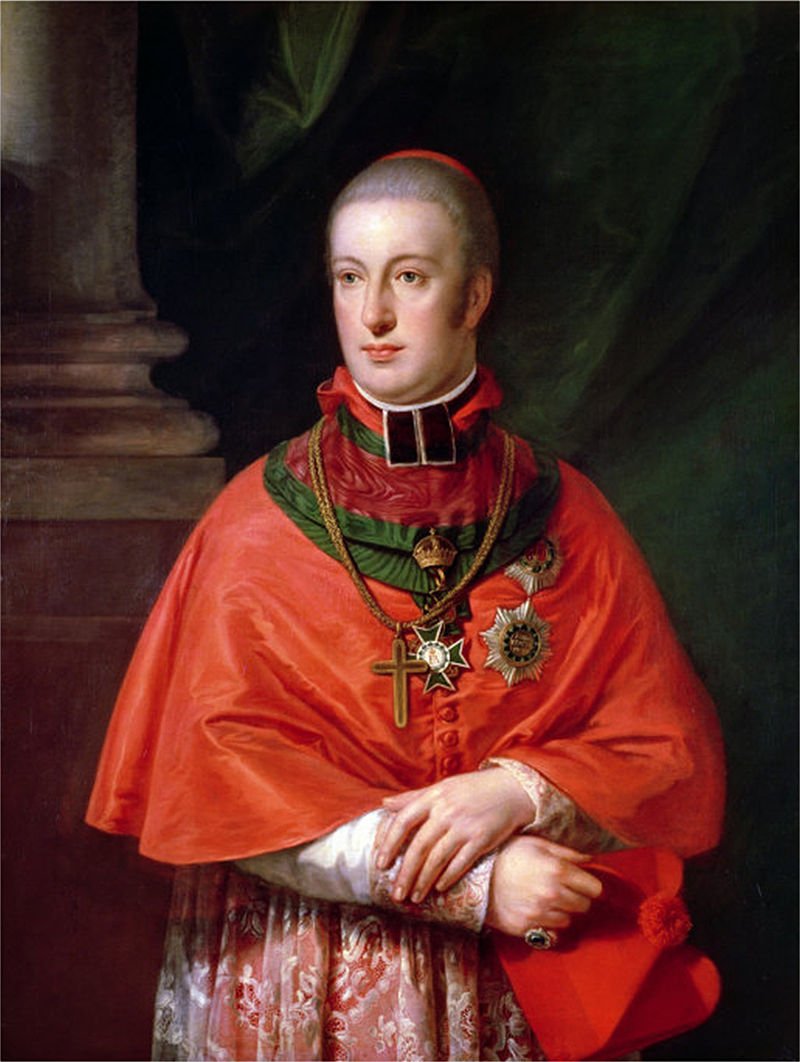
Dedication: Beethoven initially thought of dedicating Op. 111 to Adolph Martin Schlesinger (BGA 1462, May 1, 1822). However, at the end of August 1822, after renewed inquiry from the publisher, he informed Schlesinger’s son Maurice that the sonata was dedicated to Archduke Rudolph, who had already been informed (BGA 1491, August 31, 1822). On February 18, 1823, Beethoven expressed the desire that the dedicatee be Antonie Brentano (BGA 1572), a dedication that also appeared on the frontispiece of the first London edition by Clementi & Co. Maurice Schlesinger remained faithful to the dedication to Archduke Rudolph. On June 27, 1823, Beethoven sent Archduke Rudolph a copy of the original Viennese edition by Cappi & Diabelli. Apparently, Archduke Rudolph was unaware of the dedication, because in a letter dated July 1 of that year, Beethoven wrote to him: “E.K.H. ersehen aus dem Beyfolgenden Recipisse vom 27ten Jun. die Übersendung einiger Musikal., da E.K.[H.] schienen Vergnügen zu finden an der Sonate in C moll, so glaubt ich mir nicht zuviel herauszunehmen, wenn ich Sie mit der Dedication an Höchstdieselben überraschte. […] die Sonate in C moll ward in Paris gestochen sehr fehlerhaft, und da sie hier nachgestochen wurde, so sorgte ich so viel wie möglich für Korrektheit” (BGA 1686).
First Performance: Unknown. Carl Czerny privately performed the sonata at the beginning of February 1824 (BKh 5, p. 133).
The sketches will be featured in an article specially created for the Beethoven Music Research Center, www.lvbeethoven.org