Opus 119, Eleven Bagatelles for Piano
I) Allegretto – II) Andante con moto – III) A l’ allemande – IV) Andante cantabile – V) Risoluto – VI) Allegretto – VII) Allegro non troppo – VIII) Moderato – IX) Vivace moderato – X) Allegramente – XI) Andante non troppo
Opus 119, 11 Bagatelles for piano, op. 119, late 1820–autumn 1822, published in Paris by Schlesinger at the end of 1823. GA no. 189 (series 18/7) – B. 119 – KII. 119 – L. IV, p. 132 – N. 119 – T. 233.
The date “late 1820–autumn 1822” refers to the final preparation of the work for publication, although the origin of several of the Bagatelles is much earlier, as indicated below for each of them. For the Bagatelles in general, see what has already been said under no. 334, p. 362, note. (In a later Diabelli edition (1826?) a twelfth Bagatelle also appeared, which is nothing other than an abbreviated reproduction of the piano part of the song An Laura, composed by Beethoven in 1790.)
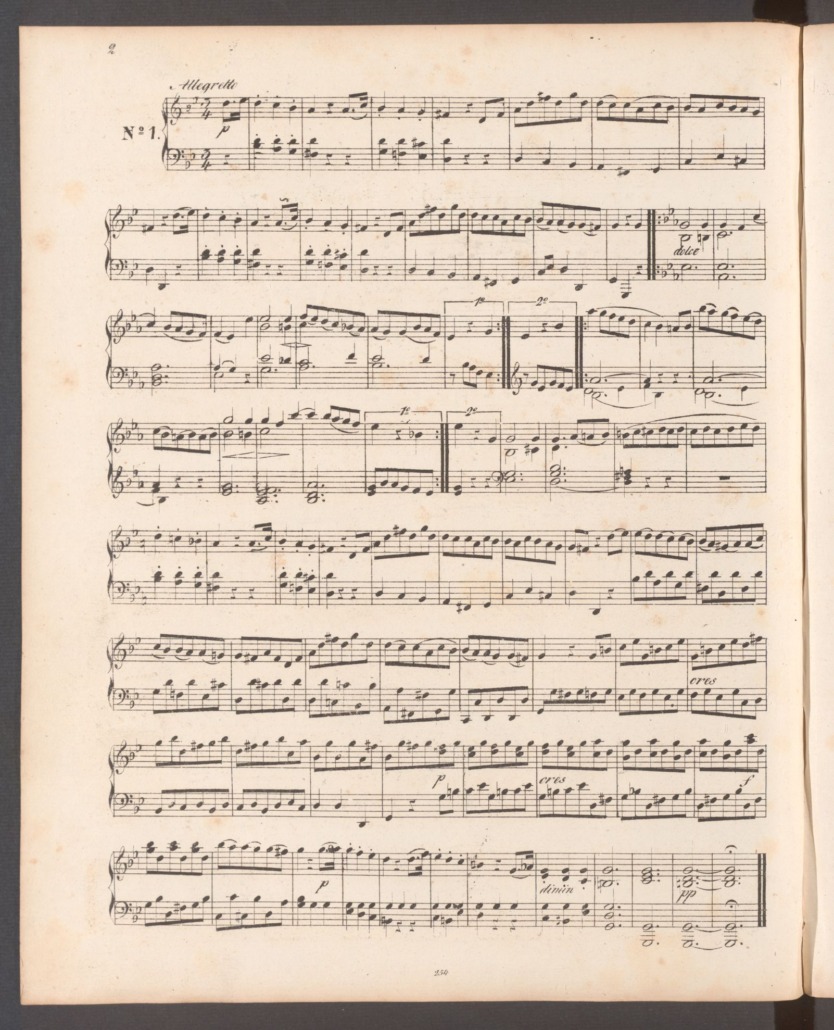
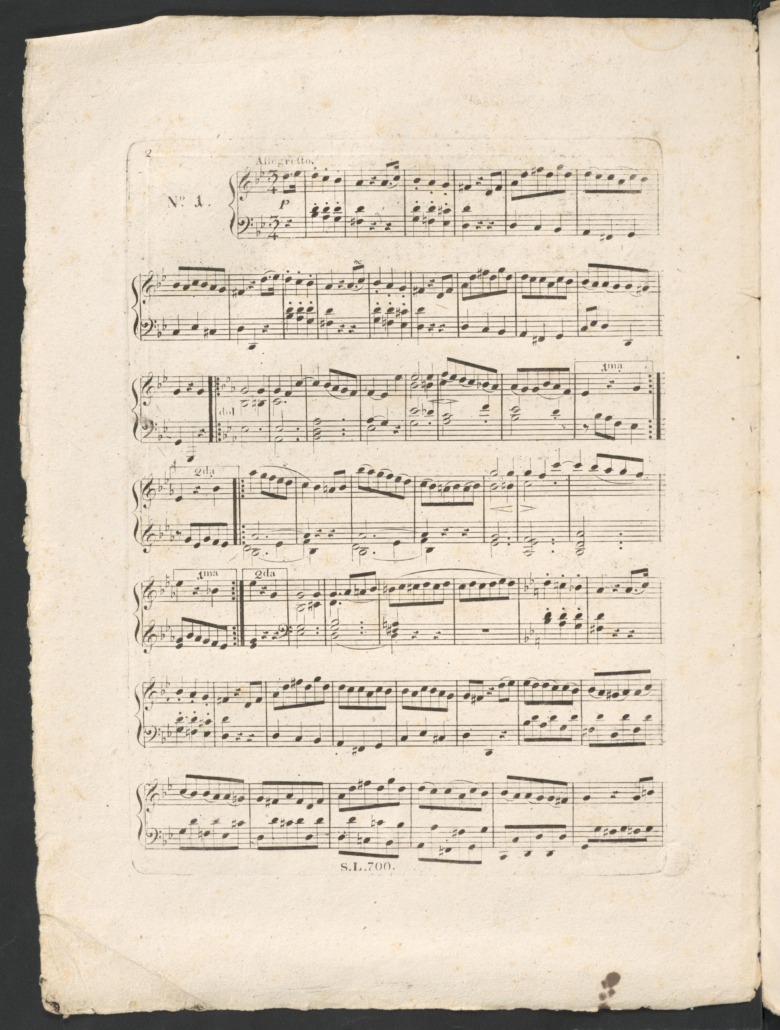
First Bagatelle. Allegretto.
The autograph manuscript is held in the Deutsche Staatsbibliothek in Berlin. According to Nottebohm, its origins lie in a period probably between 1800 and 1804, with later refinement at the time of its grouping with the other Bagatelles for publication. A finely wrought piece, imbued with a gentle, lightly melancholic character.
Second Bagatelle.
The autograph manuscript is preserved in the Deutsche Staatsbibliothek in Berlin. Its origin, according to Nottebohm, likewise dates from 1800–1804, with subsequent reworking. A witty, spirited page in which a lively pattern of triplets weaves and flutters around a calm, well-poised motion.
Third Bagatelle.
The autograph manuscript is kept in the Deutsche Staatsbibliothek in Berlin. Its earliest form, as Nottebohm notes, stems—like the preceding Bagatelles—from the years 1800–1804, albeit with later revision. It has the character of an allemande in two sections: the first exudes great lightness; the second, with full chords in the upper part set against rapid bass runs, marks the rhythm more heavily, as in a rustic dance.
Fourth Bagatelle.
The autograph manuscript is held in the Deutsche Staatsbibliothek in Berlin. Its initial conception, according to Nottebohm, again dates from the period 1800–1804. It is of a melodic cast, in which (as also, and even more so, in the eleventh Bagatelle) Rolland discerned a distant echo of Gluck’s Iphigénie.
Fifth Bagatelle.
The autograph manuscript is preserved in the Deutsche Staatsbibliothek in Berlin. Its earliest origin, according to Nottebohm, again belongs—like the preceding Bagatelles—to the years 1800–1804.
Sixth Bagatelle.
The autograph manuscript is held in the Deutsche Staatsbibliothek in Berlin. The piece likely dates from 1820–1821; a completed sketch appears on a leaf that also contains drafts for the “judicare vivos et mortuos” of the Missa solemnis. More elaborate than the preceding Bagatelles, it opens with a short introduction (six grave bars whose theme recalls the first movement of the A minor Quartet op. 132, followed by a capricious cadenza) and continues with an Allegretto in 2/4, a 6/8 of airy, swirling lightness.
Seventh Bagatelle.
The autograph manuscript is part of the Karl von Vietinghof collection in New York. Its date may be set at the end of 1820. Sketches appear in Nottebohm, together—or almost so—with those for the “Benedictus” of the Missa solemnis. A theme at first grave and almost hesitant is interspersed with a few playful accents; it then descends again in a more restless motion and concludes in a whirlwind.
Eighth Bagatelle.
The autograph manuscript is in the Beethoven-Haus. The date of composition and the sketches correspond to those of the preceding Bagatelle. A short page of somewhat opaque character, illuminated only at the end by the cadence in C major.
Ninth Bagatelle.
The first part of the autograph manuscript is preserved in the Beethoven-Haus, the second in the library of the Paris Conservatoire. Date of composition and sketch material as for the seventh and eighth Bagatelles. A short and delicate piece, kindred in spirit to the first section of the Third Bagatelle.
Tenth Bagatelle.
The autograph manuscript is held in the library of the Paris Conservatoire. Its date of composition and sketch material correspond to those of the seventh, eighth, and ninth Bagatelles. It is the briefest of all the Bagatelles, a brisk 13-bar passage.
Eleventh Bagatelle.
The autograph manuscript is likewise kept in the library of the Paris Conservatoire. Date of composition and sketches as for the preceding piece. Melodic in character; Rolland discerned in it Gluckian influence even more strongly than in the Fourth Bagatelle.
[By Biamonti Giovanni – Catalogo cronologico e tematico delle opere di Beethoven comprese quelle inedite e gli abbozzi non utilizzati, Torino, ILTE 1968]
Official title: “Opus 1119” Elf Bagatellen für Klavier Widmung: — NGA VII/6 AGA 189 = Serie 18/7 Nr. 2
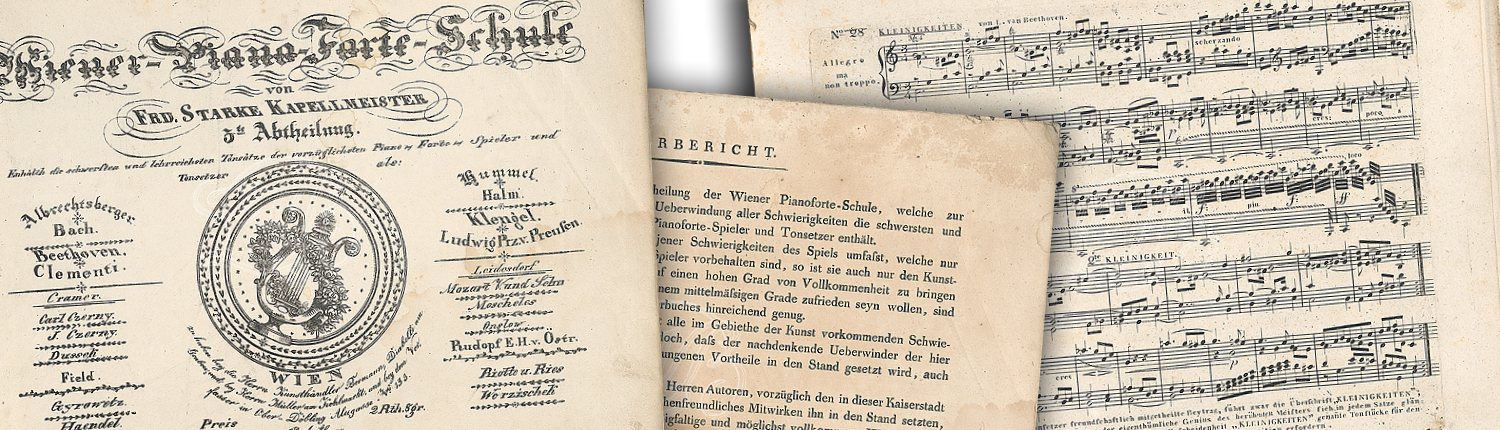
Origin and publication. Nos. 7–11 were written in the second half of 1820 for Friedrich Starke’s Wiener Piano-Forte-Schule. Nos. 1–5 were taken by Beethoven from a portfolio of earlier compositions, some of which had not yet been completed. He revised them in November 1822. No. 6 was probably composed at this time. Nos. 7–11 were published in 1821 in the third section of Starke’s piano school in Vienna; the original London edition of Nos. 1–11 followed in June 1823 at Clementi & Co.
On 18 May 1822 Carl Friedrich Peters approached Beethoven with a request for various compositions, including “Solosachen für Pianoforte (worunter auch kleinere Werke sein könten)”. This prompted the composer to review a number of minor works and musical ideas that had not yet been published. To this end, he created in 1822 a portfolio in which at least twelve different pieces were assembled. On 5 June 1822 Beethoven offered Peters “Bagatelles oder Kleinigkeiten für Klawier allein” without specifying any number (BGA 1468). On 22 November he wrote: “von bagatellen könn[t]e ich ihnen noch mehrere schicken als die bestimmten 4, Es sind deren noch 9 oder 10 vorhanden, wenn sie mir hierüber gleich schreiben, so könnte ich selbe oder soviel sie davon verlangen mit allem ändern mitschicken” (BGA 1512).
As the dating of the sketches for the individual numbers shows, Nos. 2 and 4 probably go back to 1794, and Nos. 3 and 5 to 1802. Barry Cooper assigns No. 1, on stylistic grounds, to the years 1796/97. Sketches for No. 6 were probably produced at the end of November 1822, since on 22 November Beethoven was considering sending Peters only four pieces (BGA 1512). On 20 December he spoke of “gerade 6” (BGA 1516). As the manuscript sources for Bagatelles Nos. 1–6 show, Beethoven thoroughly revised the pieces and experimented with their ordering. He had sketched Nos. 7–11 in August 1820 and copied them out for Starke on 1 January 1821.
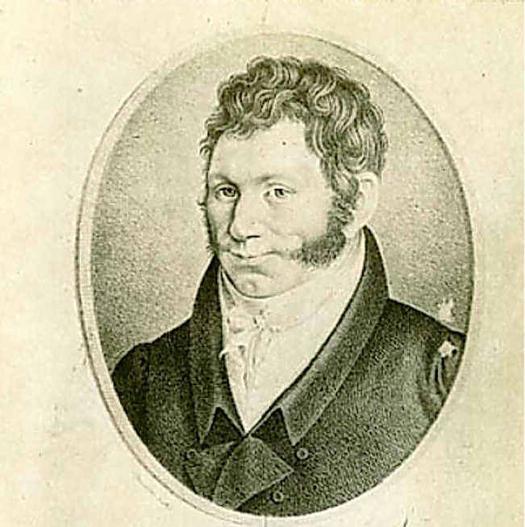
No documentation survives concerning the publication process of Nos. 7–11 in the third section of Starke’s Wiener Piano-Forte-Schule, issued in Vienna in 1821. Beethoven held Friedrich Starke (1774–1835) in high esteem; like Beethoven, he had been a pupil of Johann Georg Albrechtsberger. Around 1815 Beethoven temporarily entrusted Starke with his nephew’s piano lessons. Besides the newly composed Bagatelles, Starke used parts of Beethoven’s compositions in the second and third sections of his piano school, with the composer’s consent or participation (for section 3 see Op. 27 no. 1, Op. 31 and WoO 200, Sources IV, as well as Op. 37, Sources V; in section 2, Op. 28, Sources IV, already published in 1820). References to his approval are also found in the conversation books of April and July/August 1820.
In February 1823 Beethoven sent the fair copies for the engraving of op. 119 nos. 1–6 (together with Ops. 121b, 122 and 128, and WoO 18–20 and 24) to Leipzig, but Peters rejected them at the beginning of March and returned them, writing: “Kleinigkeiten habe ich allerdings gewünscht, aber diese sind doch wirklich auch gar zu klein, zudem sind die mehrsten so leicht, daß sie für schon etwas bessere Spieler nicht passen und für angehende Spieler sind mitunter wieder Stellen die für solche zu schwer sind; übrigens gestehe ich, daß der Effeckt meinen Erwartungen ganz entgegen war, N2. 1. 3 u. 5. haben etwas aber die ändern gar nicht angesprochen” (BGA 1604).
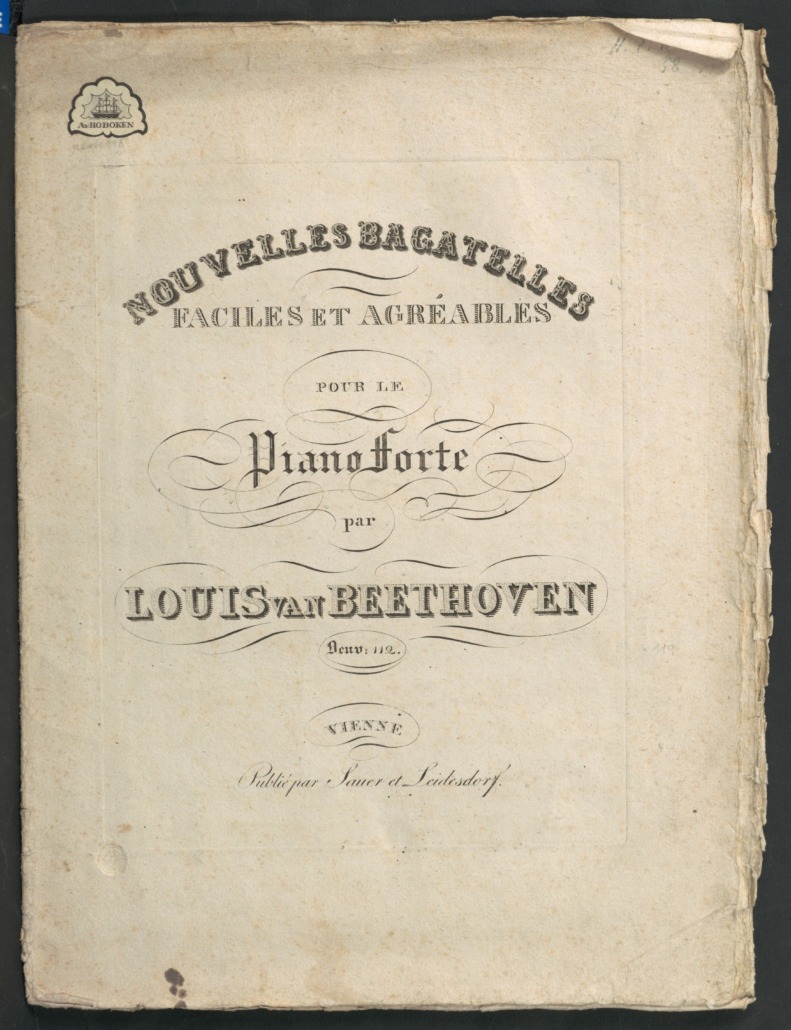
Beethoven was more successful in London thanks to the mediation of Ferdinand Ries. On 25 February 1823 he sent him the materials for engraving the two groups, Nos. 1–6 and 7–11: “zugleich erhalten Sie 6 bagatellen oder Kleinigkeit. fenl u. wieder Fünf zusammengehörend in 2 Theile. verschachern sie selbe so gut sie können” (BGA 1580). Ries sold the Bagatelles to Clementi & Co., who registered the publication at Stationers’ Hall on 3 June 1823. The fact that all eleven numbers were published by Clementi as a single group (and later received an opus number) is probably due to Beethoven’s ambiguous publication instructions, and does not necessarily reflect his true intentions. The editions by Maurice Schlesinger in Paris and Sauer & Leidesdorf in Vienna—long considered authorised prints—are reprints of the original London edition.
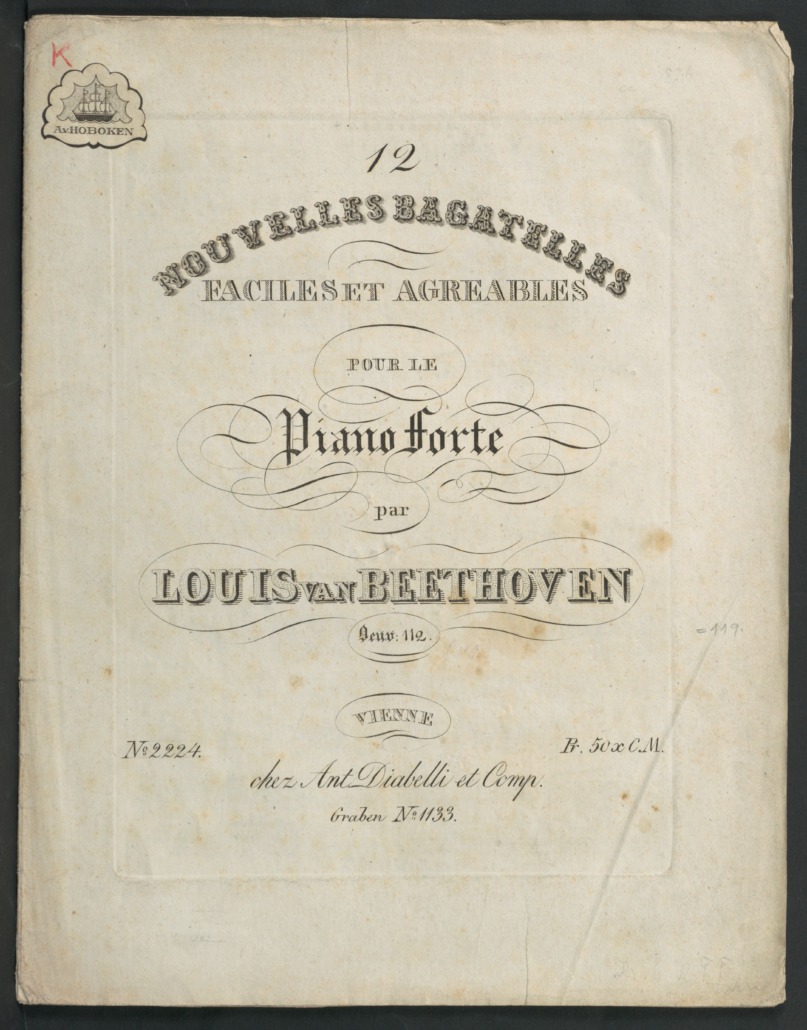
A Viennese original edition of Nos. 1–6 was never realised despite repeated efforts by Beethoven and his brother Johann (BGA 1519, 1549, 1728, 1731). Negotiations with Pacini in Paris failed, as did those with Lissner in St Petersburg (BGA 1518, 1664, 1647). The piece in G major printed in the Diabelli edition as No. 12 on page 13 is a slightly altered adaptation of the piano part of the first section of Beethoven’s song An Laura, WoO 112, probably written in 1792 (Hess Anhang 21 – Bagatelle for piano (published as op. 119/12; adaptation of the Lied “An Laura”, WoO 112)). According to Willy Hess, it is not proven that Beethoven himself arranged the piece, though it is possible. On the other hand, given Diabelli’s known unauthorised interventions in Schubert’s songs, No. 12 may equally well be attributable to Diabelli himself.
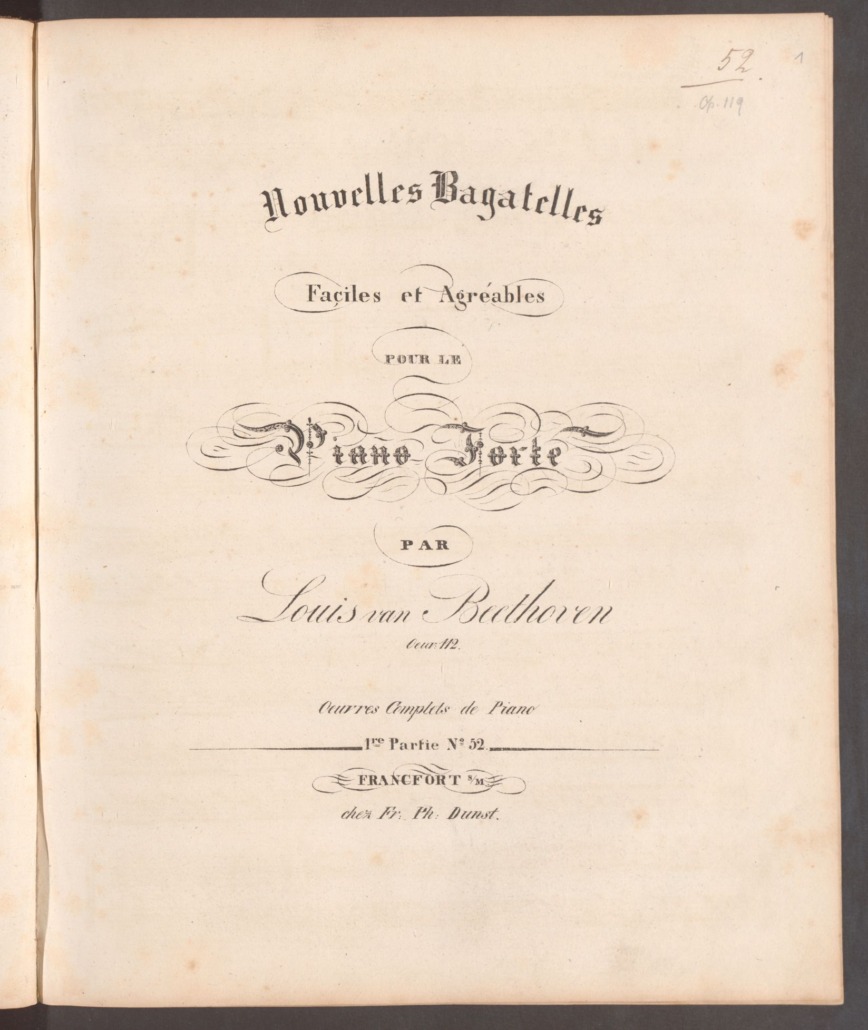
Opus number. Whereas the London edition appeared without an opus number, Schlesinger in Paris—and all later publishers—issued the Bagatelles as op. 112. This opus number was presumably assigned by Schlesinger after the sonatas op. 109–111, which he had published, although it had already been designated for the choral work Meeres Stille und Glückliche Fahrt, published in spring 1822. In Artaria’s completed Catalogue des Oeuvres of 1837 the Bagatelles are listed as op. 112, the choral work as “No. 112”; opus number 119 is not assigned. In the Haslinger–Rudolphin collection the Bagatelles bear the arbitrary opus number 104, and are correspondingly listed in Seyfried’s Index (p. 103 of the appendix). The work appears with the number 119 for the first time in B&H/1851. It is possible that Cappi & Diabelli chose to publish the Diabelli Variations op. 120 in June 1823 while Steiner (or his partner and later successor Haslinger) reserved the numbers 115–119 for compositions that Steiner had acquired as early as 1815 but which had not yet been issued.
First performance unknown.
The sketches will be featured in an article specially created for the Beethovenian Music Research Center, www.lvbeethoven.org

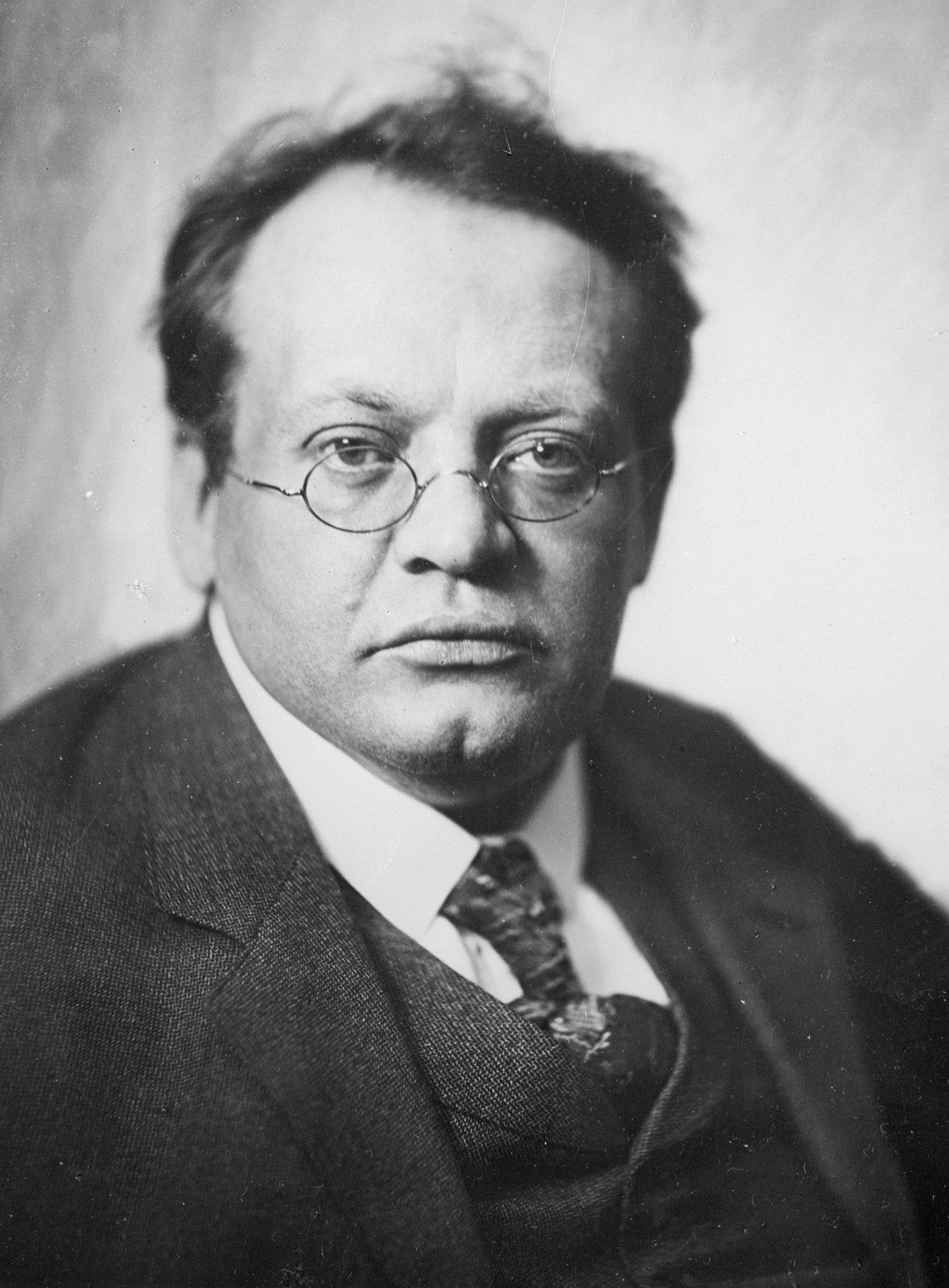
Max Reger (Johann Baptist Joseph Maximilian Reger)
Transcriptions, Arrangements, and Fantasias on Works by Beethoven
An absolute genius, taken from us far too soon by an untimely death, Max Reger wrote in 1904 a set of piano variations on a theme by Beethoven (incidentally, on the theme of the Piano Bagatelle Opus 119 No. 11). The same variations later appeared in an orchestral version, charged with poignant melancholy and a striking modernity.
In the space of barely half an hour, Reger’s Opus 86 explores virtually all the sonic possibilities contained in Beethoven’s theme, employing a highly personal musical language that never slips (or yields) either towards Brahmsian seductions or towards Mahlerian expansiveness. It is a language falsely triumphalist, yet pervaded by a chill shudder—the desire to retreat into a fenced-off realm of false, comforting certainties.
Below are some biographical notes adapted from the blog clarinettoinmusicadacamera.
Max Reger (Johann Baptist Joseph Maximilian Reger) (1873–1916) was born in the small Bavarian town of Brand. He began his musical studies at an early age, and his talent for composition was evident from the outset. After receiving his first instruction from his parents, who hoped he would become a schoolteacher like his father, he began organ lessons with Adalbert Lindner, later continuing his training at the Wiesbaden Conservatory between 1890 and 1893 under the guidance of Hugo Riemann (who played such an important role in Beethoven scholarship, Author’s note).
Riemann was so impressed by Reger’s talent that he urged him to devote himself entirely to music. In his short life (he died at 43) Reger wrote an extraordinary quantity of music—147 opus-numbered works were published during his lifetime—toured as a conductor and pianist, and held prestigious teaching posts in Munich and Leipzig. Nervously fragile yet intensely active, he died of heart failure.
He left 147 works with opus numbers and many more without. Among the most important are: Symphoniestta (1905); Concerto in the Old Style (1912); Four Böcklin Tone Poems (1913); Variations and Fugue on a Theme of Hiller (1906–07); Lustspiel-Ouverture (1905), for orchestra; the Violin Concerto in A major, op. 101 (1908); the Piano Concerto in F minor, op. 114 (1910); numerous chamber works (six string quartets, various trios and quintets, seven sonatas for violin and piano, four sonatas for cello and piano, two sonatas for clarinet and piano, op. 49 (1900) and op. 107 (1909), a string sextet, and more); around 250 Lieder; and many works for organ and piano.