Opus 133 – “Grosse Fuge” in B-flat Major for String Quartet
(for the String Quartet Opus 130)
Overtura – Allegro
Opus 133 Great Fugue (Grosse Fuge) for string quartet (conceived for the Quartet Opus 130) August–November 1825, later published separately by the publisher Artaria in May 1827 with a dedication to Archduke Rudolph of Austria (GA. no. 53, series 6/17 – B. 133 – KH. 133 – L. IV, p. 303 – N. 133 – T. 256).
Opus 133 Great Fugue (Grosse Fuge) for string quartet (conceived for the Quartet Opus 130) August–November 1825, later published separately by the publisher Artaria in May 1827 with a dedication to Archduke Rudolph of Austria (GA no. 53, series 6/17 – B. 133 – KH. 133 – L. IV, p. 303 – N. 133 – T. 256).
It was advised to Beethoven to replace this fugue with a lighter piece, but one can well consider the powerful page as ideologically connected with the organic, fantastic, and delicate whole to which it had originally been destined. Naturally without doing violence to the typical form of pure music that governs it; although Beethoven, with the phrase added to it: “tantôt libre tantôt recherchée,” wished to sanction the extremes of an unrestrained license of a superior artist and of an austere discipline of craftsman: fantasy and rule united in a challenge both to the overly learned and to the overly romantic. “The Beethovenian fugue,” wrote D’Indy, “is notably inferior to that of Bach, from the point of view of the plasticity of writing and architectural balance, but it possesses, despite this inferiority, indeed perhaps because of it, something more human: dramatic expression.” As for the fugue in question, one may think, referring it to the quartet, of a vigorous affirmation of life after so many episodes of dream: the life of a powerful man of will who takes revenge for the moments—though so suggestive and profound—of sweet abandonment.
A brief introduction or Overture, as Beethoven himself calls it, exposes the principal theme in its various forms: the first “similar to a massive colonnade supporting the portico,” says Rolland (A); then another in shorter note values with a leaping rhythm (B); then a broader movement (Meno mosso e moderato) (C) accompanied by a fanciful figure of semiquavers, from which the second fugue will develop; finally (Allegro) a figuration of repeated and slurred quavers.
Then begins the first fugue, based moreover on a different theme, impetuous, hammered, to which the principal theme, in the form of the aforementioned Allegro, serves only as countersubject, remaining always subordinate to it during the long development. A change of tempo and key (Meno mosso e moderato, D-flat major) brings this fugue to an end with the entrance and development of the semiquaver figure, which brings into the hitherto so violent picture a note of poetic fantasy, while beneath it begins to unfold, at first without particular prominence, the principal theme in form (C).
But all this is only the beginning of the second fugue (Allegro molto e con brio, in B-flat), this time with the principal theme in form (B) as subject. The theme of the first fugue seems momentarily forgotten, but finally it too returns to appear and to combine in various ways with the others. As in a rapid recollection, the impulsive theme of the first fugue and the tender one (C) are fleetingly recalled in their original forms, then comes the energetic conclusion.
[To Biamonti Giovanni – Chronological and thematic catalogue of Beethoven’s works including the unpublished ones and the unused sketches, Turin, ILTE 1968]
[To Biamonti Giovanni – Catalogo cronologico e tematico delle opere di Beethoven comprese quelle inedite e gli abbozzi non utilizzati, Torino, ILTE 1968]
Original title: Opus 133 Große Fuge (B-dur) für zwei Violinen, Viola und Violoncello
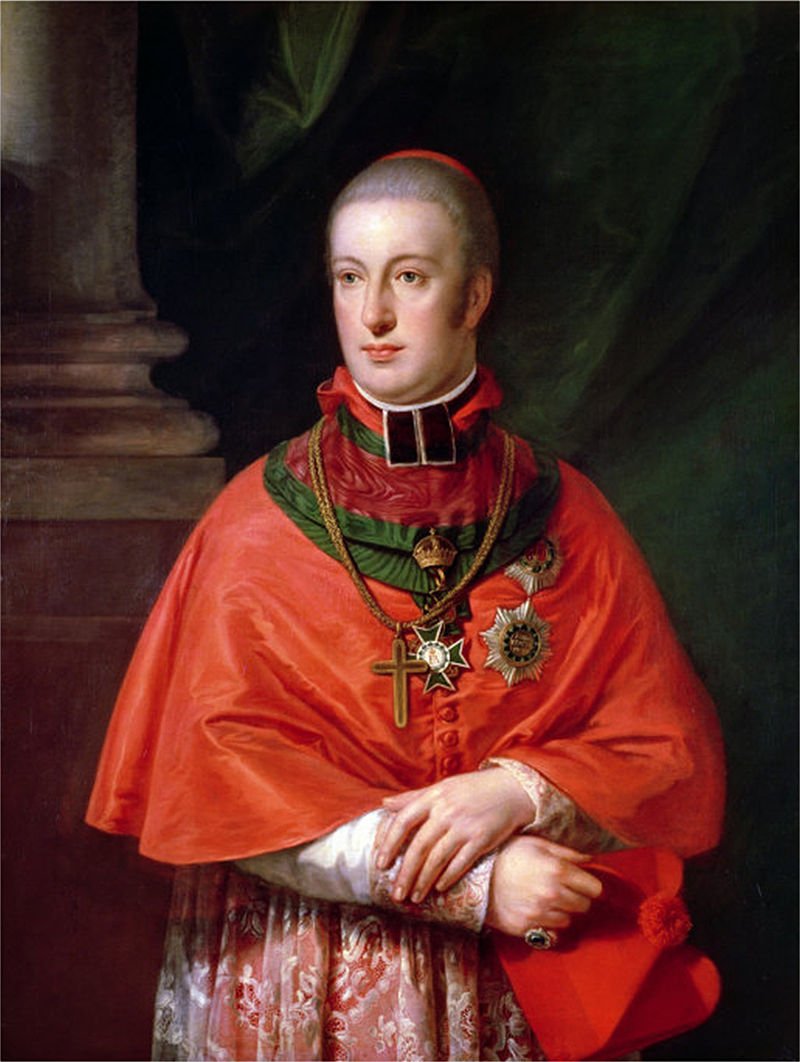
Dedication: Archduke Rudolph of Austria
Composition and publication: Originally composed as the final movement of the Quartet Op. 130, which Beethoven composed in Vienna between May and December 1825, but later published separately. The original editions were published in May 1827 in score and parts by Mathias Artaria in Vienna and in parts by Maurice Schlesinger in Paris. For the genesis and the editorial negotiations up to August 1826, see Op. 130.
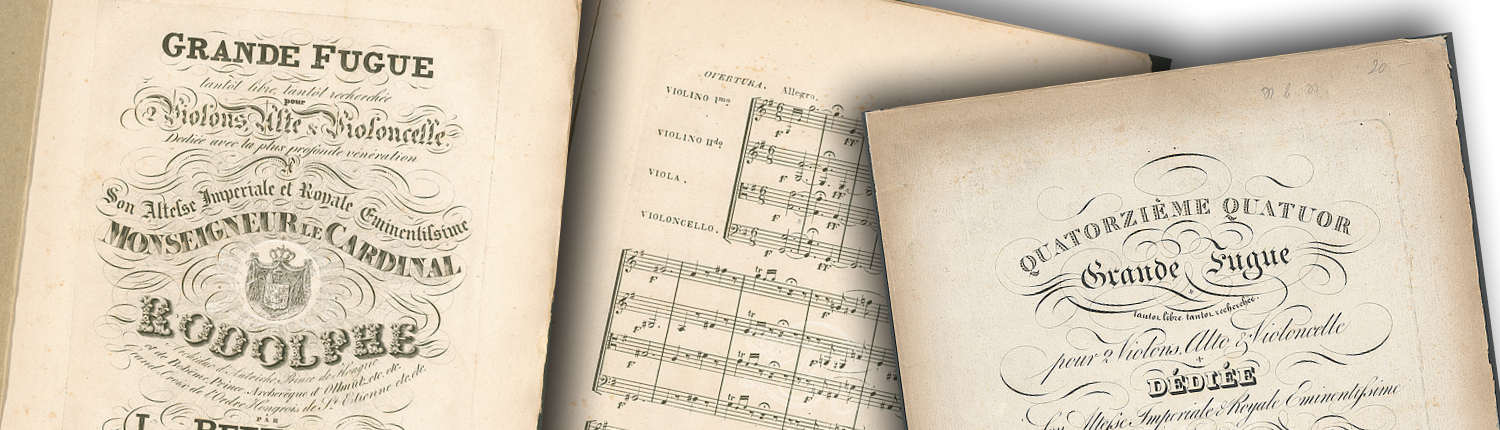
After the separation of the fugue from the Quartet Op. 130 was decided in September, Artaria at the beginning of December presented Beethoven with the title proofs for a separate edition of the movement: “The fugue is now engraved and I will send you the corrections. Here are the titles; do you want to see if they are right like this? — I knew it, but Holz told me you did not like the word ‘composé’ — In the middle comes the coat of arms” (BKh 10 p. 292). To find an appropriate title, Artaria wrote in an internal ledger: “To Kurka for 1 title for Beethoven’s Fugue […] 25 Cf.” (Nottenbohm/Beethoveniana II p. 265). On 15 February 1827 were paid “2 titles for the Beethoven scores” (probably Op. 130 and 133), which were again modified during the month of February. The plates of the originally planned edition of the Quartet Op. 130 with the fugue as final movement were used to print the edition of the parts. On the other hand, the plates for the edition of the score were probably re-engraved.
Simultaneously with Op. 130, published in May 1827, score and parts of Op. 133 were produced from plates probably made according to an engraving model of the “original version” now lost. The pre-existing proofs of the Artaria edition seem to have been the model for the Paris edition within the “Nouvelle Edition.” But almost two years later, Schlesinger published a revised “Nouvelle Edition.”
First performance: 21 March 1826 in Vienna, by the Schuppanzigh Quartet, as the final movement of Op. 130.
Sketches: see Op. 130.
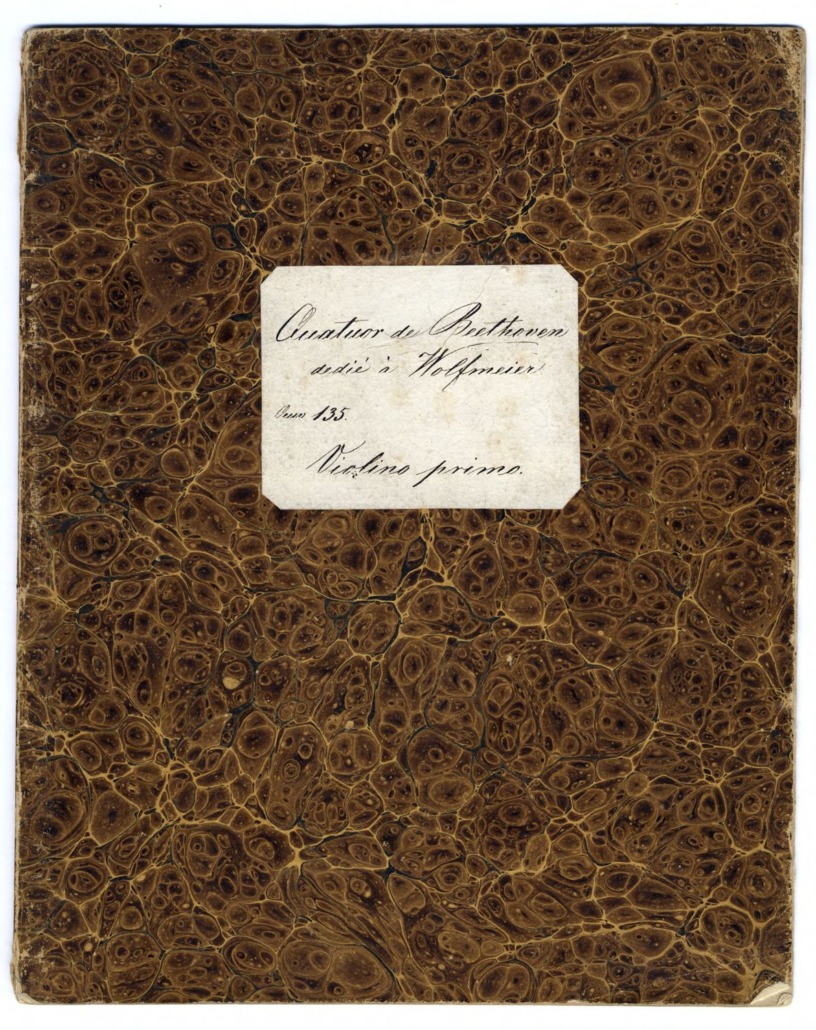
Score partially autograph, without the last 26 bars: PL-Kj, Mus. SM. autogr. Beethoven Artaria 215. Date: second half of 1825. Pages 76–78 written by Wenzel Rampl, page 79 written together with Beethoven. The last leaf is missing. Title: Leaf 1 recto titled “overtura.” 48 leaves; 91 pages of musical text. Leaves 1 recto / 48 verso. Leaves 1 recto 8, 62, 75 and 80 blank; p. 61 with annotations.
Paper of various types: pages 75–78: horizontal format, approx. 25 × 32 cm, 8 staves; other leaves: horizontal format, approx. 25 × 32 cm, 10 staves.
Provenance: Purchased as no. 102 at the 1827 Beethoven estate auction by Domenico Artaria, Vienna. Erich Prieger, Bonn, from 1897. Acquired in 1901.
Facsimile: SBB.
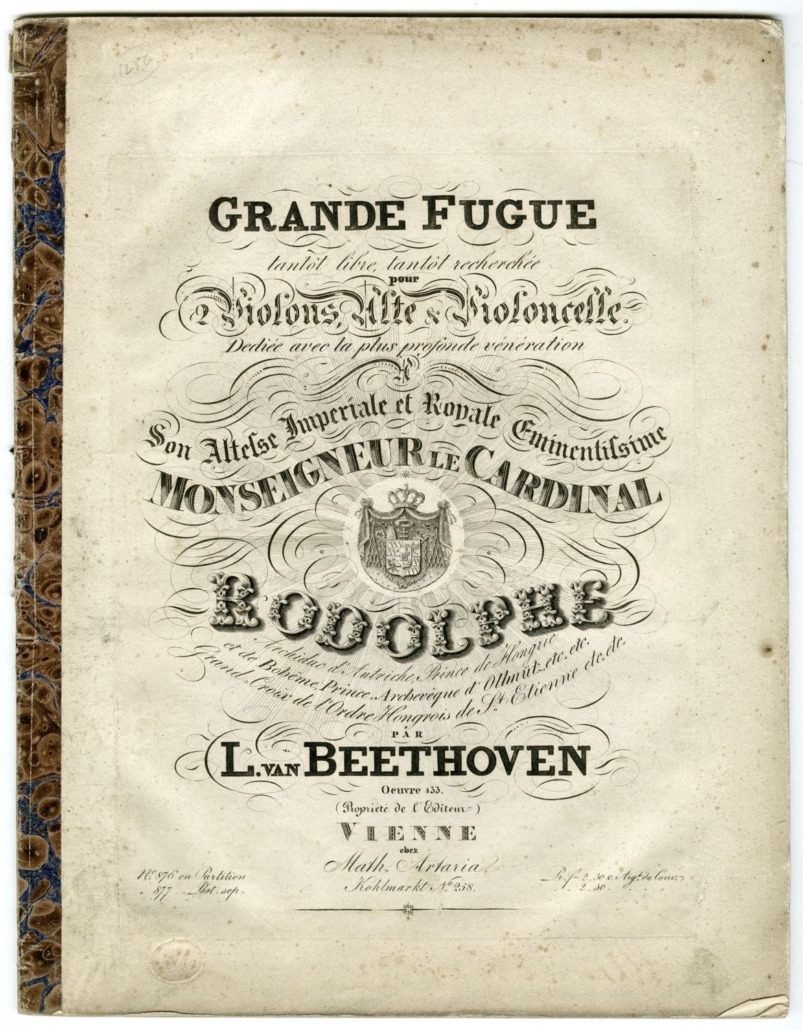
First edition: (complete transcription of the title page follows exactly as printed)
“GRANDE FUGUE / tantot libre, tantot recherchée / pour / 2 Violons, Alte & Violoncelle. / Dediée avec la plus profonde veneration / A’ / Son Altesse Imperiale et Royale Eminentissime / MONSEIGNEUR LE CARDINAL / [coat of arms] / RODOLPHE / Archiduc d’Autriche, Prince de Hongrie / et de Boheme, Prince-Archeveque d’Ollmütz, etc., etc., / Grand-Croix de l’Ordre Hongrois de St. Etienne etc., etc., / PAR / L. VAN BEETHOVEN / Oeuvre 133. / (Propriété de l’Editeur) / VIENNE / chez / Math. Artaria, / Kohlmarkt No. 258.”