Composition exercises with Albrechtsberger

Hess 234 – About 125 Exercises in Counterpoint in the Rigorous Style

BEETHOVEN WERKE
GESAMTAUSGABE BEGRÜNDET VON JOSEPH SCHMIDT-GÖRG HERAUSGEGEBEN VON BERNHARD R. APPEL IM AUFTRAG DES BEETHOVEN-ARCHIVS BONN

ABTEILUNG XIII • BAND 1 (IN DREI TEILEN)

Kompositionsstudien

bei Joseph Haydn, Johann Georg Albrechsberger und. Antonio Salieri
G. HENLE VERLAG MÜNCHEN

BEETHOVEN

KOMPOSITIONSSTUDIEN

BEI JOSEPH HAYDN, JOHANN GEORG ALBRECHTSBERGER UND ANTONIO SALIERI
HERAUSGEGEBEN VON JULIA RONGE

1. TRANSKRIPTIONEN
2014

G. HENLE VERLAG MÜNCHEN

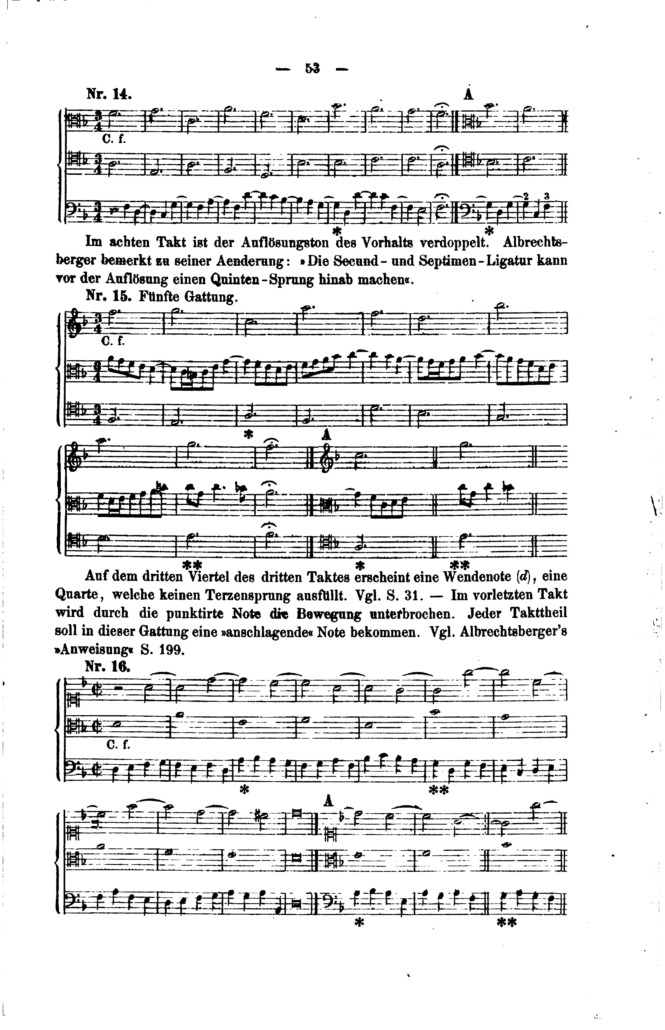
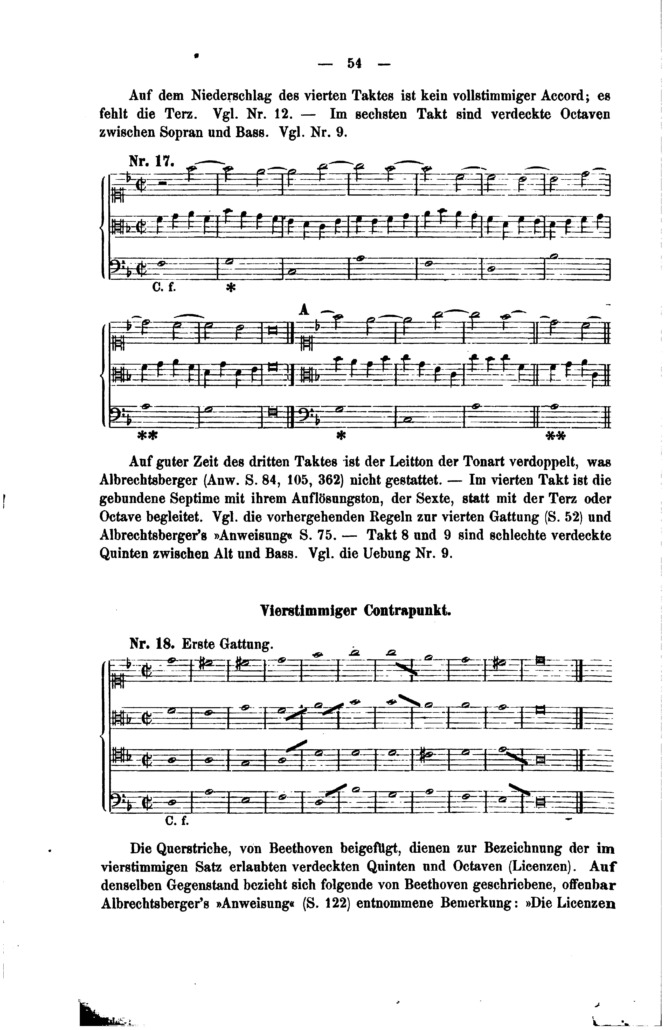
Approximately 125 counterpoint exercises in the strict style, based on two “cantus firmus” in F major and D minor. (Ronge pages 58/71) Vienna, A – Wgm, A 75 II, 1 sheet 3, 1 recto et seq.

We also have the material by Nottebohm (Nottebohm Gustav – Beethoven Studien – Beethovens Unterricht bei Haydn, Albrechtsberger und Salieri. Leipzig und Winterthur. Reiter Biedermann – 1873), which you will find available on the website in PDF format, and that of Ingaz Seyfied, the famous Ludwig van Beethovens Studien in Generalbass, Contrapunkt und in der Compositionslehre, aus dessen handschriftlichen Nachlasse Haslinger, 1832, also digitized and available on the website, with musical examples in MP3 and MIDI format.

Johann Georg Albrechtsberger (Klosterneuburg, 3 February 1736 – Vienna, 7 March 1809). He studied music at Melk Abbey and philosophy at a Benedictine seminary in Vienna, becoming one of the most cultured and skilled counterpointists of his time. After being engaged as organist at Rahab in 1755 and Maria Taferl in 1757, he was appointed Thurnermeister at Melk Abbey. In 1772 he was appointed organist at the court of Vienna, and in 1792 Kapellmeister of the Vienna Cathedral.

His fame as a theoretician brought him a few pupils, some of whom later became eminent musicians. These include Ludwig van Beethoven and Wolfgang Mozart. Beethoven had arrived in Vienna in 1792 to study with Joseph Haydn, but he was not satisfied with the lessons and studied harmony and counterpoint with Albrechtsberger.

His published compositions consist of preludes, fugues and sonatas for piano and organ, string quartets, and other composition but most of his works, vocal and instrumental, exist only in manuscript form.  They are in the library of the Vienna Gesellschaft der Musikfreunde. Around 1765, he wrote at least seven concertos for harps and strings (three of which are still in good condition and are in the Hungarian National Library in Budapest). These are pretty and well-written works. Among his most noteworthy works is the Concerto for alto trombone and orchestra in B flat major. Since the trombone does not boast many compositions dedicated to it during the classical period, this concerto is held in high esteem by trombonists.

Perhaps the most important contribution he has made to music, however, is in his theoretical works. In 1790 he published a treatise on composition in Leipzig. A collection of his writings on harmony, in three volumes, was published by his pupil Ignaz von Seyfried (1776–1841) in 1826. His compositional style derives from the counterpoint of Johann Joseph Fux.

Albrechtsberger died in Vienna; his tomb is in St. Marx’s Cemetery.