Opus 37, Concerto No. 3 in C minor for piano and orchestra

I) Allegro con brio – II) Largo – III) Rondo – Allegro

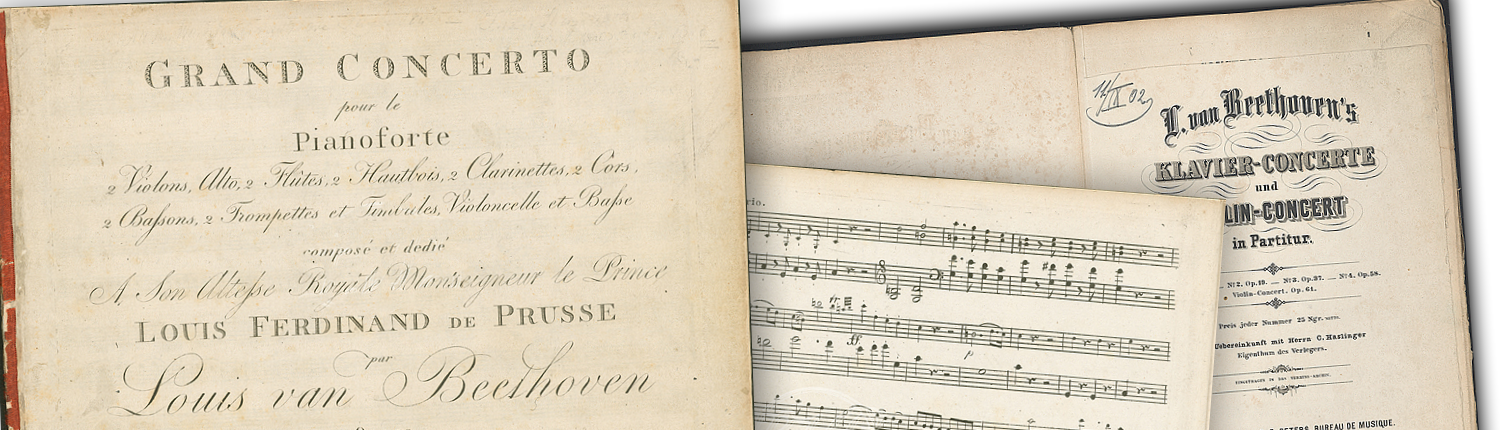
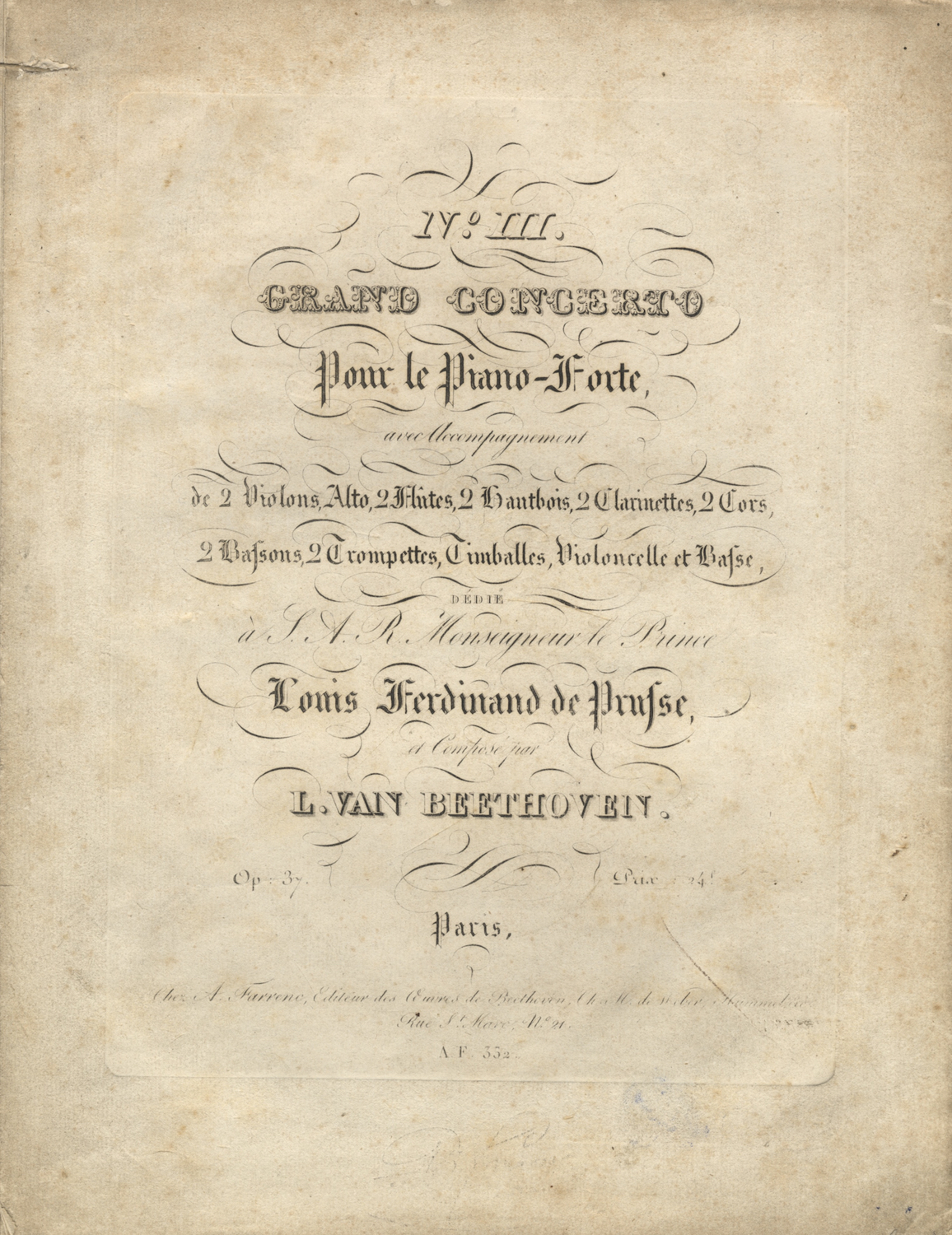
Opus 37, Concerto in C minor for piano and orchestra, op. 37, dedicated to Prince Louis Ferdinand of Prussia, nephew of Frederick the Great, that is, the son of his youngest brother. 1800–1802, published in orchestral parts in Vienna by the Bureau d’arts et d’industrie in the summer of 1804; full score published in Frankfurt by Dunst at the end of 1834 or the beginning of 1835. GA no. 67 (series 9/3) – B. 37 – KH. 37 – L. II, p. 220 – N. 37 – T. 73

Three sketches for this Concerto, dating several years before 1800, are preserved in the Kafka collection of the British Museum and were published at the time by Shedlock. Two of these (the second having the character of a cadenza) clearly relate to the first movement; the third, originally intended for the Rondo and listed as Biamonti 337, remained unused. The autograph manuscript, kept in the Deutsche Staatsbibliothek in Berlin, bears the inscription: “Concerto 1800, by L. van Beethoven.” This indicates that by 1800 the music must already have been composed at least in its essential elements, even if not yet fully developed. The revisions, however, continued until 1802; and it cannot be ruled out—based on reports by Seyfried and Ries—that further modifications and additions were introduced later, up to the time when the work was delivered to the publisher for printing.

The Allegro con brio is based on one of those typical C minor frameworks that appear in several other Beethoven works from the same period: the Quartet op. 18 no. 4, the Sonata for Piano and Violin op. 30 no. 2, the Trios op. 1 no. 3 for piano, violin and cello, and op. 9 no. 3 for violin, viola and cello, as well as the Piano Sonata op. 10 no. 1. Yet when the piano re-enters after the orchestral exposition, restating the same thematic material, it asserts itself with the authority of a true protagonist; and as the movement continues—alternately in opposition to or in alliance with the orchestral forces—it intensifies and expands the traditional form, already so expressively enriched by Mozart’s noble models.

Among the various thematic elements, principal or secondary, there is one of a special character which, at first bound to the main theme as its natural echo in rhythm and tone, later assumes in the dialectical and dramatic context of the recapitulation and coda a marked individuality—essentially instrumental in nature (in contrast to the melodic expansiveness of the main theme)—by turns acquiescent or mysterious, doubtful or sombre. It foreshadows, comments on, echoes, or at times even seems to contradict the discourse of the main idea. Particularly striking is its reappearance, after the cadenza, in the timpani.

The Largo opens with a nocturne-like melody on the piano, made all the more alluring by the shifting of tonal colours it touches upon before settling gently into its final cadence in B major. The orchestra then enters in the initial key, concluding its phrase with a descending bass line, expressively complemented by the contrary ascending motion of the upper strings and woodwinds. A second, more florid melody, again rising from the solo instrument, is less intimate, though sweet and refined; notable is the ensuing episode, where from the piano’s shadowy arpeggios emerge the sighing voices of some wind instruments, especially the bassoon. Structurally, this passage leads, through a gradual return of the opening atmosphere, to the restatement of the original melody, now in a closer expressive union between soloist and orchestra, continuing to the final cadence.

The Finale (Allegro) has, as is customary, a lighter character; its themes and developments take on a lively, dance-like quality, full of instrumental playfulness. During the development, certain rhythmic echoes in the piano, with its rebounding octaves and vivid shifts in tonality, recall the Finale of the Eighth Symphony.

Witty, too, is the concluding Presto in 6/8 and C major, derived from the same motif. Beethoven republished it in 1820 in a version for solo piano, together with five Bagatelles from op. 119, in the third part of F. Starke’s Wiener Pianoforte-Schule (see Hess 65 – Biamonti 730).

 [By Biamonti Giovanni – Catalogo cronologico e tematico delle opere di Beethoven comprese quelle inedite e gli abbozzi non utilizzati, Torino, ILTE 1968]
Opus 37 - Concerto in C minor for piano and orchestra

Opus 37 - Concerto in C minor for piano and orchestra

Score in PDF

Official title: Opus 37 Konzert Nr. 3 (c-moll) für Klavier und Orchester Widmung: Louis Ferdinand Prinz von Preußen NGAIII/2 AGA 67 = Serie 9/3 SBG IX/20 (Hess 65)

Origin and publication: the autograph score bears Beethoven’s date “1803.” Of the few surviving sketches, which are not always clearly related to op. 37, the earliest date back to 1796. The work was developed in several stages, whose exact chronology—essentially between the end of 1799 and 1804—remains disputed. Some evidence suggests that part of the score had already been worked out in 1799/1800, and that there may even have existed, as early as 1796, a preliminary version, perhaps not fully developed in all its movements—as was the case with opp. 15 and 19. The original orchestral parts were published in the autumn of 1804 by the Kunst- und Industrie-Comptoir in Vienna. The earliest sketches specifically referring to a piano concerto in C minor can be found among notes for works completed during or shortly after Beethoven’s stay in Berlin in the spring/early summer of 1796 (between opp. 5 and 16).

These sketches already contain material for the first and third movements, which later reappear in similar form in op. 37. Some musical fragments from late 1797 or early 1798 can also be clearly linked to the theme of the first movement. It remains uncertain whether these sketches from 1796–1798 were isolated conceptual ideas later taken up again, or whether Beethoven was already working more concretely on another concerto alongside opp. 15 and 19. At least the sketches for the first movement suggest the possibility of an earlier version of that movement. Around 1799 or 1800, Beethoven set about composing op. 37.

A letter to Franz Anton Hoffmeister in Vienna, dated 15 December 1800, shows that after completing opp. 15 and 19, he was working on another concerto—perhaps one already available in score. He offered the publisher:
“3tens ein Konzert fürs Klawier [Op. 19] welches ich zwar für kein’s von meinen Besten ausgebe, so wie ein anderes [Op. 15], was bey mollo hier herauskommen wird, (zur Nachricht an die Leipziger Rezensenten), weil ich die Bessern noch für mich behalte, bis ich selbst eine Reise mache, doch dörft es ihnen keine schände machen es zu stechen” (BGA 49; see also BGA 59).
If there was already another “better” concerto, it may have been op. 37. The sketches from this period cannot be verified.

However, Aloys Fuchs described the sketchbook “Autograph 19e,” used by Beethoven in the summer of 1800 and now only partially reconstructable, as follows: “ein Skizzenbuch aus früher Zeit mit Entwürfen zu den 6 Quart: Op. 18/36 Blätter/ C mol Klav. Conzert etc. etc.”
(D-B, Mus. ms. theor. Cat. 510, quoted by JTW p. 92).

It is therefore possible that the now-missing pages of this notebook contained notes for op. 37. It has often been suggested that a lost sketchbook used by Beethoven between autumn 1799 and about April 1800 may have contained material primarily for this work.

Beyond the question of sketches, examination of the autograph score paper has not yielded definitive dating results. Hans-Werner Küthen dates the paper used for most of the manuscript to 1799/1800, though this has been questioned by Leon Plantinga. Based on the possible existence of a score only partially worked out in 1800, it has been suggested that op. 37 was originally planned for Beethoven’s Akademie concert of 2 April 1800, but was replaced at short notice by op. 15.

In April 1802, Beethoven planned another Akademie, which had to be cancelled because the necessary venue was unavailable (BGA 85). This concert was to include, among other works, a new piano concerto, as indicated by a letter from Kaspar Karl van Beethoven to Breitkopf & Härtel dated 28 March 1802:
“ferner werden wir in 3 bis 4 Wochen eine grose Simpfonie [Op. 36], und ein Konzert für das Klavier [Op. 37, vielleicht aber auch das nicht vollendete Tripelkonzert von 1802] haben” (BGA 81).

For the planning of the Second Symphony op. 36, Beethoven used the “Keßler” notebook. Among the orchestral sketches for this Akademie there is a single notation resembling op. 37, though its function is disputed. Küthen interprets it as a revision sketch for the autograph score, while Plantinga regards it as an isolated musical idea not yet elaborated.

If a (perhaps partial) score was indeed available for the Akademie of 1802, Beethoven may have sketched the composition between April and December 1801, during which time he used the “Sauer” notebook—now only partially reconstructable.

After the cancellation of the Akademie in April 1802, Kaspar Karl van Beethoven asked Breitkopf & Härtel for patience regarding the Second Symphony and the piano concerto, “weil wir sie noch in einer Musick zu gebrauchen denken” (BGA 85). When Breitkopf offered less payment than Beethoven requested, both works were sold instead to the Vienna Kunst- und Industrie-Comptoir in February/March 1803 (BGA 129). By March 1803 at the latest, a performable version of op. 37 had been completed for Beethoven’s Akademie of 5 April 1803.

Ignaz von Seyfried, who turned pages for the composer at that concert, later described the state of the manuscript: “Ich erblickte fast lauter leere Blätter” (Caecilia 9, 1828, p. 220).
Ferdinand Ries likewise wrote: “Die Clavierstimme des C moll Concerts hat nie vollständig in der Partitur gestanden; Beethoven hatte sie eigens für mich in einzelnen Blättern niedergeschrieben” (Wegeler/Ries, p. 115).

Küthen therefore hypothesises that Beethoven undertook a comprehensive revision of all movements and finalised the solo part only for the concert of 19 July 1804, in which Ries made his debut as Beethoven’s pupil. It is thus highly probable that the original Viennese publisher did not receive a complete engraving model before July 1804. As Beethoven’s correspondence from September 1804 shows, the proofs were corrected in part by Ferdinand Ries (BGA 190–192). The work was published together with opp. 36 and 38, already announced in November 1803.

Regarding the publication date, BGA 190, Note 2 states: “Erschienen ist sie frühestens in der zweiten Hälfte September 1804, da die Widmung an Prinz Louis Ferdinand von Preußen sicherlich durch dessen Besuch in Wien, 8. bis 13.9.1804, veranlaßt wurde. Anfang Oktober 1804 wurde sie allerdings bereits bei Breitkopf & Härtel in Leipzig als vorrätig angezeigt (AmZ 7, 1804/05, Intelligenzblatt 1, Sp. 1).”

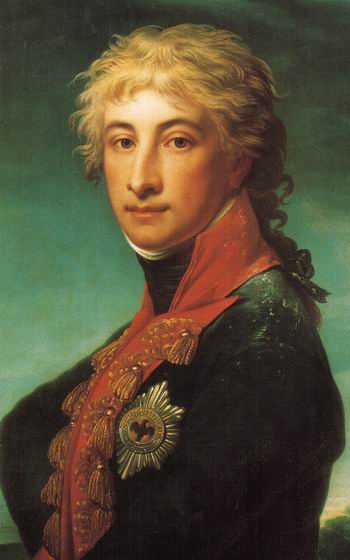
Dedication: Louis Ferdinand (Ludwig Friedrich Christian), Prince of Prussia, born 18 November 1772 in Friedrichsfelde near Berlin, died 10 October 1806 at Wöhlsdorf near Saalfeld, was the son of Prince August Ferdinand of Prussia (1730–1813) and his wife Anna Elisabeth Luise of Brandenburg-Schwedt (1738–1820), and nephew of Frederick the Great. He was an excellent pianist and a gifted composer.

Beethoven met Louis Ferdinand during his concert tour to Berlin in June 1796 (cf. op. 5) and greatly admired his piano playing: he “played better than the royal Prussian Kapellmeister Friedrich Heinrich Himmel and spiele gar nicht königlich oder prinzlich, sondern wie ein tüchtiger Clavier-spieler” (Wegeler/Ries, p. 110).

In 1804 the two met again. Louis Ferdinand stayed in Vienna from 8 to 13 September, en route to inspect the Austrian autumn manoeuvres, and dined with Beethoven several times (ibid., p. 111). From autumn 1804 onwards, Louis Ferdinand was also a close friend of Beethoven’s patron, Prince Franz Joseph Maximilian von Lobkowitz (1772–1816), whom he had met in the summer of 1800. At Lobkowitz’s castle in Raudnitz (Roudnice, Czech Republic), a private performance of the Eroica took place on 18 or 19 October 1804 in the Prince’s presence, who requested two repetitions.

At Constanze Mozart’s suggestion, six of Mozart’s piano concertos (KV 503, 595, 491, 482, 488, and 467) were dedicated to Louis Ferdinand and published together in 1800 by Johann André in Offenbach (see Debuch/Louis-Ferdinand).

The sketches will be featured in an article specially created for the Beethovenian Music Research Center, www.lvbeethoven.org