

Opus 48 – 6 Songs on poems by Chr. F. Gellert for voice and piano
I) Bitten – II) Die Liebe des Nächstens – III) Vom Tode – IV) Die Ehre Gottes aus der Natur – V) Gottes Macht und Vorsehung – VI) Busslied
Opus 48 – Six songs on poems by Chr. F. Gellert, for voice and piano, Op. 48, dedicated to Count Georg von Browne, composed between mid-May and June 1803, published in Vienna by Artaria in August 1803. GA no. 217 (series 23/3) – Boett. VI/1-6 – B. 48 – KH. 48 – L. II, p. 187 – N. 48 – T. 109.
The original manuscript, put up for public auction along with other papers and music from the “Beethoven estate” on 5 November 1827, was purchased by the carpet merchant Johann Nepomuk Wolfmayer (the devoted friend to whom Beethoven would later dedicate his final F major Quartet, Op. 135). The Wolfmayer heirs subsequently sold it around 1850; it then passed into other hands and has since become partly dispersed. Today, the Beethovenhaus preserves only numbers 5 and 6, as well as a page containing the final twelve bars of the latter in an early version that differs in some details from the final one, within the Bodmer collection (Hess, cat. 141 and the fifth fascicle of the Supplemente zur GA, 1962).
The work was physically composed during the relatively short period from mid-May through the end of June 1803; and this is undoubtedly also the time of a draft containing the central words of the third song: “Denk, O Mensch an deinen Tod” (Think, O man, of your death), which remained unused, a detail that Nottebohm references in his description of the Eroica sketchbook.
However, the same scholar later mentions, without quoting it, another draft, in D minor 3/4 time, fully laid out, of the same song, found in a notebook from 1798. Although here too the music “has no relation to the printed version,” this may demonstrate how Beethoven had already been considering a composition of this kind from that time. The expressive “property” of these pages (so different in form and style from Beethoven’s other songs) suggests they originated in a remote inner world—ideological and musical—gradually formed in the master’s mind since his Bonn years.
Biamonti 190. See our research, with a study of the sketches by Graziano Denini.
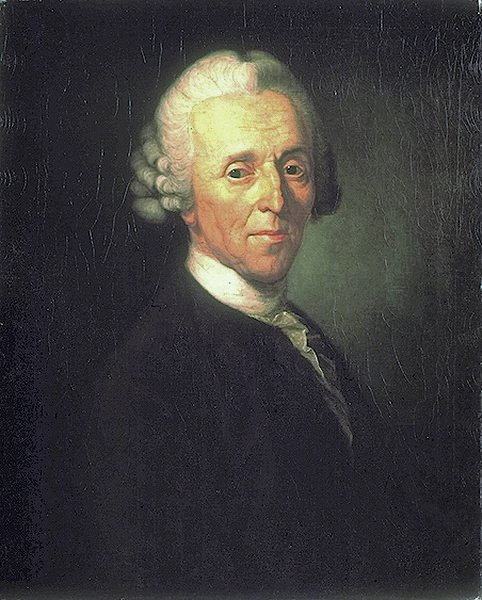
The poetic works and Enlightenment doctrines of Christian Furchtegott Gellert (Hainichen, Erzgebirge, 1715–Leipzig, 1769) had long been widespread throughout the German lands; even Neefe, Beethoven’s teacher, had connections with this writer and had attended his lectures at the University of Leipzig. Gellert’s Geistliche Oden und Lieder (Spiritual Odes and Songs), written based on excerpts from the Protestant Bible, attracted the attention of more than one composer from their first appearance. Carl Philipp Emanuel Bach set them all to music with the stated aim—in his Preface—of “giving splendour” to the poet’s devout intentions and “contributing to the edification of lovers of this kind of music.”
It is likely that Beethoven was already familiar with these texts and music while in Bonn; there too, in his role as “vicar” or substitute for Neefe in accompanying singers during religious services and Holy Week offices—functions he already attended as a thirteen-year-old in the Catholic electoral chapel—he undoubtedly had direct contact with sacred texts speaking of the power and glory of the Lord, the terror of death, the despair of grief without God, and the sweet confidence of rediscovery.
These feelings and impressions, inseparably linked to the musical forms that practice and study presented from time to time to his sensitivity and reflection (the old Protestant chorales, the church songs of Bonn, and also those of liturgical services and compositions by classic Viennese authors), must have contributed, as they developed, to the formation of a particular spiritual “complex” which, under the impulse of an event we cannot but call accidental, was able to take concrete shape in the work within a certain brief period of time.
The composition of the songs was in fact practically prompted by the premature death, which occurred in Vienna on 13 May 1803, of Countess Anna Margarethe von Browne, wife of Count Georg von Browne. The work was completed the following June. The poetic text of each song consists of several stanzas. The GA edition reproduces in full the six stanzas of the last song and only the first two (out of six) of the fourth; it includes the opening stanzas (out of a total of four, fourteen, seven, and fifteen, respectively) of the first, second, third, and fifth songs. Some have wondered whether it might be appropriate to add a few stanzas, at least to some of the songs. However, it seems to us that, especially when performing the work in its entirety, as we believe Beethoven envisaged it—with the order and proportions he established—no additions should be made.
[By Biamonti Giovanni – Catalogo cronologico e tematico delle opere di Beethoven comprese quelle inedite e gli abbozzi non utilizzati, Torino, ILTE 1968]
Official title: „Opus 48“ Sechs Lieder nach Gedichten von Christian Fürchtegott Geliert für Singstimme und Klavier Widmung: Johann Georg Reichsgraf von Browne-Camus NGAXII/1 Nr. 20-25, 103f AGA 217 = Serie 23/3 SBG V/10 (2. Auflage: 11; Quelle 1.2, Hess 141)
Origin and Publication: The autograph sources are undated, but a complete copy of the songs bears the date 8 March 1802. Since Beethoven wrote an earlier version of No. 3 in the “Grasnick 1” notebook at the end of 1798, it is clear that he began working on Gellert’s poems at that time. The original edition was published by Mollo in Vienna in the summer of 1803. No sketches for the compositions of Op. 48 have survived. Only the aforementioned earlier version of No. 3, “Vom Tode,” and a later draft noted in the sketchbook “Landsberg 6” after the publication of the original edition (early August 1803) are documented. Even in 1822, Beethoven offered the Leipzig publisher Peters a song, “meine Lebenszeit verstreicht,” possibly another musical setting of the same text (BGA 1468, draft).
Manuscript sources show that Beethoven arranged the songs by placing the fifth Lied after the sixth. Only the original Mollo edition presents the songs in the order still customary today. The reprint published by Hoffmeister & Kühnel in Leipzig places No. 5 before No. 6.
Max Unger’s essay on the genesis of Op. 48 suggests that the songs were „veranlaßt wahrscheinlich durch den unerwarteten Tod (13. Mai [1803]) der Gräfin Anna Margarete von Browne“ (KH p. 113); a hypothesis confirmed by the later discovery of a first dated copy. In a letter dated 6 August 1803 (BGA 152), Ferdinand Ries sent „mehrere Beethovensche Werke“ to Nikolaus Simrock in Bonn and noted that „bei Mollo […] nächstens 6 geistliche Lieder“ were forthcoming. An invoice, obviously related to the shipment and either enclosed with the letter or issued shortly after, lists the six songs as the last item at the price of 1 fl. 30. Although this edition was not included in the shipment of 6 August, it is clear that Mollo was the publisher of the first edition and brought the work to the musical market in the summer of 1803. Franz Anton Hoffmeister in Leipzig also received a copy of the Six Songs „eben herausgekommenen“ in a letter dated 10 September 1803.
During this period, relations between the companies Artaria and Mollo became complicated. At the end of August 1802 Carlo Artaria sold the company Artaria & C., which split into two new firms: the first went to Tranquillo Mollo (T. Mollo & Comp.) and the second to Domenico Artaria (Artaria & Comp.). Both operated together as a company but published their editions separately. This collaboration ended in 1804, with Mollo publishing a series of titles, including Op. 48, which apparently remained under Artaria’s control (for example, editions or arrangements for quintet Op. 4, 21, 29).
Text: Christian Fürchtegott Gellert (1715–1769), from „Geistliche Oden und Lieder“, Leipzig 1757. For the dedication, see Op. 9. Regarding the opus number: like the “Adelaide” Op. 46, the Gellert-Lieder originally appeared without an opus number and only received the number 48 in 1819 in Artaria’s “Catalogue des Oeuvres” appended to Op. 106. The date of the first performance is unknown.
The sketches will be featured in an article specially created for the Beethovenian Music Research Center, www.lvbeethoven.org



Opus 48 numero 1 – Bitten
Feierlich und mit Andacht
It recalls in some ways the ecstatic mysticism of the Opferlied (in the same key of E major), though it lacks its fervor; it has a festive character, to which a certain organ-like character of the piano part gives its particular imprint. A delicate nuance of color is introduced into the melody with the change from G sharp to G natural in the final words, before the resolution to the major key. The text:
Gott, deine Güte reicht so weit,
So weit die Wolken gehen,
Du krönst uns mit Barmherzigkeit
Und eilst, uns beizustehen.
Herr! Meine Burg, mein Fels, mein Hort,
Vernimm mein Flehn, merk auf mein Wort;
Denn ich will vor dir beten!
Ich bitte nicht um Überfluß
Und Schätze dieser Erden.
Laß mir, so viel ich haben muß,
Nach deiner Gnade werden.
Gib mir nur Weisheit und Verstand,
Dich, Gott, und den, den du gesandt,
Und mich selbst zu erkennen.
Ich bitte nicht um Ehr und Ruhm,
So sehr sie Menschen rühren;
Des guten Namens Eigentum
Laß mich nur nicht verlieren.
Mein wahrer Ruhm sei meine Pflicht,
Der Ruhm vor deinem Angesicht,
Und frommer Freunde Liebe.
So bitt ich dich, Herr Zebaoth,
Auch nicht um langes Leben.
Im Glücke Demut, Mut in Not,
Das wolltest du mir geben.
In deiner Hand steht meine Zeit;
Laß du mich nur Barmherzigkeit
Vor dir im Tode finden.
Opus 48 numero 2 – Die Liebe des Nächstens
Lebhaft, doch nicht zu sehr
We don’t understand how the Allgemeine Musik Zeitung could criticize this song, considering it the least appropriate due to the “doctrinal” nature of the lyrics. The divine precept vibrates with emotion in the musical phrasing, somewhere between melodic and declaimed. And the profound sweetness of “Gott ist die Lieb” (God is love) is its most beautiful interpretation. The lyrics:
So jemand spricht: Ich liebe Gott,
Und haßt doch seine Brüder,
Der treibt mit Gottes Wahrheit Spott
Und reißt sie ganz darnieder.
Gott ist die Lieb, und will, daß ich
Den Nächsten liebe, gleich als mich.
Wer dieser Erden Güter hat,
Und sieht die Brüder leiden,
Und macht den Hungrigen nicht satt,
Läßt Nackende nicht kleiden;
Der ist ein Feind der ersten Pflicht,
Und hat die Liebe Gottes nicht.
Wer seines Nächsten Ehre schmäht,
Und gern sie schmähen höret;
Sich freut, wenn sich sein Feind vergeht,
Und nichts zum Besten kehret;
Nicht dem Verleumder widerspricht;
Der liebt auch seinen Bruder nicht.
Wer zwar mit Rat, mit Trost und Schutz
Den Nächsten unterstützet,
Doch nur aus Stolz, aus Eigennutz,
Aus Weichlichkeit ihm nützet;
Nicht aus Gehorsam, nicht aus Pflicht;
Der liebt auch seinen Nächsten nicht.
Wer harret, bis ihn anzuflehn,
Ein Dürftiger erst erscheinet,
Nicht eilt, dem Frommen beizustehn,
Der im Verborgnen weinet;
Nicht gütig forscht, ob’s ihm gebricht;
Der liebt auch seinen Nächsten nicht.
Wer andre, wenn er sie beschirmt,
Mit Härt und Vorwurf quälet,
Und ohne Nachsicht straft und stürmt,
So bald sein Nächster fehlet;
Wie bleibt bei seinem Ungestüm
Die Liebe Gottes wohl in ihm?
Wer für der Armen Heil und Zucht
Mit Rat und Tat nicht wachet,
Dem Übel nicht zu wehren sucht,
Das oft sie dürftig machet;
Nur sorglos ihnen Gaben gibt;
Der hat sie wenig noch geliebt.
Wahr ist es, du vermagst es nicht,
Stets durch die Tat zu lieben.
Doch bist du nur geneigt, die Pflicht
Getreulich auszuüben,
Und wünschest dir die Kraft dazu,
Und sorgst dafür: so liebest du.
Ermattet dieser Trieb in dir:
So such ihn zu beleben.
Sprich oft: Gott ist die Lieb, und mir
Hat er sein Bild gegeben.
Denk oft: Gott, was ich bin, ist dein;
Opus 48 numero 3 – Vom Tode
Mäßig und eher langsam als geschwind
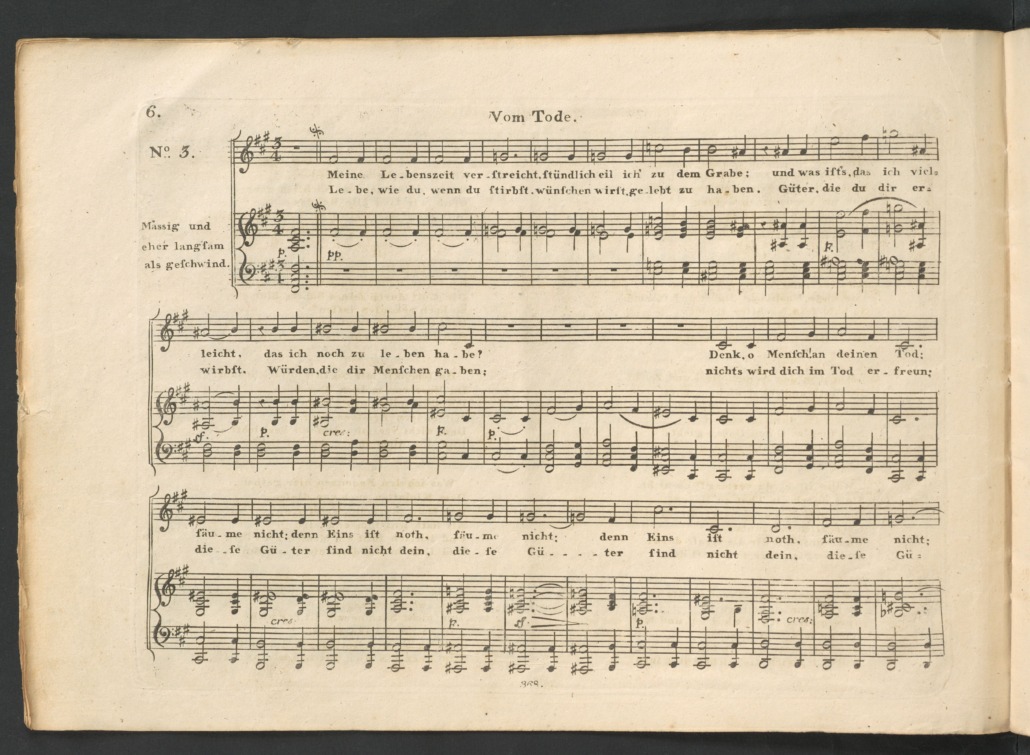
It is the darkest and most dramatically expressive of the six songs. A nocturnal colour scene that only Beethoven’s palette could have painted. What burning anguish lurks terrifyingly in the thought: How much longer do I have to live? The entrance is ghostly: “Denk, o Mensch, an deinen Tod” (Think, man, of your death!); and at the end, the funeral bell tolls in deep, sombre strokes. One cannot fully know Beethoven without this devastating song. We also think, for some musical and ideological analogy, of the second movement of Brahms’s German Requiem: “Denn alles Fleisch es ist wie Gras, und alle Herrlickheit des Menschen wie des Grasses Blumen”.
Meine Lebenszeit verstreicht,
Stündlich eil ich zu dem Grabe,
Und was ist’s, das ich vielleicht,
Das ich noch zu leben habe?
Denk, o Mensch, an deinen Tod!
Säume nicht, denn Eins ist Not!
Lebe, wie du, wenn du stirbst,
Wünschen wirst, gelebt zu haben
Güter, die du hier erwirbst,
Würden, die dir Menschen gaben;
Nichts wird dich im Tod erfreun;
Diese Güter sind nicht dein.
Nur ein Herz, das Gutes liebt,
Nur ein ruhiges Gewissen,
Das vor Gott dir Zeugnis gibt,
Wird dir deinen Tod versüßen;
Dieses Herz, von Gott erneut,
Ist des Todes Freudigkeit.
Wenn in deiner letzten Not
Freunde hülflos um dich beben:
Dann wird über Welt und Tod
Dich dies reine Herz erheben;
Dann erschreckt dich kein Gericht;
Gott ist deine Zuversicht.
Daß du dieses Herz erwirbst,
Fürchte Gott, und bet und wache.
Sorge nicht, wie früh du stirbst;
Deine Zeit ist Gottes Sache.
Lern nicht nur den Tod nicht scheun,
Lern auch seiner dich erfreun.
Überwind ihn durch Vertraun,
Sprich: Ich weiß, an wen ich gläube,
Und ich weiß, ich werd ihn schaun
Einst in diesem meinem Leibe.
Er, der rief: Es ist vollbracht!
Nahm dem Tode seine Macht.
Tritt im Geist zum Grab oft hin,
Siehe dein Gebein versenken;
Sprich: Herr, daß ich Erde bin,
Lehre du mich selbst bedenken;
Lehre du mich’s jeden Tag,
Opus 48 numero 4 – Die Ehre Gottes aus der Natur
Majestätisch und erhaben
A page full of splendour, which, by its very character, contrasts with the desolation of the preceding one, ideally linking to the first two songs. Magnificent is the passage in E-flat major of the second stanza, where from the accompaniment of low, repeated chords played pianissimo on the piano rises a kind of melodic recitative with the questioning: “Wer trägt der Himmel unzählbare Sterne? Wer führt die Sonn aus ihrem Zelt?”, before returning to the stark opening phrase.
Die Himmel rühmen des Ewigen Ehre;
Ihr Schall pflanzt seinen Namen fort.
Ihn rühmt der Erdkreis, ihn preisen die Meere;
Vernimm, o Mensch, ihr göttlich Wort!
Wer trägt der Himmel unzählbare Sterne?
Wer führt die Sonn aus ihrem Zelt?
Sie kommt und leuchtet und lacht uns von ferne
Und läuft den Weg gleich als ein Held.
Vernimm’s, und siehe die Wunder der Werke,
Die die Natur dir aufgestellt!
Verkündigt Weisheit und Ordnung und Stärke
Dir nicht den Herrn, den Herrn der Welt?
Kannst du der Wesen unzählbare Heere,
Den kleinsten Staub fühllos beschaun?
Durch wen ist alles? O gib ihm die Ehre!
Mir, ruft der Herr, sollst du vertraun.
Mein ist die Kraft, mein ist Himmel und Erde;
An meinen Werken kennst du mich.
Ich bin’s, und werde sein, der ich sein werde,
Dein Gott und Vater ewiglich.
Ich bin dein Schöpfer, bin Weisheit und Güte,
Ein Gott der Ordnung und dein Heil;
Ich bin’s! Mich liebe von ganzem Gemüte,
Und nimm an meiner Gnade Teil.
Opus 48 numero 5 – Gottes Macht und Vorsehung
Mit Kraft und Feurig
A very brief, epigraphic page that continues the solemn manner, albeit less grandiose than the previous one, and can nevertheless be connected as an appropriate prelude to the following piece. It seems to us that it should not be regarded otherwise and that, within the overall balance of the six songs, as they are juxtaposed, attempting to extend it by adding more stanzas—even in the reduced form proposed by Moser—would diminish its effectiveness.
Gott ist mein Lied!
Er ist der Gott der Stärke,
Hehr ist sein Nam’
Und groß sind seine Werke,
Und alle Himmel sein Gebiet.
Er will und spricht’s;
So sind und leben Welten.
Und er gebeut; so fallen durch sein Schelten
Die Himmel wieder in ihr Nichts.
Licht ist sein Kleid,
Und seine Wahl das Beste;
Er herrscht als Gott, und seines Thrones Feste
Ist Wahrheit und Gerechtigkeit.
Unendlich reich,
Ein Meer von Seligkeiten,
Ohn Anfang Gott, und Gott in ewgen Zeiten!
Herr aller Welt, wer ist dir gleich?
Was ist und war,
In Himmel, Erd und Meere,
Das kennet Gott, und seiner Werke Heere
Sind ewig vor ihm offenbar.
Er ist um mich,
Schafft, daß ich sicher ruhe;
Er schafft, was ich vor oder nachmals tue,
Und er erforschet mich und dich.
Er ist dir nah,
Du sitzest oder gehest;
Ob du ans Meer, ob du gen Himmel flöhest:
So ist er allenthalben da.
Er kennt mein Flehn
Und allen Rat der Seele.
Er weiß, wie oft ich Gutes tu und fehle,
Und eilt, mir gnädig beizustehn.
Er wog mir dar,
Was er mir geben wollte,
Schrieb auf sein Buch, wie lang ich leben sollte,
Da ich noch unbereitet war.
Nichts, nichts ist mein,
Das Gott nicht angehöre.
Herr, immerdar soll deines Namens Ehre,
Dein Lob in meinem Munde sein!
Wer kann die Pracht
Von deinen Wundern fassen?
Ein jeder Staub, den du hast werden lassen,
Verkündigt seines Schöpfers Macht.
Der kleinste Halm
Ist deiner Weisheit Spiegel.
Du, Luft und Meer, ihr Auen, Tal und Hügel,
Ihr seid sein Loblied und sein Psalm!
Du tränkst das Land,
Führst uns auf grüne Weiden;
Und Nacht und Tag, und Korn und Wein und Freud
Empfangen wir aus deiner Hand.
Kein Sperling fällt,
Herr, ohne deinen Willen;
Sollt ich mein Herz nicht mit dem Troste stillen,
Daß deine Hand mein Leben hält?
Ist Gott mein Schutz,
Will Gott mein Retter werden:
So frag ich nichts nach Himmel und nach Erden,
Und biete selbst der Hölle Trutz.
Opus 48 numero 6 – Bußiled
Poco adagio
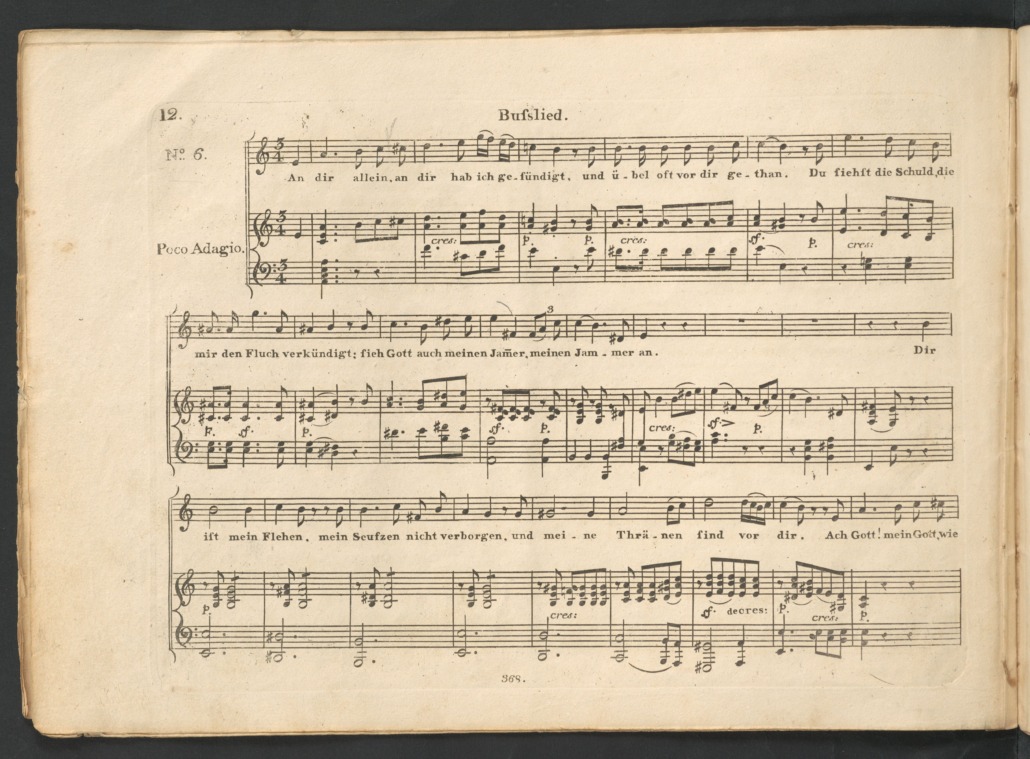
It is divided into two corresponding parts, following a logical line of formal and expressive development, reflecting the two different moments contemplated by the poet: the pain of repentance and the hope of redemption. The anguished melody of the first part in minor (verses 1-3) is matched by the consoling melody of the second part (verses 4-6), based on the same theme but in major, and enriched in its spirit by the joyful instrumental figuration that surrounds it.
An dir allein, an dir hab ich gesündigt,
Und übel oft vor dir getan.
Du siehst die Schuld, die mir den Fluch verkündigt;
Sieh, Gott, auch meinen Jammer an.
Dir ist mein Flehn, mein Seufzen nicht verborgen,
Und meine Tränen sind vor dir.
Ach Gott, mein Gott, wie lange soll ich sorgen?
Wie lang entfernst du dich von mir?
Herr, handle nicht mit mir nach meinen Sünden,
Vergilt mir nicht nach meiner Schuld.
Ich suche dich, laß mich dein Antlitz finden,
Du Gott der Langmut und Geduld.
Früh wollst du mich mit deiner Gnade füllen,
Gott, Vater der Barmherzigeit.
Erfreue mich um deines Namens willen,
Du bist mein Gott, der gern erfreut.
Laß deinen Weg mich wieder freudig wallen
Und lehre mich dein heilig Recht
Mich täglich tun nach deinem Wohlgefallen;
Du bist mein Gott, ich bin dein Knecht.
Herr, eile du, mein Schutz, mir beizustehen,
Und leite mich auf ebner Bahn.
Er hört mein Schrei’n, der Herr erhört mein Flehen
Souvenirs de Voyage.
Morceaux de Salon sur des airs populaires pour le Piano
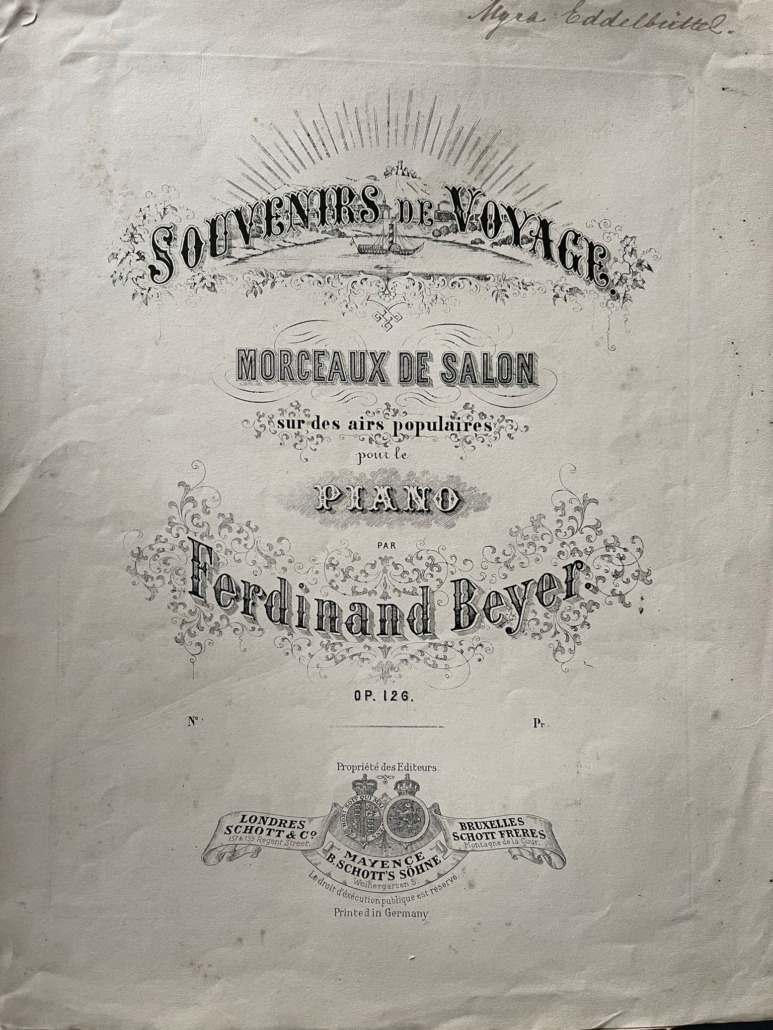
Souvenirs de Voyage. Morceaux de Salon sur des airs populaires pour le Piano par Ferdinand Beyer Opus 126. Schott à Londres – Mayence – Bruxelles. (Grazie a Luigi Bellofatto per avere messo a disposizione la partitura).
Ferdinand Beyer (Querfurt, 25 July 1803 – Mainz, 14 May 1863) was a German pianist and composer. Well known in his time for his piano arrangements of orchestral works and popular melodies, he is now primarily recognised for his method Preparatory School of the Piano, Op. 101. This is a collection of 106 simple piano exercises of gradually increasing difficulty, intended for beginner instruction. The text remains a key reference in piano pedagogy to this day.
(From Wikipedia, the free encyclopedia.)



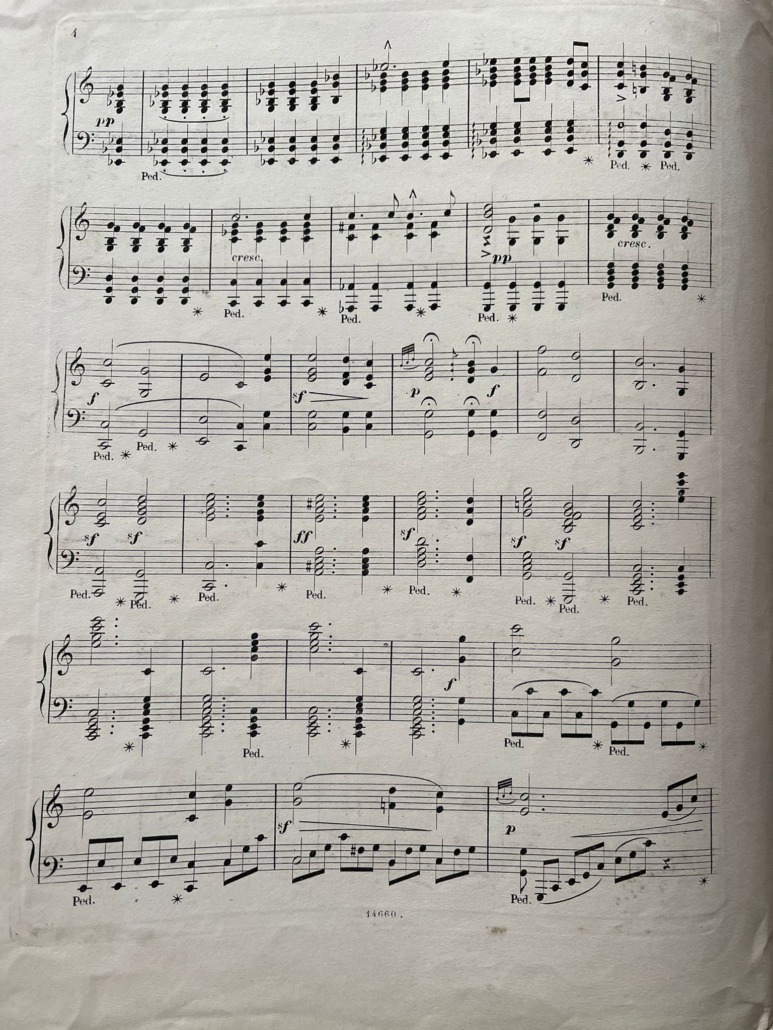

The Dream of Saint Jerome, Theme from the second of the Gellert Lieder, with variation on the theme. London, Cramer, Beale & Wood. (Wood & Co, Edinburgh, Glasgow & Aberdeen) New Piano-Forte Gallery, 209, Regent Street. (Dr. Luigi Bellofatto Collection)


L’Orfeo Moderno is a collection of vocal works for four male voices, intended to be sung a cappella and in chorus, with the option of doubling the vocal parts. The anthology gathers compositions by some of the most celebrated masters of the musical world.
The compilation and the Italian poetic adaptation were prepared by Cesare Paganini, author of the Canzoniere umoristico and of the lyrical collections I fiori, among others. The first book was issued in Florence at the Studio Paganini, Via degli Archibusieri No. 1269, and also circulated in Milan through the publishers Tito and Giovanni Ricordi.
The thematic material derives from the fourth Lied of Beethoven’s Opus 48, the cycle Six Songs on Poems by Christian Fürchtegott Gellert for voice and piano: I) Bitten – II) Die Liebe des Nächsten – III) Vom Tode – IV) Die Ehre Gottes aus der Natur – V) Gottes Macht und Vorsehung – VI) Busslied.
The page also includes an audio reader for consultation and invites scholars, musicians, and enthusiasts to contribute additional information, curiosities, or sources related to this work. Submitted materials—after verification by the Center’s curators—will be published together with the contributor’s name and source.
The texts and documents presented here are curated by Luigi Bellofatto, and have been reviewed by the Center’s editorial team. Anyone wishing to consult or request these resources may contact the author or the reviewers through the official contact form of the Beethoven Music Research Center.

