Pages

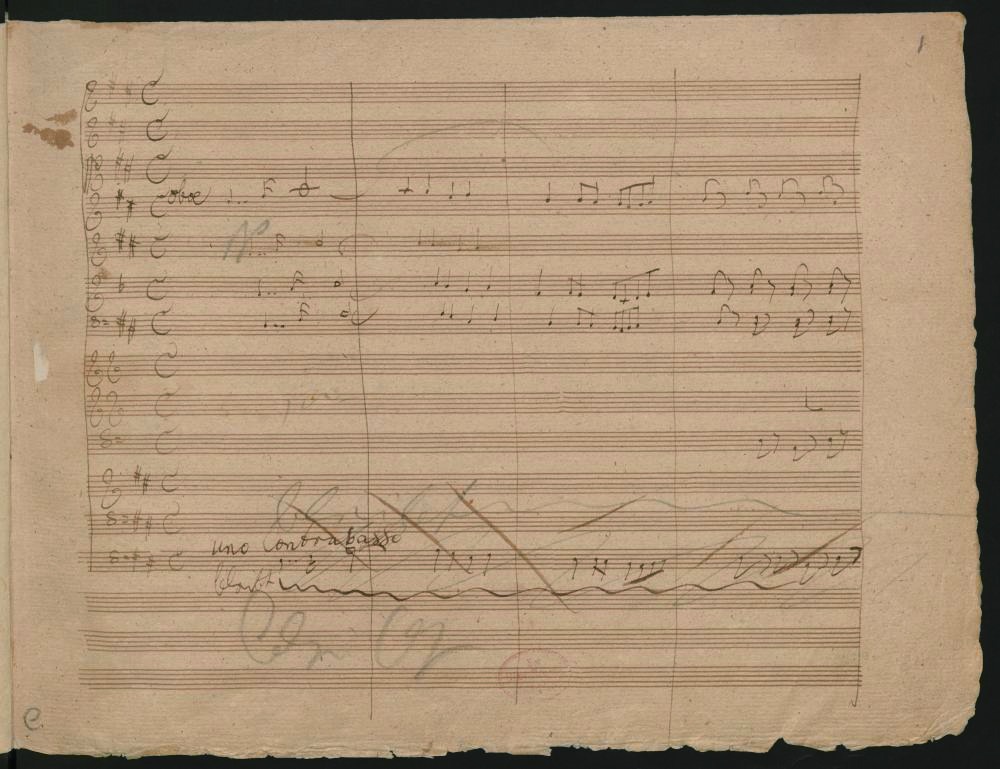
Unv.06 Hess 15 – Concerto in D major for piano and orchestra (Sketch)

Unv. 6 Hess 15 – Concerto in D major for piano and orchestra (Sketch)

Allegro con brio

Origin: Composed in the early months of 1815.

At the end of December 1814, Beethoven apologised to Archduke Rudolf for his prolonged absence, citing as an excuse the charity concert of 25 December 1814 and another planned concert (which ultimately did not take place), for which he had “einiges neue im werden” (“some new things to do”) (BGA 760). One of these new pieces was probably the unfinished 6th Piano Concerto, which, according to sketches, Beethoven began working on at the start of 1815. Most of the documented drafts and the autograph score pertain to the first movement of the concerto.

The reason why Beethoven did not complete the 6th Piano Concerto remains unclear. Lewis Lockwood suspects that Beethoven abandoned it when he realised that he would no longer be able to perform the concerto himself due to his hearing disability (Lockwood/Concerto, p. 626). He had already withdrawn from performing as a soloist some time earlier. It is possible that his motivation to continue composing diminished as the planned concert for which the piece was intended never came to fruition. Additionally, it can be speculated that Beethoven set the work aside due to concerns about its poor quality and lack of feasibility. Nicolas Cook proposes that structural difficulties may have been the reason for the incomplete composition. Even in the later stages of writing, Beethoven seemed uncertain about the form he wished to pursue: a piano concerto or a symphonic work in one movement (an overture?) with an obligatory piano part (Cook/Concerto).

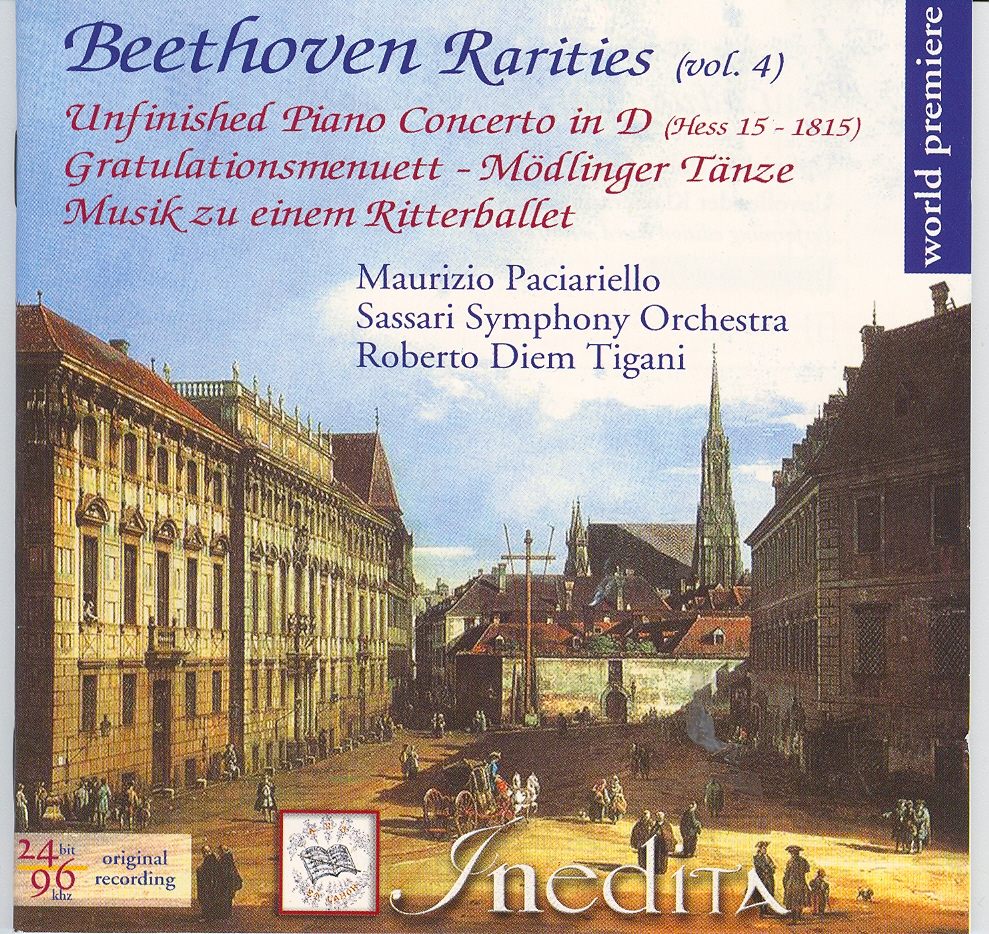
Cook’s performing edition of the first movement was first performed in 1987 at the University of Hong Kong and the Shanghai Conservatory (Cook/ConcertoEdition). The concerto was recorded by IneditaCD, our partner and supporter, in volume 4 of the series, conducted by the late Roberto Diem Tigani with the Orchestra of Sassari, and Maurizio Paciariello as the pianist.

Sketches and drafts:

  1. PL-Kj, Mus. SM. autogr. Beethoven Mend. stift. 6 (“Mendelssohn 6”), pp. 114-133. Dating: early 1815, facsimile: SBB, partial citations: Nottebohm/Beethoveniana II, p. 312, Cook/Concerto, p. 350, 352s.

  2. PL-Kj, Mus. SM. autogr. Beethoven Mend. stift. 1 (“Mendelssohn 1”), pp. 4-6?, 7, 9. Dating: around February 1815, facsimile: SBB, partial citation: Nottebohm/Beethoveniana II, pp. 314f.

  3. US PR Scheide (Dpt. in: PRu), M. 130 (“Scheide”), pp. 1, 3-32. Dating: around March 1815, partial transcriptions: Nottebohm/Beethoveniana II, p. 321f, Lockwood/Concerto, p. 643.

  4. RE-B, Mus. SM. autogr. Beethoven Landsberg 10, pp. 79-82. SBB/, partial transcription: Lockwood/Concerto, p. 635, 642.

(5) GB-Lbl, Add. Ms. 29997, pp. 4lr-42r.

(6) D-B, Mus. SM. autogr. Beethoven Grasnick 20b, pp. 21r-23r. SBB, partial transcription: Lockwood/Concerto, pp. 637, 642.

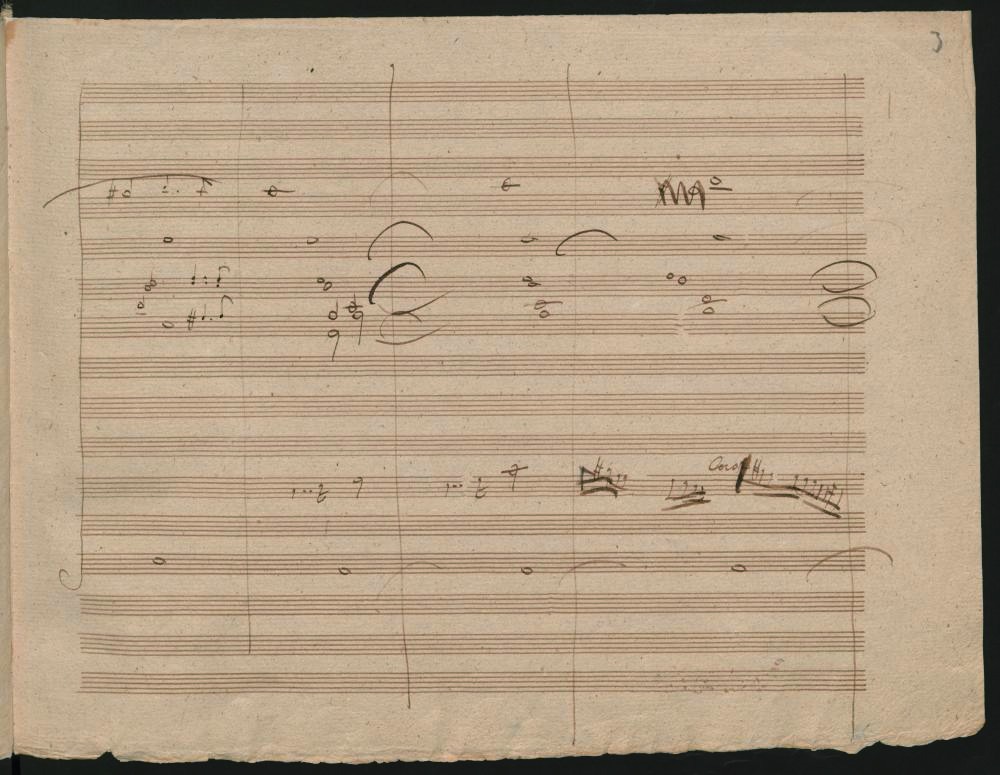
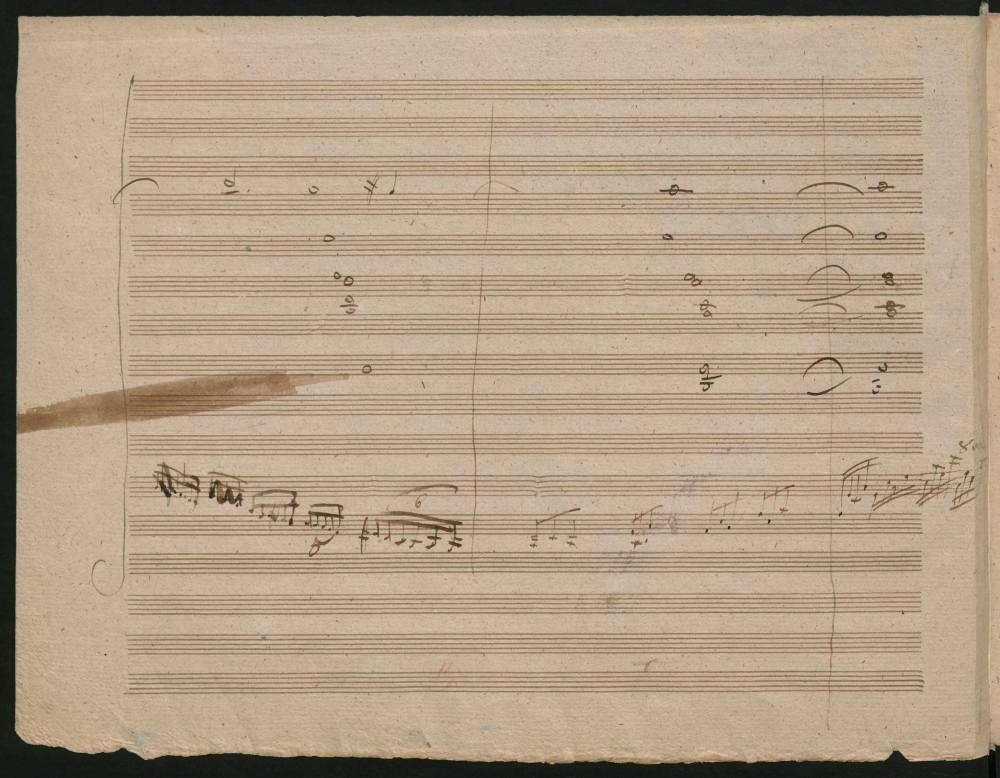
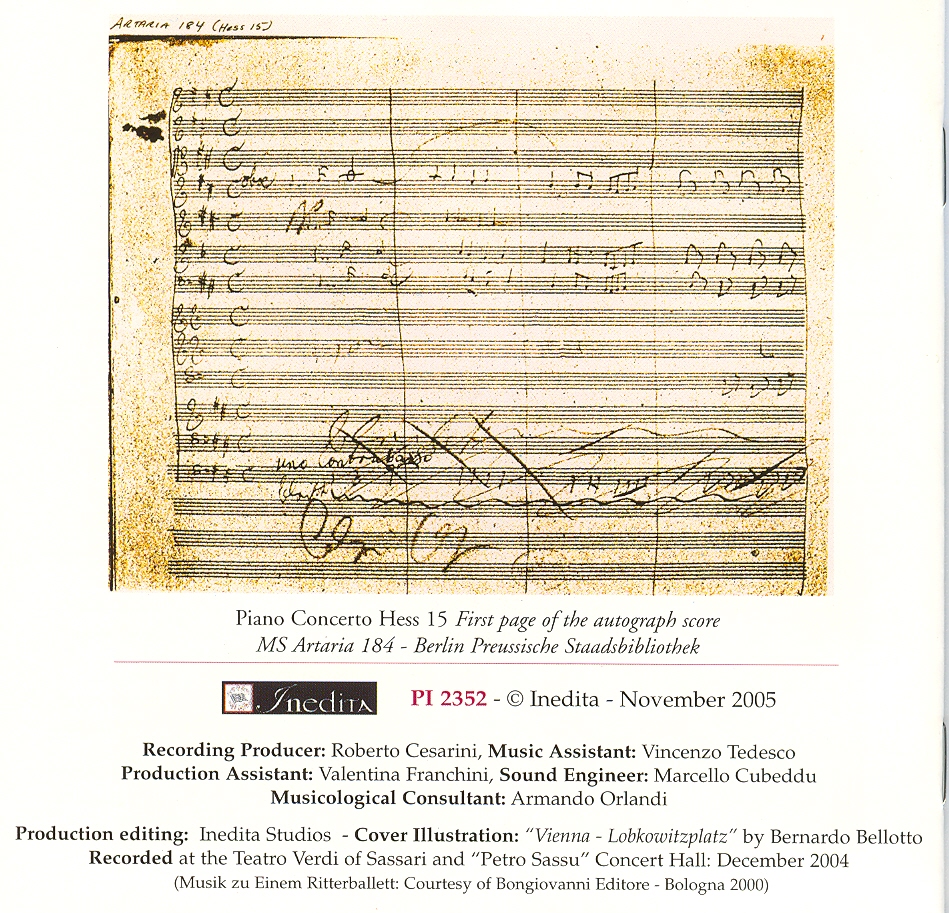
Autograph score, 1st movement, measures 1-256: D-B, Mus. SM. autogr. Beethoven Artaria 184. Complete autograph, ends at measure 256; the order of sheets has been altered, some may have been added (Johnson/Artaria, p. 226, Cook/Concerto, p. 362f, and Roberto Diem Tigani).

Form: 30 sheets; 57 pages of musical text. Sheets 1r-30v, Sheets 14 and 18v are blank. Dimensions: 23.5 x 31.5 cm. Two types: (a) pp. 1-40 and 53-56: 16 lines; (b) pp. 41-52 and 57-60: 14 lines.

Provenance: Purchased by Domenico Artaria at auction no. 65 in 1827. Artaria Publishing House, Vienna. – Erich Prieger, Bonn, from 1897. – Acquired in 1901. Facsimile: SBB. Descriptions: Bartlitz/Catalogue. – Cook/Concerto. Correspondence references: BGA 760.

Bibliography: Cook/Concerto. – Cook/Concerto Edition. – Lockwood/Concerto. – Lockwood/Problems, pp. 44-46. – Nottebohm/Beethoveniana II, pp. 223 and following.

Unv.11 – Hess 46 Sonata in A major for piano and violin (fragments)

Unv.11 – Hess 46 Sonata in A major for piano and violin (Fragments)

Allegro (fragment) – Adagio (fragments) – Rondo (?) fragments
Musical examples by Graziano Denini and Albert Willem Holsbergen

Unv. 11 (Hess 46) Sonata in A major for piano and violin, 1783, Hess 46 Sch. page 172.

Rather discontinuous fragments, contained in three sheets (the last with only seven and a half bars) currently preserved in the Deutsche Staatsbibliothek in Berlin. Described by Thayer – Riemann (I, page 171), published by Willy Hess in the ninth issue of the Supplemente zur G.A., 1965).

Origin and publication: probably composed in 1790/91. The first edition of the fragment appeared in 1965 as part of the SBG at Breitkopf & Härtel in Wiesbaden. (edited by W. Hess)

Of this sonata only 37 bars of a middle section of a slow Movement or a Minuet with a Trio in minor and 54 bars of a Rondo are preserved, and unfortunately it’s missing the main theme too. In any case, even if it has come down to us, Beethoven probably did not complete this work (Brandenburg / Op. 12 p.6f). Douglas Johnson dates the paper and manuscript of the autograph score to 1790/91 (Johnson / Fischhof Vol. 1 p. 264).

The authenticity of this composition was questioned for a long time. Willy Hess included this fragment of the Sonata in the SBG DC as a work “of unproven authenticity”. Hermann Deiters had already assumed that the source was a transcription and not an autograph (TDR I, p.117 note 1), Ludwig Schiedermair also doubted its authenticity (Schiedermair / Jung Beethoven p 172). Thanks to the investigations of Douglas Johnson and Hans-Günther Klein, these doubts have been dispelled since the early 1980s (Johnson / Fischhof Vol. 1 pp. 259-264, Klein / Autograph p. 116).

Autograph score, 37 and 54 bars: D-B, Mus. ms. autogr. Beethoven Artaria 131. Appearance: 3 sheets (single and double sheets); 5 Score Pages: Lr/v Pages & 2r-3r Sheets, Blank 3v Sheet. Paper: landscape, 23 x 31.5 cm, 10 pentagram lines. Provenance: Possibly sold at auction in the “Beethoven Succession” in 1827 as lot number 136 and purchased by Johann Wolfmayer. Artaria Archive, Vienna, Then to Eric Prieger, Bonn, 1897. Purchased in 1901. Facsimile SBB/Microfilm. Notes in Brandenburg, Op.12, Johnson/Fischhof Vol. 1 p. 259-264, Kramer, Op.30 page 48.

It is a Sonata that has come down to us in a fragmentary way: two sheets containing parts of the first Movement and the Finale, probably torn from a larger work of which they could have been part, since there is also a sketch of 13 bars for solo piano with a refrain for a second movement. Willy Hess certainly affirmed this thesis and published the sonata in 1965 dating it to 1783 but, more recently, Barry Cooper has dated it approximately between 1790 and 1792. If the thesis that it is a complete Sonata is correct, then it would be the first of its kind for Beethoven. In 1998, Albert Willem Holsbergen, a Dutch musicologist and composer, made a real completion.

In 2005 violinist Rachel Barton Pine performed these fragments at a live concert in Chicago. (If you want to listen to the recording it is present on this page)

“Notes in the Dark” – suggestions and comparisons for quality Beethoven listening

With a slide of the recordings mentioned in the article – By the YouTube channel SecondAVitA


Unv.20 – The “Lamentations of Jeremiah”

Unv.20 – The “Lamentations of Jeremiah”

Study of figured basses found on page 96 recto of the “Kafka Sketchbook” Fourteen staves, all written in double clef. (with research by Graziano Denini)

On staff 8 Beethoven writes H‑Moll (B minor), then G‑Dur (G major). Further on one reads “bejm Simonetti” and “und Delombre.” The handwriting is bold, in black ink, yet precise. Few erasures, bass clefs typical of the late 1700s, note stems turned in the characteristic Beethovenian manner.

Folio 96 verso is completely blank, very worn, and stained with black ink.

The group of preceding leaves, from 90 recto to 95 verso, contains the Piano Fantasia Biamonti 213, attributable to the period 1788–1789.

Not a true independent work, but a study in figured bass. Thus, determining the dating of these pages is difficult; they could belong to a rather broad period, from 1785/6 to 1790/92.

See also the study by Schmidt‑Görg, “Ein neuer Fund in den Skizzenbüchern Beethovens: die Lamentationen des Propheten Jeremias”, B‑Jahrbuch III (1959), pp. 107–110.

The discoveries of Prof. Schmidt‑Görg may be summarized as follows:

Wegeler recounted an anecdote concerning Beethoven’s days as assistant organist of the Electoral Chapel in Bonn, when he had to accompany the tedious Lamentations during Holy Week. The young composer asked a singer (Heller) whether it might be possible to create unusual harmonizations of the liturgical chant and, having obtained his consent, began to study them. The sketches on page 96 must be the preparatory studies for this chant.


Beethoven mentions, among others, two singers of the Bonn Chapel: not Heller, the singer of the anecdote, but Simonetti and Delombre. To complicate the dating further, Simonetti worked in Bonn only from 1790 onward. The anecdote and the leaf could therefore have been conceived together for a Holy Week between 1790 and 1792 (Thayer inclines toward 1790).

Wegeler’s assertion that a piano was used—customary during Lent—is confirmed by the word “Knie” (“knee”) written at measure 12. Knee‑levers were associated with the pianos of the time, not with organs.

The cantus firmus studied by Beethoven differs slightly from the version given by Schindler (see Schindler, Beethoven, p. 41). The last three measures contain an acrostic of Hebrew letters (see description below).

Thus sketched in Bonn for Holy Week 1790, 1791, or 1792. The paper of the sketch leaf is from the Bonn period (Johnson/Fischhof vol. 1, pp. 247–251).

Fundamental for dating is the mention of the two singers “bejm Simonetti / und / Delombre.” Ludwig Simonetti is listed in the documents of the Bonn court chapel from 1790 to 1794; Christian Hubert Delombre from 1779 to 1796 (Braubach/Hofka p. 53).

In his memoirs, the master baker Gottfried Fischer lists both court tenors as “the said friends who spent their time with Hr. Joh. v. Beethoven and his son Ludwig v. Beethoven, often visiting […]” (Wetzstein/Bäckermeister p. 126).

A much‑quoted anecdote by Franz Wegeler reports that the liturgically prescribed Lamentations were also sung during Holy Week at the court of the Archbishop‑Elector of Cologne (according to Schmidt‑Görg: “Lamentationen in stillen Metten um sechs Uhr abends”):

In the Catholic Church, during three days of Holy Week, the Lamentations of the Prophet Jeremiah are sung. These consist of small sections of 4 to 6 lines and were performed, though according to a certain rhythm, as chorales. The chant consisted of four successive tones, e.g., c, d, e, f, on which several words, even entire sentences, were sung, until a few notes at the end returned to the fundamental tone. Since the organ must remain silent on these three days, the singer is accompanied freely only by a keyboard player. When this duty once fell to our Beethoven, he asked the very pitch‑secure singer Heller whether he would allow him to ‘throw him off,’ and used the somewhat too hastily granted permission in such a way that, through deviations in the accompaniment—although Beethoven continued to strike the sustained tone with his little finger—the singer lost the pitch so completely that he could no longer find the final cadence. The then music director of the Electoral Chapel and first violinist, Father Ries, still recounts in detail how astonished Kapellmeister Luchesi was by Beethoven’s playing. Heller, in the first outburst of anger, complained to the Elector, who, although amused by the spirited and at times mischievous young man, nevertheless ordered a simpler accompaniment.

In place of the organ, it was arranged that the singer be accompanied by a piano.

Besides the names of the singers, beneath a series of repeated quavers Beethoven notes “mit dem knie” (“with the knee”), i.e., with the knee‑lever. Keyboard instruments of the time had this feature.

Given the length of the texts, it is entirely plausible that Heller, Simonetti, and Delombre shared this duty.

The leaf also shows that Beethoven did not improvise the accompaniment freely, but prepared it in advance, establishing the Gregorian melody with figured‑bass patterns, usually given according to the Graduale Romanum.

The Lamentations (also Jeremiads, Vulgate Lamentationes Jeremiae, Septuagint Threni) are written in a book of five poems (chapters) in the Old Testament recounting the destruction of Jerusalem and the First Temple by the Babylonians in 586 BC. The author is anonymous, but according to Jewish tradition the Lamentations are attributed to the prophet Jeremiah.

In the liturgy of the Roman Catholic Church, the Lamentations are read in the night office (Matins) on Holy Thursday, Good Friday, and Holy Saturday.

Sketches: GB‑Lbl, Add. Ms. 29801 (“Kafka”), fol. 96r. Facsimile and transcription: Kerman/Kafka.

Bibliography: Kramer/Education (especially pp. 72–86). Schmidt‑Görg/Lamentationen.

Additional Research by Graziano Denini

Denini describes his attempt to locate the Gregorian chant corresponding most closely to Beethoven’s minim notes in the first staff. He found a YouTube recording with matching melodic contour and a written Gregorian notation corresponding to chapter 2 of the Lamentations. He transcribed the chant onto staff notation, adjusting pitch to match Beethoven’s notes, modifying discrepancies according to Beethoven’s line.

He then copied Beethoven’s outer voices, added figures and Kerman’s indications, and inserted his own observations (marked with an asterisk). In the second part he juxtaposed the bass notes with the rhythmic chant, maintaining the incipit and HETH, and completed the inner voices following the figures and contrapuntal rules. He notes that HETH and TETH in the chant correspond perfectly to Beethoven’s notes.

A detailed analytical commentary follows, measure by measure, on the correctness of the figures relative to the chant.

Liturgical Context

In the Roman Catholic liturgy, the readings for the first Nocturn of the Triduum Sacrum (Holy Thursday, Good Friday, Holy Saturday) consist of the Lamentations of Jeremiah. They are among the most important sung texts of Holy Week, often set polyphonically by major composers from the 15th century onward.

The Concilio di Trento standardized the selection of verses. A detailed list of the readings for each day is provided, including the famous Incipit Lamentatio Jeremiae Prophetae and the Oratio Jeremiae.

A distinctive feature is the appearance of Hebrew letters (Aleph, Beth, Gimel, etc.) at the beginning of each verse, reflecting the acrostic structure of the Hebrew original—also present in Beethoven’s sketch.

Each reading ends with “Jerusalem, Jerusalem, convertere ad Dominum Deum tuum.”

A historical overview follows of the tonus lamentationum, its medieval variants, the post‑Tridentine standardization, and the survival of the ornate Spanish tone used for the Oratio Jeremiae.

Reference is made to a monophonic English setting by John Tuder (15th century), a paraphrase of the Roman tone.

A list of other composers who set the Lamentations is provided: Tallis, Byrd, Vallotti, Durante, Alessandro Scarlatti, Jommelli, and others.

The “Lamentations of the Prophet Jeremiah”, texts and music by other authors

Thomas Tallis, William Byrd, Francesco Antonio Vallotti, Francesco Durante, Alessandro Scarlatti, Niccolò Jommelli and others.

Unv.22 – Hess 149 – Rastlose Liebe, Sketch of a Song for Voice and Piano

Unv. 22 – Hess 149 – Rastlose Liebe. Text by Johann Wolfgang von Goethe. Sketch of a song for voice and piano.

Hess 149 – (Unv. 22) Rastlose Liebe.
Text by Johann Wolfgang von Goethe. Sketch of a song for voice and piano, 1800–1810. An incomplete facsimile was published by Elsa Bienenfeld in the Neue Wiener Journal on 27 March 1927.

Continuous sketches for a Lied on Goethe’s text Rastlose Liebe (1800–1810). [The sketches for this song were found alongside some of those for Erlkönig from 1796.] The melody is written out in full, while the refrains are only sketched. Jean Chantavoine published a completion in La Revue Musicale – Publication Mensuelle, II, H. Welter, Paris 1902, pp. 409–414. An incomplete facsimile was published by Elsa Bienenfeld in the Neue Wiener Journal on 27 March 1927.

[According to Mark Zimmer, “The sketches are currently held in Berlin, as part of the Fischhof Miscellany, and in Vienna in manuscript A 67 of the Gesellschaft der Musikfreunde. Gustav Nottebohm suggested that these sketches could have been composed at any time between 1800 and 1824. Douglas Johnson, however, verified that they were written on paper Beethoven used in Prague in early 1796. The sketches from the Fischhof Miscellany were published in transcription by Douglas Johnson in Beethoven’s Early Sketches in the Fischhof Miscellany: Berlin Autograph 28, 2 vols., Ann Arbor, Michigan, 1980, pp. 1222–5.

There are, in a sense, three complete continuous sketches of this Lied — quite different melodically, yet consistent in their overall conception. I say ‘in a sense’ because Beethoven wrote only one continuous sketch, but with his characteristic corrections written over it. Nevertheless, Douglas Johnson managed to decipher all the erased notes and concluded that there are three versions written one over another (or, if you will, worked on by Beethoven on three separate occasions). In his transcription, Johnson published all three versions, while preserving the layout of Beethoven’s original manuscript. Johnson hypothesises that this Lied was written for Countess Josephine de Clary, for whom Beethoven had composed the mandolin pieces WoO 43 and 44, using the same type of paper.” If a finished version by Beethoven ever existed, no trace of it has been found.]

Dem Schnee, dem Regen,
Dem Wind entgegen,
Im Dampf der Kluefte,
Durch Nebelduefte,
Immer zu! Immer zu!
Ohne Rast und Ruh’

Lieber druch Leiden
Moecht’ ich mich schlagen,
Also so viel Freuden
Des Lebens ertragen.
Alle das Neigen
Von Herzen zu Herzen,
Ach, wie so eigen
Schaffet das Schmerzen!

Wie, soll ich fliehen?
Waelderwarts ziehen?
Alles vergebens!
Krone des Lebens,
Glueck ohne Ruh’
Liebe, bist du!

Beethoven made the first sketches at the beginning of 1796. In 1823 he planned to resume work on the piece, but no sketches from that period have been traced.

These sketches were produced early in 1796, though there may have been earlier drafts. Douglas Johnson considers it possible that Beethoven worked on the songs Rastlose Liebe and Erlkönig (WoO 131) at the request of Josephine von Clary-Aldringen, for whom he may also have written Op. 65 (Johnson, Fischhof, vol. 1, p. 460).

On 8 February 1823 Beethoven informed Goethe of his plan to publish some of Goethe’s poems in the near future:
„Es dörften bald vieleicht mehrere ihrer immer einzig bleibenden Gedichte in Töne gebracht Von mir erscheinen, worunter auch ,Rastlose Liebe‘ sich befindet, wie hoch würde ich eine Allgemeine Anmerkung überhaupt über das komponiren oder in Musick sezen ihrer Gedichte achten!“ (BGA 1562).
(“It may perhaps soon happen that several of your ever-unique poems will appear set to music by me, among them Rastlose Liebe; how highly I would value a general comment from you on the setting of your poems to music!”)

Consequently, around 1823 Beethoven appears to have been re-engaged with older drafts of songs on Goethe’s texts, as also evidenced by the sketches for the song Heidenröslein (Unv. 23), on which Beethoven again worked between 1818 and 1823—also left unfinished.

The poem by Johann Wolfgang von Goethe (1749–1832) was written in 1776. It was printed in Vol. 8 of Goethe’s Schriften (Leipzig, 1789, p. 1470), from which Beethoven probably took the text for Erlkönig (see the unfinished works WoO 131).

Sketches:
(1) D-B, Mus. SM. autogr. Beethoven 28 (“Fischhof”), page I4r.
Dating: 1796.
Facsimile: SBB.
Transcriptions: Chantavoine/Beethoveniana; Johnson/Fischhof vol. 2, pp. 159–162.

(2) A-Wgm, A 67, fols. 1r–2r.
Dating: early 1796.
Transcriptions: Chantavoine/Beethoveniana; partial transcription in Johnson/Fischhof vol. 2, pp. 159–162; Nottebohm/Beethoveniana II, p. 575.

Document: letter BGA 1562.

Bibliography:
Bienenfeld/Unv. 22 – Chantavoine/Beethoveniana – Johnson/Fischhof vol. 1, pp. 458–460 – Johnson/Tour 1796.

Unv.15 – Hess 115 – Vestas Feuer, First Scene of an Opera by Schikaneder

Unv. 15 (Hess 115) – Vestas Feuer, first scene of an opera by Schikaneder, soloists (soprano, two tenors and bass) and orchestra


Hess 115 – Vestas Feuer, first scene of an opera by Schikaneder, soloists (soprano, two tenors and bass) and orchestra, 1803, completed and published by Willy Fless, Wiesbaden, Bruckner Verlag (now Alkor Édition, Kassel), 1953. H. 115 – T. 266.

The autograph manuscript of the fragmentary vocal piece known as Vestas Feuer is today preserved in the archive of the Gesellschaft der Musikfreunde in Vienna. It was originally part of the so, called “Beethoven estate”, a collection of the composer’s papers auctioned on 5 November 1827. The manuscript was described at that time as a “Pezzo di canto con orchestra, compiuto ma non interamente strumentato”,  a vocal piece with orchestra, complete but not fully orchestrated. Alexander Wheelock Thayer, in his foundational catalogue of Beethoven’s works, mentions the piece without assigning a date, referring to it as a “Terzetto vocale: Volivia, soprano; Sartagone, tenore; Poro, basso: manoscritto incompiuto, in possesso della Musikverein a Vienna”.

Gustav Nottebohm published both the text and the first thirty-five bars of the closing section — the actual trio — in the first volume of Beethoveniana, proposing that it could be the finale of a larger work, perhaps an opera or a Singspiel. He suggested that the libretto might be by Emanuel Schikaneder, the theatrical impresario and librettist best known for Die Zauberflöte, and that Beethoven had been asked to set it to music around 1803. In a later publication, Nottebohm returned to the topic and observed that sketches for the aria “Hort, Rachegötter, mich” followed the trio. On this basis, he retracted the earlier theory of it being a finale, though he continued to believe that both fragments came from the same dramatic project,  a work for the Theater an der Wien that Beethoven had begun before he turned his attention to Fidelio.

Thayer, in a later expansion of his work with Hermann Deiters and Hugo Riemann, put forth a different hypothesis. He imagined that Schikaneder had commissioned a second opera from Beethoven titled Alessandro, set in India, as a thematic or symbolic continuation of the inaugural production staged at his new theatre two years prior. Yet it wasn’t until 1930 that the matter was finally clarified. That year, Raoul Biberhofer discovered in the Österreichische Nationalbibliothek a complete manuscript of Vestas Feuer, a large-scale two-act opera written by Schikaneder. Thanks to this find, scholars were able to confirm with certainty that Beethoven’s music belonged to the opera’s opening scene, and that the additional sketches pertained to an aria from the second act.

The historical context of this unfinished collaboration sheds light on its abrupt abandonment. In the early 1800s, Schikaneder was seeking to compete with the imperial court theatres and the growing popularity of French opera in Vienna. To this end, he recruited two composers for his new operatic venture: the rising young Ludwig van Beethoven, whose fame and promise were increasing rapidly, and the 54-year-old abbé Georg Joseph Vogler, a respected operatic composer, organist, pianist, and theorist.

Beethoven was likely approached in the early months of 1803 and invited to compose Il Fuoco di Vesta (Vestas Feuer). However, it soon became apparent that he was uncomfortable with the task. The libretto, with its convoluted Roman setting and overwrought plot, did not appeal to his aesthetic or dramatic sensibilities. Moreover, Viennese audiences were turning their attention to the so-called Rettungsopern, “rescue operas”, of French origin, which emphasised realistic conflict, moral resolution, and the triumph of liberty and justice over oppression. These themes were considerably more compelling than exotic heroism or implausible dramatic twists.

Beethoven’s dissatisfaction is directly evidenced in a letter dated 4 January 1804, addressed to Johann Friedrich Rochlitz. In it, the composer declines a proposed opera libretto on the grounds that it “had to do with magic”, adding that he regretted this refusal even more because “a new libretto could deliver me, at this precise moment, from an extremely embarrassing situation.” He continued: “I have broken definitively with Schikaneder, whose empire has, in truth, been completely eclipsed by the light of the brilliant and seductive French operas. Meanwhile, he held me captive for six whole months… I have thus cancelled all agreements with him, even though I had already composed several pieces. Imagine a Roman subject (of which I had been told neither the general plan nor any details), and a language and verses that could have come straight from the mouths of our Viennese Aepfelweiber.” He concluded that he had quickly adapted an old French libretto and had begun work on that instead.

The matter soon resolved itself. At the beginning of 1804, the Theater an der Wien was purchased by Baron von Braun, who removed Schikaneder from his position as theatre director. This development liberated Beethoven from his obligations to the project. Schikaneder subsequently handed the libretto to Joseph Weigl, Kapellmeister of the court theatre, who composed a complete setting in short order. The opera premiered on 10 August 1805 — only a few months before the first performance of Fidelio — and was repeated several times before disappearing from the repertoire. To our knowledge, Vestas Feuer has never been revived. The complete libretto was later published by Willy Hess.

The plot is as elaborate as it is unlikely. Volivia, daughter of the Roman nobleman Poro, is secretly in love with Sartagone, the son of her father’s mortal enemy. Malo, a slave of Poro who is also in love with Volivia, reveals the affair. Guided by Malo, Poro observes the couple’s meeting, during which they vow eternal love. When discovered, Volivia and Sartagone plead for forgiveness, and Poro eventually relents. However, Malo, in league with the tribune Ponteo, denounces Poro before the decemvir Romenio, claiming that he and Volivia were abducted as children and brought to Rome as slaves, and that Volivia is in fact his sister. Romenio, the third and most dangerous of Volivia’s suitors, has already cast off the noble Sabine Sericia to pursue her. On the advice of Ponteo, who desires Sericia for himself, Romenio sends Poro and Sartagone away on military missions and orders Volivia held in his palace until the matter is judged within three days. Hoping to win her in the meantime, Romenio faces an uprising from the people, who resist the guards attempting to seize Volivia. The Augurs intervene and decree that she must be consecrated as a Vestal. Though Romenio storms the temple, extinguishes the sacred fire, and wreaks destruction, Volivia escapes. After further complications, including the return of Poro and Sartagone and a people’s revolt, Romenio finds Volivia again. She is pursued by Malo, who threatens to kill her unless she submits to him. Romenio captures Malo and has him thrown bound into the Tiber. Believing the woman is finally his, he is instead stabbed by Sericia, who has also become a Vestal. In this final act of vengeance and redemption, the villains are vanquished, peace is restored, and the sacred fire of Vesta rekindles itself miraculously. The final chorus unites Poro, Sartagone, Volivia, Sericia, the Vestals, the Augurs, and the people in a hymn of thanksgiving to the gods.

Beethoven’s contribution to the project consisted of four episodes, comprising a continuous dramatic scene. The first, Blick, o Herr, sees Poro and Malo secretly watching the lovers; the orchestra whispers beneath Malo’s words, while Poro replies darkly. Their tension is briefly captured in a short duet. The second episode is a lyrical duet, Liebe Freundin, lebe ivohl!, in which Volivia and Sartagone bid each other farewell, swearing eternal love in a tender Andante molto cantabile. The melody alternates between voices before briefly uniting them, only to be interrupted by Poro’s sudden entrance. The third episode, Dein Vater war mein Feind, is more dramatic: Poro threatens his daughter and her lover, while the two plead desperately. Sartagone, facing Poro’s implacability, draws his sword to end his life, but is stopped by a joint cry of Halt ein! from father and daughter. The orchestra comments briefly on Poro’s inner turmoil, and finally, his anger is overcome he forgives the lovers. As Malo cries in despair, Web mir! Sie ist dahin. Für mich ist sie ewig hin!, the orchestra rises in an animated crescendo.

The final episode is a trio: Nie war ich so froh wie heute, sung by Volivia, Sartagone, and Poro, celebrating their union and peace. The piece foreshadows the duet O namenlose Freude from Leonora (later Fidelio), both in tone and musical style. However, the score remains unfinished.

The manuscript includes some minor gaps in the vocal lines and the string parts. While the wind instruments are meticulously listed on the title page: 2 flutes, 2 oboes, 2 clarinets, 2 bassoons, 2 pairs of horns in G and E♭ (used alternately depending on key), their actual parts are almost entirely missing. These gaps, as well as those in dynamic markings, expression, articulation, and even musical orthography, were filled in by Willy Hess in his 1953 edition, which includes a historical introduction and full documentation of his editorial decisions. He also produced a piano–vocal reduction.

Vestas Feuer remains an intriguing relic of a project abandoned, a project which, had Beethoven seen it through, might have become his first opera. Instead, it was the failure of this very libretto that eventually led him to a better one: Leonore, and its final incarnation as Fidelio.
Unv.21 – Hess 151 – Traute Henriette, Sketch of a Song for Voice and Piano

Unv. 21 (Hess 151) – Traute Henriette, sketch of a song for voice and piano

((previously Hess 151)


Hess 151 – Traute Henriette, sketch of a song for voice and piano, 1792-1793, published in Vienna, Österreichische Musikzeitschrift, 1949, issues 1 and 2, by Adolf Erler, and in a critical edition, with citation of other preparatory sketches by Willy Hess in the fifth issue of the Supplemente zue G.A. 1962.

Text by unknown author.

Traute Henriette, holdeste brünette,

hast du Lieb für mich?
Heit’re mein Gemüte,
sänft’ge mein Geblüte!
Mädchen, liebe mich,
liebe mich!

os van der Zanden dates this sketch to around 1792-1793. Almost complete sketches of this lied may have been composed in the early period in Vienna and are in the possession of the Wiener Stadtbibliothek (no. 383 of the catalogue of the exhibition held in Vienna in 1927 on the occasion of the centenary of Beethoven’s death – “Beethoven-Zentenar-Austellung der Stadt Wien, 1927) [These sketches are currently catalogued as SV 392.] Adolf Erler rearranged these continuous sketches and published them in «Österreichische Musikzeitschrift», IV (1949) (parts 1 and 2). Cf. Adolf Erler’s reference in “Ein Lied aus Beethovens Friihzeit”; cf. also the reference to p. 23-5. [A more recent edition was published by Hess in SBG, volume. V, 1962, p. 14.]

The continuous sketches of the Lieder catalogued here from nos. 148 to no. 151, as well as the numbers 129-131, should be included in the edition of the new Gesamtausgabe because these sketches are at a stage of work in which they already convey a complete artistic idea. On the other hand, we have no longer included, for example, under the number Hess 262 (second edition of the Hess catalogue), the sketches of the lied “Wehrmannslied” (Soldier’s Song) by [Heinrich Joseph von Collin, Hess 115c (third edition of the Hess catalogue). The citation of all the sketches of Beethoven’s Lieder by name would be beyond the scope of this catalogue and would have to be the subject of a separate work.

Beethoven corrects the sketch a little (some chords were originally not in thirds but in fifths, just as the first of the basses was in D. Later several measurements were revised into voids left on the sketch sheet: measures 17-22 were erased. The last addition is the revision of bars 18 – 20 (Piano, right hand and voice).

Beethoven sketched a large part of the piano of this lied with the text annotated underneath without finishing it. Willy Hess, Giovanni Biamonti and, more recently, the musicologist Jos van der Zanden date it back to the period 1792/93 but, the very latest trends, date it to the period 1790/92. The text, according to Willy Hess,  is by an unknown author but, in reality, is taken from Ludwig Christoph Heinrich Hölty’s poem  “An Henrietten” published in the poetry editions “Sämtlich hinterlaßen Gedichte” (“Everyone leaves poems”), in 1782. According to Giulia Giachin it is one: “(…) cantilena (…) almost like a barcarola in its popular 6/8 (…)»[1]

[1] Giulia Giachin: Beethoven’s Lieder. Edizioni dell’Orso