
Posts

Pages

A stolen Beethoven letter and its connection to Beethoven’s grand‑nephew Ludwig Johann van Beethoven – James F. Green

A Stolen Beethoven Letter and its Connection to Beethoven’s Grand-nephew Ludwig Johann Van Beethoven

Presented at “Musicology after Beethoven. XVII International Congress of the German Musicological Society (GfM)” by James F. Green

On July 9, 2011 a member of the staff of the Maryland Historical Society in Baltimore saw Jason Savedoff take a document out of the Society’s library. The police were called. They found 60 documents hidden in Savedoff’s lap-top computer case in a locker, several of them having been signed out by Barry Landau.

In addition to the lap-top computer they each had oversized pockets sew into their jackets in order to hide stolen documents.

Once the pair of criminals were arrested it became necessary for the police to determine the scope of their criminal activity. Since the pair were arrested in Maryland and their residences were in New York it became a Federal crime not just a local theft. The Baltimore police alerted the Federal Bureau of Investigation (FBI), that the theft may have crossed state lines. The FBI arranged for a search warrant for Landau’s New York apartment. They were not prepared for what they found. The found more than ten thousand pieces of Presidential memorabilia ranging from campaign buttons to menus for State Dinners. They also found important historical documents, like letters from Thomas Jefferson, Abraham Lincoln, Benjamin Franklin even Sir Isaac Newton. The thefts had been going on for years. Not just the historical societies of New York, Pennsylvania and Maryland, but the Library of Congress and the Franklin Roosevelt Presidential Library in Hyde Park. The seized materials were sent to the Office of the Inspector General of the National Archives for sorting out. Slowly the owners of the stolen items were being identified. Most of the institutions did not know that the items were missing. A thousand more items would be quickly traced to Historical Society collections and Presidential libraries up and down the east coast of the United States. The two men were jailed in Baltimore and indicted by a Federal Grand Jury in late July of 2011. Both defendants pleaded guilty; Savedoff in October 2011 and Landau in February 2012.

On June 27, 2012 Landau was sentenced to seven years in prison by Federal District Judge Catherine Blake. In commenting on the sentencing US attorney Rod J. Rosenstein said: “The evidence proved that Barry Landau was a con artist who masqueraded as a presidential historian to gain people’s trust so he could steel their property, the revelation that Mr. Landau was a prolific thief sent a wake-up call to museums, libraries and other institution that entrust valuable historical items to persons who claim to be engaged in academic research.”

Barry Landau (born 1948) is a noted collector of presidential artifacts, the author of “The Presidents Table” published in 2007 and “self-styled” American Presidential Historian. Landau showed off some prized pieces of his collection on the Martha Stewart Show. He also served as a commentator on CNN and NBC’s Today Show.

While all of this was playing out in a Federal Court in Baltimore I was working on a design job for a client, Michael Cunningham and his wife. Michael Cunningham was an assistant prosecutor for the Justice Department and he was working on the case with lead prosecutor Rod Rosenstein. While on a visit to the Cunningham’s house, Michael  mentioned the arrest and prosecution to me. He was quite surprised when I replied that I had met Barry Landau at the White House several years earlier when he came to look at designs that I had helped prepare for a State Dinner. I was then surprised to learn from Cunningham that one of the letters stolen from the Historical Society of Pennsylvania in Philadelphia was written by Beethoven (this had not been mentioned in the news reports). I thought this story would make an interesting article and asked Cunningham if he could get me more information about which Beethoven letter had been stolen. Cunningham told Rosenstein of my interest and arranged not only to get a photocopy of the letter, but to also go to the National Archives and inspect it myself. Normally no one outside of the prosecuting or defense attorneys is ever anyone allow to see evidence in a criminal prosecution. How lucky was I, as a Beethoven researcher, to be given such privileged access.

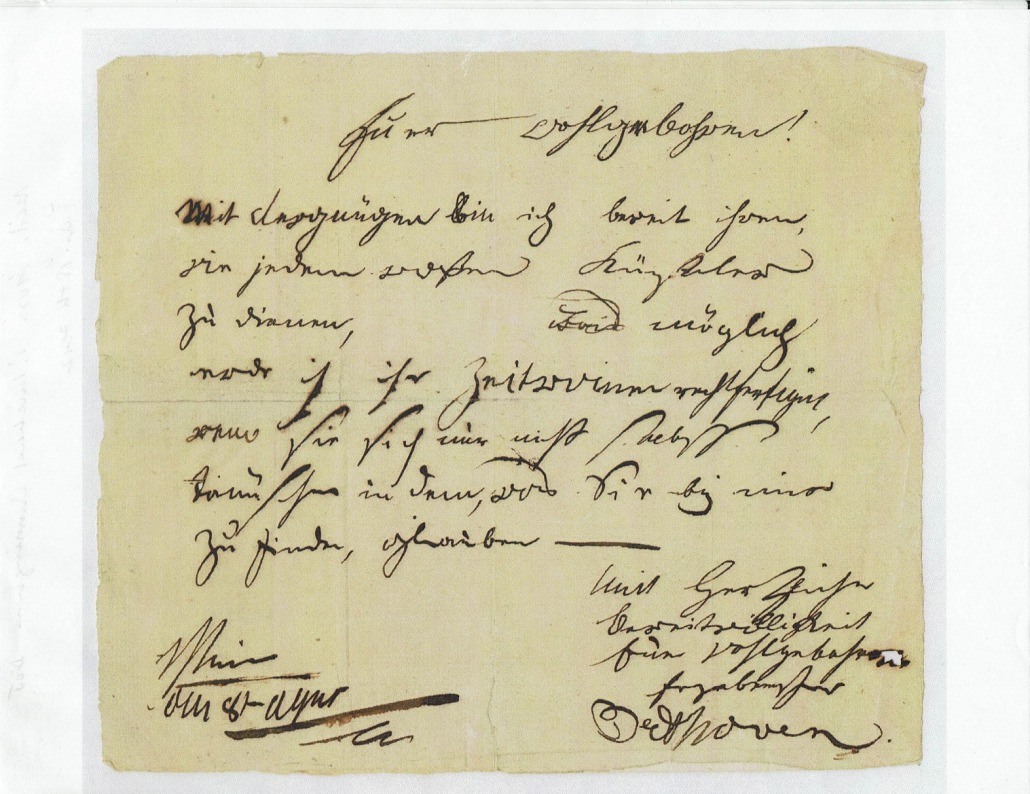
On the 8th of August probably in 1825 Beethoven wrote a letter to Karl Friedrich Müller in Berlin. There are two persons in the Beethoven literature with nearly identical names Carl Friedrich Müller and Karl Friedrich Müller. They are often confused, even by experienced Beethoven scholars. Carl Friedrich Müller was from Vienna and an invalid actor for whom Beethoven wrote two Waltzes and an Ecossaise, WoO 84-86 around 1824-25. Karl Friedrich Müller (1796-1846) on the other hand was a well known piano teacher and composer in Berlin. He was the son of Louise Müller (1763-1829) who was a well known and highly regarded opera singer. His father was an actor. Müller and his mother settled in Berlin; he teaching and she singing. Sometime in late 1825 or possibly 1826 Muller wrote a letter to Beethoven probably asking that Beethoven set some texts to music as songs. These could have been his own texts and he may have intended them to be performed by his mother. This we know only by implication because his original letter to Beethoven has not survived and this conjecture is based on the contents of Beethoven’s reply. It consists of a sheet of paper on which is written the address on one half and the letter on the other half. When folded the letter would be on the inside and the address on the outside.

The letter was fairly easy to identify once I got a look at it. It is listed in Anderson as A 1227 and in Brandenburg as B 2027.  What confused me was that both Anderson and Brandenburg listed different owners and locations for the letter. After I was able to examine the letter at the National Archives I asked if they had looked for a watermark and was told no. I asked to look at the letter on a light-box to see if a watermark existed and it did. But not one that we were expecting. The letter described by Brandenburg, which is now in the Beethoven-Haus bears a Van-der-Ley watermark and came from the famous Max Josef Mannheim collection. I was expecting to see the Van-der-Ley watermark, but instead I saw an F B watermark on laid paper.

After much research I was able to identify the watermark as that of the Frederick Bicking company which was establish in 1762 in the Philadelphia suburbs and that they used this particular from of a watermark from the mid-1870s until the early 1880s.

Only one conclusion could be made and that was that the letter stolen by Landau and his accomplice was in fact a forgery that had gone undetected for nearly a century. Records at the Historical Society of Pennsylvania indicate that the letter was donated by a Mrs. Thomas Leaming on the 20th of March in 1917 along with two other letters; one by Franz List and the other by Mercadante. No one had ever checked the letters for watermarks or authenticity. The Beethoven letter had even been published in 1927 in facsimile by Oscar O. Sonneck in his “Beethoven Letters in America.” The great question now was; “Who did the forgery?” and “How did it come into the possession of Mrs. Leaming. The second question was little easier to answer. Mrs. Leaming’s husband was Thomas Leaming, Jr. a very prominent Philadelphia lawyer and collector of autographs and other important historical documents as was also his father, Thomas Leaming Sr. He was an equally well known lawyer and collector. Since the letter was on paper from the late 1870s, it was probably Leaming Sr. who acquired the letter and on his death it passed to his son and eventually his daughter-in-law who donated it to the Pennsylvania Historical Society. Who could have done the forgery is more speculative, but the only know and convicted forger of Beethoven letters living in Philadelphia at the time was Beethoven’s own grand-nephew, Ludwig Johann van Beethoven.

Ludwig Johann van Beethoven was born in 1839 and named for his two great uncles. He was taught music as a child and at some point studied engineering. He embarked on a military career and after that worked as a civil engineer. He spent time in Munich and Berlin. He found himself frequently short of funds and started selling Beethoven memorabilia. Perhaps a cufflink or a button that may or may not have actually belonged to his famous uncle. Who would know the difference as long as the items seems plausible and were old enough to have belong to the composer. At some point he started to forge letters and papers asserting that they had been written by his famous uncle. It must have been easy for him, perhaps a little too easy, for by the early 1870s he got caught selling forged documents to King Ludwig II of Bavaria. He was convicted but seems to have jumped bail before being sentenced to four  years in jail. Documents show that he went with his wife and young son to London to arrange for passports. Ship documents show that he arrived in New York on the 15th of September 1871. Clearly a month or two before being sentenced in absentia. He must have feared conviction and fled before sentencing. The Bavarian police don’t seem to have been willing to pursue him. Probably because they didn’t want further publicity. To have brought him back would only add to the embarrassment of King at being fooled.

Once in America he seems to have flourished. He worked for several different railroads and in several cities in the US including New York City and Rochester, Buffalo, Detroit and Jackson in Michigan and Chicago among other places. He was enterprising; he started a company for the renting of wheel-chairs to visitors of the Centennial Exhibition in Philadelphia in 1876 as well a messenger company with two offices in New York and one in Philadelphia. It is his activities with the wheel-chair company and the messenger company that puts him in Philadelphia in the late 1870s and early 1880s and thus a likely candidate for forger. He even dabbled in invention, having applied for a patent for a method of metering the distances traveled by taxicabs and thus making sure the fare charged is correct.

On one occasion when he was working for the Union Pacific Railroad he made a trip with his wife and children to San Francisco. While there he decided to take a vacation trip to Hawaii by boat. He stayed at the Royal Hawaiian Hotel on Waikiki beach. The hotel still stands, although much enlarged today.

The German American community was very tight knit one. They frequently reach out to help new arrivals. Ludwig Johann van Beethoven who now went by the name of Louis von Hoven seems to have benefitted from these connections. He found work quickly as a railroad manager. His background as a civil engineer must have helped. Although he had some success in America he never gave up his shady instincts. He left America in around 1890 but lapsed into obscurity. It is not know where he died or even where he is buried.

Il 9 luglio 2011 un membro dello staff della Maryland Historical Society di Baltimora vide un certo Jason Savedoff sottrarre un documento dalla biblioteca della Società. Fu chiamata immediatamente la polizia. Le forze dell’ ordine trovarono 60 documenti nascosti nella custodia del computer portatile di Savedoff, celato in un armadietto, molti dei quali erano stati firmati da Barry Landau.

Oltre al computer portatile, ognuno di loro aveva tasche enormi cucite nelle giacche per nascondere i documenti rubati.

Una volta che la coppia di criminali fu arrestata, divenne necessario per la polizia determinare la portata della loro attività criminale. Dal momento che la coppia fu arrestata nel Maryland e le loro residenze erano a New York, ciò divenne crimine federale e non solo un furto locale. La polizia di Baltimora avvertì il Federal Bureau of Investigation (FBI), che il furto potrebbe aver attraversato i confini di stato. L’FBI predispose un mandato di perquisizione per l’appartamento di Landau a New York. La polizia non era preparata per quello che trovò. Più di diecimila pezzi di cimeli presidenziali, dai pins per le campagne elettorali ai menu per le cene di stato. Trovarono anche importanti documenti storici, come lettere di Thomas Jefferson, Abraham Lincoln, Benjamin Franklin e persino Sir Isaac Newton. Questi furti andavano avanti da anni. Non solo nelle società storiche di New York, Pennsylvania e Maryland, ma anche a danno della Biblioteca del Congresso e della Biblioteca presidenziale Franklin Roosevelt a Hyde Park. I materiali sequestrati furono inviati all’Ufficio dell’Ispettore Generale degli Archivi Nazionali per lo smistamento. A poco a poco vennero identificati i proprietari degli oggetti rubati. La maggior parte delle istituzioni non sapeva che gli elementi fossero stati sottratti. Altri mille oggetti sarebbero stati rapidamente rintracciati nelle collezioni della Historical Society e nelle biblioteche presidenziali site nella  costa orientale degli Stati Uniti. I due uomini furono incarcerati a Baltimora e incriminati da un Grand Jury federale alla fine di luglio del 2011. Entrambi gli imputati si dichiararono colpevoli; Savedoff nell’ottobre 2011 e Landau nel febbraio 2012.

Il 27 giugno 2012 Landau fu condannato a sette anni di carcere dal giudice distrettuale federale Catherine Blake. Nel commentare la condanna, l’avvocato statunitense Rod J. Rosenstein dichiarò: “Le prove hanno dimostrato che Barry Landau era un truffatore che si è mascherato da storico presidenziale per ottenere la fiducia della gente in modo da poter rafforzare le loro proprietà, la rivelazione che il signor Landau era un prolifico ladro ha lanciato un campanello d’allarme a musei, biblioteche e altre istituzioni che affidano preziosi oggetti storici a persone che affermano di essere impegnate nella ricerca accademica”.

Barry Landau (nato nel 1948) è un noto collezionista di manufatti presidenziali, l’autore di “The Presidents Table” pubblicato nel 2007 e “sedicente” American Presidential Historian. Landau ha mostrato alcuni pezzi pregiati della sua collezione al Martha Stewart Show. È stato anche commentatore della CNN e del Today Show della NBC.

Mentre tutto questo si svolgeva in un tribunale federale di Baltimora, stavo lavorando a un lavoro di progettazione per dei clienti, Michael Cunningham e sua moglie. Michael Cunningham era assistente del procuratore del Dipartimento di Giustizia e stava lavorando al caso con il procuratore capo Rod Rosenstein. Durante una visita alla casa dei Cunningham, Michael mi parlò dell’arresto e dell’azione penale. Rimase piuttosto sorpreso quando risposi che avevo incontrato Barry Landau alla Casa Bianca diversi anni prima, quando era venuto a vedere i progetti che avevo aiutato a preparare per una cena di stato. Fui poi sorpreso di apprendere da Cunningham che una delle lettere rubate alla Historical Society of Pennsylvania di Filadelfia era stata scritta da Beethoven (questo non era stato menzionato nelle notizie dei media). Pensai che questa storia sarebbe stata un articolo interessante e chiesi a Cunningham se poteva darmi maggiori informazioni su quale lettera di Beethoven fosse stata rubata. Cunningham fece presente a Rosenstein del mio interesse sulla questione e fece in modo non solo di ottenere una fotocopia della lettera, ma anche di andare agli Archivi Nazionali e ispezionarla di persona. Normalmente nessuno, al di fuori degli avvocati dell’accusa o della difesa, è autorizzato a vedere le prove di un procedimento penale. Sono stato fortunato, quale ricercatore beethoveniano, ad avere un tale accesso  privilegiato.

Fu probabilmente l’ 8 agosto 1825 che Beethoven scrisse una lettera a Karl Friedrich Müller a Berlino. Esistono due persone, nella letteratura beethoveniana, con nomi quasi identici: Carl Friedrich Müller e Karl Friedrich Müller. Sono spesso confusi, anche da esperti studiosi. Carl Friedrich Müller, viennese, fu un attore invalido per il quale Beethoven scrisse due valzer e un’Ecossaise, WoO 84-86 intorno al 1824-25. Karl Friedrich Müller (1796-1846) fu un noto insegnante di pianoforte e compositore attivo a Berlino. Era il figlio di Louise Müller (1763-1829) che a sua volta fu cantante d’opera, ben nota e molto apprezzata. Suo padre era attore. Müller e sua madre si stabilirono a Berlino; lui insegnava e lei cantava. Verso la fine del 1825 o forse nel 1826 Müller scrisse una lettera a Beethoven, probabilmente chiedendo che Beethoven mettesse in musica alcuni testi come Lieder. Probabilmente i testi erano i suoi e potrebbe aver voluto che fossero cantati dalla madre. Evinciamo questo implicitamente, dal momento che la lettera originale di  Müller inviata a Beethoven non è sopravvissuta e questa congettura si basa sul contenuto della risposta del compositore. Consiste in un foglio di carta su cui è scritto l’indirizzo su una metà e la lettera sull’altra metà. Una volta piegata, lo scritto sarebbe stato rivolto all’interno e l’indirizzo all’esterno.

Dopo una rapida visione la lettera è stata abbastanza facile da identificare. È elencata in Anderson come A 1227 e in Brandenburg come B 2027. Ciò che mi ha confuso è che sia Anderson che Brandenburg hanno elencato diversi proprietari e collocazioni. Dopo essere stato in grado di esaminare la lettera presso gli Archivi Nazionali, ho chiesto se avessero cercato la filigrana e mi è stato detto di no. Ho chiesto quindi di visionare la lettera su di una scatola luminosa, per vedere se esistesse una filigrana. La filigrana era presente ma non quella che si aspettasse. La lettera descritta da Brandenburg, che ora si trova alla Beethoven-Haus reca una filigrana Van-der-Ley e proveniva dalla famosa collezione Max Josef Mannheim. Mi aspettavo quindi di vedere la filigrana Van-der-Ley, invece notai una filigrana “F B” su carta vergata.

Dopo molte ricerche sono stato in grado di identificare la filigrana come quella della società Frederick Bicking che fu fondata nel 1762 nei sobborghi di Filadelfia e che usarono questa particolare filigrana dalla metà degli anni 1870 fino ai primi anni 1880.

Si poteva dunque trarre una sola conclusione: che la lettera rubata da Landau e dal suo complice fosse in realtà un falso, passato inosservato per quasi un secolo!. I documenti della Historical Society of Pennsylvania indicano che la lettera fu donata da una certa signora Thomas Leaming il 20 marzo 1917 insieme ad altre due lettere; una di Franz List e l’altra di Mercadante. Nessuno aveva mai controllato le lettere o la filigrana per stabilirne l’ autenticità. La lettera di Beethoven fu persino pubblicata nel 1927 in facsimile da Oscar O. Sonneck nelle sue “Lettere di Beethoven in America”. La domanda principale ora era questa; “Chi ha falsificato?” e “In qual modo ne entrò in possesso la signora Leaming?. Alla seconda domanda era un po’ più facile rispondere. Il marito della signora Leaming era Thomas Leaming, Jr., un importante avvocato di Filadelfia e collezionista di autografi e altri importanti documenti storici, così come suo padre, Thomas Leaming Sr., altrettanto noto avvocato e collezionista. Poiché la lettera era su carta della fine del 1870, fu probabilmente Leaming Sr. ad acquistare la lettera e alla sua morte passò a suo figlio e poi a sua nuora, che la donarono alla Pennsylvania Historical Society. Chi avrebbe potuto falsificare il documento è più speculativo, ma l’unico falsario noto (e condannato) di lettere di Beethoven e all’ epoca viveva a Filadelfia era il pronipote di Beethoven, Ludwig Johann van Beethoven.

Ludwig Johann van Beethoven nacque nel 1839 e prese il nome dai suoi due prozii. Da bambino gli fu insegnata musica e seguì studi di ingegneria. Intraprese la carriera militare e successivamente lavorò come ingegnere civile. Trascorse qualche tempo a Monaco e Berlino. Si trovò spesso a corto di soldi e iniziò a vendere cimeli di Beethoven. Ora un gemello ora un bottone che avrebbero potuto esser appartenuti (o meno) al famoso zio. Del resto, all’ epoca chi avrebbe potuto riconoscere come veri questi oggetti purché fossero abbastanza vecchi da attribuirli al compositore. Ad un certo punto iniziò anche a falsificare lettere e documenti. Quest’ attività dovette sembrargli fin troppo facile, tanto che, all’inizio degli anni 1870, fu sorpreso a vendere documenti falsi al re Ludovico II di Baviera. Fu condannato, non pagò la cauzione e fu condannato a quattro anni di carcere. I documenti mostrano che si recò con sua moglie e suo figlio a Londra, per imbarcarsi. I documenti della nave mostrano che arrivò a New York il 15 settembre 1871. Chiaramente un mese o due prima di essere condannato in contumacia. Praticamente fuggì prima della sentenza. La polizia bavarese non sembrò essere stata troppo interessata alla sua fuga. Probabilmente perché non volevano ulteriore pubblicità negativa; averlo riportato indietro avrebbe solo aumentato l’imbarazzo del Re per essere stato ingannato.

Una volta arrivato in America sembra aver fatto fortuna. Lavorò per diverse società ferroviarie e in diverse città degli Stati Uniti, tra cui New York City e Rochester, Buffalo, Detroit e Jackson nel Michigan e Chicago. Era intraprendente; fondò una società per l’affitto di sedie a rotelle ai visitatori della Centennial Exhibition di Filadelfia nel 1876 e una società di corriere con due uffici a New York e uno a Filadelfia. Le sue attività con la compagnia di sedie a rotelle e la compagnia di messaggeri lo collocano a Filadelfia tra la fine del 1870 e l’inizio del 1880 e quindi un probabile candidato per il ruolo di falsario. Si dilettò persino nell’inventare un metodo per misurare le distanze percorse dai taxi e assicurarsi così che la tariffa applicata sia corretta.

In un’occasione, mentre lavorava per la Union Pacific Railroad, fece un viaggio con sua moglie ei suoi figli a San Francisco. Da quella città decise di fare un viaggio di vacanza alle Hawaii in barca. Soggiornò al Royal Hawaiian Hotel sulla spiaggia di Waikiki. L’hotel è ancora esistente, sebbene molto modificato.

La comunità tedesco-americana era molto affiatata. Spesso aiutavano i nuovi arrivati dall’ Europa. Ludwig Johann van Beethoven, che prese il nome Louis von Hoven, sembra abbia beneficiato di questi contatti. Trovò rapidamente lavoro come direttore delle ferrovie. Il suo background come ingegnere civile deve averlo aiutato. Nonostante abbia avuto un certo successo in America, non rinunciò mai ai suoi loschi traffici. Lasciò l’America intorno al 1890, ma cadde nell’oblio. Non si sa dove sia morto e nemmeno dove sia sepolto.


James F. Green was born in Michigan, where he studied fine art and history. He has a post graduate degree in Interior Design from the New York School of Interior Design. Mr. Green has been active in Beethoven research for nearly 50 years. Founder of the Michigan Beethoven Society, he presently serves on the Executive Board of the Ira F. Brilliant Center for Beethoven Studies in California. He is the author of the New Hess Catalog of Beethoven’s Works, which was awarded the Adele Mellen Prize. He has written several articles for European scholarly journals. Besides his Beethoven activities, Mr. Green is an International Award winning Interior Designer and President of Monument Records.


James F. Green è nato nel Michigan, dove ha studiato Belle Arti e storia. Ha una laurea post-laurea in Interior Design presso la New York School of Interior Design. Green si dedica alla  ricerca su Beethoveniana da quasi 50 anni. Fondatore della Michigan Beethoven Society, attualmente fa parte del comitato esecutivo dell’Ira F. Brilliant Center for Beethoven Studies in California. È autore del Nuovo catalogo Hess delle opere di Beethoven, vincitore del Premio Adele Mellen. Ha scritto diversi articoli per riviste scientifiche ed europee. Oltre alle sue attività Beethoveniane, Green è un interior designer vincitore di un premio internazionale e presidente dell’ etichetta discografica Monument Records.


Ludwig van Beethoven – The Letter to the Immortal Beloved: A Line‑by‑Line Transcription and Italian Translation

Letter to the Immortal Beloved – An inquiry ‘beneath every certainty’”

Teplitz, 6 and 7 July 1812

After Beethoven’s death on 26 March 1827, the letter was found in a drawer of the composer’s private bureau and preserved by Anton Schindler. It was published for the first time by the same “famulus” in his 1840 biography of Beethoven. True to his reputation as a falsifier, he omitted several lines, significant sentences, and altered many others.

The letter (written over three consecutive days) indicates only the date: Monday, 6 July. Since the year is missing, scholars initially assumed it had been written in 1801 or 1807, the only years in which 6 July fell on a Monday. The hypothesis of 1812 was first proposed by Unger (1909) and Thomas‑San‑Galli (1909), following the discovery of documents concerning Beethoven’s stay in Bohemia during that period.

Unger and San‑Galli examined the guest lists of the spa towns and were able to prove that Beethoven arrived in Teplitz (today Teplice) on 5 July 1812, coming from Prague, where he had stayed from 1 to 4 July. Another important clue in the letter is the reference to Prince Esterházy (1.11), who indeed arrived in Teplitz at the same time.

The fact that Beethoven addressed the problem of delivering the letter three separate times shows how preoccupied he was. In section 2.3 (Monday evening) he laments that the post to “K.” left on Mondays and Thursdays. Much speculation arose about the meaning of “K.” when the place of dispatch was still unknown. Today there is no doubt that Beethoven meant Karlovy Vary, about 100 km from Teplitz, reachable in one day by coach.

In 2.9 Beethoven expresses his distress (“ich weine” – “I am crying”) and notes that the recipient would “probably receive the message only on Saturday”. Since the coach from Teplitz reached Karlovy Vary on Thursday evening, the destination must have been another day’s journey further west, probably Eger (Cheb), a larger and nearer town about 50 km away.

The most important conclusion from these “logistical” considerations is that — from Beethoven’s perspective — the recipient had to be located two days’ travel from Teplitz at the time the letter was meant to be sent. This also invalidates the many unfounded speculations assuming that the recipient must have been in Karlsbad.

In section 3.12 (Tuesday morning) Beethoven discovers he has made a mistake and promises to send the letter immediately, so that the unknown woman could receive it as soon as possible (though still two days later). We cannot know whether the letter was actually sent; its discovery in Beethoven’s bureau leaves two possibilities: either it was never sent, or it was sent but returned to the composer as undeliverable because the addressee could not be found.

Thus, our inquiry “beneath every certainty” may be summarised as follows:

  • The letter was written on 6 and 7 July 1812 in Teplitz.
  • Beethoven had probably met the Beloved a few days earlier, unexpectedly.
  • The recipient was a woman Beethoven had loved for a long time and who reciprocated his feelings. He explicitly describes himself as her “Geliebter” (“lover”), reassures her of his “Treue” (“faithfulness”), and asks her to “remain faithful” to him (1.18, 3.8).
  • The letter was meant to be sent to a place two days’ travel from Teplitz, via Karlsbad (2.3, 2.9).
  • Beethoven may not have sent the letter because he learned that the Beloved was no longer where he thought, or he decided not to send it. Another possibility is that he sent it but it was returned.
  • The letter was undoubtedly important to him; otherwise he would not have kept it all his life.
  • “Wir werden uns wohl bald sehen” (“We shall probably see each other soon”, 1.14) has often been mistranslated as “Without doubt we shall meet soon”. In reality, Beethoven had no certainty about her location — how could they meet soon?
  • The letter makes clear that the Beloved lived (for some time) in Vienna, as Beethoven did.
  • It is the only letter to a woman in which Beethoven consistently uses the intimate “Du”.

Brief an die Unsterbliche Geliebte,

Teplitz, 6 and 7 July 1812

1.1 „am 6ten Juli Morgends.“1.2 „Mein Engel, mein alles, mein Ich.“

1.3 „nur einige Worte heute, und zwar mit Bleystift (mit deinem)“

1.4 „erst bis morgen ist meine Wohnung sicher bestimmt, welcher Nichtswürdiger Zeitverderb in d.g.“

1.5 „warum dieser tiefe Gram, wo die Nothwendigkeit spricht.“

1.6 „Kann unsre Liebe anders bestehn als durch Aufopferungen, durch nicht alles verlangen, kannst du es ändern, daß du nicht ganz mein, ich nicht ganz dein bin.“

1.7 „Ach Gott blick in die schöne Natur und beruhige dein Gemüth über das müßende.“

1.8 „die Liebe fordert alles und ganz mit Recht, so ist es mir mit dir, dir mit mir.“

1.9 „nur vergißt du so leicht, daß ich für mich und für dich leben muß, wären wir ganz vereinigt, du würdest dieses schmerzliche eben so wenig als ich empfinden.“

1.10 „meine Reise war schrecklich ich kam erst Morgens 4 uhr gestern hier an, da es an Pferde mangelte, wählte die Post eine andre Reiseroute, aber welch schrecklicher Weg, auf der vorlezten Station warnte man mich bey nacht zu fahren, machte mich einen Wald fürchten, aber das Reizte mich nur – und ich hatte Unrecht, der Wagen muste bey dem schrecklichen Wege brechen, grundloß, bloßer Landweg, ohne 2 solche Postillione, wie ich hatte, wäre ich liegen geblieben Unterwegs.“

1.11 „Esterhazi hatte auf dem andern gewöhnlichen Wege hierhin dasselbe schicksaal, mit 8 Pferden, was ich mit vier.“

1.12 „Jedoch hatte ich zum Theil wieder vergnügen, wie immer, wenn ich was glücklich überstehe.“

1.13 „nun geschwind zum innern vom aüßern.“

1.14 „wir werden unß wohl bald sehn,“

1.15 „auch heute kann ich dir meine Bemerkungen nicht mittheilen, welche ich während dieser einigen Tage über mein Leben machte – wären unsre Herzen immer dichtan einander, ich machte wohl keine d.g.“

1.16 „die Brust ist voll dir viel zu sagen“

1.17 „Ach – Es gibt Momente, wo ich finde daß die sprache noch gar nichts ist“

1.18 „erheitre dich – bleibe mein Treuer einziger schaz, mein alles, wie ich dir;“

1.19 „das übrige müßen die Götter schicken, was für unß seyn muß und seyn soll.“

1.20 „dein treuer ludwig.“

2.1 „Abends Montags am 6ten Juli“

2.2 „Du leidest du mein theuerstes Wesen“

2.3 „eben jezt nehme ich wahr daß die Briefe in aller Frühe aufgegeben werden müßen. Montags – Donnerstags – die einzigen Täge wo die Post von hier nach K. geht.“

2.4 „du leidest.“

2.5 „Ach, wo ich bin, bist auch du mit mir, mit mir und dir rede ich mache daß ich mit dir leben kann“

2.6 „welches Leben!!!! so!!!! ohne dich“

2.7 „Verfolgt von der Güte der Menschen hier und da, die ich meyne – eben so wenig verdienen zu wollen, als sie zu verdienen.“

2.8 „Demuth des Menschen gegen den Menschen – sie schmerzt mich – und wenn ich mich im Zusammenhang des Universums betrachte, was bin ich und was ist der – den man den Größten nennt – und doch – ist wieder hierin das Göttliche des Menschen.“

2.9 „ich weine wenn ich denke daß du erst wahrscheinlich Sonnabends die erste Nachricht von mir erhältst.“

2.10 „wie du mich auch liebst – stärker liebe ich dich doch“

2.11 „doch nie verberge dich vor mir.“

2.12 „gute Nacht – als Badender muß ich schlafen gehen.“

2.13 „Ach gott – so nah! so weit!“

2.14 „ist es nicht ein wahres HimmelsGebaüde unsre Liebe – aber auch so fest, wie die Veste des Himmels.“

3.1 „guten Morgen am 7ten Juli“

3.2 „schon im Bette drängen sich die Ideen zu dir meine Unsterbliche Geliebte,“

3.3 „hier und da freudig, dann wieder traurig, vom Schicksaale abwartend, ob es unß erhört.“

3.4 „leben kann ich entweder nur ganz mit dir oder gar nicht,“

3.5 „ja ich habe beschlossen in der Ferne so lange herum zu irren, bis ich in deine Arme fliegen kann,“

3.6 „und mich ganz heymathlich bey dir nennen kann, meine Seele von dir umgeben in’s Reich der Geister schicken kann.“

3.7 „ja leider muß es seyn.“

3.8 „du wirst dich fassen um so mehr, da du meine Treue gegen dich kennst, nie eine andre kann mein Herz besizen, nie – nie.“

3.9 „O Gott warum sich entfernen müßen, was man so liebt, und doch ist mein Leben in V.[ien] so wie jezt ein kümmerliches Leben.“

3.10 „Deine Liebe macht mich zum glücklichsten und zum unglücklichsten zugleich.“

3.11 „in meinen Jahren jezt bedürfte ich einiger Einförmigkeit Gleichheit des Lebens – kann diese bey unserm Verhältniße bestehn?“

3.12 „Engel, eben erfahre ich, daß die Post alle Tage abgeht – und ich muß daher schließen, damit du den B.[rief] gleich erhältst“

3.13 „sey ruhig, nur durch Ruhiges beschauen unsres Daseyns können wir unsern Zweck zusammen zu leben erreichen“

3.14 „sey ruhig – liebe mich – heute – gestern.“

3.15 „Welche Sehnsucht mit Thränen nach dir“

3.16 „dir – dir – mein Leben – mein alles“

3.17 „leb wohl – o liebe mich fort – verken[ne] nie das treuste Herz deines Geliebten L.“

3.18 „ewig dein ewig mein ewig unß.“

6 July, morning My angel, my all, my very self — only a few words today, written in pencil, yours. My lodging will not be settled before tomorrow; what a miserable waste of time for such trifles. Why this deep sorrow, when necessity itself speaks? Can our love endure except through sacrifice, through renouncing the desire to possess everything? What can we do, if you are not wholly mine and I not wholly yours? Look upon the beauty of nature, calm your heart with what must be. Love demands everything — and rightly so. You forget too easily that I must live for both of us. Were we completely united, you would feel this pain no more than I do. My journey was dreadful; I arrived only at four in the morning. The coach lacked horses and took another route — a terrible one. They warned me not to travel at night, spoke of a forest to frighten me, which only tempted me more — wrongly. The carriage nearly broke on that bottomless track. But enough of the outer world — now to the inner. We shall probably see each other soon. My heart is full of things to tell you. There are moments when words are nothing. Be cheerful; remain my faithful, my only treasure, my all, as I am yours. The rest the gods will send.

6 July, evening You are suffering, my dearest. I have just learned that letters must be posted early — Monday and Thursday — the only days the mail goes to K. Where I am, you are with me. I speak with you, live with you. What a life — without you. I weep to think you will probably not receive news from me before Saturday. However much you love me — I love you more. Never hide yourself from me. Good night — as a bather I must go to sleep. So near, so far. Is not our love a heavenly structure, firm as the vault of heaven?

7 July, morning Even in bed my thoughts press toward you, my Immortal Beloved — now joyful, now sorrowful, waiting to see whether fate will hear us. I can live only wholly with you or not at all. I have resolved to wander until I can fly into your arms and feel entirely at home with you, my soul enveloped by yours. You will gather strength, knowing my faithfulness. No other can ever possess my heart — never, never. Why must one be far from what one loves so deeply? My life in Vienna is miserable. Your love makes me the happiest and the unhappiest of men at once. They tell me the post leaves every day — I must close so that you may receive this at once. Be calm; only by contemplating our existence calmly can we reach our goal of living together. Love me — today, yesterday. What longing, with tears, for you — you — my life — my all. Farewell. Continue to love me; never doubt the faithful heart of your beloved. Forever yours, forever mine, forever ours.


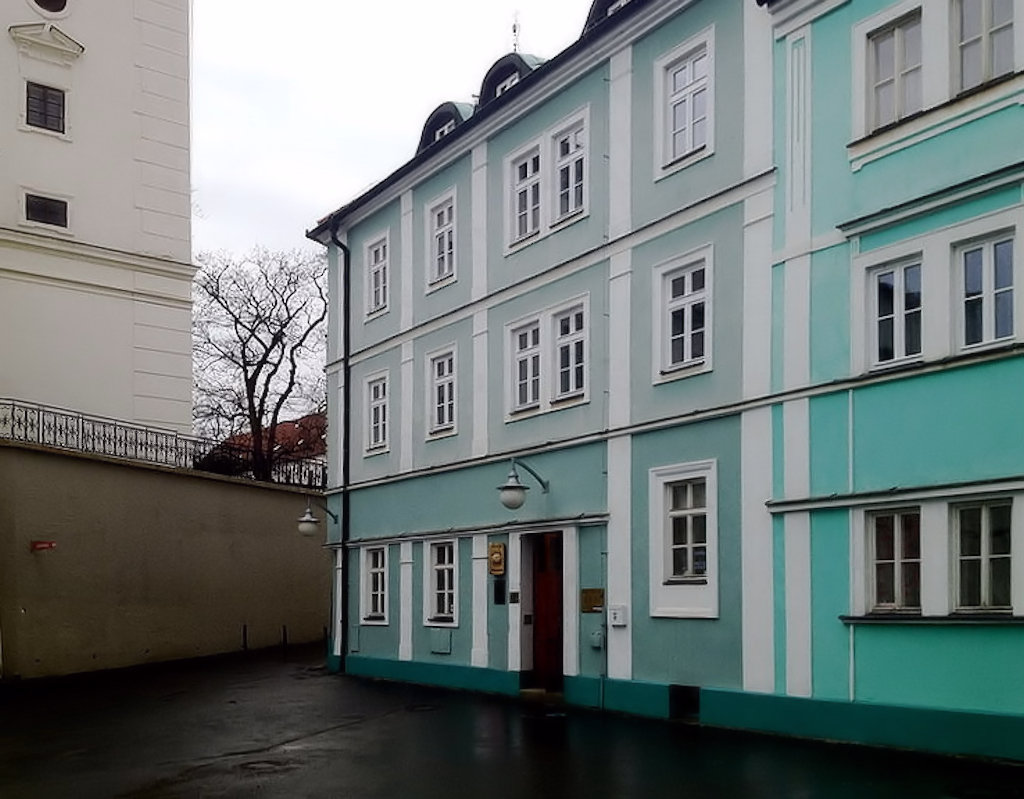
Teplitz, Pension Zur golden Sonne, where Beethoven stayed on 6 and 7 July 1812. It was probably here that he wrote the letter to his immortal beloved.

Letter to the Immortal Beloved – An inquiry ‘beneath every certainty’”

Bibliography

  • Altman, Gail S.: Beethoven: A Man of His Word – Undisclosed Evidence for his Immortal Beloved. Tallahassee: Anubian Press 1996.
  • Anderson, Emily (Hg.): The Letters of Beethoven. 3 Bände. London: Macmillan 1961.
  • Beahrs, Virginia: The Immortal Beloved Revisited. In: The Beethoven Newsletter (1986), S. 22–24.
  • Beahrs, Virginia Oakley: The Immortal Beloved Riddle Reconsidered. In: The Musical Times (1988), S. 64–70.
  • Beahrs, Virginia: “My Angel, My All, My Self”: A Literal Translation of Beethoven’s Letter to the Immortal Beloved. In: The Beethoven Newsletter (1990), S. 29, 34–39.
  • Beahrs, Virginia: Beethoven’s Only Beloved? New Perspectives on the Love Story of the Great Composer. In: Music Review (1993), S. 183–197.
  • Brandenburg, Sieghard (Hg.): Ludwig van Beethoven: Briefwechsel. Gesamtausgabe. 6 Bände. München: Henle 1996.
  • Caeyers, Jan: Beethoven: Der einsame Revolutionär. Eine Biographie. Übers. Andreas Ecke. München: Beck 2012. Orig. in Niederländisch: Beethoven. Een Biografie. Amsterdam: De Bezige Bij 2009.
  • Cooper, Barry: Beethoven’s Immortal Beloved and Countess Erdödy: A Case of Mistaken Identity? In: The Beethoven Journal (1996), S. 18–24.
  • Czeke, Marianne: Brunszvik Teréz grófnő naplói és feljegyzései. Bd. I. Budapest: Kötet 1938.
  • Dahlhaus, Carl: Ludwig van Beethoven und seine Zeit. Laaber 1987.
  • Goldschmidt, Harry: Um die Unsterbliche Geliebte. Eine Bestandsaufnahme. Leipzig: Deutscher Verlag für Musik 1977; auch als: Um die Unsterbliche Geliebte. Ein Beethoven-Buch. München: Rogner & Bernhard [1980].
  • Goldschmidt, Harry: „Auf diese Art mit A geht alles zu Grunde.“ Eine umstrittene Tagebuchstelle in neuem Licht. In: Goldschmidt (1988), S. 8–30.
  • Hess, Willy: Beethoven. 1. Aufl. Zürich 1956; 2. Aufl. Winterthur 1976.
  • Hornyák, Maria: „Mein Alles, meine Glückseeligkeit …“ Über die Liebe von Ludwig van Beethoven und Josephine Brunswick, Gräfin von Martonvásár. Martonvásár 1996.
  • Kaznelson, Siegmund: Beethovens Ferne und Unsterbliche Geliebte. Zürich 1954.
  • Kinderman, William: Beethoven. Berkeley: University of California Press 1995.
  • Klapproth, John E: Beethoven’s Only Beloved: Josephine! A Biography of the Only Woman Beethoven ever Loved. In Deutsch als: Beethovens Einzige Geliebte: Josephine! 2. Aufl. Charleston, SC: CreateSpace 2012 (1. Aufl. 2011).
  • Klapproth, John E: Preuves et épreuves du mystère de «l’Immortelle Bien-Aimée»: de la liste du Schindler au lac de Walden. In: Beethoven, sa vie, son œuvre 2012a, S. 55–68.
  • Klapproth, John E: Joséphine Brunsvik: le seul Amour de Beethoven. In: Beethoven, sa vie, son œuvre 2012b, S. 69–74.
  • Klapproth, John E: Handbuch: Unsterbliche Geliebte. Alles über die einzige Frau, die Beethoven je geliebt hat – und etliche andere. Original: The Immortal Beloved Compendium. Everything About the Only Woman Beethoven Ever Loved – And Many He Didn’t. Charleston, SC: CreateSpace 2016.
  • La Mara (Ida Maria Lipsius): Beethovens Unsterbliche Geliebte. Das Geheimnis der Gräfin Brunsvik und ihre Memoiren. Leipzig: Breitkopf & Härtel 1909.
  • La Mara (Ida Maria Lipsius): Beethoven und die Brunsviks. Nach Familienpapieren aus Therese Brunsviks Nachlaß. Leipzig: Siegel 1920.
  • Ley, Stephan: Aus Beethovens Erdentagen. Siegburg: F. Schmitt 1957.
  • Lockwood, Lewis: Film Biography as Travesty: Immortal Beloved and Beethoven. In: The Musical Quarterly (1997), S. 190–198.
  • Lockwood, Lewis: Beethoven. The Music and the Life. New York: Norton 2003.
  • Massin, Jean & Brigitte: Ludwig van Beethoven. Biographie. Histoire des Œuvres. Essai. Paris 1955 [2. Aufl. 1967]. In Deutsch als: Beethoven. Materialbiographie, Daten zum Werk und Essay. München 1970a.
  • Massin, Jean & Brigitte: Recherche de Beethoven. Paris 1970.
  • Miebach, Manuela: Beethoven – Gott, welch’ Dunkel hier! Aspekte zwischen Spekulation und Wahrheit. 2015. ISBN 978-3-99010-776-8
  • Noering, Ulrich: Beethoven und Ungarn. Budapest: TóKa-PR-System 1995.
  • Pichler, Ernst: Beethoven. Mythos und Wirklichkeit. Wien: Amalthea 1994.
  • Riezler, Walter: Beethoven. 12. Aufl. Zürich: Atlantis 1983 (1. Aufl. 1936).
  • Schindler, Anton: Biographie von Ludwig van Beethoven. 1. Aufl. Münster: Aschendorff 1840. 2. Aufl. 1845. 3. Aufl. 1860.
  • Schmidt-Görg, Joseph (Hg.): Beethoven: Dreizehn unbekannte Briefe an Josephine Gräfin Deym geb. v. Brunsvik. Bonn: Beethoven-Haus 1957.
  • Schmidt-Görg, Joseph: Neue Schriftstücke zu Beethoven und Josephine Gräfin Deym. In: Beethoven-Jahrbuch 1965/68 (1969).
  • Schmidt-Görg, Joseph & Schmidt, Hans: Wasserzeichen in Beethoven-Briefen. In: Beethoven-Jahrbuch 5 (1961/64) 1966, S. 7–74.
  • Solomon, Maynard: New Light on Beethoven’s Letter to an Unknown Woman. In: The Musical Quarterly (1972), S. 572–587.
  • Stackelberg, Wolfhart von: Ohne Beethoven klänge Estnisch anders. In: Nachrichtenblatt der Baltischen Ritterschaften. Lüdenscheid 2001, S. 4–7.
  • Steblin, Rita: Beethoven’s Immortal Beloved: Evidence against Almerie Esterházy. In: Abstracts of Papers Read at the Meeting of the American Musicological Society, Sixty-Seventh Annual Meeting, November 15–18, 2001, S. 56 ().
  • Steblin, Rita: Josephine Gräfin Brunswick-Deyms Geheimnis enthüllt: Neue Ergebnisse zu ihrer Beziehung zu Beethoven. In: Österreichische Musikzeitschrift (2002), S. 23–31.
  • Steblin, Rita: „Auf diese Art mit A geht alles zugrunde.“ A New Look at Beethoven’s Diary Entry and the “Immortal Beloved”. In: Bonner Beethoven-Studien (2007), S. 147–180.
  • Steblin, Rita: “A dear, enchanting girl who loves me and whom I love”: New Facts about Beethoven’s Beloved Piano Pupil Julie Guicciardi. In: Bonner Beethoven-Studien (2009), S. 89–152.
  • Steblin, Rita: Beethovens „Unsterbliche Geliebte“: des Rätsels Lösung. In: Österreichische Musikzeitschrift (2009a), S. 4–17.
  • Tellenbach, Marie-Elisabeth: Beethoven und seine „Unsterbliche Geliebte“ Josephine Brunswick. Ihr Schicksal und der Einfluß auf Beethovens Werk. Zürich: Atlantis 1983.
  • Tellenbach, Marie-Elisabeth: Beethoven and the Countess Josephine Brunswick. In: The Beethoven Newsletter (1987), S. 41–51.
  • Tellenbach, Marie-Elisabeth: Künstler und Ständegesellschaft um 1800: die Rolle der Vormundschaftsgesetze in Beethovens Beziehung zu Josephine Gräfin Deym. In: Vierteljahrschrift für Sozial- und Wirtschaftsgeschichte (1988), S. 253–263.
  • Tellenbach, Marie-Elisabeth: Beethoven e Josephine, contessa Brunswick: 1799–1821. In: Nuova rivista musicale italiana (1991), S. 355–374.
  • Tellenbach, Marie-Elisabeth: Psychoanalysis and the Historiocritical Method: On Maynard Solomon’s Image of Beethoven. Part 1. In: The Beethoven Newsletter (1993), S. 84–92.
  • Tellenbach, Marie-Elisabeth: Psychoanalysis and the Historiocritical Method: On Maynard Solomon’s Image of Beethoven. Part 2. In: The Beethoven Newsletter (1994), S. 119–127.
  • Tellenbach, Marie-Elisabeth: Noch eine Geliebte Beethovens gefunden – oder erfunden? Zu Klaus Martin Kopitz: „Sieben volle Monate“: Beethoven und Therese von Zandt. In: Musica (1996), S. 78–83.
  • Tellenbach, Marie-Elisabeth: Psychoanalyse und historisch-philologische Methode. Zu Maynard Solomons Beethoven- und Schubert-Deutungen. In: Analecta Musicologica (1998), S. 661–719.
  • Tellenbach, Marie-Elisabeth: Die Bedeutung des Adler-Gleichnisses in Beethovens Brief an Therese Gräfin Brunswick. Ein Beitrag zu seiner Biographie. In: Die Musikforschung (1999).
  • Thomas-San-Galli, Wolfgang A.: Die „unsterbliche Geliebte“ Beethovens, Amalie Sebald: Lösung eines vielumstrittenen Problems. Halle: Hendel 1909.
  • Unger, Max: Zum Problem von Beethovens „Unsterblicher Geliebten“. In: Musikalisches Wochenblatt [Neue Zeitschrift für Musik] (1909), S. 356–358.

Beethoven: The Intimate Side of a Lonely and Tormented Genius — Review by Concetta De Mauro

Beethoven: The Intimate Side of a Lonely and Tormented Genius

Article – Review by Concetta De Mauro, published in the online magazine “il Deutsch Italia” on 27 March 2020

“To Doctor Joseph Wilhelm von Schaden, Augsburg Bonn, 15 September 1787

(…) the closer I came to my native city, the more numerous were the letters from my father that reached me, all urging me to hasten the journey.

I found my mother still alive but in a desperate state. She was ill with consumption and died seven weeks ago.

Your having lent me three carlini in Augsburg was an act of extraordinary kindness and friendship on your part, but I must beg you to have a little more patience with me; the journey has cost me much, and here I cannot hope for any remuneration, not even the smallest. Fortune does not favour me here in Bonn.”

With these heartfelt words, the seventeen‑year‑old Ludwig van Beethoven, shaken by the loss of his beloved mother, wrote to a lawyer in Augsburg who had befriended him during the period in which the German composer stayed in that city, on his return journey from Vienna to Bonn, where he had been born in 1770. It is precisely this letter — the first personal letter from Beethoven known to us — that sets the tone for the anthology “Ludwig van Beethoven – Autobiografia di un genio”, published by the Prato‑based publisher Piano B edizioni and edited by Michele Porzio, musicologist and professor at the “Giuseppe Verdi” Conservatory in Turin.

The volume gathers personal letters, pages from the Conversation Books, and reflections by the German composer, selected and carefully annotated by Porzio in numerous notes that the reader will inevitably consult, as they prove to be a necessary lantern illuminating the path through Beethoven’s complicated human dimension — his weaknesses, his anxieties, his daily life. Beethoven is commonly described as a rough misanthrope, always in a bad mood, but from this work emerges the portrait of a profoundly contradictory man: generous and grateful to those who stood by him even only through correspondence, yet often prey to despair caused by the progressive loss of hearing and by his rather fragile health.

Except for the first letter, most of the anthology refers to the period in which Beethoven had already moved to Vienna (1792) to continue his studies under the guidance of the great composer Joseph Haydn, introduced to him by Count Waldstein — his first patron and the one who proved to be a fundamental calling card for making his talent known in the elite salons of a Vienna that, at the end of the 18th century, was the European centre of music and opera par excellence.

When Viennese publishers began to take interest in his compositions, Beethoven’s fame as a gifted pianist had already spread throughout Germany, and he was eager to secure as many commissions as possible, having to provide for the support of his entire family in Bonn, since his brutal and violent father — a musician and tenor — had been prematurely retired due to alcohol abuse.

In his correspondence with his publishers, but also with musicians and his teachers such as Cherubini and Salieri, Ludwig wrote with gentle and polite manners, at times ironic, but above all with great humility in the way he regarded himself.


To F.A. Hoffmeister, Leipzig (music publisher) Vienna, 22 April 1821

“My dearest and worthy brother, you are right to complain about me — indeed, you have every reason. (…) The only trace of genius that perhaps exists in me is that my things are not always found in the most perfect order. And therefore no one but myself is capable of understanding anything about them.”

Despite his tireless work, the German composer still managed to find the time to write to his publishers also to intercede on behalf of people dear to him, such as Bach’s daughter, Regine Susanna, who was living in poverty: “A good friend of mine has informed me of the amount that has been collected for the daughter of the immortal son of Harmony: I was astonished at the meagerness of what Germany has offered for a person whom I revere for her father’s merits. What would happen if I were to publish, by subscription, some work for the benefit of this person? Let me know soon how and best to organise the matter, before this Bach dries up.” (Bach in German means “brook”.)

While reading the correspondence, one encounters many names of nobles who were his friends and patrons, but among them all stands out that “Your Excellency!” addressed several times to the giant of German poetry, Johann Wolfgang Goethe, whom Beethoven revered like no one else. Porzio explains that the poet and the composer met more than once, but although Goethe held Beethoven’s talent and cultivated personality in high esteem, he never granted him permission to set Faust to music.

From the early 1800s onward, his hearing problems began to worsen, as the composer himself confided to his lifelong friend, the physician F.G. Wegeler: “My compositions bring me much, and I can say that I have more commissions than I am able to fulfil. Only an envious demon, my poor health, has thrown a wrench into the works. My hearing has become increasingly weak.”

The drama of deafness forced him, against his will and from as early as 1815, to give up public performances and social occasions; and when he was obliged to appear in person, he adopted such a detached attitude that it fuelled the false myth of his being a man intolerant of others. In truth, he was simply afraid that his deafness would become public knowledge and that he would no longer receive any commissions: “I must live like a proscribed man; if I am in company, I am overcome by the fear of running the risk that my condition be noticed.” A balm for these torments was his constant erudition, through readings of the Latin and Greek classics (he especially loved the Homeric writings), the works of Shakespeare, Schiller, and his beloved Kant and Goethe, many quotations of whom appear in the section of the anthology dedicated to “Beethoven’s thoughts”.

His restless and introverted nature led him never to commit himself stably, often entangling himself with women mostly inaccessible because already married — a perfect psychological alibi to hide his inability (or perhaps fear) of lasting relationships. His romantic passions were indeed always tormented, as one reads in a letter addressed to an unidentified “Immortal Beloved”: “Even in bed my thoughts rush to you — joyful at times, then again sad, waiting to know whether fate will grant our wish. To face life, I must live only with you or never see you again.”

He never had children of his own, but he managed to have himself appointed sole guardian of his nephew Karl, the son of his brother Caspar, who died in 1815, forbidding the boy any contact with his mother. In the transitional period between the heroic style and the third style, he succeeded in composing many masterpieces, such as the “Eroica” (1802, inspired by Napoleon as a revolutionary hero — a dedication Beethoven later erased when he learned that Napoleon had proclaimed himself emperor) and the Ninth Symphony (1824, whose score and text have been declared “Memory of the World” by UNESCO). Especially in the last decade of his life, his compositions became fewer, and with them his financial resources, making Ludwig increasingly a tormented soul. The fear of loneliness and the desire to feel loved poured into his relationship with his nephew, toward whom he felt an excessively possessive affection, so much so that Karl, oppressed by his uncle’s possessiveness, attempted suicide in the summer of 1826.

In his last letters, sent only a few days before his death, Ludwig described himself as in very poor health and forced to ask for loans in order to survive and continue working on a new symphony, the Tenth, never written down and lost forever.

“Like when the last note dies away, vibrating under a delicate hand striking the strings of the harp” (quoting from his own written thoughts), Beethoven died in Vienna on 26 March 1827.

Concetta De Mauro

The author

Concetta De Mauro

Born in Taranto, she lives and studies in Rome. She’s a law graduate from La Sapienza University of Rome and loves the sea and respecting the environment. Her passions include art, literature, theater, and cinema.

Gustav Nottebohm – Zweite Beethoveniana – LXIV: A Draft Letter (Page 581)

Gustav Nottebohm – Zweite Beethoveniana – LXIV – Ein Brief-Concept (Seite 581)

Nachgelassene Aufsätze von Gustav Nottebohm Leipzig, Verlag von J. Rieter Biedermann 1887

Clicca qui per aggiungere il proprio testo