

© Copyright 2005/2026 of the Centro Ricerche Musicali Beethoveniane (C.R.M.B.) www.lvbeethoven.it – Managers, co-authors, reviewers and curators: Luigi Domenico Bellofatto, Antonietta Cappelli, Graziano Denini, Armando Orlandi and Fiorella Romenzi. Texts, documents, research, scores, mp3, MIDI files and documents are the exclusive property of the Centro Ricerche Musicali Beethoveniane (C.R.M.B.) and their respective authors; therefore, none of these resources may be used or disclosed without the prior written authorization of the owners. The complete list of researchers, performers and collaborators of the Centro Ricerche Musicali is visible on the relevant page. Anyone wishing to contact us for consultation, to obtain a copy of the site’s resources or to collaborate with the Centro Ricerche Musicali Beethoveniane (C.R.M.B.), can make a request using the appropriate contact form. Web publishing: Aruba. Site optimized for mobile devices, tablets and PCs with a resolution of 1920 × 1440 or higher. To provide a better service to users, the site only uses technical cookies, which do not track the visitor or send personal data to third parties. These cookies do not require a prior consent banner: we mention them here anyway.
Posts
Pages
A stolen Beethoven letter and its connection to Beethoven’s grand‑nephew Ludwig Johann van Beethoven – James F. Green

A Stolen Beethoven Letter and its Connection to Beethoven’s Grand-nephew Ludwig Johann Van Beethoven
Presented at “Musicology after Beethoven. XVII International Congress of the German Musicological Society (GfM)” by James F. Green
On July 9, 2011 a member of the staff of the Maryland Historical Society in Baltimore saw Jason Savedoff take a document out of the Society’s library. The police were called. They found 60 documents hidden in Savedoff’s lap-top computer case in a locker, several of them having been signed out by Barry Landau.
In addition to the lap-top computer they each had oversized pockets sew into their jackets in order to hide stolen documents.
Once the pair of criminals were arrested it became necessary for the police to determine the scope of their criminal activity. Since the pair were arrested in Maryland and their residences were in New York it became a Federal crime not just a local theft. The Baltimore police alerted the Federal Bureau of Investigation (FBI), that the theft may have crossed state lines. The FBI arranged for a search warrant for Landau’s New York apartment. They were not prepared for what they found. The found more than ten thousand pieces of Presidential memorabilia ranging from campaign buttons to menus for State Dinners. They also found important historical documents, like letters from Thomas Jefferson, Abraham Lincoln, Benjamin Franklin even Sir Isaac Newton. The thefts had been going on for years. Not just the historical societies of New York, Pennsylvania and Maryland, but the Library of Congress and the Franklin Roosevelt Presidential Library in Hyde Park. The seized materials were sent to the Office of the Inspector General of the National Archives for sorting out. Slowly the owners of the stolen items were being identified. Most of the institutions did not know that the items were missing. A thousand more items would be quickly traced to Historical Society collections and Presidential libraries up and down the east coast of the United States. The two men were jailed in Baltimore and indicted by a Federal Grand Jury in late July of 2011. Both defendants pleaded guilty; Savedoff in October 2011 and Landau in February 2012.
On June 27, 2012 Landau was sentenced to seven years in prison by Federal District Judge Catherine Blake. In commenting on the sentencing US attorney Rod J. Rosenstein said: “The evidence proved that Barry Landau was a con artist who masqueraded as a presidential historian to gain people’s trust so he could steel their property, the revelation that Mr. Landau was a prolific thief sent a wake-up call to museums, libraries and other institution that entrust valuable historical items to persons who claim to be engaged in academic research.”
Barry Landau (born 1948) is a noted collector of presidential artifacts, the author of “The Presidents Table” published in 2007 and “self-styled” American Presidential Historian. Landau showed off some prized pieces of his collection on the Martha Stewart Show. He also served as a commentator on CNN and NBC’s Today Show.
While all of this was playing out in a Federal Court in Baltimore I was working on a design job for a client, Michael Cunningham and his wife. Michael Cunningham was an assistant prosecutor for the Justice Department and he was working on the case with lead prosecutor Rod Rosenstein. While on a visit to the Cunningham’s house, Michael mentioned the arrest and prosecution to me. He was quite surprised when I replied that I had met Barry Landau at the White House several years earlier when he came to look at designs that I had helped prepare for a State Dinner. I was then surprised to learn from Cunningham that one of the letters stolen from the Historical Society of Pennsylvania in Philadelphia was written by Beethoven (this had not been mentioned in the news reports). I thought this story would make an interesting article and asked Cunningham if he could get me more information about which Beethoven letter had been stolen. Cunningham told Rosenstein of my interest and arranged not only to get a photocopy of the letter, but to also go to the National Archives and inspect it myself. Normally no one outside of the prosecuting or defense attorneys is ever anyone allow to see evidence in a criminal prosecution. How lucky was I, as a Beethoven researcher, to be given such privileged access.
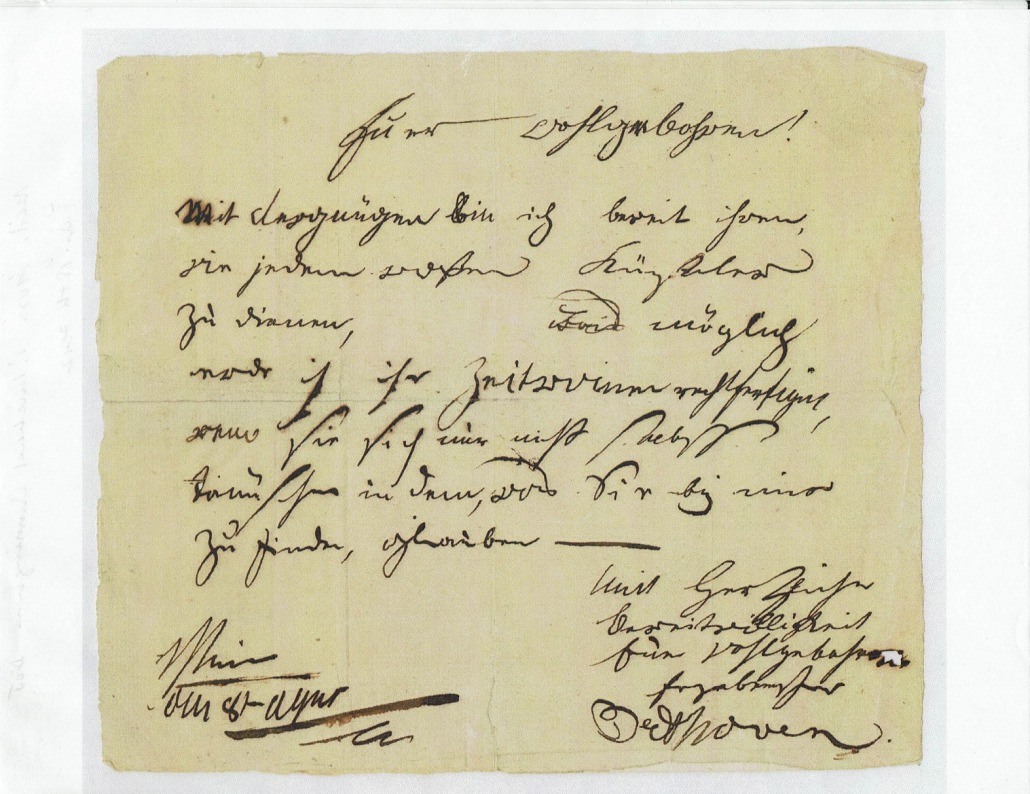
On the 8th of August probably in 1825 Beethoven wrote a letter to Karl Friedrich Müller in Berlin. There are two persons in the Beethoven literature with nearly identical names Carl Friedrich Müller and Karl Friedrich Müller. They are often confused, even by experienced Beethoven scholars. Carl Friedrich Müller was from Vienna and an invalid actor for whom Beethoven wrote two Waltzes and an Ecossaise, WoO 84-86 around 1824-25. Karl Friedrich Müller (1796-1846) on the other hand was a well known piano teacher and composer in Berlin. He was the son of Louise Müller (1763-1829) who was a well known and highly regarded opera singer. His father was an actor. Müller and his mother settled in Berlin; he teaching and she singing. Sometime in late 1825 or possibly 1826 Muller wrote a letter to Beethoven probably asking that Beethoven set some texts to music as songs. These could have been his own texts and he may have intended them to be performed by his mother. This we know only by implication because his original letter to Beethoven has not survived and this conjecture is based on the contents of Beethoven’s reply. It consists of a sheet of paper on which is written the address on one half and the letter on the other half. When folded the letter would be on the inside and the address on the outside.
The letter was fairly easy to identify once I got a look at it. It is listed in Anderson as A 1227 and in Brandenburg as B 2027. What confused me was that both Anderson and Brandenburg listed different owners and locations for the letter. After I was able to examine the letter at the National Archives I asked if they had looked for a watermark and was told no. I asked to look at the letter on a light-box to see if a watermark existed and it did. But not one that we were expecting. The letter described by Brandenburg, which is now in the Beethoven-Haus bears a Van-der-Ley watermark and came from the famous Max Josef Mannheim collection. I was expecting to see the Van-der-Ley watermark, but instead I saw an F B watermark on laid paper.

After much research I was able to identify the watermark as that of the Frederick Bicking company which was establish in 1762 in the Philadelphia suburbs and that they used this particular from of a watermark from the mid-1870s until the early 1880s.
Only one conclusion could be made and that was that the letter stolen by Landau and his accomplice was in fact a forgery that had gone undetected for nearly a century. Records at the Historical Society of Pennsylvania indicate that the letter was donated by a Mrs. Thomas Leaming on the 20th of March in 1917 along with two other letters; one by Franz List and the other by Mercadante. No one had ever checked the letters for watermarks or authenticity. The Beethoven letter had even been published in 1927 in facsimile by Oscar O. Sonneck in his “Beethoven Letters in America.” The great question now was; “Who did the forgery?” and “How did it come into the possession of Mrs. Leaming. The second question was little easier to answer. Mrs. Leaming’s husband was Thomas Leaming, Jr. a very prominent Philadelphia lawyer and collector of autographs and other important historical documents as was also his father, Thomas Leaming Sr. He was an equally well known lawyer and collector. Since the letter was on paper from the late 1870s, it was probably Leaming Sr. who acquired the letter and on his death it passed to his son and eventually his daughter-in-law who donated it to the Pennsylvania Historical Society. Who could have done the forgery is more speculative, but the only know and convicted forger of Beethoven letters living in Philadelphia at the time was Beethoven’s own grand-nephew, Ludwig Johann van Beethoven.
Ludwig Johann van Beethoven was born in 1839 and named for his two great uncles. He was taught music as a child and at some point studied engineering. He embarked on a military career and after that worked as a civil engineer. He spent time in Munich and Berlin. He found himself frequently short of funds and started selling Beethoven memorabilia. Perhaps a cufflink or a button that may or may not have actually belonged to his famous uncle. Who would know the difference as long as the items seems plausible and were old enough to have belong to the composer. At some point he started to forge letters and papers asserting that they had been written by his famous uncle. It must have been easy for him, perhaps a little too easy, for by the early 1870s he got caught selling forged documents to King Ludwig II of Bavaria. He was convicted but seems to have jumped bail before being sentenced to four years in jail. Documents show that he went with his wife and young son to London to arrange for passports. Ship documents show that he arrived in New York on the 15th of September 1871. Clearly a month or two before being sentenced in absentia. He must have feared conviction and fled before sentencing. The Bavarian police don’t seem to have been willing to pursue him. Probably because they didn’t want further publicity. To have brought him back would only add to the embarrassment of King at being fooled.
Once in America he seems to have flourished. He worked for several different railroads and in several cities in the US including New York City and Rochester, Buffalo, Detroit and Jackson in Michigan and Chicago among other places. He was enterprising; he started a company for the renting of wheel-chairs to visitors of the Centennial Exhibition in Philadelphia in 1876 as well a messenger company with two offices in New York and one in Philadelphia. It is his activities with the wheel-chair company and the messenger company that puts him in Philadelphia in the late 1870s and early 1880s and thus a likely candidate for forger. He even dabbled in invention, having applied for a patent for a method of metering the distances traveled by taxicabs and thus making sure the fare charged is correct.
On one occasion when he was working for the Union Pacific Railroad he made a trip with his wife and children to San Francisco. While there he decided to take a vacation trip to Hawaii by boat. He stayed at the Royal Hawaiian Hotel on Waikiki beach. The hotel still stands, although much enlarged today.
The German American community was very tight knit one. They frequently reach out to help new arrivals. Ludwig Johann van Beethoven who now went by the name of Louis von Hoven seems to have benefitted from these connections. He found work quickly as a railroad manager. His background as a civil engineer must have helped. Although he had some success in America he never gave up his shady instincts. He left America in around 1890 but lapsed into obscurity. It is not know where he died or even where he is buried.
Il 9 luglio 2011 un membro dello staff della Maryland Historical Society di Baltimora vide un certo Jason Savedoff sottrarre un documento dalla biblioteca della Società. Fu chiamata immediatamente la polizia. Le forze dell’ ordine trovarono 60 documenti nascosti nella custodia del computer portatile di Savedoff, celato in un armadietto, molti dei quali erano stati firmati da Barry Landau.
Oltre al computer portatile, ognuno di loro aveva tasche enormi cucite nelle giacche per nascondere i documenti rubati.
Una volta che la coppia di criminali fu arrestata, divenne necessario per la polizia determinare la portata della loro attività criminale. Dal momento che la coppia fu arrestata nel Maryland e le loro residenze erano a New York, ciò divenne crimine federale e non solo un furto locale. La polizia di Baltimora avvertì il Federal Bureau of Investigation (FBI), che il furto potrebbe aver attraversato i confini di stato. L’FBI predispose un mandato di perquisizione per l’appartamento di Landau a New York. La polizia non era preparata per quello che trovò. Più di diecimila pezzi di cimeli presidenziali, dai pins per le campagne elettorali ai menu per le cene di stato. Trovarono anche importanti documenti storici, come lettere di Thomas Jefferson, Abraham Lincoln, Benjamin Franklin e persino Sir Isaac Newton. Questi furti andavano avanti da anni. Non solo nelle società storiche di New York, Pennsylvania e Maryland, ma anche a danno della Biblioteca del Congresso e della Biblioteca presidenziale Franklin Roosevelt a Hyde Park. I materiali sequestrati furono inviati all’Ufficio dell’Ispettore Generale degli Archivi Nazionali per lo smistamento. A poco a poco vennero identificati i proprietari degli oggetti rubati. La maggior parte delle istituzioni non sapeva che gli elementi fossero stati sottratti. Altri mille oggetti sarebbero stati rapidamente rintracciati nelle collezioni della Historical Society e nelle biblioteche presidenziali site nella costa orientale degli Stati Uniti. I due uomini furono incarcerati a Baltimora e incriminati da un Grand Jury federale alla fine di luglio del 2011. Entrambi gli imputati si dichiararono colpevoli; Savedoff nell’ottobre 2011 e Landau nel febbraio 2012.
Il 27 giugno 2012 Landau fu condannato a sette anni di carcere dal giudice distrettuale federale Catherine Blake. Nel commentare la condanna, l’avvocato statunitense Rod J. Rosenstein dichiarò: “Le prove hanno dimostrato che Barry Landau era un truffatore che si è mascherato da storico presidenziale per ottenere la fiducia della gente in modo da poter rafforzare le loro proprietà, la rivelazione che il signor Landau era un prolifico ladro ha lanciato un campanello d’allarme a musei, biblioteche e altre istituzioni che affidano preziosi oggetti storici a persone che affermano di essere impegnate nella ricerca accademica”.
Barry Landau (nato nel 1948) è un noto collezionista di manufatti presidenziali, l’autore di “The Presidents Table” pubblicato nel 2007 e “sedicente” American Presidential Historian. Landau ha mostrato alcuni pezzi pregiati della sua collezione al Martha Stewart Show. È stato anche commentatore della CNN e del Today Show della NBC.
Mentre tutto questo si svolgeva in un tribunale federale di Baltimora, stavo lavorando a un lavoro di progettazione per dei clienti, Michael Cunningham e sua moglie. Michael Cunningham era assistente del procuratore del Dipartimento di Giustizia e stava lavorando al caso con il procuratore capo Rod Rosenstein. Durante una visita alla casa dei Cunningham, Michael mi parlò dell’arresto e dell’azione penale. Rimase piuttosto sorpreso quando risposi che avevo incontrato Barry Landau alla Casa Bianca diversi anni prima, quando era venuto a vedere i progetti che avevo aiutato a preparare per una cena di stato. Fui poi sorpreso di apprendere da Cunningham che una delle lettere rubate alla Historical Society of Pennsylvania di Filadelfia era stata scritta da Beethoven (questo non era stato menzionato nelle notizie dei media). Pensai che questa storia sarebbe stata un articolo interessante e chiesi a Cunningham se poteva darmi maggiori informazioni su quale lettera di Beethoven fosse stata rubata. Cunningham fece presente a Rosenstein del mio interesse sulla questione e fece in modo non solo di ottenere una fotocopia della lettera, ma anche di andare agli Archivi Nazionali e ispezionarla di persona. Normalmente nessuno, al di fuori degli avvocati dell’accusa o della difesa, è autorizzato a vedere le prove di un procedimento penale. Sono stato fortunato, quale ricercatore beethoveniano, ad avere un tale accesso privilegiato.
Fu probabilmente l’ 8 agosto 1825 che Beethoven scrisse una lettera a Karl Friedrich Müller a Berlino. Esistono due persone, nella letteratura beethoveniana, con nomi quasi identici: Carl Friedrich Müller e Karl Friedrich Müller. Sono spesso confusi, anche da esperti studiosi. Carl Friedrich Müller, viennese, fu un attore invalido per il quale Beethoven scrisse due valzer e un’Ecossaise, WoO 84-86 intorno al 1824-25. Karl Friedrich Müller (1796-1846) fu un noto insegnante di pianoforte e compositore attivo a Berlino. Era il figlio di Louise Müller (1763-1829) che a sua volta fu cantante d’opera, ben nota e molto apprezzata. Suo padre era attore. Müller e sua madre si stabilirono a Berlino; lui insegnava e lei cantava. Verso la fine del 1825 o forse nel 1826 Müller scrisse una lettera a Beethoven, probabilmente chiedendo che Beethoven mettesse in musica alcuni testi come Lieder. Probabilmente i testi erano i suoi e potrebbe aver voluto che fossero cantati dalla madre. Evinciamo questo implicitamente, dal momento che la lettera originale di Müller inviata a Beethoven non è sopravvissuta e questa congettura si basa sul contenuto della risposta del compositore. Consiste in un foglio di carta su cui è scritto l’indirizzo su una metà e la lettera sull’altra metà. Una volta piegata, lo scritto sarebbe stato rivolto all’interno e l’indirizzo all’esterno.
Dopo una rapida visione la lettera è stata abbastanza facile da identificare. È elencata in Anderson come A 1227 e in Brandenburg come B 2027. Ciò che mi ha confuso è che sia Anderson che Brandenburg hanno elencato diversi proprietari e collocazioni. Dopo essere stato in grado di esaminare la lettera presso gli Archivi Nazionali, ho chiesto se avessero cercato la filigrana e mi è stato detto di no. Ho chiesto quindi di visionare la lettera su di una scatola luminosa, per vedere se esistesse una filigrana. La filigrana era presente ma non quella che si aspettasse. La lettera descritta da Brandenburg, che ora si trova alla Beethoven-Haus reca una filigrana Van-der-Ley e proveniva dalla famosa collezione Max Josef Mannheim. Mi aspettavo quindi di vedere la filigrana Van-der-Ley, invece notai una filigrana “F B” su carta vergata.
Dopo molte ricerche sono stato in grado di identificare la filigrana come quella della società Frederick Bicking che fu fondata nel 1762 nei sobborghi di Filadelfia e che usarono questa particolare filigrana dalla metà degli anni 1870 fino ai primi anni 1880.
Si poteva dunque trarre una sola conclusione: che la lettera rubata da Landau e dal suo complice fosse in realtà un falso, passato inosservato per quasi un secolo!. I documenti della Historical Society of Pennsylvania indicano che la lettera fu donata da una certa signora Thomas Leaming il 20 marzo 1917 insieme ad altre due lettere; una di Franz List e l’altra di Mercadante. Nessuno aveva mai controllato le lettere o la filigrana per stabilirne l’ autenticità. La lettera di Beethoven fu persino pubblicata nel 1927 in facsimile da Oscar O. Sonneck nelle sue “Lettere di Beethoven in America”. La domanda principale ora era questa; “Chi ha falsificato?” e “In qual modo ne entrò in possesso la signora Leaming?. Alla seconda domanda era un po’ più facile rispondere. Il marito della signora Leaming era Thomas Leaming, Jr., un importante avvocato di Filadelfia e collezionista di autografi e altri importanti documenti storici, così come suo padre, Thomas Leaming Sr., altrettanto noto avvocato e collezionista. Poiché la lettera era su carta della fine del 1870, fu probabilmente Leaming Sr. ad acquistare la lettera e alla sua morte passò a suo figlio e poi a sua nuora, che la donarono alla Pennsylvania Historical Society. Chi avrebbe potuto falsificare il documento è più speculativo, ma l’unico falsario noto (e condannato) di lettere di Beethoven e all’ epoca viveva a Filadelfia era il pronipote di Beethoven, Ludwig Johann van Beethoven.


Ludwig Johann van Beethoven nacque nel 1839 e prese il nome dai suoi due prozii. Da bambino gli fu insegnata musica e seguì studi di ingegneria. Intraprese la carriera militare e successivamente lavorò come ingegnere civile. Trascorse qualche tempo a Monaco e Berlino. Si trovò spesso a corto di soldi e iniziò a vendere cimeli di Beethoven. Ora un gemello ora un bottone che avrebbero potuto esser appartenuti (o meno) al famoso zio. Del resto, all’ epoca chi avrebbe potuto riconoscere come veri questi oggetti purché fossero abbastanza vecchi da attribuirli al compositore. Ad un certo punto iniziò anche a falsificare lettere e documenti. Quest’ attività dovette sembrargli fin troppo facile, tanto che, all’inizio degli anni 1870, fu sorpreso a vendere documenti falsi al re Ludovico II di Baviera. Fu condannato, non pagò la cauzione e fu condannato a quattro anni di carcere. I documenti mostrano che si recò con sua moglie e suo figlio a Londra, per imbarcarsi. I documenti della nave mostrano che arrivò a New York il 15 settembre 1871. Chiaramente un mese o due prima di essere condannato in contumacia. Praticamente fuggì prima della sentenza. La polizia bavarese non sembrò essere stata troppo interessata alla sua fuga. Probabilmente perché non volevano ulteriore pubblicità negativa; averlo riportato indietro avrebbe solo aumentato l’imbarazzo del Re per essere stato ingannato.
Una volta arrivato in America sembra aver fatto fortuna. Lavorò per diverse società ferroviarie e in diverse città degli Stati Uniti, tra cui New York City e Rochester, Buffalo, Detroit e Jackson nel Michigan e Chicago. Era intraprendente; fondò una società per l’affitto di sedie a rotelle ai visitatori della Centennial Exhibition di Filadelfia nel 1876 e una società di corriere con due uffici a New York e uno a Filadelfia. Le sue attività con la compagnia di sedie a rotelle e la compagnia di messaggeri lo collocano a Filadelfia tra la fine del 1870 e l’inizio del 1880 e quindi un probabile candidato per il ruolo di falsario. Si dilettò persino nell’inventare un metodo per misurare le distanze percorse dai taxi e assicurarsi così che la tariffa applicata sia corretta.
In un’occasione, mentre lavorava per la Union Pacific Railroad, fece un viaggio con sua moglie ei suoi figli a San Francisco. Da quella città decise di fare un viaggio di vacanza alle Hawaii in barca. Soggiornò al Royal Hawaiian Hotel sulla spiaggia di Waikiki. L’hotel è ancora esistente, sebbene molto modificato.
La comunità tedesco-americana era molto affiatata. Spesso aiutavano i nuovi arrivati dall’ Europa. Ludwig Johann van Beethoven, che prese il nome Louis von Hoven, sembra abbia beneficiato di questi contatti. Trovò rapidamente lavoro come direttore delle ferrovie. Il suo background come ingegnere civile deve averlo aiutato. Nonostante abbia avuto un certo successo in America, non rinunciò mai ai suoi loschi traffici. Lasciò l’America intorno al 1890, ma cadde nell’oblio. Non si sa dove sia morto e nemmeno dove sia sepolto.