Posts

Pages

Unv.19 – Cantata in B major for Four Voices and Piano (Fischhof & Kafka Sketches)

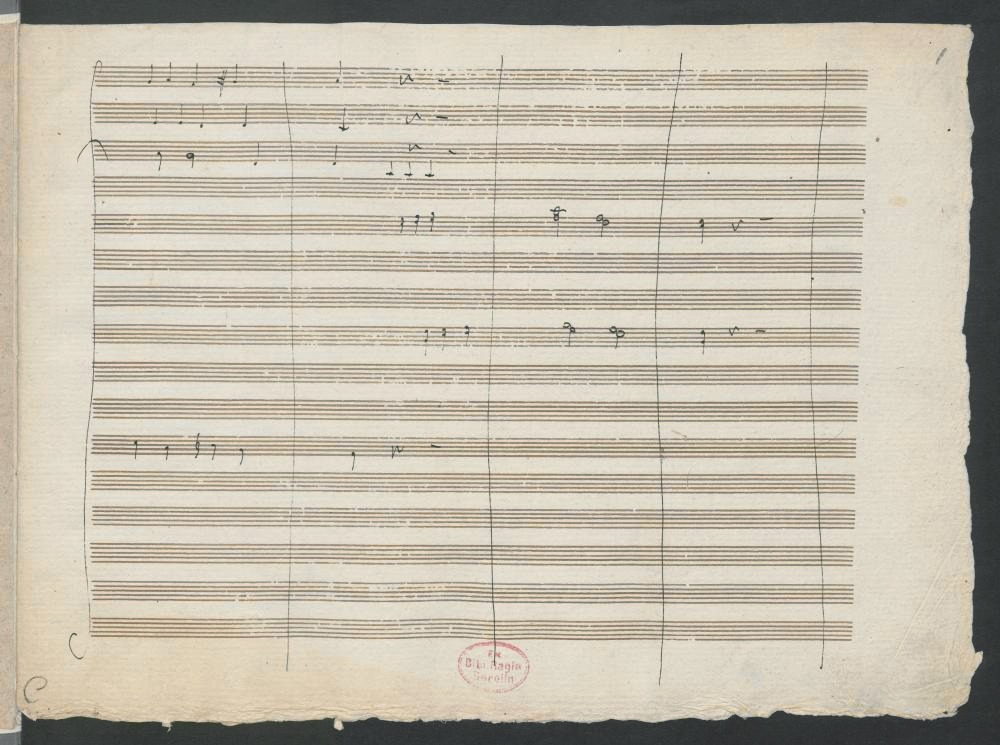
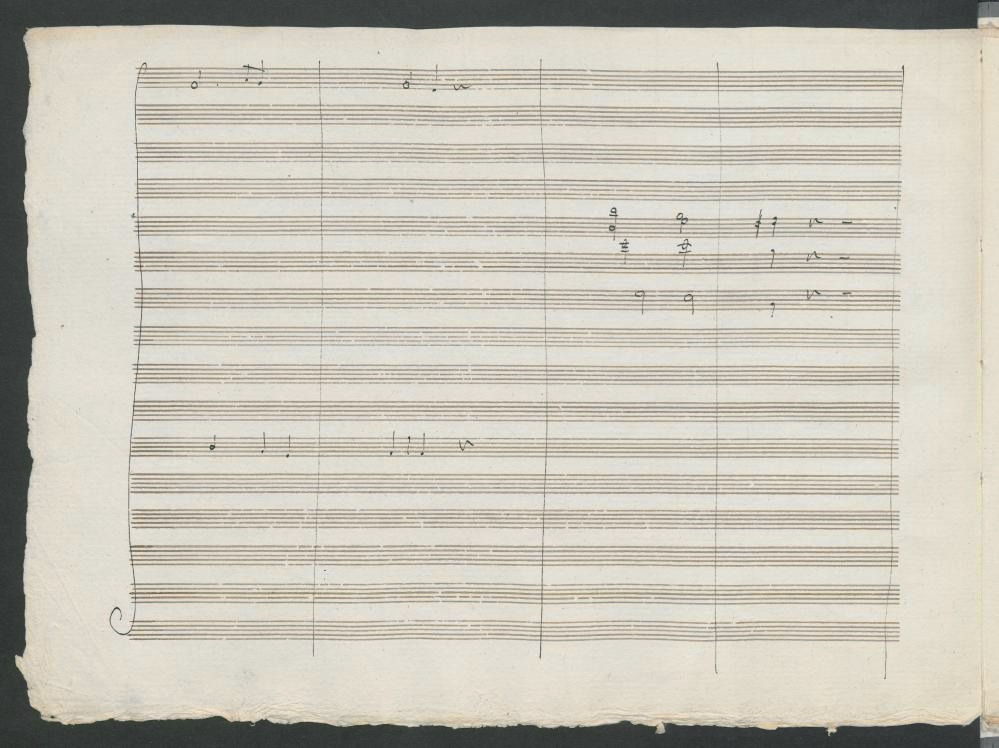
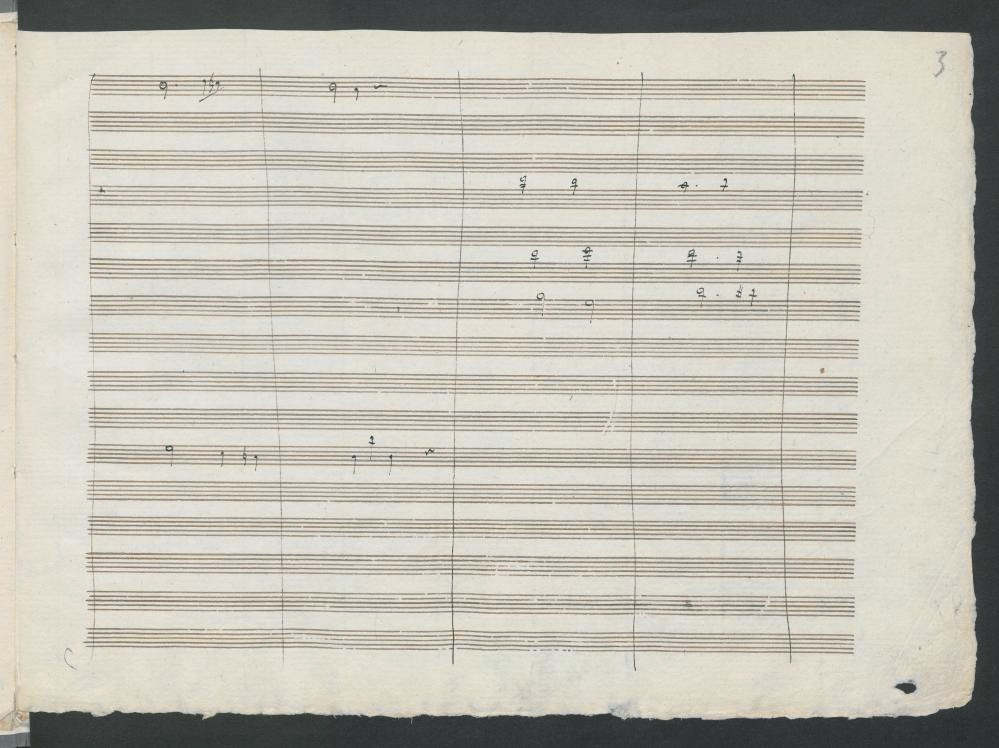
Unv. 19 Composition (Cantata, in B major) for four voices and piano

(Fischhof folio 1 versus, Kafka folio 66 e 100 recto)
The musical examples on this page are by Gerd Prengel.

Unv. 19 Composition (Cantata, in B major) for Four Voices and Piano.  Source: Fischhof folio 1 verso, Kafka folios 66 and 100 recto Musical examples: By Gerd Prengel Note: This composition is not included in NGA-AGA-e or SBG catalogs.

Origin and Dating: The work was sketched between 1790 and 1792, during Beethoven’s final period in Bonn. All three sheets containing sketches for this cantata originate from this time.

Sketch Details:

  • Sketch 1: Found on the “Fischhof” miscellanea sheet. Also includes sketches for the song Op. 75 No. 3, dated May 1790 (with a later sketch from 1793).
  • Sketch 2: Located in the “Kafka – Skizzenkonvolut” miscellanea. Adjacent to sketches for WoO 67 variations, composed between 1790–1792.
  • Sketch 3: Viennese sketch among sketches for WoO 113, known to be composed by March 1790.

Textual Fragments

  • Only a few words appear in the sketches:
    • “Sind wir gute”
    • “Sind wir”
    • “und zur”
    • “hin zu einer Jugend”
  • Due to the fragmentary nature, the author of the original text cannot be identified.

Location of Sketches

Archive Reference Notes
D-B (Berlin State Library) Mus. ms. autogr. Beethoven 28 (“Fischhof”), Bl. lv Facsimile available; transcription by Johnson/Fischhof Vol. 2, p. 148f
GB-Lbl (British Library, London) Add. Ms. 29801 (“Kafka”), Bl. 100 recto Facsimile and transcription by Kerman Kafka
A-Wgm (Vienna) A 66, Bl. Ir Transcription by Johnson/Fischhof Vol. 2
Sources
  • Johnson / Fischhof Vol. 1, pp. 441–443

Unv.05 – Fragment of a “Concertante” in C major (c. 1802) | Beethoven Music Research Center

Unv. 5 – Frammento di un “Concertante” in do maggiore

1802 circa

Many times Beethoven began large‑scale works only to abandon the project later. This is the case with this concertante in C major, a double or triple concerto—perhaps for violin, violoncello (piano), and orchestra—which predates by several years the well‑known Triple Concerto, Opus 56.

Beethoven began working intensively on this concertante in the sketchbook known as the “Kessler,” which he used from the first half of 1802. Some sketches already appear on folios 38 verso and 38 recto, continuing densely up to folio 41 verso. From this point onward, the composer was probably becoming dissatisfied with the progress, rewriting the second half of the work in a manner far more disorderly than before.

At the same time, Beethoven also began preparing a complete orchestral score, written on paper bearing the same watermark as the Kessler sketchbook. This score, which has come down to us as a 12‑page fragment, has been catalogued as Artaria 183 and is preserved at the Staatsbibliothek in Berlin. The first pages have been lost, and what remains corresponds to bar 43 of the Kessler project, continuing with the solo entry up to bars 113–126.

Some ideas for further “solo” passages were found on folio 41r of the sketchbook, but the corresponding passages in the score are much more fully developed. What clearly emerges is that the Artaria 183 manuscript lacks its opening pages. Indeed, the very first surviving note is a viola bar with a slur that must necessarily have begun on a preceding (now lost) page.

Whether Beethoven continued writing after bar 126 remains an open question. The last bar of the solo violin part coincides with the end of the page, but from that point onward the score—which until then had been fairly polished (though not complete)—gradually declines into a sketch. Little was developed beyond the first exposition: a few conceptual ideas, only lightly worked out. It is important to note that one of these ideas is marked “for the Concertante,” specifying precisely the aesthetic form Beethoven had in mind for this composition.

The principal study of this material was carried out by Richard Kramer. His work was published in 1977 in the volume Beethoven Studies. Kramer observes:

“The very existence of a fragmentary score for the first movement of the concertante stands as evidence that Beethoven would work intermittently between sketchbook and score within a single movement… Much remained to be worked out in the sketchbook: the solo exposition is not sufficiently drafted; the development has not even been attempted; the recapitulation would surely require at least some sketching. With fundamental aspects of the first movement still unsettled, Beethoven has begun the transfer from sketchbook to score.”

Many times Beethoven began large‑scale works only to abandon the project later. This is the case with this concertante in C major, a double or triple concerto—perhaps for violin, violoncello (piano), and orchestra—which predates by several years the well‑known Triple Concerto, Opus 56.

Beethoven began working intensively on this concertante in the sketchbook known as the “Kessler,” which he used from the first half of 1802. Some sketches already appear on folios 38 verso and 38 recto, continuing densely up to folio 41 verso. From this point onward, the composer was probably becoming dissatisfied with the progress, rewriting the second half of the work in a manner far more disorderly than before.

At the same time, Beethoven also began preparing a complete orchestral score, written on paper bearing the same watermark as the Kessler sketchbook. This score, which has come down to us as a 12‑page fragment, has been catalogued as Artaria 183 and is preserved at the Staatsbibliothek in Berlin. The first pages have been lost, and what remains corresponds to bar 43 of the Kessler project, continuing with the solo entry up to bars 113–126.

Some ideas for further “solo” passages were found on folio 41r of the sketchbook, but the corresponding passages in the score are much more fully developed. What clearly emerges is that the Artaria 183 manuscript lacks its opening pages. Indeed, the very first surviving note is a viola bar with a slur that must necessarily have begun on a preceding (now lost) page.

Whether Beethoven continued writing after bar 126 remains an open question. The last bar of the solo violin part coincides with the end of the page, but from that point onward the score—which until then had been fairly polished (though not complete)—gradually declines into a sketch. Little was developed beyond the first exposition: a few conceptual ideas, only lightly worked out. It is important to underline that one of these ideas is marked “for the Concertante,” specifying precisely the aesthetic form Beethoven had in mind for this composition.

The principal study of this material was carried out by Richard Kramer. His work was published in 1977 in the volume Beethoven Studies. Kramer observes:

“The very existence of a fragmentary score for the first movement of the concertante stands as evidence that Beethoven would work intermittently between sketchbook and score within a single movement… Much remained to be worked out in the sketchbook: the solo exposition is not sufficiently drafted; the development has not even been attempted; the recapitulation would surely require at least some sketching. With fundamental aspects of the first movement still unsettled, Beethoven has begun the transfer from sketchbook to score.”

These considerations indeed prompt reflection on Beethoven’s compositional method. But why, then, did Beethoven ultimately abandon this project?

Kramer believes that the answer may be found in a letter dated 22 April 1802 from Beethoven’s brother Karl to Breitkopf & Härtel:

“My brother would have written in person, but he is unwilling to do so at the moment, since Baron van Braun is a stupid and coarse theatre director and has refused the use of the theatre for the Akademie, turning it instead into a stage for utterly mediocre performers.”

If Beethoven was preparing the concertante for this Akademie and for that theatre, the incident may have discouraged him.

We find Karl again in another letter to Breitkopf & Härtel dated 14 October 1803, offering a “Konzertant für alle Instrumente für Klavier, Violonzello und Violino.” Since the earliest known sketches of the Triple Concerto Op. 56 date from the first months of 1804, it is entirely plausible that Beethoven considered returning to work on this concertante.

Beethoven’s dissatisfaction with this first attempt at a concertante may be attributed to the limited potential of the chosen material. Even though the solo entries are beautiful and interesting, as Kramer notes, the principal theme is at once short and poor, and probably not suited to support a large‑scale composition.

Kramer sees the Triple Concerto as:

“at once a reaction to the failed attempt, and… a realization of images and concepts latent in the fragment. The muted opening bars, barely articulate in the low strings, are common to both works (though we must infer some of this quality from the inconclusive sketches in ‘Kessler’). In both cases, this initial idea is detached from, or introductory to, a principal thematic event, though in Opus 56 the two are motivically akin.”

The Concertante in C major thus seems to have been abandoned when the circumstances that justified its immediate realization ceased to exist. The bitter taste of that disappointment may have reinforced Beethoven’s dissatisfaction with the flaws in the conception of the work—flaws he may have considered irreparable.

Yet it is reasonable to view the Triple Concerto as a definitive stage in the gestation of the same project. The important and fundamental concepts of the earlier concertante are not simply rejected; rather, they are assimilated—consciously or not—into a work that embodies the completion of a temporarily set‑aside undertaking.

Composition

Composed in the first months of 1802, up to April at the latest. The orchestral works drafted in the “Kessler” notebook at the beginning of 1802 (see Brandenburg/Keßler vol. 1, pp. 32f) can almost all be seen in connection with an Akademie that Beethoven planned for April 1802 and which did not take place (see letter BGA 85). Among the unfinished works, the Concertante is the most advanced; Beethoven had already begun to elaborate the exposition of the first movement. There also exist brief sketches and ideas for the other movements.

Sieghard Brandenburg assumes that Beethoven probably would not have been able to complete the work in time, even if the Akademie had taken place (Brandenburg/Keßler vol. 1, p. 14). Perhaps for this reason he had already abandoned the Concertante. Richard Kramer postulates musical reasons for the abandonment, reinforced by the failed Akademie plan (Kramer/Concertante).

In 1803 Beethoven tried again with the same instrumentation in a Concertante in F major (see BGA 163 and Op. 56), and finally composed the Triple Concerto Op. 56 in 1804. For possible musical relationships between Op. 56 and Unv. 5, see Kramer/Concertante and Ferencz/Op56.

Sketches and Drafts

A‑Wgm, A 34 (“Kessler”), folios 38v–39r, 40v–43r, and 71r. Dating: from the first months to April 1802. Facsimiles and transcriptions: Brandenburg/Keßler, Kramer/Concertante.

Autograph Score, 1st Movement

Key: D major – B‑flat. Shelfmark: Mus. SM. autogr. Beethoven Artaria 183. Missing folios at the beginning and possibly at the end; the score is incomplete. Extent: 12 folios; 24 pages in score, 1r–12v. Paper: horizontal format, 23.5 × 32 cm, double‑spaced.

Provenance: Purchased by Artaria at auction in 1827. Artaria publishing house archive, Vienna. Erich Prieger, Bonn, from 1897. Acquired in 1901.

Facsimile of folios 1r and 10v and partial transcription: Kramer/Concertante. Complete facsimile: SBB.

Descriptions: Bartlitz/Catalogue; Johnson/Artaria p. 21ff.; Kramer/Concertante. Biography: Brandenburg/Keßler; Ferencz/Op56 pp. 134–145; Kramer/Concertante.

Unv.16 – Overture “Macbeth” Fragment (Previously Biamonti 454)

Unv. 16 Overture to a “Macbeth” by H.J. Collin; unfinished work. (Previously Biamonti 454)

(Landsberg 10 Skizzenbuch seite 133 )

Unv. 16 – Biamonti 454. Macbeth, notes for an opera based on a libretto by Collin, drawn from Shakespeare’s tragedy, 1808 (no later than late autumn).

As reported by Nottebohm (Vol. II, pp. 225–227), in 1808—or possibly even earlier—Beethoven had come to an agreement with H. J. von Collin regarding a libretto based on Shakespeare’s Macbeth. The poet completed the first act, which was published in the Wiener-Hof-Theater-Taschenbuch for 1809, but the libretto progressed no further than halfway through the next act. According to a note added by Collin’s brother, Matteo von Collin, in the collected edition of the poet’s works, the opera was abandoned because it “threatened to become too gruesome.”

A sheet preserved in the Royal Library in Berlin contains a musical sketch, reproduced by Nottebohm, which can only refer to the witches’ chorus that opens Collin’s libretto. This sketch is immediately followed by drafts for the Largo of the Piano Trio in D major, Op. 70 No. 1.

The stage direction for the witches’ chorus reads as follows:
“(Waldige Gebirgsgend. Die ganze Bühne erfullt sich mit Wolken. Die Hexen kommen auf Adlern, Greifen in der Luft geflogen).” Act One (mountainous wooded region. The entire stage fills with clouds. The witches arrive flying on eagles and griffins).

First Witch: Thrice the brinded cat hath mew’d.

Second Witch: Thrice and once the hedge-pig whined.

Third Witch: Harpier cries:—’tis time! ’tis time!

First Witch: Round about the cauldron go; In the poison’d entrails throw.— Toad, that under cold stone, Days and nights has thirty-one Swelter’d venom sleeping got, Boil thou first i’ the charmed pot.

ALL: Double, double toil and trouble; Fire burn and caldron bubble.

The proximity, contemporaneity, and identical key of the sketch with those immediately following for the Largo of the Trio “lead one to suppose,” says Nottebohm, “an association of states of mind. Whether Beethoven, through an earlier reading of the libretto and the thought of Shakespeare’s terrifying drama, was led to the ghostly tone of the Trio’s Largo—or vice versa—is difficult to determine.”

On a second sheet containing sketches for The Ruins of Athens, the following note appears:
“Ouverture Macbeth fällt gleich in den Chor der Hexen ein.”


Sketched between 1808 and 1811. The only existing drafts for the opera Macbeth appear on a sheet that belongs to the Pastoral Symphony and dates back to 1808. According to a short notice in the Fliegenden Blättern aus dem Portefeuille eines Reisenden im Junius und Julius 1808 (in the Journal des Luxus und der Moden, page 705), that year Beethoven set aside Macbeth in favour of a planned staging of Goethe’s Faust:
„Die Oper, zu welcher Herr Collin das Sujet bearbeiten sollte, componiret er nun nicht.“
(“He is no longer composing the opera for which Herr Collin was to develop the subject.”)

However, it seems that the project was not entirely abandoned. At the beginning of the Petter sketchbook, there is the following note:
“Ouverture Macbeths fällt gleich in den Chor der Hexen ein”
The Petter sketchbook likely dates from September 1811. Beethoven brought it with him to Teplitz, where he spent the summer. The news that the librettist Heinrich Joseph Edler von Collin (1771–1811) had died on 28 July of that year, and thus could not complete his libretto, evidently never reached him. Still, Collin had not worked on the text for quite some time. His brother Matthäus von Collin gave the reason for this in 1813:
„Macbeth, den er [Heinrich] gleichfalls für Beethoven nach Shakespeare zu dichten unternahm, ward in der Mitte des zweyten Actes unvollendet liegen gelassen, weil er zu düster zu werden drohte“
(“Macbeth, which [Heinrich] likewise undertook to write for Beethoven from Shakespeare, was left unfinished halfway through the second act because it threatened to become too dark.”) (Collin / Biographie, p. 422f)

Heinrich Joseph von Collin (Vienna, 26 dicembre 1771 – Vienna, 28 luglio 1811) (Litografia Proprietà di Armando Orlandi(

In his Memories, the actor Heinrich Anschütz recounted a conversation he had with Beethoven in the summer of 1822 about the musical setting of Macbeth. However, this did not concern the operatic project from 1808, but rather incidental music for Shakespeare’s tragedy:

„Eines Tages begleitete ich ihn [Beethoven] eine Strecke. Wir sprachen über Kunst, Musik und endlich über Lear und Macbeth. Wie zufällig warf ich die Bemerkung hin, daß mich schon öfter der Gedanke beschäftigt habe, ob er nicht als Seitenstück zur Egmont Musik den Macbeth musikalisch illustriren sollte? Der Gedanke schien ihn zu elektrisirert blieb wie angewurzelt stehen, sah mich mit einem durchdringenden, fast dämonischen Blicke an und erwiderte hastig: ,Ich habe mich auch schon damit beschäftigt. Die Hexen, die Mordscene das Geistermahl, die Kesselerscheinungen, die Nachtwandlerscene, Macbeth’s Todesraserei Es war im höchsten Grade interessant, seinem Mienenspiele zu folgen, in welchem sich die blindschnellen Gedanken jagten. In wenigen Minuten hatte sein Genius das ganze Trauerspiel duruchgearbeitet. Bei der nächsten Frage, die ich an ihn richtete, drehte er sich um und rannte einer flüchtigen Begrüßung davon. Leider aber war einer stürmischen Erregung nicht die Thragefolgt. Als ich nach einiger Zeit das Thema noch einmal berührte, fand ich ihn verdrießlich und schwieg.“
(Heinrich Anschütz, Erinnerungen aus dessen Leben und Wirken, Vienna 1866, p. 269)

Heinrich Joseph Edler von Collin’s Macbeth (1771–1811) was based on Shakespeare, but according to Dieter Martin, it is more likely that Collin had begun composing an opera based on this subject. In 1807, Collin had published a programmatic essay „Sul dramma cantato“, in which he called for a fusion of drama and opera. In Collin’s Macbeth, Martin suspects the attempt „den Versuch, ‚die deutsche Librettistik durch die musikdramatische tion einer Shakespeare-Tragödie zu fördern und damit einen nicht etablierten Opertypus in deutsche Musiktheater einzuführen’“ (Martin/Shakespeare, p. 10).

However, Collin failed in his programme. He did not complete the libretto but broke off halfway through the second act. The completed first act appeared in the Wiener Hof-Theater-Taschenbuch for 1809 (pp. 87–109). An anonymous reviewer of this publication found the plot “dark and horrible,” and also wrote: „Eine Handlung von solcher Beschaffenhet kann nicht der Stoff des Singspieles seyn“ (Review of the Vienna Court Theatre 1809, in: Annalen der Literatur und Kunst 2, 1809, p. 123, cited by Martin/Shakespeare p. 13).

(1) D-B, Mus. SM. autogr. Beethoven Landsberg 10, p. 133. Belonging to the Pastoral sketchbook (GB-Lbl, Add. Ms. 31766). Dated: 1808
(2) D-BNba, Coll. H. C. Bodmer, HCB Mh 59 („Petter“), folio 9verso, September 1811, facsimile: DBH

(see below)

Unv. 16 Overture to a “Macbeth” by H. J. Collin; unfinished work. (Previously Biamonti 454)

Sketches written for the concert held in November 2002 in Rennes (F) and for other circumstances

Programmatic Notes on Beethoven’s Macbeth Overture

Biamonti 454 (1808/11)

Shortly after the premiere of the Macbeth overture in Washington in 2001, an article appeared in the online version of the Encyclopaedia Britannica stating: “The desire of classical music enthusiasts for Beethoven’s music remains insatiable; and this desire is heightened by the knowledge that many of his compositions never saw the light of day.” This observation compels us to reflect: What is it about Beethoven’s music that provokes such enduring fascination? Why do scholars and musicologists dedicate themselves to the study of fragmentary sketches and drafts? The answer lies in Beethoven himself and his music: he wrestled with fate — not only his own, but that of humanity at large. His struggle — one of the great epic poems of the modern world — is embodied in a succession of powerful works that, in their humanity and unmediated immediacy, have never been equalled.

Through his personal battle, Beethoven became one of humanity’s heroes, and through his triumph, he was — and remains — one of its prophets. This is why scholars pursue unfinished works, seeking possibilities of completion. Musicologists and composers who, through their efforts, have shed new light on Beethoven’s genius are themselves musical heroes of the modern age. In expanding our understanding of Beethoven, they have broadened our understanding of ourselves. Against the skepticism of closed minds and at the risk of ridicule, they have liberated these works from silence; from our side, the only fitting response is sincere gratitude.

The sketches for Macbeth are essentially grouped into three collections. One page of sketches, preserved in the Beethoven-Haus, bears the inscription: “introduction… Macbeth suddenly joins the witches’ chorus.” Another notebook, held by the British Library, contains sketches for Macbeth alongside a trio entitled “Geist.” Some scholars, including Gustav Nottebohm — the most eminent Beethoven scholar of the nineteenth century — believed that the trio sketches directly relate to the witches’ chorus in Macbeth. A third sheet of sketches, preserved in Berlin, contains stage directions and outlines the introduction. The version featured on this recording, based on these sketches, was completed in 2000 by Albert Willem Holsbergen and is dedicated to Avishai Kallai, an Israeli musicologist.

The Introduction is a miniature version of the opera’s dramatic action. It begins — as does Shakespeare’s drama and Collin’s libretto — with thematic material representing the “witches’ chorus.” This is followed by the thematic exposition defining the characters of Macbeth and Lady Macbeth. Macduff and his troops are evoked through a musical depiction of the battle in which “Birnham wood” moves to attack Dunsinane Hill. The material of the witches’ chorus then returns. Holsbergen writes, “I like to imagine a listener familiar with Shakespeare’s drama who, upon hearing this work for the first time, perceives that it has been written solely for Macbeth, and no other drama.”

Preliminary Draft of CD Article: Macbeth Overture

The Macbeth Overture, Biamonti 454: from the virtual to the real.

When, in the spring of 2000, Willem Holsbergen shared with me the definitive reconstruction of the Macbeth overture, Biamonti 454, we had many reasons to feel satisfied. Not only was the website www.unheardbeethoven.org receiving countless monthly visitors, but for the first time a work of considerable intellectual depth had been completed. Both the sketches—of remarkable quality—and the reconstruction appeared to us as the most ambitious project attempted up to that point. The MIDI file was uploaded in the site’s summer update of the same year, yet it took a long time before the work took on the tangible form of a public performance.

The opportunity arose from a meeting between James Green, Mark Zimmer, and the renowned conductor Leonard Slatkin, music director of the National Symphony Orchestra in Washington, in the spring of 2001. From this fruitful encounter came the world premiere of the overture at the Kennedy Center in Washington on 20 September 2001. Unfortunately, due to a tragic coincidence, this concert was overshadowed by far more momentous events that shook the world at that time. Although the newly unveiled overture was met with warm applause, reflection focused more on the meaning of the word “life” than on the meaning of “art.”

The second public performance took place in a decidedly different atmosphere, in the charming city of Rennes, Brittany. The European premiere was entrusted to the vigorous baton of Stefan Sanderling, conductor of the Orchestre de Bretagne. On 29 November 2002, at the Opera de Rennes, as the second part of a concert-recital by Fazil Say, the overture filled for the first time that Europe Beethoven so cherished. People and artists divided by an ocean met for the first time on that occasion; what distance divides, art unites.

This recording edition is the fruit of the passion and dedication of conductor Roberto Diem Tigani. Roberto honoured us by conducting the overture’s first performance on Italian soil on 9 December 2003, leading the Orchestra Sinfonica Teatro e/o Musica di Sassari at the Sala Concerti “Pietro Sassu.” This concert demonstrated, if ever it were necessary, the sensitivity with which Inedita embraces new musical propositions.

Conceived in 1808 and never completed, the overture has been given new life and brought to completion through the work and love of all these artists. This recording marks the first great step toward the work’s consecration. The final words, therefore, belong to Macbeth himself, and seem addressed to those who, with dedication and passion for research, always feel they have only just begun their journey in Art: “My strange illusion is the fear of the initiate, who needs rigorous practice. We are still novices in the work.”

The overture “Macbeth” Unv. 16 is part of the project “Research becomes Art”

A New Life for the Unknown Works of Ludwig van Beethoven: An Artistic Exploration by Ensemble Accademia Ducale. Musical adaptation by Giovanni Claudio Traversi

Macbeth Overture premiered on 14 September 2022 in Potenza, at the Teatro F. Stabile.
The reduction for instrumental ensemble, by Giovanni Claudio Traversi, was based on the version by Roberto Diem Tigani, composer and conductor, who in turn worked on the version by Albert Willem Holsbergen. The concert, sponsored by the Municipality of Potenza, was part of the concert season I nuovi fiori dell’Accademia, which has received recognition from the Ministry of Culture – General Directorate for Performing Arts for the 2022–2024 triennium.

ENSEMBLE ACCADEMIA DUCALE
Michele Fiore, flute
Maria March Vazquez, oboe
Erminia Nigro, clarinet
Marco Coviello, bassoon
Antonio Fracchiolla, horn
Fabio Macchia, timpani
Francesca Cicolecchia*, violin I
Mirko Palmieri, violin I
Michele Barbieri, violin I
Ludovica Del Bagno*, violin II
Davide Moro, violin II
Maria Grazia D’Agostino, violin II
Carmine Caniani*, viola
Rosalba Potenza, viola
Vito Stano*, cello
Vincenzo Lioy, cello
Giuseppe D’Amico, double bass

CONDUCTOR
Simone Genuini

The Beethoven Music Research Center at the Beethoven-Haus in Bonn – September–October 2021

The Beethoven Music Research Center at the Beethoven-Haus in Bonn

Universität Bonn – – September 28 –October 1, 2021

The Beethoven Music Research Center lvbeethoven.org travelled to Bonn, where Luigi Bellofatto, within the framework of the conference “Musicology after Beethoven. XVII International Congress of the German Musicological Society (GfM)”, presented his research “Beethoven’s Reception in Italy through the Editions of his Music Printed in Italy in the 19th Century.” He also presented two studies by James F. Green, who was not present at the symposium.

The entire staff attended the event: Armando Orlandi, Fiorella Romenzi, Graziano Denini, and Marinella Bianco.

The Beethoven Music Research Center was invited to the Beethoven-Haus Birthplace Museum by its director, Dr. Nicole Kämpken.

Graziano Denini and Luigi Domenico Bellofatto had the pleasure of presenting the Beethoven-Archiv with two publications curated by the Beethoven Music Research Center:

  • The Revision of the Trio Anhang 3 by Graziano Denini, published by Da Vinci Publishing
  • The Piano Variations Unv. 14, with pianistic notes by Emanuele Stracchi

Beethoven’s Reception in Italy through the Editions of his Music Printed in Italy in the 19th Century

The years between the 1810s and 1830s mark the true beginning of the history of Beethoven’s reception in Italy: Milan was, along with Florence, one of the most active Italian centers, where Giovanni Ricordi and Giuseppe Lorenzi played an important role in publishing Beethoven’s works. In 1813, La Scala presented Salvatore Vigano’s ballet Prometeo, which included excerpts of Beethoven’s op. 43, some of which Ricordi published in a piano arrangement later that year, making it the first known Italian edition of Beethoven’s music. Many other Beethoven excerpts were included in ballets of Vigano and Gaetano Gioja, such as La vestaie, Didone, Gli ussiti, La vendetta di Venere, and II conte Essex, all performed at the Teatro alia Scala; most of them were then published in piano arrangements by Ricordi during the years 1815-1819, although the composer was not always acknowledged. Several early editions of Beethoven music were published in Italy, including an arrangement of op. 101 for piano and violin published by Ricordi in 1820 as well as other small, easy compositions. During the years 1817-1820, Lorenzi in Florence published almost 20 works by Beethoven, including piano and violin sonatas, and trios. Ricordi published Beethoven’s op. 85, Christ on the Mount of Olives in 1825. This became the first foreign edition of this work; several published librettos confirm that it was widely performed.


Luigi Bellofatto Born in Milan (Italy), studied piano and cello. He graduated in Physics-Electronic Engineering, has been organist making several recordings and performed several recitals. A lifelong devotee of Beethoven, Bellofatto has an extensive personal library on the subject and has given lectures on Beethoven and his music. He has written a book and contributed several articles on Alexander W. Thayer, the biographer of Beethoven, for the Beethoven-Haus in Bonn, the American Beethoven Society, the Harvard Magazine, the Association Beethoven France and other journals. He is co-author of the Italian website dedicated to Beethoven: www.lvbeethoven.org for which he wrote many articles.

James Green (Monument Records and Vance Brook Publishing, Alexandria, US)

Beethoven’s Only Uncle: Johann Peter Keverich.  New research will be presented on the life of Beethoven’s only surviving uncle. An examination of the name will be made. Because two his of brothers, his father and several other relatives including his only brother-in-law were named Johann, he probably was known in the family as “Peter”. If his sister called him Peter then his nephew, the young Beethoven, would have probably called him “Uncle Peter”. After becoming a Carmelite priest he took the name of Hubertus and was known as Father Hubertus from then on. He became the last prior of the Carmelite Monastery in Koblenz before his forced retirement to Ehrenbreitstein, the place of his birth. His activities will be described and examined in detail including his fateful encounter with the invading French army forced his retirement. An examination will be made of surviving municipal documents and contemporary newspapers of the last decade of Beethoven’s uncle’s life. There are no surviving records of any contact between Beethoven and his uncle during this period. Nor do either of Beethoven’s brothers, Carl and Johann, seem to have been in contact with him either. He died in 1807, well past the time when his nephew had become an internationally famous composer.

Beethoven Forgeries: A Recent Discovery and Its Connection to Ludwig Johann van Beethoven.  One of the more interesting aspects of the study of Beethoven’s history is the way in which things associated with him are valued, even coveted. After his death everything associated with Beethoven had value, not just his musical manuscripts and sketches, but everything from a lock of hair to letter. This demand for relics of the composer spawned an industry, that of the Beethoven forgery. Recently a letter was stolen from a public institution in the United States that had owned it for nearly a century. After its recovery an examination of the letter revealed that it was a 19lh century forgery probably done by Beethoven’s grand-nephew, Ludwig Johan van Beethoven who was living in the United States at the time. The presentation will provide detailed information on the letter’s history, its theft, recovery and the infamous career of Beethoven’s grand-nephew as a forger. A closer look will also be done of his activities as an entrepreneur, inventor, engineer and traveLer during his 19 years in America.


James F. Green was born in Michigan, where he studied fine art and history. He has a post graduate degree in Interior Design from the New York School of Interior Design. Mr. Green has been active in Beethoven research for nearly 50 years. Founder of the Michigan Beethoven Society, he presently serves on the Executive Board of the Ira F. Brilliant Center for Beethoven Studies in California. He is the author of the New Hess Catalog of Beethoven’s Works, which was awarded the Adele Mellen Prize. He has written several articles for European scholarly journals. Besides his Beethoven activities, Mr. Green is an International Award winning Interior Designer and President of Monument Records.

Il Centro Ricerche Musicali www.lvbeethoven.org a Bonn, Beethoven Haus.

Bonngasse – 28 settembre – 1 ottobre 2021

Luigi Bellofatto at the Beethoven Conference in Boston

Luigi Bellofatto at the Beethoven Conference in Boston

December 12, 2020

On 12 December 2020, the international symposium on Beethoven biographies (International Symposium on Beethoven Biography) was held at the Beethoven Research Center of Boston University. The event brought together the most important Beethoven biographers at the international level. Among them was the moderator, Jeremy Yudkin. The speakers included Lewis Lockwood, Barry Cooper, Robin Wallace, William Kinderman, Jan Swafford, and other members of the Beethovenian “Gotha.”

The Beethoven Music Research Center www.lvbeethoven.org also took part in the event thanks to the contribution of our Luigi Bellofatto, co‑author of the website and scholar of the work of Alexander Wheelock Thayer, who in turn was the most important biographer of the Master of Bonn — and the only Italian among the speakers.

Luigi’s presentation illustrated his research “Beethoven’s Music and Biographies Published in Italy in the 18th Century.”

To Luigi goes the praise of the entire staff of the Beethoven Music Research Center. We are proud to have been able to participate — thanks to Luigi — in such a prestigious event.

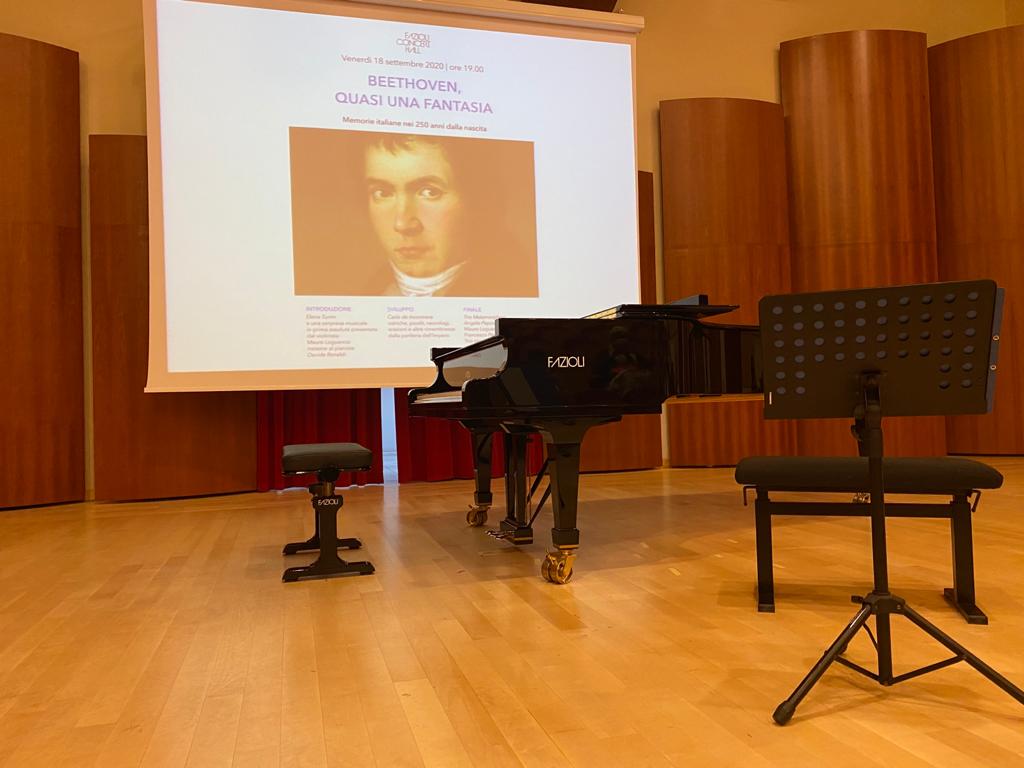
Luigi Bellofatto – Beethoven, Almost a Fantasy: Italian Memories for the 250th Anniversary

Beethoven, Almost a Fantasy – Italian Memories in the 250th Anniversary of His Birth

Conference / Concert held on Friday, 18 September 2020, at 7:00 PM at the Fazioli Concert Hall in Sacile (PN), as the final event of the series “Return to Music”.

Some time ago, the composer, musicologist, and man of great culture and vast experience in the musical field, Prof. Carlo de Incontrera, contacted us to request information on Beethoven’s works published in Italy, and the website promptly provided the material needed to create this wonderful musical evening.

For our website, the concert could not have begun better, thanks to the presentation by Dr. Elena Turrin of Fazioli, who clearly and professionally illustrated several Italian editions of Beethoven’s works and thanked us (though the honour is truly ours!) for having responded to the invitation. I report her words:

“I must express my sincere thanks to those who provided these title pages and the source of what I am presenting; this is Dr. Bellofatto, who is here with us and whom I warmly thank, having travelled four hours to join us. He is not only a great collector but also one of the curators — together with Armando Orlandi and Graziano Denini — of a very important resource: a website that gathers an immense wealth of information on Beethoven. I am speaking of lvbeethoven.org, which I strongly recommend visiting. You will find a biography approached in an intelligent way through primary sources, images of title pages, manuscripts, printed works, cataloguing information, and articles. It is truly a boundless resource, and I congratulate this team for such vibrant musicology, carried out voluntarily and selflessly — all the more commendable. If we can see these title pages today, it is thanks to this website.”

The performance began with the extremely rare execution of a movement from the Sonata Op. 101, according to the edition published by Ricordi in 1820 for piano and violin, performed by violinist Mauro Loguercio and the young pianist Davide Ranaldi. On our website, in the Articles section, you will find a detailed description of this rare edition, revised by co-author Graziano Denini.

Prof. Carlo de Incontrera then presented his talk with the unusual title: “Oysters, Picolit, Obituaries, Orations, and Other Remembrances from the Outskirts of the Empire”, illustrating in great detail the entourage of Beethoven who lived in Friuli — including the Guicciardi and the Breuning families — and their relationship with the Gossleth, leading up to Beethoven’s biographer Alexander W. Thayer, who spent much of his life in Trieste. The professor’s father, Oscar de Incontrera, was a great scholar of Trieste’s musical and historical life, and it is thanks to him that Thayer’s tomb was restored and preserved.

The evening concluded with a performance by the Trio Metamorphosi — Angelo Pepicelli (piano), Mauro Loguercio (violin), and Francesco Pepicelli (cello) — who performed the Trio in C minor Op. 1 No. 3. An impeccable and resonant performance that delighted the audience, who were further treated to the first movement of the Trio WoO 38, a very lively piece composed by a twenty-year-old Beethoven.

The evening ended with a pleasant gathering, where Beethoven was again the topic of conversation, and Prof. de Incontrera shared numerous anecdotes about Trieste’s musical life over the past forty years. In short, a night of fine music — and the satisfaction for me and for the website did not end there, because a few days later Ing. Fazioli sent us the letter of thanks you see attached. What more can be said? Collaboration and shared knowledge can only lead to exceptional results!

Your correspondent and co-author of the website, Luigi Bellofatto

Luigi Bellofatto – The New Musical Printing: Manifesto of a New Enterprise for Casting Music Types Exactly as Written

Luigi Bellofatto – The New Musical Printing:

Manifesto of a New Enterprise for Printing Music with Cast Types Exactly as It Is Written

A cornerstone of musical printing, published in 1765 and revolutionary in its method of printing musical notation, was a treatise by Giacomo Falconi: Manifesto d’una nuova impresa di stampare la musica in caratteri gettati nel modo stesso come si scrive. This small booklet was printed in Venice by the typographer De Castro in 1765; it consists of five octavo pages with two musical plates.

This rare publication presents a new method for printing musical writing through the use of movable type devised by Giacomo Falconi. The treatise offers brief remarks on the origins of music and on the various types used for printing musical notation, which until then relied on punches based on sixteenth‑century models that, after centuries, had become impractical. Even the technique of etching on copper plates, according to Falconi, was excessively costly.

For this reason, when the typographer De Castro undertook the printing of Paolucci’s Arte pratica di contrapunto — of which we shall speak later — these new types were used. In this specimen Falconi provides a demonstration by printing a musical excerpt using both the old and the new characters. Similar experiments were carried out in France by Fournier, engraver and type‑founder, who produced a comparable modernization of musical printing types and published a specimen in 1756. [Fétis, Biographie…, 2, p. 301: “…ces caractères servirent à imprimer L’arte pratica del contrapunto du P. Paolucci…”]

Antonio De Castro (1713–1793), bookseller and printer active in Venice in the second half of the eighteenth century, carried out between 1765 and 1772 a limited but important activity in the musical field, significant for the printing method he employed.

He was registered in the Mariegola on 3 December 1748 and, a few years later, in 1751, began printing the periodical Magazzino universale aperto per l’utilità e per il diletto di tutti, edited by G. D. Baysel. He spent a long period in Spain on behalf of the bookseller Orazio Poletti, specializing in the acquisition of printing privileges from Madrid printers, later having them printed in Venice. In 1765 he began his first musical publication, producing — with new typographic characters — the first volume of Paolucci’s Arte pratica di contrappunto dimostrata con esempj di varj autori. Paolucci, formerly a pupil of Padre Martini and like him a Conventual Franciscan, was at that time maestro di cappella at the church of the Frari in Venice. His important treatise, dedicated to the “cavaliera procuratessa Chiara Marcello Zeno”, would later serve as a model for Martini’s own celebrated treatise on counterpoint (1774–75).

After unsuccessfully approaching the Bolognese printer Dalla Volpe, Paolucci chose De Castro in March 1765. The first volume was completed — not without friction, as Paolucci complained of excessive delays — at the end of September 1765. For the occasion, De Castro issued the specimen described above, Manifesto d’una nuova impresa di stampare la musica in caratteri gettati nel modo stesso come si scrive, a precious document on the art of printing, five pages long and accompanied by two plates “incise e gettate dal M. Rev. Sig. D. Giacomo Falconi”.

Not only did it describe Paolucci’s work and announce the subscription terms (eight Venetian lire), but it also included, as a model of the types used for printing the musical examples, the duet Quando sono vicino all’idol mio, printed both with the old rhomboidal characters and with Falconi’s new method. De Castro, criticizing in his Manifesto the unsatisfactory system of printing then in common use — obtained through engraving on copper plates — argued that:

«si è perciò studiato il mezzo di stampare qualunque composizione in caratteri uniformi a que’ della musica scritta; in guisa che, gittati questi in quelle spezzature medesime, in che si gittano le lettere dell’alfabetto, si viene ad agevolarne la stampa, non che a minorarne la spesa; ed a soddisfare ad un tratto quelle persone, che mancano delle più eccellenti opere in questo genere».

The following year, although engaged in printing the second volume of Paolucci’s treatise, De Castro issued — using the same method — several anonymous pieces: Duetti galanti e facili n. XXIV, da cantarsi al cembalo; s’aggiungono n. VI Canons a tre voci, composed by various celebrated living authors.

In August 1767 he published Paolucci’s Preces octo vocibus concinendae, while the third volume of the Arte pratica di contrappunto would not appear until 1772.

The 1765 article from the “Giornale d’Italia”. A long article titled Nuovi incrementi dell’Arte della Stampa in Venezia, per rapporto alla Musica, published in issue XVII (26 October 1765) of the Giornale d’Italia, describes in detail this new technique and its advantages. This article is reproduced in full below, exactly as printed in 1765.

Nella stessa maniera, che gli uomini inventarono segni e caratteri, per comunicarsi scambievolmente, mercé la combinazione dei medesimi, i loro sentimenti, così pure escogitarono note figure, per dirigere la varia modulazione delle voci e de’ suoni sotto quelle leggi armoniche, che costituiscono la nobilissima Scienza della Musica. V’hanno gran quistioni fra gli eruditi intorno i segni della Musica Ebraica, e di alcune altre Nazioni Orientali. Gli antichi Greci si servirono delle loro lettere dell’alfabeto, e comecchè i Romani dagli stessi appararono la Musica, di esse lettere similmente fecero uso. San Gregorio sostituì ai caratteri Greci sette lettere latine, che da lui furono dette Gregoriane. Guido Aretino nel 1300, secondo alcuni, oppure Franchino Gaffurio ad opinioni di altri, cambiò le lettere in sillabe, che furono l’Ut, re, mi, fa, sol, la, traendole dall’inno che canta la Chiesa in onore di San Giovanni; UT queant laxis / REsonare fibris / MIra gestorum / FAmuli tuorum / SOLve polluti / LAbii reatum, Sancte Iohannes [“affinché i tuoi servi possano cantare con voci libere le meraviglie delle tue azioni, cancella il peccato, o santo Giovanni, dalle loro labbra indegne”]. Queste sillabe, che vennero disposte sopra le linee, servirono poi, come tutt’ora servono a facilitare la lettura delle Note Musicali. Il suddetto Aretino fu l’inventore de’ punti, de’ quali se ne trovarono di varia figura, talvolta semplici, ad alle volte con le code, quando unite, quando sciolte, e quando tortuose a maniera di geroglifici. Questi in progetto si ridussero quasi quadrati, ond’ebbero origine le nostre Note correnti del Canto fermo, che stabile figura non ebbero; alcune essendo rotonde, altre quadrate, ed anche a romboide diversamente caudate. Venne successivamente Giovanni de Muris Francese, da cui nel 1353 furono inventate le otto figure Musicali. Tal invenzione fu adottata dai più celebri Professori di que’ tempi; ed  abbenché l’arte del comporre avesse la denominazione di Contrappunto dai punti, co’ quali si componeva, la mutazione nonostante di punti, co’ quali si componeva, la mutazione nonostante di punti in Note, non fece perderle la denominazione, essendosi sempre continuato a chiamarla Contrappunto.

Queste ultime figure furono quelle, che vennero di continuo usate fin a’ giorni nostri, essendosi con esse stampate varie Opere Musicali, fra cui è celebre quella de’ Salmi del Veneto Patrizio Benedetto Marcello, pubblicato nell’anno 1724.

Ma poiché ultimamente fu raffinato oltre modo riguardo alla scrittura musicale sì cambiando affatto la figura romboidale delle Note, sì introducendo varie maniere di legature delle Note medesime, n’è seguito, che la Musica sia restata priva di quel sussidio, che proviene dalla stampa rispetto ad ogni arte e scienza.

Decaduto dunque l’uso delle dette figure romboidali, e resa poco intelligibile quella maniera di scrittura, non altra via restò, per diffondere le composizioni Musicali, che quella, o di spargere manoscritte, o di farlo incidere sopra piastre di rame o di legno, o di stagno. Dei quali modi siccome il primo non è atto a spargere con facilità e prestezza tutto ciò che hai di bello, e di dotto nei generi varj della Musica tutto dì viene creato da valenti Professori della medesima, l’altro poi, al sommo dispendioso, priva ugualmente di poter dar fuore, ciò che veramente meriterebbe di essere pubblicato, onde far conoscere gl’incrementi di questa Scienza e ciò, che potrebbe servire di scorta sicura a que’, che sono intesi all’acquisto della medesima.

Onde supplir dunque ad entrambi i detti inconvenienti, era d’uopo trovare una maniera di stampare la Scrittura Musicale secondo il sistema in cui ella presentemente ritrovasi; che le stampe potessero eseguirsi con facilità e prestezza, e che potessero essere acquistate con un prezzo mediocrissimo.

Ciò è stato eseguito e mirabilmente dal Sig. D. Jacopo Falconi Veneziano. Egli ha formato le madri, ed incise queste nuove Note con le loro spezzatura, legatura e quant’altro occorre per recare sotto l’occhio la Musica composizione nitidamente impressa, come n’é dei comuni caratteri della stampa.

Il Libro in cui viene fatt’uso di questa nuova pruova questo titolo: Arte pratica di Contrappunto dimostrata con esempi di vari Autori, e con osservazioni di Fr. Giuseppe Paolucci, Minor Conventuale. Tome I, In Venezia 1765 per Antonio de Castro.

Nel Manifesto dato fuori da questo Librajo per far conoscere al Pubblico la natura e la qualità di tale suo imprendimento, v’hanno due fogli spiegati, uno de’ quali esibisce il saggio della nuova maniera di stampare la Musica in un pezzo d’arietta con note e parole, e l’altro reca sotto gli occhi (onde se ne faccia il confronto) questa medesima composizioni con le note quali usavansi in tempo del Marcello, cioè trent’anni in addietro.

Riguardo poi a ciò, ch’è contenuto nel detto volume primo, di figura di 4.0 e di pag. 269 vi si veggono per opera del suddetto P. Paolucci raccolte ed esposte parecchie composizioni Musicali a due, tre, quattro, e anche più voci, le quali o come parti dei più insigni e celebri Maestri de’ tempi passati, de’ presenti, sono da reputarsi pregevolissime, massime essendo di vario stile e di varia condotta. Esso Padre, vi ha aggiunto alle stesse, a maniere di note, non poche osservazioni trascelte da’ più rinomati Scrittori dell’arte pratica della Musica, e singolarmente del Contrappunto, per l’oggetto di farvi rilevare la varia maniera di bene e lodevolmente comporre; la differenza dello stile, ch’era in uso per lo addietro, da quello che a’ dì nostri è più comune, e gradito, e alla fine, le bellezze, e gli artificj della Musica, ugualmente che i difetti.

Quindici sono le composizioni o gli esempj recati in questo primo volume, ed appartengono tutte a celebri Maestri, cioè ad Orlando Lasso, a Jacopo Antonio Perti, a Carlo Maria Clari, al Palestrina, al Caldara, a Benedetto Marcello, a Giuseppe Berrabei, a Ludovico Vittoria, a Gianpaolo Colonna, a Costanzo Porta, a Matteo Asola.

Queste composizioni sono a due, e tre voci, e così pure alcune quattro. Altre a più di quattro voci sonosi riserbate per due altri Volumi, da cui il presente verrà seguito. L’edizione è bella e magnifica, e di vero il prezzo de’ volumi, fissato a Lire 8. Viniziane per ognuno, è tenuissimo, qualora considerisi la spesa grande, che ha bisognato fare nell’incisione, e nelle madri dei caratteri musicali. E’ quest’Opera insomma una prova ben sicura della diligenza del libraio de Castro e dell’attenzione che adopera per distinguersi nella sua professione.


Giuseppe Paolucci was an Italian music theorist and composer (Siena, 25 May 1726 – Assisi, 26 April 1776). A frate minore conventuale in the convent of San Francesco di Prato, he studied under Padre Giovan Battista Martini at San Francesco in Bologna, where in 1756 he was designated as his master’s successor in directing the chapel. At the end of that same year, however, he was called instead to direct the chapel of Santa Maria Gloriosa dei Frari in Venice, where he remained until 1761, when he moved to direct the chapel of San Francesco in Perugia.

From 1764 to 1771 he served as maestro di cappella at San Martino dei Servi di Maria in Senigallia, and from 1771 until his death he was maestro di cappella at the Basilica di San Francesco in Assisi.

Among his writings are the three volumes of the Arte pratica di contrappunto (Venezia, 1765–1772), enriched with examples by the most esteemed authors and a precursor to the Saggio fondamentale di contrappunto by Padre G. B. Martini.

The examples included are drawn from the works of the great masters of the past: Palestrina, Lasso, Caldara, Marcello, Vittoria, Bernabei, as well as J. J. Fuchs and Händel.

He published Preces Octo vocibus concinendae (Venezia 1767, De Castro) and left in manuscript form 231 compositions of sacred music and several others of secular music.

Giacomo Falconi

Giacomo Falconi was an Italian editor and printer (18th century – ?). Contemporary with S. P. Fournier (1712–1768), he devised new round‑shaped musical types to replace the old lozenge‑shaped ones. He used them, among other things — and perhaps for the very first time — to print Paolucci’s Arte pratica di contrappunto. He introduced into musical typography the round‑headed note types in place of the square‑headed ones invented two centuries earlier and used by the Italian Ottaviano de’ Petrucci.

Paolucci, Beethoven, and Luchesi

Within this editorial innovation there is also a reference linking Paolucci to Beethoven and Luchesi. In fact, the Venetian composer benefited from the teachings of Giuseppe Paolucci, who in 1768 confirmed his instruction of Luchesi. Giving credit to the report by C. G. Neefe in the Cramer Magazin, Paolucci does not appear particularly indulgent toward his pupil — perhaps because he was critical of the contrapuntal theories developed in the Paduan environment by A. Callegari, P. Vallotti, G. Tartini, and Count G. Riccati, which Luchesi himself, from 1764 onward, would follow intensely.

Regarding Paolucci’s teaching and this work, T. A. Henserl writes: “Certamente Paolucci aveva già lavorato alla raccolta di questi pezzi negli anni Cinquanta e insegnato all’allievo secondo questi maestri, ovviamente Luchesi ricevette da Paolucci i sottili insegnamenti sulla ‘differenza di stili’, sugli stili a cappella e pieno, fugato e concertato, ecclesiastico e profano, che si possono trovare in quest’opera. […] Quando nel corso degli anni Luchesi si dimostrerà un maestro della tecnica della composizione rigorosa nei suoi lavori sacri, probabilmente lo deve soprattutto a Paolucci.”

We must thank Falconi and the publisher De Castro for having ushered in a new era of musical printing.

The Inauguration of the New Beethoven-Haus in Bonn, 16–17 December 2019

The Inauguration of the New Beethoven-Haus in Bonn,

By Luigi Bellofatto 16–17 December 2019

The Beethoven Music Research Center lvbeethoven.org could not miss the inauguration of the Beethoven-Haus after a year of renovations, restorations, and the setting up of new rooms. When I received the invitation, sent to me personally by the director to attend the inauguration ceremony—coinciding with the beginning of the celebrations for the 250th anniversary of Beethoven’s birth—I confess that I felt moved, surprised, and sincerely honored.

My collaboration with the Beethoven-Haus began about twenty years ago thanks to my study trips to Bonn, which allowed me to meet my friend Michael Ladenburger, then director of the Museum and the Archive, and later the directors of the Beethoven-Haus Verlag: Prof. Ernst Herttrich, Prof. Bernhard Appel, and Prof. Christine Siegert, for the articles I wrote for the Bonner Beethoven Studien, published in volumes 5, 6, 8, 9, and 11. In the library field, I also collaborated with Dr. Friederike Grigat through loans and consultations, and more recently with Julia Ronge, now responsible for the manuscripts section, and Nicole Kämpken, responsible for the museum section. A group of scholars representing the highest expertise and knowledge of the works of the Master of Bonn.

In 2010, I had the opportunity to present and curate “my” exhibition Beethoven – The Man, dedicated to Beethoven’s great biographer Alexander Wheelock Thayer, in which I also displayed some pieces from my private collection belonging to Thayer.

On 16 December 2019, with the landing at the airport, my exciting experience began, with tight schedules that would allow me to carry out my collaborative work for the website without giving up enjoying the view of the new prestigious venue, listening to Beethoven’s music, and spending time with my friends in Bonn, reunited for the occasion.

I quickly headed to the Library to consult some sketchbooks kindly made available by Ms. Kuban, and their study will soon become part of the heritage of the website lvbeethoven.org.

The afternoon was dedicated to the inauguration ceremony of the Beethoven-Haus. The director Malte Boecker and the president of the Beethoven-Verein Michael Kranz welcomed the guests (only 199, and strictly by invitation), and I took my seat in the Kammermusiksaal.

The celebrations began with speeches by the authorities: Michael Kranz welcomed the audience and explained the new Beethoven-Haus, thus opening the festivities for the 250th anniversary of the composer’s birth. The German Minister of Culture Monika Grütters delivered splendid words to solemnly define the importance of the event, which I report here:

“The encounter with the visionary, humanist, and convinced European Ludwig van Beethoven is today more relevant than ever. Beethoven was already in his time a legend: an artist who, with his radical approach, overturning schemes and conventions, crossed boundaries and thus thrilled a vast audience. Even today his music moves, touches, overwhelms, and unites people from all countries and continents. He was one of the first ‘mega-stars’ venerated worldwide—and this projects him directly into our own time. The aim of the upcoming Beethoven anniversary year is to make Beethoven’s genius perceptible today.”

And further:

“The renovated and expanded museum, with its new permanent exhibition, shows the man and musician Ludwig van Beethoven with all the facets of his personality; this makes the museum experience both instructive and emotionally engaging. By using all the multimedia possibilities of the digital age and taking into account the visual and experiential habits of the 21st century, the museum has become a ‘Beethoven House for Everyone’: a place that allows us to approach one of the greatest artists and cultural ambassadors of our country from different perspectives, regardless of age, origin, or knowledge.”

What more could be added… nothing!

It was explained that the 250th anniversary of the great composer would be celebrated with concerts, exhibitions, readings, lectures, and conferences throughout Germany and beyond. Speeches followed by Isabel Pfeiffer-Poensgen (Minister for Culture and Science of North Rhine–Westphalia) and Ashok Sridharan (Mayor of Bonn).

The floor then passed to Guido Kohlenbach (Regional Head of Culture), Nicole Kämpken (curator of the museum section of the Beethoven-Haus), and Barbara Holzer, the architect who designed the new Beethoven-Haus, illustrating the renovation and “modernization” project of Beethoven’s birthplace, with larger spaces entirely dedicated to the Master, also thanks to the relocation of the merchandising area to the building opposite the museum.

A video titled “Making of” was then shown, illustrating the various stages that led to the creation of the new rooms.

The speeches were interspersed with performances by pianist Frank Dupree, who played Beethoven works: a movement from the Sonata Op. 31 No. 3, Bagatelle No. 6 Op. 126, and the second movement of Sonata Op. 111 “Arietta. Adagio molto semplice e cantabile”, ending with a jazz-style finale that surprised the audience.

At 6 p.m., Minister Grütters officially inaugurated the new permanent exhibition of the Beethoven-Haus and the new spaces, highlighting the importance of this museum, one of the most visited in the world among those dedicated to composers.

On the ground floor, where the souvenir shop once stood, there is now a room dedicated to exhibitions—currently one on Joseph Stieler, painter of the famous portrait of Beethoven composing the Mass in C-sharp minor—and the concert hall, where our esteemed collaborator Maestro Massimo Anfossi once performed on the Graf piano in a memorable concert.

The museum visit was very interesting, with a new arrangement of the various relics, and in one room I saw prominently displayed the pendulum clock repaired by Armando Orlandi. The only flaw—if one must find one—is that many Beethoven manuscripts in the display cases are shown in facsimile rather than in their original beauty.

The display cases are all newly designed and very well lit; everything has been restored: walls, ceilings, floors, and even the wooden staircases.

Another important novelty is the Bodmer Room, located in the basement, where about ten pieces from the collection of scores and Beethoven memorabilia belonging to the great Swiss collector Hans Conrad Bodmer are exhibited. Every six months the pieces are rotated so that visitors can see different manuscripts.

After so much culture, a “Germanic” buffet in the atrium of the Kammermusiksaal could not be missing, with a variety of canapés accompanied by wine or beer, and conversations with guests, including Silke Bettermann (curator of the Stieler exhibition). I realized I was the only Italian present at the event—a great honor for the website lvbeethoven.org.

The evening could not have ended better: I received from Julia Ronge the two volumes of the Beethoven works catalogue, edited by her together with Kurt Dorfmüller and Norbert Gertsch, complete with a dedication on such a special day.

The following morning began with breakfast with my friend Michael Ladenburger at a café in the Marktplatz and a walk along the Rhine.

I hurried to the Bundeskunsthalle, where on 17 December the exhibition “Beethoven. Welt. Bürger. Musik” was inaugurated, open until 26 April 2020. About 250 objects were displayed, and the aim was to present Beethoven as a figure belonging to History, as explained by Agniezska Lulinska, curator together with Julia Ronge of the Beethoven-Haus.

The exhibition retraced the most important stages of Beethoven’s life (from his baptism, with the register, to his death in Vienna, with documents) and intertwined them with his musical work. It was divided into themes, some even innovative, such as “Beethoven’s view of himself” or “Friendships,” linked to his works.

Unique pieces and rarities from around the world were presented, from various institutions and private collections, with portraits that introduced the composer’s personality and at the same time highlighted his image. Not only was the composer’s working method illustrated, but also the historical and cultural context of his life and story.

Let the photos speak for themselves: they show the beauty of this exhibition, unique in its kind and for the rarities displayed all at once. Absolutely worth visiting!

The day continued with a return to the Beethoven-Haus for an appointment with Nicole Kämpken and director Malte Boecker, from whom I received: a pin, a pen from the BTHVN2020 event, and the book of the New Complete Edition on Beethoven, edited by him for Deutsche Grammophon, with a dedication thanking me for having accepted his invitation and: “Thank you Luigi for all your support in keeping Beethoven’s legacy alive!”

I could not leave Bonn without meeting the von Busch couple at their home: about three hours with coffee and a table full of Christmas delicacies and sweets. Speaking about Beethoven with Mrs. Dagmar Weise von Busch has always been a pleasure for me for about thirteen years. I met them during the exhibition on H.C. Bodmer at the Beethoven-Haus, and since then I have been fascinated by Mrs. von Busch’s great knowledge of Beethoven—she is the author of several studies on Beethoven published in the 1950s–60s—and above all by their kindness and cordiality.

Mrs. Dagmar told me several anecdotes from years past at the Beethoven-Haus and her encounters with scholars of the Master of Bonn such as H.C. Bodmer, Emily Anderson, Willy Hess, and many others.

The moment to leave had arrived. I went to the airport: back to Milan after two days of intense Beethovenian experiences of the highest level, having inaugurated the celebrations for the 250th anniversary of the composer’s birth.

The website lvbeethoven.org, also thanks to this exciting experience, will make a substantial contribution to the celebrations in this important year. Follow us for the latest news.

Luigi Bellofatto

Photographic Reportage. Bonn, Beethoven-Haus, 16–17 December 2019

By Luigi Domenico Bellofatto

Jäger und Sammler – 34 Years in the Service of the Beethoven-Haus: Michael Ladenburger and Luigi Bellofatto

Jäger und Sammler – 34 Jahre im Dienst des Beethoven-Hauses.

Luigi Bellofatto ha scritto il presente articolo per il libro/ricordo pubblicato in occasione del pensionamento di Michael Ladenburger. E renderlo pubblico è il personale omaggio del sito www.lvbeethoven.org

I have known Michael Ladenburger for more than 10 years. I first met him when I started work on the biographer of Beethoven, Alexander Wheelock Thayer. I was impressed by his willingness to help me and to provide information I needed on every occasion when asked.

From that day, a good friendship has been established between us and every time I visited the Beethoven-Haus, he was always available to spend his time with me. He also invited me several times to his home, to meet his family where I always enjoyed great hospitality.

He is one of the most valuable experts on Beethoven, in all fields: music, life, manuscripts and more…

In 2008, Michael asked me if I was interested in preparing an exhibition on A. W. Thayer at the Beethoven-Haus that was to open in May 2010 “Beethoven dem MENSCHEN gewidmet” – Der Beethoven-Biograf Alexander Wheelock Thayer. He came a few times to my home in order to see my collection and prepare all the items for this exhibition. Michael’s kindness was impressive and together we completed the preparations for the exhibition with several items from my collection that we brought together from Milan to Bonn. He came to visit me at my house a few times after the exhibition and it was always a pleasure to meet him and to spend the day together.

Michael catalogued my sizeable collection on Thayer that includes several letters, photos, books, notes, and the copy of Beethoven’s Biography that belonged to Henry Edwards Krehbiel with many very interesting letters of friends of Thayer to him, such as the famous letter by Anselm Hüttenbrenner sent on 20th of August 1860 describing the last moments of Beethoven’s life.

All people are aware of Michael’s deep knowledge of Beethoven, but only by being with him is it possible to see how he is ready and available to help any person, and to share all the information he knows with a humility that only few people have.

He is an organist like myself, so we have shared this passion and on one occasion he came to my town where we played the pipe organ together with great pleasure! But he is also a great cyclist, and fortunately we had time to spend cycling in Germany and in Italy.

My profession is not related to music, as I graduated as an engineer, but since I was a child I was introduced to classical music by my mother (her father was a tenor) and often we listened to LPs on opera and classical music in general. I studied piano and later cello, and passed a few exams at the Conservatorio of Milan, but I did not have time to complete my studies.

Beethoven was one of my favorite composers, and my first research on him was for a middle school exam. Since that date, I decided to learn much more about him.

So I began to collect books on this composer and now have a sizeable collection of books, scores and prints.  They are mainly old ones and some are very rare, among them the Cramer Magazin der Musik, the Blumenlese für Klavierliebhaber,  the Musikalische Korrespondenz der teutschen Filarmonischen Gesellschaft für das Jahr 1791,  the original edition of WoO 67 –Variations à quatre mains pour le piano forte sur un theme de Monsieur le Comte de Waldstein, Bonn, Simrock, [1794] (maybe the only existing copy) and the 50 Veränderungen über einen Walzer von Anton Diabelli für Klavier (C-Dur), 1–50, Vaterländischer Künstlerverein, Abt. 2, Diabelli, 1381 (on loan from me to the Beethoven-Haus ).

Michael helped me on several occasions to catalogue books and scores, and to transcribe in “current” German language the old handwritten language of letters of my collection, including that by Breuning, Wegeler, Schindler, Caroline van Beethoven, Nottebohm, Frimmel, and many others.

In one of my visits to Bonn (September 2011), I came to the Beethoven-Haus with my friend Armando Orlandi and Michael was pleased to let Armando repair the Beethoven clock that is in the Museum. This pendulum clock was given to Beethoven as a gift from the Princess Christine Lichnowsky. The repair on this clock started at 8.45 in the Reading room of the Library of the Beethoven Haus. The tools were previously shipped from Genua to the Beethoven Haus, after a careful check that everything was available including any emergency piece. It took around two hours to repair the clock and once completed Michael relocated it back in room 9 of the museum.

A few years later, on 25th of April 2014, I came again to Beethoven-Haus with my friends Armando, the pianist Massimo Anfossi and Marco Pescetto. For that occasion, Michael kindly allowed me to present the Fantasy Biamonti 213 in the afternoon concert organized by the Beethoven-Haus at Small Music Hall and Massimo played this piece and other variations by Beethoven on the Graf piano in that room.

I would like to thank him for his continuous hard work over the years, for his loyalty and the professional working relationship we have had.

I am honored to have met him and be considered one of his friends!

Michael, I wish you a long, happy and healthy retirement.

Ciao!

Il tuo amico,

Luigi

Gustav Nottebohm – Biography and Complete Beethoveniana Bibliography

Gustav Nottebohm – Biography

By Luigi Domenico Bellofatto

Martin Gustav Nottebohm, German musicologist and composer, was born on 12 November 1817 in Lüdenscheid, in Westphalia (where a commemorative plaque was placed on his birthplace at 46 Wilhelmstraße). He was the tenth of eleven children born to Franz Friedrich Nottebohm (1778–1842) and Maria Gertrud Tappe. He died in Graz on 29 October 1882.

His father, a skilled merchant and owner of a small business, intended the young Gustav for commercial studies. His childhood friend Karl Grün recalls him thus: “He was not sociable; one did not see him playing with the other children—he preferred to play the piano.” And again: “One day, he must have been about eleven, he took me into his room by the piano and showed me a score of one of his compositions for eight instruments! I was astonished. Then he played the individual parts on the same piano. Later he took flute lessons and subsequently violin lessons.”

Nottebohm, bowing to his father’s will, attended the “Kortegarn Institute for Commerce” in Lennep and then entered as an apprentice at the firm “Orth and Heyn” in Barmen; meanwhile, he took piano lessons in nearby Elberfeld. Although he had entered the world of commerce obtorto collo, he proved so skilled in his work that his employers suggested to his father that he leave the young man with them as a partner in the business. Naturally, the father firmly rejected the proposal; he wanted his son, after that experience, to return to the family business. This paternal attitude is easily understood considering that two of his four sons had died in early childhood, so that only Heinrich and Gustav remained with him. “Alte Nottebohm” (“Old Nottebohm”), as the children called him, had made his way from humble origins, was proud of what he had built, and could not accept that his sons did not wish to continue his work.

In 1838, while in Berlin, Gustav enlisted voluntarily in the Gardeschützenbataillon, and in his free time took piano and composition lessons from Ludwig Berger and Siegfried W. Dehn. At the end of his service (1839), his love for music had so deeply taken hold of him that, once back home, he more decisively embarked on the path toward Art, defying his parents’ wishes by going to Leipzig and taking lessons from Hofkapellmeister Friedrich Schneider in Dessau.

Later, on Schneider’s advice, Nottebohm presented himself to Mendelssohn, submitting his compositions to him and playing them for him. Mendelssohn encouraged him to study more thoroughly, and in 1840 Nottebohm began studying with Mendelssohn himself, with Schumann, and with M. Hauptmann at the Leipzig Conservatory. These great musicians supported Nottebohm not only musically but also humanly: when in 1844 the family expressed doubts about the young Gustav’s talent, Schumann wrote to the husband of the elder sister, Reverend Johann Schöneberg in Sprockhövel:

“Honoured Sir, your concerns must cease! The noble and indefatigable effort of your brother‑in‑law will certainly guarantee him an honourable future.”

One obstacle still remained before Nottebohm could study music without further worries: freeing himself from military obligations. Mendelssohn intervened, writing a letter requesting that the young musician be released from all military duties; and on the advice of the President of Westphalia, Ludwig Freiherr von Vincke, the great composer sent his request directly to His Majesty King Frederick William IV of Prussia, who granted it. The letter contained the following words:

“Mr. Gustav Nottebohm, who combines rare diligence and the utmost seriousness with his talent in musical composition and piano playing, has greatly improved in the art during his time here in Leipzig, and a longer stay would be of great benefit to him and to his education; therefore, in his interest as well as in the interest of Art, permission is requested for him to prolong his stay here and continue his studies for several years. I can confirm these words by affixing my signature. Leipzig, 15 March 1843. Felix Mendelssohn Bartholdy.”

Thus Nottebohm was able to study for several years in Leipzig, and not only did he perfect his piano playing and his knowledge of composition theory, but he also had the opportunity to acquaint himself with the musical literature available at the time.

Always eager for knowledge, in 1846 he visited Vienna, which became his second home. He first took a course in counterpoint with the excellent theorist and court organist Simon Sechter, and soon became a respected teacher of piano and composition. In 1858–1859 he became a member of the Gesellschaft der Musikfreunde; in 1863 archivist of the newly founded Protestant choral society; and in 1864 librarian and archivist of the Gesellschaft der Musikfreunde.

From 1861 he directed the complete critical edition of Beethoven’s works published by Breitkopf & Härtel, and from then on Nottebohm entered a musical field for which he was particularly suited. This was followed, in 1875, by his collaboration with Mendelssohn on a complete edition of Mozart’s works. When Thomas‑Kantor Karl Wilhelm Rust (who between 1853 and 1878 published 18 volumes of the Bach Edition) retired in 1882, Nottebohm was chosen as his successor; but he was already so ill that he could not assume the position.

Up to that point he had earned great merit by publishing thematic catalogues of Beethoven, Mendelssohn, and Schubert, and especially through his critical essays and studies on Beethoven’s sketchbooks. With these pioneering works, he offered for the first time to all readers a clearer and highly detailed view of Beethoven’s creative process.

As for Nottebohm’s compositions—almost all predating his activity as a music critic—his variations for four hands on a theme by Bach, Op. 17, deserve mention; he often performed them with Brahms. As a public performer he appeared only three times (1864–69) in the Gesellschaftsconcerten, playing the piano in Bach’s St Matthew Passion and St John Passion.

In 1882 his tireless work came to an abrupt halt. Nottebohm contracted a severe lung illness and, on doctors’ advice, went to Salzburg and later to the spa town of Gleichenberg in Styria; but it was too late. After a six‑week stay, he wished to return to Vienna. On his return journey he had to stop in Graz, where he arrived exhausted. On the 26th he was taken to hospital and died shortly before midnight on 29 October. Many friends and musicians attended the funeral on the afternoon of the 31st. Even Brahms (whom he had met in 1862), rushing from Vienna to his dying friend, took care of the funeral arrangements. He now rests in the Protestant cemetery Petersfriedhof, in a grave adorned with a tombstone carved by one of his former students.

His writings were published in the Musikalisches Wochenblatt (1875–1879). Under the title Neue Beethoveniana, a first volume was published in 1882 by Rieter‑Biedermann in Leipzig, and later collected by his friend Eusebius Mandyczewski and published in 1887 by the same publisher as Zweite Beethoveniana. The index of both volumes was published in October 1888 by Mandyczewski.

He was described thus:

“In his material needs, he lived solely for his art. Behind a reserved nature he concealed a profound mind that opened itself only to those who knew him intimately.”

He had few friends, but among them were the violinist Joseph Joachim, the music teacher Johann Rufinatscha, the writer Peter Graf Ferdinand Laurencien, and Eduard Hanslick. Truly intimate with him were only a handful: Robert Schumann, Johannes Brahms, Beethoven’s biographer Alexander Wheelock Thayer, his childhood friend Karl Grün, and the composer Robert Volkmann (1815–1883), who worked in Vienna and later as professor at the Academy of Music in Budapest (1854–1858). Together they travelled widely, even to distant countries, and maintained a very interesting correspondence that reveals their deep friendship and sheds light on the musical life of Vienna at the time. This correspondence was published in:

Hans Clauß, Gustav Nottebohms Briefe an Robert Volkmann, with biographical introduction, commentary, and other contemporary documents. Published for the 150th anniversary of Gustav Nottebohm’s birth by the city of Lüdenscheid (Beiträge zur westfälischen Musikgeschichte, Heft 1), 1967.

Nottebohm is considered the founder of modern sketch research, today an essential part of Beethoven studies, as it offers a unique view of the composer’s creative process. His tireless and philologically conscientious work in tracing sources and dates was truly remarkable, and his scholarship benefited many later researchers. Although he was not the first to explore Beethoven’s sketches, he certainly studied them in a more detailed manner than anyone before him, and his work—ignored for several years—has been greatly appreciated in the last fifty years.

A true epigone of rigorous musicology, he investigated the creative processes of the great masters; Nottebohm’s studies were not limited to Beethoven. He published a thematic catalogue of Schubert and was an avid collector of Baroque and pre‑Baroque music, both vocal and instrumental. Brahms inherited part of his collection and donated it, along with his own library, to the Gesellschaft der Musikfreunde in Vienna, where it is still preserved.

Musical Compositions Published

  • Quatuor pour le Pianoforte, Violon, Viole et Violoncello, Op. 1, Leipzig, C. F. Peters.
  • 6 Romanesques pour Piano, Op. 2, Leipzig, Peters.
  • Rondeau in A pour Piano, Op. 3, Leipzig, Peters.
  • Premier Trio pour Piano, Violon et Violoncelle dédié à Mons. J. W. Kalliwoda, Op. 4, Leipzig, Peters.
  • 6 Charakter- und Phantasiestücke für Clavier, Op. 6, Vienna, Haslinger.
  • Fliegende Blätter, 6 Tonstücke für Clavier, Op. 10, Vienna, Spina.
  • Trois caprices pour Piano, Op. 11, Vienna, Spina.
  • Zwei lyrische Tonstücke für Clavier, Op. 13, Vienna, Spina.
  • La Séréna, Impromptu, Op. 14, Vienna, Spina.
  • La contemplative, pour Piano, Vienna, Spina.
  • Ballade, pour Piano, Op. 16, Leipzig, Peters.
  • Variationen über ein Thema von J. S. Bach, zu vier Händen, Op. 17, Leipzig, Breitkopf & Härtel.

Unpublished Musical Compositions

  • Salve Regina, in four parts (performed in 1875 by the Wiener Singakademie).
  • Two string quartets (performed in 1858 and 1859 by the Hellmesberger Quartet).
  • Andante und Rondo capriccioso für Clavier mit Orchesterbegleitung, full score (ca. 1842).
  • Clavierconcert mit Orchesterbegleitung, sketches (1842).
  • Elegie für das Pianoforte, dedicated to his brother Heinrich.

Writings on Various Composers

  • Ueber die Suite, in Monatsschrift für Theater und Musik, Vienna, edited by Klemm, 1855 and 1857.
  • Die Bach-Gesellschaft in Leipzig, essay in Österreichische Blätter für Litteratur und Kunst (supplement to the Österreichische Kaiserliche Wiener Zeitung), 1857, no. 12.
  • Zwei unter Mozart’s Namen herausgekommene Clavierconzerte (Köchel’s catalogue, Appendix Nos. 204 and 136), in Recensionen und Mittheilungen über Theater und Musik, Vienna 1865, no. 24.
  • Thematisches Verzeichniß der im Druck erschienenen Werke von Franz Schubert, Vienna, Fr. Schreiber (Spina, now Cranz), 1874.
  • Mozartiana. Von Mozart herrührende und ihn betreffende, zum großen Theil noch nicht veröffentlichte Schriftstücke. Nach aufgefundenen Handschriften herausgegeben, Leipzig, Breitkopf & Härtel, 1880.
  • Bach’s letzte Fuge, in Musik-Welt, edited by Max Goldstein, Berlin 1881, nos. 20 and 21.
  • Eine fragliche Stelle über Mozart’s Don Giovanni. Ein Wort Beethoven’s über Mozart, in Musik-Welt, Berlin 1881, no. 59.

Gustav Nottebohm – Beethoveniana and Zweite Beethoveniana – Bibliography – By Luigi Bellofatto

Beethoveniana: Aufsätze und Mittheilungen von Gustav Nottebohm
Leipzig ; Winterthur : J. Rieter-Biedermann 1872 und Zweite Beethoveniana, Nachgelassene Aufsätze, Leipzig ; Winterthur : J. Rieter-Biedermann 1887.

Detailed Chronological List of Articles and Books by Nottebohm on Beethoven:

  • Von Beethoven’s Hand corrigirte Orchesterstimmen, in the possession of the Gesellschaft der Musikfreunde, 1862. In: Deutsche Musik-Zeitung, 3 (1862), no. 27, pp. 215–216.

  • Mehrere noch ungedruckte Briefe Beethovens, 1863. In: Allgemeine musikalische Zeitung, N.F. 1 (1863), nos. 40, 43.
  • Beethoven’s theoretische Studien, 1863. In: Allgemeine musikalische Zeitung, N.F. 1 (1863), nos. 41–50.
  • Nachtrag zu dem Artikel “Beethoven’s theoretische Studien”, 1864. In: Allgemeine musikalische Zeitung, N.F. 2 (1864), nos. 9–10.
  • Ein Skizzenbuch von Beethoven, Leipzig: Breitkopf & Härtel, [1865], 43 pp.
  • Thematisches Verzeichniss der im Druck erschienenen Werke von Ludwig van Beethoven, 2nd enlarged edition, Leipzig: Breitkopf & Härtel, 1868, IV + 220 pp.
  • Briefwechsel: (ein Trio von Händel in Beethoven’s Abschrift), 1869. In: Allgemeine musikalische Zeitung, [3rd series] 4 (1869), no. 5.
  • Beethoveniana, 1869. In: Allgemeine musikalische Zeitung, [3rd series] 4 (1869), nos. 36–48.
  • Beethoveniana, 1870. In: Allgemeine musikalische Zeitung, [3rd series] 5 (1870), nos. 2–19.
  • Beethoveniana: Nachträge, 1871. In: Allgemeine musikalische Zeitung, [3rd series] 6 (1871), nos. 5–7.
  • Zu Beethoven-Photographien, 1871. In: Allgemeine musikalische Zeitung, [3rd series] 6 (1871), no. 7.
  • Beethoveniana: (Berichtigung), 1871. In: Allgemeine musikalische Zeitung, [3rd series] 6 (1871), no. 17.
  • Beethoveniana: Aufsätze und Mittheilungen, Leipzig/Winterthur: J. Rieter-Biedermann, 1872, 203 pp.
  • Beethoven’s Studien, vol. 1, Leipzig/Winterthur: J. Rieter-Biedermann, 1873, 232 pp.
  • Beethoven’s Musik zur “Weihe des Hauses”, 1873. In: Allgemeine musikalische Zeitung, [3rd series] 8 (1873), nos. 25–28.
  • Drei Briefe Beethoven’s: I. An Simrock in Bonn, 1873/74. In: Allgemeine musikalische Zeitung, [3rd series] 8 (1873), no. 51.
  • Neue Beethoveniana, 1875. In: Musikalisches Wochenblatt, 6 (1875), multiple issues.
  • Zur Reinigung der Werke Beethoven’s von Fehlern und fremden Zuthaten, 1876. In: Allgemeine musikalische Zeitung, [3rd series] 11 (1876), nos. 21–33.
  • Neue Beethoveniana, 1876. In: Musikalisches Wochenblatt, 7 (1876), multiple issues.
  • Neue Beethoveniana, 1877. In: Musikalisches Wochenblatt, 8 (1877), multiple issues.
  • Ein Skizzenbuch von Beethoven aus dem Jahre 1803, Leipzig: Breitkopf & Härtel, 1880, 80 pp.
  • Zweite Beethoveniana, edited by Eusebius Mandyczewski, Leipzig: J. Rieter-Biedermann, 1887, X + 590 pp.
  • Namen- und Sachregister zu Nottebohm’s Beethoveniana und Zweite Beethoveniana, compiled by Eusebius Mandyczewski, Leipzig: J. Rieter-Biedermann, 1888, 19 pp.