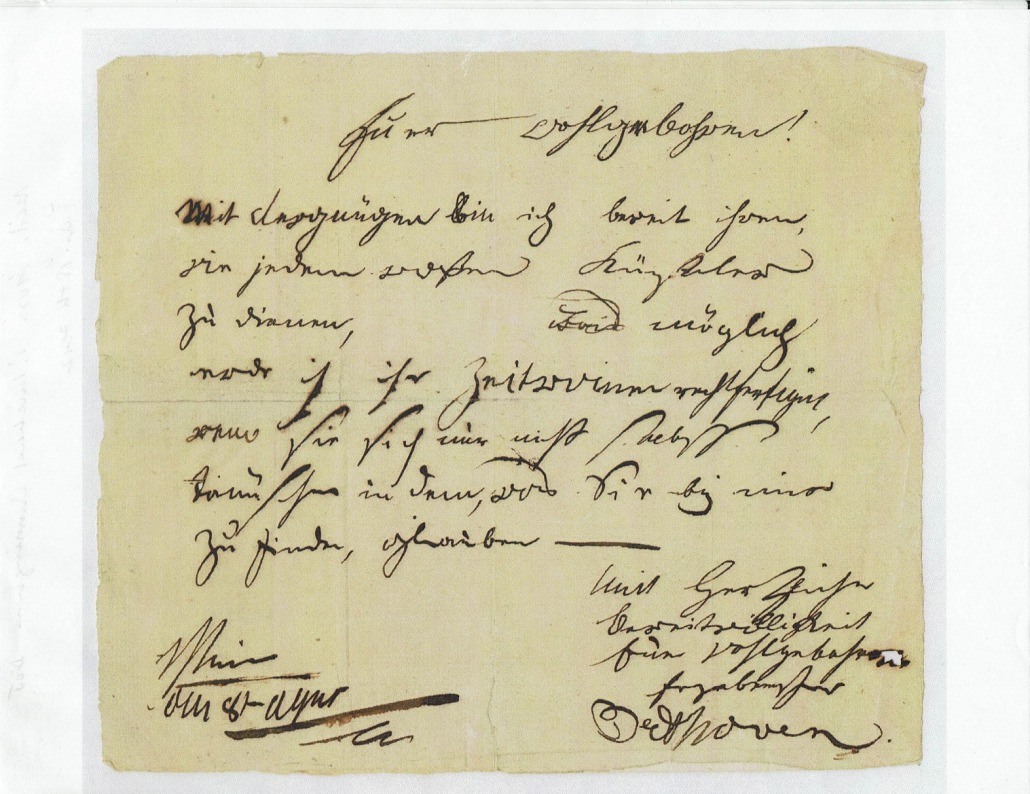
Anhang 8 – A Comparative Study of the Various Editions By Graziano Denini

1) Gavotte in F major for piano four hands.
Hess Anhang 18/1 – Kinsky Halm Anhang 8 – p. 42.

2) Allegro in B‑flat major for piano four hands.
Hess Anhang 18/2 – Kinsky Halm Anhang 8 – p. 42.

3) Marzia (Marcia) Lugubre in C minor (fragment) for piano four hands.
Hess Anhang 18/3 – Kinsky Halm Anhang 8 – p. 42.

Description from the British Museum

Title Collection of compositions attributed to Wolfgang Amadeus Mozart.

Content: ff. 10–12. Piano duets wrongly attributed to Mozart. Autograph. Apparently unpublished (K. Anh. 41a).

  1. Gavotte in F. f. 10.
  2. Allegro in B‑flat. f. 10b.
  3. “Marzia lugubre” in C minor. Beginning only. f. 12. (Arrangements of three numbers from L. Kozeluch’s ballet La ritrovata figlia di Ottone II – Music & Letters, Jan. 1945).

ff. 1–2b. [Motets] De profundis; for four voices with figured bass for organ, in score, by J. C. W. A. Mozart. Autograph. The top stave is marked at the beginning “Violino i, ii,” but the music for those instruments has not been filled in.

ff. 13–14b. [Piano solos] A movement in 6/8 time, in B‑flat, for piano. The bass is incomplete. Apparently unpublished; described in Köchel (511a) as a Rondo (see Music & Letters 1945, pp. 47 ff.).

ff. 15–27. [String quintets] Quintet in C minor for two violins, two violas and cello, in score, by Mozart. Autograph. No. 4 in Peters’ collection, and no. 406 (now 516b) in Köchel’s thematic catalogue. Originally composed as a Serenade for wind instruments (K. 384, now K. 388) in July 1782.

ff. 3–9b. [Trios for piano and strings] Allegro and Rondo allegretto in D; piano duet partly adapted for piano, violin and cello, in score, in the same hand as Add. MS 31750. Apparently unpublished (Köchel Anh. 52a). See Music & Letters 1945, pp. 47 ff.

Author’s Considerations – The Revision

By Graziano Denini

I was fortunate enough to have at hand both the orchestral score and the piano reduction of the ballet in question; finally, I also obtained a copy of the Anhang 8 manuscript preserved in the British Museum (which, incidentally, also contains the Trio for Piano, Violin and Cello Anhang 3).

I was therefore able to compare the three editions and, in my view, these three pieces are not a simple four‑hand piano reduction of Kozeluch’s score. Rather, considering the additions and alterations made by the composer, it would be more accurate to describe them as genuine re‑elaborations. Supporting this hypothesis are, for example, the semiquaver Alberti‑style arpeggios in Piano II (right hand) immediately after the opening ritornello of the Gavotte, and the entire left hand of Piano II in the few surviving bars of the Marzia Lugubre.

Another interesting detail is the descending scale played by Piano II, right hand, in bar 3 of the Gavotte (ex. 1), which should contain E‑flat, as found both in the second violin part and in the London reduction. In this case, however, I preferred to retain the natural E, since the same passage appears in bar 18 (ex. 2), again without the flat, and should therefore not be considered an oversight.

Research Method

By Graziano Denini

For the first two pieces, which are complete, I made a copy of the score prepared by De Saint‑Foix and another derived from the manuscript in the British Museum, and compared the two editions. I then compared everything again with the orchestral score and the London piano reduction, thus producing a so‑called Urtext version.

As for the third piece, the Marzia Lugubre, I copied the few original bars and then continued according to the compositional procedures observed in the two preceding pieces.

The two tables below present the revision work carried out on the manuscript sources, with corresponding photographic examples, while the third image shows the first comparative page of the Allegro Anhang 8 No. 2, a piece that will receive its world premiere in the Urtext version by the piano duo Fusaro–De Rosa Arcuri.

A Bibliographical Note – Sources for the Beethoven Catalogue

Foreword

A bibliographical note

This catalogue lists all of Beethoven’s completed works, published or unpublished, together with fragments, notes and musical ideas found in letters, album leaves, sketchbooks and conversation notebooks known to date — excluding, of course, material that is clearly identifiable as preparatory work for the pieces mentioned. It also includes compositions of doubtful authenticity and plans for stage works, cantatas, oratorios, and similar projects.
Each entry provides essential information: dates, editions and references to other catalogues, along with details useful for placing the work within the historical and aesthetic context of Beethoven’s output. You will find expositions, commentary, comparisons, cross-references to other works, and notes on interpretations or critical approaches of varying prominence.
Given the author’s renown, we have chosen to make an exceptional reference to Arnold Schering’s interpretations. In publications from the first half of the twentieth century Schering argued that many of Beethoven’s compositions were inspired or shaped by episodes from certain poetic or dramatic works, classical or modern. These readings often seem arbitrary or overly personal: they rest tenuously on a few phrases attributed to Beethoven or on not always reliable indications from acquaintances such as Schindler and Czerny, and they attempt to identify in the music minute correspondences with gestures, phrases, words, or specific dramatic or descriptive moments. It is possible that reading and reflecting on the works Schering mentions — or others — provided fertile ground for Beethoven’s imagination; nevertheless, reducing music in its developed reality to a conjectural origin in another art, and explaining its formation and course by the logic of that art, always appears to us limiting and contrary to a free and deeper understanding of music itself.
For sketches and fragments we relied on the classic studies by Nottebohm, Nohl, De Roda and Shedlock, and on complete editions of Beethoven’s notebooks edited by Mikulicz and Schmitz; more recently we used work by Prof. Joseph Schmidt-Görg and Dr. Dagmar Weise of the Beethovenhaus and Dr. Nathaniel Fishman of the Glinka Museum in Moscow. The calligraphic preparation of the musical examples for the clichés is the work of Maestro Lorenzo Tolu of Rome.
We are especially grateful to Prof. Willy Hess of Winterthur for the information and interest he showed in our work. We also remember with gratitude Max Unger, Donald W. MacArdle and Hans Halm, who passed away in recent years, and the dear Ludwig Misch, who died suddenly on 22 April 1967.
Our affectionate and grateful thoughts go to Avv. Fortunato Postiglione, CEO of I.L.T.E. in Turin, an ardent promoter of this project who died prematurely before its completion.
The work was neither short nor easy, and we do not claim to be free from shortcomings. We trust, however, in the kind reception of enthusiasts and scholars.

Rome, summer 1968
Giovanni Biamonti

A) Works cited on the website pages

with abbreviations.

A. = Anderson Emily, le lettere di Beethoven, Torino, Ilte, 1968.

B. = Bruers Antonio, Beethoven – catalogo storico-critico di tutte le opere, Roma, Bardi, 1951.

B.J. = Beethoven Jahrbuch (Mies – Schmidt Görg), Bonn, Beethovenhaus: I (1953-1954), II (1955-1956), III (1957-1958), IV (1959-1960), V (1961-1964, published in 1966).

Boett. = Boettcher Hans, Beethoven als Liederkomponist, Augsburg, Benno Filsere Verlag, 1928.

Der. = De Roda Cecilio, Un quaderno di autografi di Beethoven del 1825, Torino, Bocca, 1907.

D. W. F. = Weise Dagmar, Beethoven. Ein Skizzenbuch zu Chorfantasie op. 80 und zu anderen Werke, Bonn, Beethovenhaus, 1957.

D. W. P. = id. id., Beethoven. Ein Skizzenbuch zu Pastoral Symphonie op. 68 und zu den Trios op. 70 nn. 1 u. 2, Bonn, Beethovenhaus, 1961.

Fish. = Fishman Nathaniel, Beethoven’s Sketchbook of 1802-1803 (Wielhorsky Manuscript), complete publication, in facsimile and print, with commentaries, Russian edition, Moscow, 1962. (See also Beethoveniana in Soviet Russia, by Boris Schwarz in The Musical Quarterly, January 1961.)

G.A. = Ludwig van Beethovens, Werke, vollständige kritish durchgesehene überall berechtigte Ausgabe (Gesamtausgabe), Leipzig, Breitkopf & Härtel, serie 1-24, 1864-1867; serie 25 (Supplemen.), 1888.

H. = Hess Willy, Verzeichniss der nicht in der Gesamtausgabe veröffentlichten Werke Ludwig van Beethovens, Wiesbaden, Breitkopf & Härtel, 1957.

K.H. = Kinsky Georg e Halm Hans, Das Werk Beethovens, bibliographisches Verzeichniss, München-Duisburg, G. Henle Verlag, 1955.

L. = Lenz (De) Wilhelm, Kritischer Katalog sämmtlicher Werke Ludwig van Beethovens mit Analysen derselben (I: op. 1-20; II: op. 21-55; III: op. 56-100; IV: op. 101-138 und die Werke ohne Opuszahl), Hamburg, Hoffmann u. Campe, 1860.

M. = Misch Ludwig, Beethoven-Studien, Berlin, Walter De Gruyter, 1950.

M.A. = id. id. e Donald MacArdle, Beethoven- Studies, University of Oklahoma Press: Norman, 1953,

M. A.L. = Misch Ludwig e MacArdlc Donald W., New Beethovens Letters, University of Oklahoma Press: Norman, 1957.

Mik. = Mikulicz Karl L., Ein Notierungsbuch von Beethoven, Leipzig, Breitkopf e Härtel, 1927.

M. I. = Shedlock J. S., Beethoven’s Sketch Books, in The Musical Times, 1892-1894.

M.U. = Unger Max, Die Beethovenhandschriften der Pariser Konservatoriumsbibliothek, in N.B.J., VI, 1935.

M.U.S. = id. id., Eine Schweizer Beethovensammlung, Zürich, Verlag der Corona, 1939.

M.U.W. = Unger Max, Die Beethoven handschriften der Familie W. (Wittgenstein) in Wien, in N.B.J., VII, 1937.

N. = Nottebohm Gustav, Ludwig van Beethoven: Thematisches Verzeichnis, Leipzig, Breitkopf & Härtel, 1932.

N., I. = id. id., Beethoveniana, Leipzig, Peters, 1872.

N., II. = id. id., Zweite Beethoveniana, Leipzig, Peters, 1887.

N., Sk., I = Nottebohm Gustav, Ein Skizzenbuch von Beethoven (1801-1802), Leipzig, Breitkopf & Härtel, 1865 (P. Mies, 1924).

N., Sk., II = id. id., Ein Skizzenbuch von Beethoven, aus dem Jahre 1803, Leipzig, Breitkopf e Härtel, 1880 (reprinted by P. Mies, 1924).

N., St. = id. id., Beethovens Studien, Leipzig u. Winterthur, Rieder-Biedermann, 1873.

N.B.J. = Neues Beethoven Jahrbuch (Sandberger): I (1924), II (1925), III (1927), IV (1930): Augsburg, Benno Filser; V (1933), VI (1935). VII (1937), VIII (1938), IX (1939): Braunschweig, LitolfFs Verlag; X (1942): Augsburg, Reichel u. Sohn.

P. = Prod’homme Jacques Gabriel, La jeunesse de Beethoven (catalogo), Paris, Delagrave, 1927.

P. Quad., = id. id., Les cahiers de Beethoven (1819- 1827)(Summary compendium, compiled from various sources), Paris, Correa, 1946.

Quad. = Schünemann Georg, Quaderni di conversazione di Beethoven, Ilte, Torino, 1968.

Rolland, Ep. = Rolland Romain, Beethoven, les grandes epoques creatrices, Paris, Editions du Sablier: I, De l’ Eroica à l’ Appassionata (1928) – II, Goethe et Beethoven (1930) -III, La Messe solemnelle et les dernieres sonates (1937) – IV, La Neuvieme Symphonie (1943) – V, Finita comoedia (1945) – VI, Les aimées de Beethoven (1949).

Sch. = Schiedermair Ludwig, Der junge Beethoven. First edition: Leipzig,Quelle u. Meyer, 1925; second edition: Weimar, II. Bohlaus, Nachf., 1939; third edition: Bonn, F. Dümmler, 1949.

Schm. = Schmitz Arnold, Beethoven, unbekannte Skizzen und Entwürfe, Bonn, Beethoven-haus, 1924.

T. = Thayer Alexander Wheelock, Chronologisches Verzeichniss der Werke L.v. Beethovens, Berlin, Schneider, 1865.

Th. R. = Thayer Alexander Wheelock, Deiters Hermann, Riemann Hugo, Ludwig van Beethovens Leben, Leipzig, Breitkopf e Härtel: I, 1917; II, 1922; III, IV, V, 1923.

B) Other works cited

on the site pages

Allorto Riccardo, Le sonate per pianoforte di Muzio Clementi, Firenze, Olschki, 1959.

Beethoven Jahrbuch (Frimmel), München und Leipzig, Müller: I (1908), II (1909).

Beethoven Ludwig van: Works: Beethovens Werke, herausgegeben von Beethoven-Archiv, Bonn, unter Leitung von J. Schmidt-Görg, München-Duisburg, G. Henle Verlag; Abteilung VII. Band 5: Variationen für Klavier (Schmidt-Görg), 1961; Abteilung VI. Band 3: Streichquartette, l (Quar-tetti op. 18 e op. 14 n. 2 dalla Sonata per pianoforte op. 14 n. 1) (P. Mies). Klavier-Sonaten, herausgegeben von B. A. Wallner, München-Duisburg, G. Henle Verlag, 1953. Klavierstücke, herausgegeben von Otto von Trmer, München-Duisburg, G. Ilenle Verlag, 1950. Leonore Oper in zwei Akten, vollständiger Kla-vicrauszug der zweiten Bearbeitung (1806) mit den Abweichungen der ersten (O. Jahn), Leipzig, Breitkopf e Härtel, 1851. Leonore, Oper in drei Akten (1805), Klavier Auszug (E. Prieger), Leipzig, Breitkopf e Härtel, 1907. Neues Volksliederheft, für eine Singstimme und Klavier, mit Begleitung von Violine und Violoncelle, herausgegeben von Georg Schünemann, Leipzig, Breitkopf e Härtel, 1940. Quartetti, Milano, Ricordi, 1954. Sinfonie, Milano, Ricordi, 1952. Sonate per pianoforte (Casella), Milano, Ricordi, 1950. Sonaten für Klavier und Violine, herausgegeben von Walter Lampe und Kurt Schäffer, München-Duisburg, G. Henle Verlag, 1949-1950. Die Klaviersonaten L. v. Beethovens, Studien über Form und Vortrag (R. Rosenberg). Urs Graf Verlag, Olten und Lausanne.

Bellague Camille, Les époques de la musique, Paris, Delagrave, 1920.

Bekker Paul, Beethoven, Berlin, Schuster e Loeffler, 1912.

Berlioz Hector, A travers chants (Les symphonies de Beethoven), Paris, Calmann-Lévy, 1927.

Boyer Jean, le «Romantisme» de Beethoven, Paris, Librairie H. Didier, 1938.

Braubach Max, Eins Jugendfreundin Beethovens (Babette Koch-Betderbusch und ihr Kreis), Bonn, Ludwig Röhrscheid Verlag, 1948.

Braunstein Josef, Beethovens Leonore Ouvertüren, Lipsia, Breitkopf e Härtel, 1927.

Breuning Gerhard, Aus dem Schvarzspanierhause, Berlin u. Leipzig, Schuster u. Loeffler, 1907.

Bücken Ernest, Ludwig van Beethoven, Potsdam, Akademische Verlagsgesellschaft Athenaion, 1934.

Casella Alfredo, II pianoforte, Milano, Ricordi, 1954. V. anche: Beethoven, Sonate.

Chantavoine Jean, Beethoven, Paris, Alcan, 1920. id., Les symphonies de Beethoven, Paris, Mellottée. id., Musiciens et poetes, Paris, Alcan, 1912.

Closson Ernest, L’ element flamand dans Beethoven, Bruxelles, Editions universitaires, Les presses de Belgique, 1946.

Cockshoot John V., The fugue in Beethoven’s piano music, London, Routledge & Kegan Paul, 1959.

Colombani Alfredo, Le nove Sinfonie di Beethoven, Torino, Bocca, 1897.

Confalonieri Giulio, Prigionia d’un artista (Il romanzo di L. Cherubini), Milano, Genio, 1948.

Cortot Alfred, Cours d’Interpretation, recueilli et rédigé par Jeanne Thieffry, Paris, Librairie Musicale R. Légouix, 1934.

Czerny Carl, Czernys Erinnerungen an Beethoven, a cura di Georg Schünemann, in Neues Beethoven-Jahrbuch, Braunschweig, H. Litolffs Verlag, 1939.

Dal Fabbro Beniamino, Crepuscolo del pianoforte, Torino, Einaudi, 1951.

De Curzon Henri, Les livres et airs détaches de Beethoven, Paris, Fischbacher, 1905.

De Hevesy Andre, Beethoven, vie intime, Paris, Emil-Paul Freres, 1926.

Deldevez E.M.E., Curiosités musicales: Beethoven: Gli uomini di Prometeo, Paris, Didot Freres, 1873.

De Marliave Joseph, Les quatuors de Beethoven, Paris, Alcan, 1925.

De Wizewa Teodor, Beethoven et Wagner, Paris, Perrin, 1914

D’ Indy Vincent, Beethoven, Paris, Laurens, 1913. Cours de composition (I, II), Paris, Durand, 1909.

Fischer Edwin, Ludwig van Beethovens Klaviersonaten, Wiesbaden, im Insel Verlag, 1956.

Frimmel Teodor, Beethoven Handbuch, Leipzig, Breitkopf e Härtel, 1926.

Furtwangler Wilhelm, Diatoghi sulla musica,, trad. di E. Grassi, Milano, Curci, 1950.

Gaveaux P., Léonore ou l’ amour conjugal. ( Représenté pour la prèmiere fois sur le Théâtre de la Rue Feideau 1° Ventôse de l’ An 6°) Paris, Stuber.

Grove George, Beethoven and his nine symphonies, London, Novello, 1896.

Helm Theodor, Beethoven’s Streichquartette, Leipzig, C. F.W. Siegel’s Musikalienhandlung, 1910.

Herriot Edouard, La vie de Beethoven, Paris, Gallimard, 1929.

Herwegh Marcel, Technique d’Interpretation (Sonates pour piano et violon de Beethoven), Paris, Schneider, 1926.

Hess Willy, Supplemente zur Gesamtausgabe (fasc. I-IX), Wiesbaden, Breitkopf e Härtel, 1959-1965. id., Beethoven, Zürich, Büchergilde Gutenberg, 1956. id., Beethovens Oper Fidelio, Zürich, Atlantis Verlag, 1953.

Hohenemser Heinrich, Luigi Cherubini, sein Leben und seine Werke, Leipzig, Breitkopf u. Härtel, 1913.

Huber A. H., Der Held der « Eroica », Strasburg – Zürich, 1947.

Irmer (von) Otto, v. Beethoven: Opere (Klavierstücke). Jahn Otto, v. Beethoven: Opere {Fidelio).

Jolivet Andre, Ludwig van Beethoven, Paris, Richard-Masse, 1955.

Kalischer Alfr. Chr., Beethoven und seine Zeitgenossen, Berlin, Schuster u. Loeffler, 1909, 1910. id., Beethovens Sämtliche Briefe, Berlin, Schuster e Loefiler, 1906-1908.

Kaznelson Sigmund, Beethovens ferne und unsterbliche Geliebte, Zürich, Standard Buch Verlag, 1954.

Kinsky Georg Die Beethoven Handschriften der Sammlung Louis Koch, in Neues Beethoven Jahrbuch, 1953.

Kufferath Maurice, Fidelio de L. van Beethoven, Paris, Fischbacher, 1913

La Mara, see Lipsius.

Lampe Walter, v. Beethoven: Opere (Sonaten für Klavier und Violine).

Lenz (de) Wilhelm, Beethoven et ses trois styles, Paris, Legouix, 1909.

Leux Irmgard, Chr. Gottlob Neefe, Leipzig, Kistner u. C., 1925.

Lipsius Maria (La Mara), Beethovens Unsterbliche Geliebte, Lipsia, 1909.

Liuzzi Fernando, Introduzione alla lirica vocale di Beethoven, in “Annuario 1931-1932 dell’ Accademia Nazionale di Santa Cecilia”, Roma.

Magnani Luigi, I quaderni di conversazione di Beethoven, Milano, Ricciardi, 1962.

Magni Duffloq Enrico, Le Sinfonie di Beethoven, Milano, Magazzino musicale, 1935.

Mahaim Ivan, Beethoven, Naissance et renaissance des derniers quatuors, Paris, Desclee De Brouver, 1964.

Marr A Bernhard Ludwig; van Beethoven, Leben und Schaffen,, Berlin, Janke, 1863.

Mersmann Hans, Beethoven (Kammermusik Kretzebmar), Leipzig, Breitkopf e Härtel, 1928.

Mies Paul, v. Beethoven: Opere (Beethovens Werke).

Mottini G. Edoardo, Beethoven, profilo, Roma, Formiggini, 1928.

Nagel Willibald, Beethoven und seine Klaviersonaten, Langensalza, Beyer, 1903-1905.

Nef Karl, Die neun Sinfonie Beethovens, Leipzig, Breitkopf e Härtel, 1928.

Nelson Robert U., The technique of Variation, Berkeley and Los Angeles, University of California Press, 1948.

Noack Friedrich, Sinfonie und Suite (in Guide Kretzschmar), Leipzig, Breitkopf e Härtel, 1932.

Nohl Ludwig, Beethoven, Liszt u. Wagner, Wien, Braunmüller, 1874.

Paër Ferdinando, Leonora e l’ amor coniugale, opera semi-seria (manuscript score existing in the library of the Royal Conservatory of Brussels).

Pannain Guido, L. van Beethoven, Torino, edizioni Alcione, 1939.

Paribeni Giulio Cesare, Muzio Clementi nella vita e nell’ arte, Milano, Primato editoriale, 1921.

Prieger Erich, v. Beethoven: Opere (Leonore).

Prod’homme Jacques Gabriel, Les symphonies de Beethoven, Paris, Delagrave, 1926. Les sonates pour piano de Beethoven, Paris, Delagrave, 1937.

Riemann Hugo, L. van Beethovens sämtliche Klavier-Solo-sonaten, Berlin, Max Hesses Verlag, 1919.

Ries Ferdinand, v. Wegeler.

Riezler Walter, Beethoven, Zürich, Atlantis Verlag, 1951.

Ritorni Carlo, Commentari della vita e delle opere coreo-drammatiche e delle coreografie e de’ corepei, Milano, Guglielmini e Redaelli, 1838.

Rolland Romain, Vie de Beethoven, Paris, Librairic Hachette, 1927.

Ronga Luigi, Bach, Mozart, Beethoven, Venezia, Neri Pozza, 1956. Arte e gusto nella Musica (dall’ Ars Nova a Debussy), Milano, Ricciardi, 1956. V. Schumann.

Rust Friedrich Wilhelm, Sonate (12) per cembalo, pubblicate « conformement aux manuscrits originaux de la Bibliothèque de Berlin» da V. d’Indy, Paris, Rouart Lerolle e C., 1913.

Sandberger Adolf, Ausgewälte Aufsätze zur Musikgeschichte: Beethoven, München, Drei Masken Verlag-1924.

Schäfer Kurt, v. Beethoven: Opere (Sonatas for piano and violin).

Schering Arnold, Beethoven in neuer Deutung Leipzig C. F. Kahnt Verlag, 1934. id., Beethoven und die Dichtung, Berlin, Junker und Dunnhaupt Verlag, 1936.

Schindler Anton, Biographie von  Ludwig van Beethoven – First edition: Münster, Aschendorff, 1840. Second edition: id id, 1945; Third edition: id. id., 1860.

Schmidt-Görg Joseph, Beethoven, dreizehn unbekannte Briefe an Josephine Gräfin Deym geb. v. Brunswik, Bonn, Beethovenhaus, 1957. id., Missa solemnis, Bonn, Dümmler Verlag, 1948. V. Beethoven: Opere (Beethovens Werke).

Schumann Robert, Gesammelte Schriften über Musik und Musiker, Italian translation of a selection by Luigi Ronga: Writings on Music and Musicians, Milan, Bottega di Poesia, 1925; another edition by the same translator with the title: Romantic Music, Turin, Einaudi, 1950.

Schünemann Georg, v. Beethoven: Works (Neues Volks-liederheft).

Scuderi Gaspare, Beethoven, Le Sonate per piano forte, Milano, Bottega di poesia, 1926.

Seyfried Ignaz, Ludwig van Beethoven’s Studien im Generalbasse, Contrapuncte und in der Compositions-Lehre, Wien, Haslinger, 1832.

Tenger Mariam, Beethovens Unsterbliche Geliebte, nach persönlichen Erinnerungen, Bonn, Neusscr, 1890, Cohen, 1903.

Thomas-San Galli Wolfgang A., Ludwig van Beethoven, München, Piper & C., 1913.

Torrefranca Fausto, Le origini italiane del romanticismo musicale, Torino, Bocca, 1930. La vita musicale dello spirito, Torino, Bocca, 1910.

Ulibiscef Alexandre, Beethoven, ses critiques et ses glossateurs, Leipzig, Brockhaus, Paris, Gavelots, 1857.

Unger Max, Auf Spuren von Beethovens unsterblicher Geliebte, Langensalza, H. Beyer & Söhne, 1915. id., Ein Faustoperplan Beethovens und Goethes, Regensburg, G. Bosse, 1952.

Vermeil Edmond, Beethoven, Paris, Ed. Rieder, 1929.

Wallner B. A., v. Beethoven: Opere (Klavier-Sonaten).

Wartel Mme Th., Leçons écrites sur les sonates pour piano seul de L. van Beethoven, Paris, Girod, 1865.

Wasieliewski Joseph Wilhelm, Ludwig van Beethoven, Berlin, Brachvogel u. Rauft, 1888.

Weber Carl Maria, Ausgewälte Schriften, Leipzig;, Verlag von Ph. Reclam.

Wedig Hans, Beethovens Streichquartette op. 18 n. 1 und seine erste Fassung., Lipsia, Quelle u. Meyer, 1922.

Wegeler Franz Gerhard e Ries Ferdinand, Biographische

Notizen über Ludwig van Beethoven, Koblenz, Bädeker, 1838.

Treatise of Harmony and Composition – Part Three – Chapter 14 Appendix

Treaty of Harmony and Composition – Part Three

CHAPTER XIV – Andante for two Violins and Violoncello (A Torso)

Andante for two Violins and Violoncello (A Torso)

End of the work

Page taken from: Louis van Beethoven’s Studies in Thorough-Bass, Counterpoint and the Art of Scientific Composition, Collected from the autograph posthumous manuscripts of the great composer, and first published, together with biographical notices, by Ignatius von Seyfried. Translated and edited by Henry Hugh Pierson (Edgar Mannsfeldt). With Beethoven’s portrait, and other illustrative plates. Schuberth and Co. Leipzig, Hamburgh and New‑York. 1853.

The Ivy Green and Beethoven’s Op. 52 No. 8: Dickens, Siefert and the American reception – Michel Rouch

Michel Rouch: The Ivy Green – le lierre. Charles Dickens – Ludwig van Beethoven

Articolo di Michel ROUCH Apparso sulla rivista della A.B.F. (Association Beethoven France) “Beethoven, sa vie, son oeuvre” , numero 15 – 2013, pagine 93 – 95.

À la demande des éditeurs londoniens Chapman & Hall, Charles Dickens publia par fascicules, sous le pseudonyme de “Boz”, The Pickwick Papers, de mars 1836 à décembre 1837, fascicules mensuels de 24 pages, illustrés au début par Robert Seymour [1798-1836].

L’ensemble parut ensuite en livre sous un titre interminable : The Posthumous Papers of the Pickwick Club, containing a faithful record of the perambulations, perils, travels, adventures and sporting transactions of the corresponding members. Edited by “Boz”.

Une traduction libre en français de Mme Eugénie Niboyet suivit immédiatement à Paris, chez Charpentier, en 1838.
Le poème apparaît au chapitre 6 : – Les vers de l’ecclésiastique. – [Traduction de Paul Dottin, pour le centenaire de l’œuvre, Nouvelle Revue Critique, 1937]

«  – Oserais-je dire, monsieur, le plaisir que j’aurais à vous l’entendre réciter ? dit M. Snodgrass.
– En réalité, c’est très peu de chose, répondit l’ecclésiastique ; et ma seule excuse pour m’en être rendu coupable, c’est que j’étais jeune à l’époque. Tel quel, vous allez l’entendre, si vous le désirez.

Un murmure de curiosité s’éleva naturellement en guise de réponse ; et le vieil  ecclésiastique, avec l’aide de sa femme qui lui soufflait de temps à autre, se mit à réciter les vers en question.

– Je les ai intitulés, dit-il

LE LIERRE.

Oh ! quelle plante délicate que le lierre,
Rampant sur les vieilles ruines !
De nourriture de choix se composent ses repas
Dans sa cellule si froide et solitaire.

Le mur doit être écroulé, la pierre délabrée,
Pour satisfaire son caprice délicat ;
Et la poussière humide que les ans ont créée,
Est pour lui un joyeux repas.
Rampant où nulle vie ne paraît,
Quelle vieille plante singulière que le lierre !

Vite il se glisse, bien que sans ailes,
Et ferme en son vieux cœur ;
Comme il enlace étroitement, comme il s’accroche fort,
Sur son ami, le chêne immense !

Et sournois, il traîne sur le sol,
Et doucement agite ses feuilles,
Tandis qu’il enserre joyeusement et entoure
Le riche terreau des tombes des morts.
Rampant où est passée la Mort farouche,

Quelle vieille plante singulière que le lierre !

Des siècles sont écoulés, et leur œuvre est en ruine,
Et des nations se sont dispersées ;
Mais le vieux lierre solide ne se fanera point,
Il gardera sa verdure cordiale et saine.
La brave vieille plante, en ses jours solitaires,
S’engraissera du passé ;

Car le plus bel édifice que l’homme puisse élever,
Est enfin nourriture pour le lierre.
Rampant toujours, où le temps a passé,
Quelle vieille plante singulière que le lierre !

En 1899, le compositeur d’origine allemande Henry Otto Rudolf Siefert [1841-1928] est professeur de mathématiques dans un collège de Milwaukee, dans le Wisconsin (USA). Voulant réaliser un recueil de chants à l’usage des collèges publics de sa région, il choisit plusieurs poèmes touchant le patriotisme, la nature, les sentiments, l’enfance, la dévotion, et leur offre un arrangement de musiques appropriées provenant du folklore, d’auteurs classiques ou de lui-même. Deux volumes voient le jour : Choice Songs for Soprano, Alto, and Bass selected and arranged by H. O. R. Siefert, publiés par l’American Book Company, paraissent à New York, Cincinnati et Chicago. Une seconde édition, révisée, sortira en 1906. Le 86e du volume II adapte et arrange le Lied [Opus 52 n° 8] de Beethoven, remplaçant « Das Blümchen Wunderhold » de Bürger par « Le Lierre » de Dickens (6 mesures de plus):

*

Ce chant doit être suffisamment répandu aux États-Unis pour que le 29 janvier 1915, à Camden, dans le New Jersey, le célèbre baryton Reinald Werrenrath [1883-1953], accompagné au pianoforte par le Québécois Rosario Bourdon [1885-1961], l’enregistre sur 78 t/mn pour la firme Victor (Matrice B-15644/1) :

Depuis, The Ivy-Green n’a plus jamais été repris par personne et semble tombé dans l’oubli. C’est le cas de bien d’autres airs, de Beethoven en particulier.

*

“The Ivy-Green” chanté par Reinald Werrenrath peut être écouté sur le site de la Library of Congress  et sur celui de la Victor Discography :

Vous pouvez écouter cette version sur internet, à cette adresse The ivy-green | Library of Congress (loc.gov)
Depuis, The Ivy-Green n’a plus jamais été repris par personne et semble tombé dans l’oubli. C’est le cas de bien d’autres airs, de Beethoven en particulier.

Testo tradotto in italiano.

Su richiesta degli editori Chapman & Hall di Londra, Charles Dickens pubblicò a puntate, sotto lo pseudonimo di “Boz” nel The Pickwick Paperst dal marzo 1836 al dicembre 1837, in uscite mensili di 24 pagine, illustrato inizialmente da Robert Seymour [1798-1836]. Il tutto fu poi pubblicato in un libro con un lungo titolo: The Posthumous Papers of the Pickwick Club, containing a faith-ful record of the perambulations, périls, travels, adventures and sporting transactions of the corresponding members. Edited by“Boz”. Una libera traduzione in francese di Madame Eugénie Niboyet seguì poco dopo, pubblicata a Paris, Charpentier, 1838. La poesia appare nel Capitolo 6: Les vers de I ecclésiastique. – Traduzione di Paul Dottin, per il centenario dell’opera, Nouvelle Revue Critique, 1937].

« – Dovete scusarmi, signor Pickwick, — riprese a dire il signor Wardle dopo un breve silenzio, — se vi parlo tanto di questo antico nido; perché gli voglio tutto il mio bene, e non ne conosco altro; le case vecchie ed i campi mi hanno l’aria di vecchi amici e così pure la nostra chiesetta tutta ornata di edera, sulla quale, a proposito, il nostro ottimo amico qui presente fece una sua canzone quando la prima volta venne fra noi. Signor Snodgrass, mi pare che il vostro bicchiere sia vuoto?— Grazie, no, è pienissimo, — rispose il signor Snodgrass, la cui poetica curiosità era stata vivamente eccitata. — Parlavate, mi pare, di una canzone sull’edera.— Dovete domandare all’amico di faccia a voi, — rispose il signor Wardle accennando con un cenno del capo al parroco. — Potrei esprimere il desiderio di udirvela ripetere? — disse il signor Snodgrass.— Davvero, — rispose il prete, — è una cosuccia da nulla; e la sola mia scusa per averla perpetrata, è che allora ero molto giovane. Comunque sia, ve la dirò, se così volete. Un mormorio di curiosità fu naturalmente la risposta; e il vecchio prete prese a recitare, con l’aiuto della sua signora che gli suggeriva qua e là, i versi in discorso. — Io l’ho intitolata, — disse,

L’edera verde.

Oh, è pur quest’edera la cara pianta
Che le macerie cerca ed agguanta
Vuol mura dirute, pietre smussate,
Archi decrepiti, torri smozzate,
E della polvere soltanto è ghiotta

Dai mille secoli insiem ridotta.
Dovunque l’anima manca e la vita
Verdeggia l’edera, fresca, nutrita.
Pianta fantastica, pianta curiosa
È pur quest’edera, verde ed annosa.

S’alza, s’inerpica, dà la scalata,
Va fino al vertice, nè certo è alata.
Che amplessi teneri la quercia antica
Prende dall’edera, fedele amica!
Umile striscia, nessun la vede,

Perfin dei tumuli s’attacca al piede,
E là s’abbarbica, s’alza più forte,
E par che giubili sopra la morte.
Pianta fantastica, pianta curiosa
È pur quest’edera, verde ed annosa.

Batte dei secoli l’ala funesta,
I regni cadono, l’edera resta.
È sempre vegeta, è sempre verde,
E il suo rigoglio non scema o perde.
Nulla ne stuzzica l’acre appetito
Come la polvere, cibo squisito.

Ingorda pascesi a due palmenti
Sopra il più solido dei monumenti.
Pianta fantastica, pianta curiosa
È pur quest’edera, giovane e annosa.

Mentre il vecchio ecclesiastico ripeteva per la seconda volta questi versi per dar agio al signor Snodgrass di trascriverli nel suo libro di appunti, il signor Pickwick osservava i suoi lineamenti con grande interesse. Quando il vecchio ebbe finito di dettare e il signor Snodgrass s’ebbe rimesso in tasca il suo libro, il signor Pickwick disse: — Scusatemi, signore, se mi permetto di fare una osservazione dopo una così breve conoscenza; ma una persona come voi deve avere assistito a molte scene ed incidenti degni di nota esercitando il nobile ufficio di ministro del Vangelo.

“Nel 1899, il compositore di origine tedesca Henry Rudolf Otto Siefert [1841 – 1928) fu insegnante di matematica in una scuola di Milwaukee,Winsconsin ( USA) . Volendo fare un canzoniere ad uso delle scuole pubbliche nella sua regione , scelse alcune poesie sull’ argomento del patriottismo, la natura, i sentimenti , l’infanzia , la devozione , e offrì loro una vasta gamma di musica propria o presa dal folklore o da autori classici. Ne furono tratti due volumi: Songs Choice per Soprano , Alto , e Basso, selezionati e arrangiati da H.O.R. Siefert , pubblicati dalla American Book Company, apparvero a New York, Cincinnati e Chicago. Una seconda edizione riveduta uscì nel 1906.

Il numero 86 del secondo volume è appunto tratto dal Lied [ Opus 52, No. 8 ] di Beethoven, sostituendo “Dos Wunderhold Blümchen ” di Bürger con il ” Ivy Green” di Dickens ( con 6 misure più ).

Questa canzone deve essere stata sufficientemente diffusa negli Stati Uniti; difatti il 29 gennaio 1915, per la Camden, New Jersey, il famoso baritono Reinald Werrenrath [1883-1953], accompagnato al pianoforte da Quebec Rosario Bourdon [1885-1961], registrò un 78 giri per la casa Victor (Matrix B -15644/1). È possibile ascoltare questa versione su internet a quest’ indirizzo: The ivy-green | Library of Congress (loc.gov)
Da allora, The Ivy Green non è mai stata ripresa da nessuno e sembra essere caduta nel dimenticatoio. Questo è la sorte toccata a molti altri brani, di Beethoven in particolare.

Cramer’s 21 Piano Études with Beethoven’s Finger Exercises – Historical and Technical Study

J.B. Cramer – 21 ETÜDEN FÜR KLAVIER

Nebst Fingerübungen von Beethoven Nach dem Handexemplar LUDWIG VAN BEETHOVENs Herausgegeben von Hans Kann

Johann Baptist Cramer was born in Mannheim on 24 February 1771; he spent his entire life in London, having followed his parents there as a child. In that city he lived and developed the greater part of his musical career and his publishing activity. He died there on 16 April 1858.

From 1782 to 1784 he studied piano and had as his teacher the celebrated Muzio Clementi. He soon became a renowned pianist, and his fame spread widely across the continent. He enjoyed great reputation and was particularly esteemed by Beethoven, with whom he engaged in pianistic “contests” in Vienna. Both were considered the greatest pianists of their time; from the accounts that have come down to us, it seems that Beethoven excelled in interpretative expressiveness, while Cramer excelled in pure technical perfection — a quality acknowledged by Beethoven himself.

In England he was a prolific editor of Beethoven’s works, and it is in his printed edition of the Piano Concerto No. 5, Op. 73, that the title “Emperor” appears for the first time. The “Cramer & Co. Musical Instrument Manufacturing and Music Publishing Firm” was then located at 201 Regent Street. His business partners were Thomas Frederick Beale and Robert Addison. Cramer ended his personal involvement in the company at the end of 1833, although the firm retained its original name.

He wrote a considerable number of sonatas (over 200!), 50 sonatas for piano with another instrument, 9 concertos for solo instrument and orchestra, as well as a plethora of various piano pieces. Above all, his piano studies are still considered fundamental didactic works for conservatory students.

His music is generally less dramatic and elegant than Clementi’s, far less adventurous than Dussek’s, and much less romantic and sentimental than Chopin’s. Although stylistically conservative, in terms of passagework and purely pianistic technique his didactic output has crossed two centuries without showing any sign of decline.

The printed volume of the Cramer Études that forms the basis of our study is preserved in the Deutsche Staatsbibliothek in Berlin. The peculiarity of this copy (which belonged to Felix Anton Schindler) is that 21 out of the 84 studies are annotated in Beethoven’s hand (Schindler actually mentions only 20).

The exercises in question are numbers: 1, 2, 3, 4, 5, 6, 7, 8, 9, 12, 13, 15, 16, 18, 21, 23, 24, 27, 29, 30, and 41.

In reality, almost all the Cramer exercises that Beethoven used for the studies of his nephew Karl are annotated in Schindler’s handwriting, and many are even signed “A. Schindler”.

The introductory texts that follow are taken directly from the volume in question; to consult the complete texts, we invite you to purchase the volume by clicking the link above.

An excellent article on these exercises annotated by Beethoven is Beethoven’s Annotations to Cramer’s Twenty-One Piano Studies: Context and Analysis of Performance by Dimitri Karydis, available on our website.

ÜBER SCHINDLERS EXEMPLAR DER CRAMER-ETÜDEN


In der Deutschen Staatsbibliothek Berlin befindet sich ein Exemplar der Cramer-Etüden aus Beethovens Handbibliothek. Das Bemerkenswerte an diesem Exemplar, das aus dem Besitz Schindlers stammt, sind die beigefügten Bemerkungen, die von Beethoven stammen sollen, als dieser Cramers Etüden für den Unterricht seines Neffen verwendet hatte. Die Bemerkungen stehen vor 21 Studien (Schindler erwähnt nur 20) und sind mit dem Namen Beethovens unterzeichnet. Nahezu alle der 84 Studien enthalten Bemerkungen, die restlichen jedoch sind mit A. Schindler unterzeichnet. Ein großer Teil der Bemerkungen ist überklebt und enthält unterhalb Blei- stifteintragungen, die nicht mit dem Namen Beethovens unterzeichnet sind, wie überhaupt alle schriftlichen Bemerkungen die Charakteristik der Schindlerschen Handschrift tragen. Der Text unterhalb ist oft anders als der überklebte. Die beigefügten Akzente und metrisdien Bezeichnungen in den Noten sind unterschiedlich mit rötlicher und schwarzer Tinte sowie mit Bleistift hinzugefügt worden und dürften höchstwahrscheinlich von Beethoven stammen. Der Ursprung der von Schindler auf gezeichneten Bemerkungen könnte in mündlicher Überlieferung gesucht werden, da Schindler Zeuge des Unterrichts gewesen sein mag. Die Ursprünglichkeit und Direktheit der vorliegenden Bemerkungen, die sich sehr deutlich von den stereotypen Wiederholungen Schindlers unterscheiden, lassen Beethoven als Autor annehmen. Schindler hat diese Hefte zu seinen Lebzeiten nicht veröffentlicht. (1893 hat J. S. Shedlock bei Augner 20 Etüdeh mit den Bemerkungen Beethovens herausgegeben.) Das Titelblatt des Handexemplars enthält von Schindlers Hand einen Hinweis, daß man die Metronom bezeichnungen vergleichen möge und nimmt Bezug auf einen Artikel über das Metronom bei Cramer in der Leipziger Allgemeinen Musik-Zeitung 1817, Nr. 37. Nach Vergleich dieser dort angeführten Metronombezeichnungen mit dem Handexemplar Beethovens durch den Herausgeber stellten sich jedoch die Metronombezeichnungen als authentisch heraus. (Von den zahlreichen späteren Herausgebern der Cramer-Etüden sind die Metronombezeichnungen allerdings oftmals willkürlich geändert worden.)


BEMERKUNGEN AUS SCHINDLERS BEETHOVEN-BIOGRAPHIE


Es folgen nun Bemerkungen aus Schindlers Beethoven- Biographie über die Cramer-Etüden im Speziellen sowie über den Vortrag Beethovenscher Klavierwerke im Allgemeinen : Seite 182 und ff. in Beethoven’s Biographie II, 3. Auflage, ist vom Unterzeichneten bemerkt, daß Beethoven 20 Nummern (21, Anm. d. Hrsgb.) in ]. B. Cramer’s Etüden zum Studium für seinen Neffen didaktisch vorbereitet, wie noch, daß Beethoven diese Etüden mit der von ihm angegebenen Weisung der Behandlung als die geeignetste Vorschule zu seinen Werken betrachtet hat. Seite 206 wird dort ferner angeführt, daß aus der angezeigten Nutzanwendung jener 20 Nummern Beethoven’s Methode Klavier zu spielen ersichtlich ist.

Nach dem Vorgang meines Lehrers war es mir ein leichtes, Zweck und Behandlung bei allen übrigen Nummern dieser Etüden anzugeben und somit die Vorschule für Beethoven’s Klavierwerke zu vervollständigen. Sollte die Frage entstehen warum ich die gesammte Nutzanwendung dieser Etüden im Interesse von Beethoven’s Musik nicht veröffentlicht habe, so diene zur Antwort, daß die seit 30 Jahren herrschende Richtung im Clavierspiel, die als einziges Erforderniß nur die Technik kennt, von dieser ganz entgegenstehenden Methode keine Notiz genommen haben würde. Es muß eine andere Zeit kommen, welche die Instrumental Musik jeder Gattung wieder von der geistigen Seite aufzufassen bestrebt ist, dann erst wird dem Verständniß der Beethoven’sehen Intentionen der Weg gebahnt werden können.

Einsichtsvolle Musiker werden das begreifen. Meinerseits kann ich bekräftigen, daß dieser Weg dem ungeachtet ein sehr beschwerlicher ist. Ohne vorheriges Studium der (deutschen) Prosodie, ohne genaue Kennt- niß des iambischen 1), trochäischen 2), daktylischen 3) und spondäischen 4) Versmaßes, als derjenigen Dichtungsformen, die aller Instrumentalmusik zum Grunde liegen, ist beim Schüler nichts zu erreichen, denn auf dieser Kenntniß beruht die Kunst der richtigen Accentuation und Unterscheidung von Längen und Kürzen in den Tongruppen. Die richtige Declamation der Wort-Poesie dient hierbei als Analogie.

Zur Veröffentlichung dieser Etüden hätte mich nur der Fall bewegen können, wenn mein Schüler Franz Wüll-ner, der nach sechsjährigem Cursus mit allen Eigenthüm-lichkeiten dieser Schule nach Beethovens Intentionen wohl vertraut, der Bestimmung gefolgt wäre, für rieh-tiges Verständniß der Beethoven7sehen Claviermusik, vornehmlich der Sonaten, darin die tiefste Poesie verborgen liegt, durch öffentliche Vorträge nach bestem Vermögen wirksam zu seyn, wobei sich Gelegenheit und Veranlassung ergeben hätten, auf den sicheren Weg zu diesem eigentlichen Parnaß aller musikalischen Poesie aufmerksam zu machen. Daß ich in meinen gerechten Hoffnungen und Wünschen getäuscht worden, habe ich in Beethovens Biographie II, seite 206, mit wahrhaft schmerzlichen Gefühlen ausgesprochen und aussprechen müssen.

Wer immer einstens über das vorliegende Exemplar der Cramers sehen Etüden zu verfügen haben wird, an den sey hiermit die Bitte gerichtet, die Zustände auf musikalischem Gebiete sorgsam zu erwägen, bevor er diese gänzlich abweichende Methode die Claviermusik zu behandeln, der Öffentlichkeit übergibt. Zur Unzeit herausgegeben, wird sie, gleich vielem ändern Guten und Werthvollen, das Schicksal der Nichtbeachtung treffen und für alle Zeit verloren seyn. Es ist wohl aber selbstverständlich, daß, um wirksam seyn zu können, die Beethoven’sehen Anmerkungen nur in Verbindung mit diesen Etüden veröffentlicht werden sollen.

The Cramer Studies in the Project “La ricerca diventa Arte”

A New Life for the Unknown Works of Ludwig van Beethoven: An Artistic Exploration by the pianist Professor Antonietta Cappelli

The 100 studies composed by J. B. Cramer are essential milestones for the pianist preparing to become a professional. The composer himself writes, in the Preface to his first edition, that he composed the studies to: “facilitate the progress of those who intend to study the piano seriously.”

The studies were first published in 1803 in two series of 42 pieces; later, the 16 studies of Op. 81 were added (source: Gallica). Cramer was German but lived between England (he was a pupil of M. Clementi) and the France of F. Chopin. Great names are associated with this highly esteemed musician, hence the London epithet “glorious.” He lived to the age of 87 and had the good fortune of knowing the great pianists of the early nineteenth century. His studies were immediately adopted as didactic material, and many great names testify to their pedagogical value: L. v. Beethoven, F. Chopin, Hans von Bülow, and many others.

Browsing through the original collection of Cramer’s studies, I noticed that there is no gradual order of difficulty; therefore, studying them does not imply following the numerical order. Ideally, one should study them all, because each contains technical formulas found in many piano compositions of the time.

I focus on Hans von Bülow’s edition (thanks to which Cramer’s studies returned to didactic use). He prepared a critical revision of 60 studies, selected from the 100, in which he changed the numbering, fingering, phrasing, and arranged them in order of technical‑expressive difficulty. Bülow, as Alessandro Longo states, “provided rational fingering and added annotations and advice suggested by experience,” and in the Preface to the 60 studies of the 1988 Curci edition he declares: “I have eliminated the harshness of the fingering, almost all due to the rigid system adopted by Bülow regarding the alternation of fingers.” Bülow’s annotations are very precise, and he often emphasizes the importance of transposing the studies into other keys, preferring those with many black keys.

It is undoubtedly useful to play the studies in multiple positions; however, I do not agree with his choice to publish Study No. 3 (No. 7 in Bülow’s numbering) in D‑flat major instead of D major, which, as Longo states, “was done to simplify the fingering and the technique of legato.” Furthermore, the metronome indication appears as quarter note = 100, whereas in the first edition preserved at the Bibliothèque nationale de France it is eighth note = 100. Since it is marked Moderato and the right hand is written in sixteenth notes, the latter seems far more plausible.

Before 1800 there were no collections of “studies”; instead, one finds the terms “lessons” and “exercises.” Muzio Clementi wrote several didactic methods, such as Preludes and Exercises (first edition 1811) for the study of scales in all major and minor keys. Unlike Cramer’s studies, these are repetitive “exercises” whose sole purpose is to teach scales in all their forms, leaving aside interpretative aspects.

The piano was invented in the early 1700s, and by 1800 the mechanics and pedals had been perfected; thus, the improvement of the instrument required a corresponding refinement of pianistic technique. A turning point came precisely in 1803: Cramer published the first book of 42 studies — the first of its kind — consisting of repeated note patterns in various forms, designed to develop speed, coordination, and endurance.

Classicism was giving way to Romanticism, and this new musical form, the “study,” would lead to compositions of pure poetry, combining didactic purpose with artistic and expressive value, as technique demanded new elements. Cramer’s studies mark an important milestone in pianistic technique because they preserve all the techniques proper to the piano, no longer tied to harpsichord technique, and they open the way to the transcendental technique of Chopin, Liszt, Alkan, and others. Adolf von Henselt prepared a version of Cramer’s studies for two pianos (Étida J. B. Cramers, op. 41): the first piano presents the studies as written by Cramer, while the second plays the “skeleton” of the pieces in the form of a figurated chorale.

The piano was invented by the Paduan harpsichord maker Bartolomeo Cristofori at the request of Prince Ferdinando de’ Medici. The earliest surviving instrument is preserved at the University of Michigan in Ann Arbor and bears the date 1702.

In 1711 it was described in detail by Scipione Maffei in the Giornale dei letterati, and later in 1719 in his Rime e Prose. The publication made Cristofori’s invention known in other countries, inspiring the Germans Schroter and Silbermann (who attempted to claim the fame of being the first piano makers) to build similar instruments.

Cristofori’s instrument, called cembalo piano e forte, differed from the modern piano: it had no pedals, the hammers were placed below the strings, and the sound resembled that of a harpsichord. Yet, as historian Sergio Durante notes, the essential characteristics of the instrument played by Mozart and Beethoven were already present. Silbermann began building pianos in 1726 and presented them to J. S. Bach, who was not enthusiastic about the weak treble and the heaviness of the keyboard. Bach’s severe judgment led Silbermann to stop building pianos for years, though he continued secretly to improve the mechanism and reintroduced them twenty years later. On 7 May 1747, in the palace of Frederick the Great in Potsdam, J. S. Bach played a Silbermann instrument and was satisfied with the improvements (although he remained faithful to the harpsichord throughout his life).

The earliest pianos were fragile: wooden frames, thin strings, delicate mechanisms. For this reason, the instrument did not initially enjoy great success. The harpsichord remained dominant until the arrival of the great Viennese Classicists (Haydn, Mozart, Beethoven) and the great Muzio Clementi.

Thanks to continuous innovations, the great Classical composers dedicated numerous works to the new instrument. Beethoven in particular contributed to the development of the fortepiano, offering useful advice to builders regarding the robustness of the frame and the mechanics. Historically, the evolution and diffusion of pianos were made possible by the first Industrial Revolution, which originated in Britain. Scientific research stimulated technological discoveries; agriculture was in the hands of innovative landowners; manufacturing and mining industries generated capital; transportation networks expanded; cities grew; and internal and international trade flourished.

The market was ready to absorb new products. In this context, the economic and social conditions for mass production of pianos emerged, especially in England. Machines could produce mechanical components more quickly, lowering costs and making the instrument accessible to more people. The piano, always a social status symbol, became a hallmark of Georgian and especially Victorian England. Every bourgeois household had a piano. From 1770 onward, square pianos became widespread: rich, mellow sound, more so than the vertical and grand pianos of the time. They were domestic instruments, not intended for concert use. The late‑eighteenth‑century square piano became popular and played an important role in the commercial evolution of the piano, transforming it from an elite instrument into a mass‑market good.

In 1768, the London builder Johann Zumpe promoted the sale of his small square pianos. Production was only 500 instruments per year — far too few to meet demand. Other builders opened workshops in London, such as the Scotsman John Broadwood, who began selling square pianos in 1780. A grand piano cost 70 guineas (about €16,800 today): a luxury item, difficult to sell. Square pianos sold for 20–27 guineas, far more accessible.

Between 1782 and 1802, Broadwood sold 7,000 square pianos and only 1,000 grands. He had representatives in various countries (UK, France, Spain, Haiti, the East Indies) and exported to Russia, Denmark, Portugal, Italy, and America. High production and competitive prices were possible because Broadwood organized his workshop efficiently: each technician specialized in building a single part of the piano, which was then assembled and decorated — a process very similar to modern mass production. Until 1790, square pianos rested on four legs; later, elegant Sheraton‑style furniture with saber legs appeared, followed by Regency style with six turned legs and bronze decorations. The woods were fine (mahogany, maple), richly decorated and inlaid. Each builder painted or stamped his name; Clementi loved this type of decoration and used it extensively.

Germany and France also had significant piano production, and builders sought publicity and sponsors. Gifting instruments to great musicians was an effective promotional strategy. Broadwood often used this method, not only in England with Clementi but also abroad. In 1817 he sent Beethoven a grand piano as a gift — a major commercial victory, given that Austrian builders were England’s main competitors. In this scenario, the great pianist‑composers of the Classical era, increasingly drawn to the new instrument, fostered the development of its mechanics and repertoire.

Antonietta Cappelli

BIBLIOGRAPHIE

Breuning, G.: Aus dem Schwarzspanierhaus. Wien 1874.

Fischmann, Nathan L.: Ein Skizzcnbuch (Wielhorsky) von Beethoven aus den Jahren 1802—1803. Moskau 1962.

Frimmel, T.: Beethoven-Handbuch I., II. Leipzig 1926.

Beethoven-Jahrbuch I. 1908.

Kästner, E.: Beethovens sämtliche Briefe. Leipzig 1910, 1923.

Bibliotheca Beethoveniana, Breitkopf & Härtel, 1913.

Koch, H. Chr.: Musikalisches Lexikon, Frankfurt 1802.

Mikulicz, K.: Ein Notierungsbuch von Ludwig van Beethoven. Leipzig 1927.

Skizzen zur III. und V. Symphonie und über die Notwendigkeit einer Gesamtausgabe der Skizzen Beethovens. BZ (1927). Nottebohm, G.: Beethoveniana, Band II. Leipzig 1887.

Ein Skizzenbuch von Beethoven aus dem Jahre 1801. Leipzig 1865.

Ein Skizzenbuch von Beethoven aus dem Jahre 1803. Leipzig 1880.

Schindler, A.: Biographie von Ludwig van Beethoven. Münster 1840, 1870.

Schmidt-Görg, J.: Katalog der Handschriften des Beethoven-Hauses und Beethoven-Archivs Bonn. 1935.

Drei Skizzenbücher zur Missa Solemnis. Bonn 1952.

Seyfried, I.: Ludwig van Beethoven, Studien im Generalbasse, Contrapuncte und in der Compositions-Lehre. Wien 1832.

Sonneck, O. G.: Beethoven Letters in America. Schirmer 1927.

Thayer, A. W.: Ludwig van Beethovens Leben, Band I—V. Leipzig 1901—1911.

Wegeier und Ries: Biographische Notizen über Ludwig van Beethoven. Coblenz 1838.

Weise, Dagmar: Ein Skizzenbuch zur Chorfantasie und zu anderen Werken. Bonn 1957. Wir möchten an dieser Stelle für die freundliche Hilfe von Prof. Dr. J. Schmid-Görg, Prof. F. Racek, Dr. A. Weinmann, Prof. O. Jonas und K. H. Füssl danken. XVU.

Christ on the Mount of Olives: First Editions and Performances in Italy

Christus am Ölberge, Opus 85: Christ on the Mount of Olives – The First Performances and Editions in Italy

Unpublished article by Luigi Bellofatto concerning the first editions and the earliest performances in Italy of Beethoven’s oratorio Christus am Ölberge (Christ on the Mount of Olives, Opus 85), given during the composer’s lifetime and in the years immediately following his death, as well as the very first printed editions of the music and the libretto and their translations into Italian.

Christus am Ölberge (in Italian, Cristo sul Monte degli Ulivi), Op. 85, is an oratorio by Ludwig van Beethoven in which the emotional turmoil of Jesus in the Garden of Gethsemane before his crucifixion is depicted. It was begun in the autumn of 1802—as indicated in the Wielhorsky sketchbook—and completed in a very short period: in a letter to Breitkopf & Härtel written shortly after the oratorio’s completion, Beethoven stated that he had finished it in “a few weeks”, although he later claimed that the work had required no more than fourteen days to complete. The libretto was written in German by the poet Franz Xaver Huber, director of the Wiener Zeitung, with whom Beethoven worked closely. The text is freely drawn from the Gospels and concerns the moment in which Jesus prays in the Garden of Olives and his Passion.

Christ on the Mount of Olives has generally been regarded as a minor work, chiefly because of the weakness of Franz Xaver Huber’s libretto; although it is—one might say—Beethoven’s only dramatic composition, it has never been considered among his masterpieces. The composer himself, in 1811, before publication, revised the work, without however resolving its problems. As will be seen, and as Prof. Biancamaria Brumana writes, the work nevertheless enjoyed considerable success in Italy in the years that followed.


The composition of the Christus was particularly influenced by Beethoven’s frequentation of the Viennese academy, and its commission may likewise be traced back to the Masonic milieu to which both Baron van Swieten and Emanuel Schikaneder, director of the Theater an der Wien, belonged. Christus was performed for the first time on Maundy Thursday, 5 April 1803, at the Theater an der Wien; the programme of the concert, entirely devoted to Beethoven, also included performances of the Second Symphony and the Third Piano Concerto, as well as a revival of the First Symphony. The concert was a financial success, although the press expressed contrasting opinions. The Allgemeine musikalische Zeitung initially reported that it had been a great success, but several months later wrote that Beethoven’s evening had not been well received. Another journal, the Zeitung für die elegante Welt, gave a favourable judgement of the work.

As for performances, Christus was often given even during Beethoven’s lifetime. Approximately thirty‑three performances are recorded between 1803 and 1830 in German‑speaking countries, the Netherlands, Scandinavia, and Russia. Sir George Smart introduced it in London in 1814. In 1830 a bold attempt was made to overcome the shortcomings of the oratorio, with the aim of rendering the work suitable to the English context. The original libretto was replaced with an entirely new one—which is not a translation and has nothing in common with the original text—and is instead based on the Old Testament story, in the Book of Samuel, of Saul’s persecution of David. The transformed oratorio, entitled Engedi; or David in the Wilderness, was published and probably commissioned by J. Alfred Novello.


Article on the first performance of the Oratorio in Vienna, from the Allgemeine musikalische Zeitung, vol. 5 (1802/1803), no. 29, 13 April, p. 489


Announcement of the first edition of the Oratorio in full score, from the Allgemeine musikalische Zeitung, vol. 14 (1812), no. 1, 1 January, pp. 3–7; no. 2, 8 January, pp. [17]–25

The libretto of Engedi is by the Irish amateur musicologist Henry Hudson. The result is one of the few adaptations of a dramatic‑musical work in which a radically different text is superimposed upon the original music. Engedi was published, perhaps for the first time, in 1857, and there is also a later edition from 1894. A particular aspect of the publication of Engedi is that it reflects the aims of Novello Publishing during the period 1837–1890. The Preface to the 1854 edition places Engedi within the context of the efforts to establish Novello as the most innovative publisher with educational purposes in what was a highly competitive and unregulated market.

In Italy, by contrast, the first foreign edition of the oratorio appeared, and Christus was among the first works by Beethoven to be published there. The score was sent to engraving by Giovanni Ricordi in September 1824 and published in April 1825, with the Italian translation of the text by Franz Sales Kandler and the composer Nicola Vaccaj. In his 1955 catalogue, Kinsky cites this edition, but gives the wrong date, reporting it as 1828.


The title page reads:

Cristo sull’ oliveto Oratorio posto in musica da Luigi van Beethoven, prima versione italiana umiliata  a sua Maestà Federica Guglielmina Carolina Regina di Baviera da Francesco Sal Kandler, membro di varie accademie letterarie, e filarmoniche d’Italia, e di Germania.

We find the announcement in the Gazzetta di Milano of 13 April: “Dai torchi di Gio. Ricordi in Milano uscirà in breve l’oratorio di Beethoven, intitolato: Cristo sul Monte Oliveto, in piena partitura al prezzo di fr. 20 in carta comune, e fr. 30 in carta velina. Quest’opera, scritta a Vienna nell’idioma tedesco, si distingue fra le classiche di quell’egregio compositore per la grandiosità dello stile, e pel mirabile accoppiamento d’idee variate e sublimi, e co’ tratti i più luminosi di una vivace ed inesauribile fantasia. Le gradevoli cantilene, la ricchezza istromentale e l’impronta del genio che in ogni nota traluce, indussero gli intelligenti a riguardare quest’oratorio come un capo-lavoro, e determinarono l’editore Gio. Ricordi ad offrirlo alla conoscenza ed ammirazione degli amatori e professori, in questa versione ed alle cure dell’edizione istessa, dall’emerito sig. Francesco Kandler, membro di varie accademie letterarie e filarmoniche d’Italia e Germania. Quest’oratorio, tradotto in poesia italiana con tata esattezza, che ben si può dire traduzione del tutto corrispondente all’originale, vedrà la luce dedicato ad altissimo Personaggio, a cui le belle arti vanno debitrici della più efficace protezione e del favore il più distinto”.

t is interesting to note that the Paris publishers A. Ferrence and M. Schlesinger issued, a few years later, the score of this oratorio not with the original German text nor with a French one, but with the Italian translation by Kandler–Vaccaj. This French edition too is unknown to Kinsky.

The knowledge of Beethoven in Italy (or rather the first printed editions of Beethoven’s works) began with piano music and then with chamber and symphonic works. One of the earliest disseminators—if not the very first—was the publisher Giuseppe Lorenzi in Florence, who began issuing several complete piano pieces by Beethoven in 1817, although the printing of “Beethovenian pieces” in Italy had begun earlier, in 1813, in Milan, with the publication by Ricordi of the first Beethoven music in the

Raccolta di varj e migliori pezzi di musica per Forte Piano del Ballo Prometeo Inventato e portato sulle scene del R° Teatro alla Scala dal Signor Salvatore Viganò.

The searches in Modena and Parma yielded negative results. The Christus was probably performed in Florence, where Adelmo Damerini discovered a copy of the programme. For the moment, he has found no further documents, not even after consulting the Gazzetta di Firenze and Vieusseux’s Antologia.

In any case, there is another indication in favour of Florence: the protagonist. F. Ceccherini (born and died in Florence, 1792–1858) was living in Florence precisely in those years, and although he possessed, as Schmidl recounts, “a phenomenal tenor voice” and was “first tenor of the Court of Tuscany”, he did not wish to pursue a theatrical career and devoted himself instead to ecclesiastical singing and teaching. He was also a composer of considerable merit, especially of sacred music.

Given his professional prestige, his religious disposition, and his exceptional qualities as a singer, it is reasonable to suppose that it was he who took the initiative to perform Beethoven’s oratorio in Florence and, consequently, in Perugia. Unless new documents suggest another solution, the singular fact remains of a simultaneous performance of Beethoven’s oratorio in two Italian cities, twelve days after the death of the great Composer.

As regards the first documented performance of the Christus, it is Pietro Lichtenthal himself who, in the Allgemeine musikalische Zeitung of 26 June 1824, besides specifying that the text of the Christus had been translated by Franz Sales Kandler and by the composer Nicola Vaccaj, reports a performance entrusted to amateurs, among whom were Kandler himself and the pianist Costanza Casella (daughter of the host and pupil of Karl Mozart, the eldest son of W. A. Mozart), who conducted while seated at the piano. Thus the first performance took place in Milan, on Good Friday, 16 April 1824, at the house of the imperial colonel Giovanni Casella, as part of one of the weekly academies; this occurred even before Giovanni Ricordi published the score. A libretto written and signed by Lichtenthal for this performance exists, preceding Ricordi’s printed edition of the oratorio.

Subsequently, in 1826, in Bergamo, the Christus was performed again by the Unione Filarmonica di Bergamo under the direction of Johann Simon Mayr; the Bergamo Conservatory still preserves the autograph parts (13 vocal and 23 instrumental, in many cases in Mayr’s own hand, each bearing the indication “Unione Filarmonica”). Concerning this performance, an article in the Giornale d’Indizj Giudiziarj della provincia di Bergamo of 5 October 1826 notes: “Imprevedute combinazioni interrompono alcuna volta il corso prefinito delle statutarie discipline agli applauditi lavori della nostra Unione Filarmonica; ma non per questo è da temersi possa venir meno l’ardore che, tutti d’ accordo verso li stesso scopo, guida gli egregi Socj di questo esimio musicale istituto. Chè anzi le interruzioni sono sempre compensate dalle frequenti occasioni nelle quali il pubblico ammira l’ognora crescente fervore della Società, e gode o in gustare grandiose classiche composizioni (come f in quest’ anno tra le altre l’Oratorio di Beethoven) o in udire professori e dilettami anche stranieri di merito preclaro.”

For this performance a libretto was printed in Bergamo by Luigi Sonzogni, and it is the only libretto published while Beethoven was still alive.

The following year the Christus was performed in Perugia, at the house of Marchese Nicola Antinori, on 7 April 1827 (the Saturday before Palm Sunday), only twelve days after Beethoven’s death, on the occasion of a literary gathering of professors of the University of Perugia, who contributed prose or poetic writings. The programme leaflet reads: Cristo sull’Oliveto (Oratorio, Op. 85). Programme sheet (31 × 21 cm), 4 pp. Page 1: Nel dì 7 aprile 1827, in casa del Marchese Niccola Antinori, eseguendosi da alcuni dilettanti di canto e di suono, l’Oratorio intitolato Cristo sul l’Oliveto posto in musica da chiarissimo Signor Beethoven, alcuni Professori della Università di Perugia si uniscono in letteraria radunanza coll’ordine seguente. Page 2: Programma della serata (Prolusione e 10 componimenti poetici). Pages 3-4: Testo italiano dell’Oratorio. Italian text of the Oratorio. At the end: Perugia 1827 per Giulio Garbinesi e Vincenzo Santicci, Tipografia Camerali, con approvazione.


The name of Antinori appears consistently on the title pages of librettos of works performed in Perugia: he is the owner of the house to whom honour, respect, and gratitude are owed for his hospitality. What these performances have in common is that the vocal parts were entrusted to amateurs. Amateurs, however, in the nineteenth‑century sense of the term: persons belonging for the most part to the noble class who, though well trained, devoted themselves to music disinterestedly and did not tread the stages of public theatres. The instrumentalists, too, were in fact amateurs, but in this they did not differ from the usual collaborators of the operatic seasons, who simultaneously pursued other occupations. The members of the Antinori family who appear to have been involved in music are Adelaide, Alemena, Teresa, and Girolamo. Mariotto wrote the introductory prose for the two Beethovenian academies.

There exists, moreover, another programme of the Christus that raises a problem, as Bruers reports: page 1 consists of a typographical half‑title bearing the inscription “Accademia di Corte per la sera del 7 aprile 1827”. The remaining pages follow. Page 3: “Parte Prima (vocale e strumentale)”. Pages 5-16 “Parte Seconda: Cristo sull’Oliveto, oratorio posto in musica da L.V. Beethoven”. There is no indication of the city, and the text is that of the Kandler version. It is noteworthy that the performance took place on the same evening as the one in Perugia mentioned above. Is it possible that these are two different programmes for the same Perugian performance? It does not seem so. First of all, there was no Court Academy in Perugia; secondly, in the Umbrian programme the performers are described as amateurs, whereas those of the other programme were not, as is clear from the names written in pencil on the copy in the Rolandi Collection: Christ: Ferdinando Ceccherini; Serafino: Amalia Bonini; Peter: Ferdinando Grillo. If the city of the sine loco programme was not Perugia, then in which other city was the Christus performed “la sera del 7 aprile 1827”? Florence, Modena, Parma?


Announcement of the first performance of the Oratorio in Milan, from the Allgemeine musikalische Zeitung, vol. 26 (1824), no. 31, 29 July, p. 512


Announcement of the Italian Ricordi edition in Caecilia: eine Zeitschrift für die musikalische Welt, vol. 3 (1825), no. 10, p. 124

Some scholars believe that the second performance took place in Naples, where in later years (in 1842) the Christus was performed under the direction of Mercadante, as well as on many other occasions, as demonstrated by the numerous manuscript scores and librettos preserved at the Naples Conservatory. The hypothesis that the two performances were given in memory of Beethoven’s death can already be excluded, since there was not enough time between the arrival of the news and the organisation of the event. Indeed, it is interesting to note that Beethoven’s death was announced in Trieste and Venice on 3 April, in Milan on the 5th, in Turin and Florence on the 10th, in Genoa on the 14th, in Bologna on the 19th, and in Perugia only on 24 April.

Moreover, the presentation of an oratorio during Lent was in keeping with the musical customs of the genre. What is certainly striking is the choice of Beethoven’s oratorio on the same day in two different cities.

The journal Caecilia of Mainz reports that the work was performed a second time in Milan; although it does not specify the occasion, it is almost certain that it refers to the performance at the Conservatory by the students, as demonstrated by the manuscript solo, choral, and orchestral parts preserved in the Library of the Milan Conservatory. Indeed, one score bears on its title page the inscription: “D’ogni intorno onore e gloria, ridotto coll’accompagnamento di Piano Forte da Frascesco Schira, allievo pensionista nell’I.R. Conservatorio di musica in Milano” with the date 1827.

On 16 April 1829 the Gazzetta Piemontese published a review of a concert held two days earlier in Turin at the Accademia Filarmonica: “L’Oratorio, Cristo al Monte Oliveto, ammiranda fattura dell’immortale Beethoven, è stato cantato la prima volta in questa Città martedì sera più per esperimento che per saggio de’ progressi degli Allievi e delle Allieve della Scuola di musica istituita sotto gli auspici di SUA MAESTA’ dell’Accademia Filarmonica. Senza parlare della parte istrumentale che, a malgrado delle gravi difficoltà di sui ribocca, venne dagli Accademici eseguita con una precisione ed un accordo superiori ad ogni elogio, è giunto di dire ad onore resi dei Cantanti, come de’ Professori – Maestri della Scuola, che la parte vocale, in cui brillarono franca intonazione, tredici voci di soprani, contralti, tenori e bassi, non ostante una quali invincibile timidità, non ha lasciato un non nulla da desiderare.”

Another performance in 1830, proposed by Giovanni Battista Polledro (who had returned to Italy after serving as Kapellmeister at the Dresden court), also at the Accademia Filarmonica in Turin, is mentioned by Giorgio Pestelli in his 1982 essay Beethoven a Torino e in Piemonte nell’Ottocento: “the Accademia mounted what appears to have been the first Beethovenian undertaking of some significance for the Subalpines, the Oratorio op. 85 Christ on the Mount of Olives, performed in Italian, which, while attesting to the seriousness of the studies pursued by the School (which contributed 13 voices), was rightly celebrated at the time as a title of honour for the Accademia.” I believe Pestelli intended to refer to the year 1829, since I have found no reference to the Christus in the Gazzetta Piemontese of 1830. The separate manuscript parts used for this performance are preserved in the Library of the Accademia Filarmonica of Turin.

In 1830 a libretto printed in Rome by Giunchi under the title Gesù all’Oliveto demonstrates yet another performance only a few years after Beethoven’s death.

In 1834 the oratorio was again performed at the house of Marchese Antinori in Perugia, and a libretto was printed as follows: Nella sera del dì 15 marzo 1834 alcuni dilettanti di canto e di suono eseguiscono in casa del marchese Niccola Antinori l’oratorio CRISTO AL MONTE OLIVETO coll’ordine seguente, Perugia, V. Santucci, 1834. Personaggi: Cristo, Domenico Furlani; Serafini, marchese Adelaide Antinori, contessa Almena Salvatori, contessa Teresa Cesarei; Pietro, Giovanni Zannoni; coro di discepoli e coro di guerrieri. Eugenio Tancioni (direttore della musica); Rinaldo Barbi (I violino e direttore di orchestra).

In Naples too the Christus was performed many times from 1830 onwards, as demonstrated by the numerous manuscript librettos and scores preserved at the Naples Conservatory; the chorus of warriors formed part of the inaugural concert of the Philharmonic Society on 12 April 1835.

In February 1842 Christ on the Mount of Olives was performed in the Church of San Giovannino at the Scuole Pie in Florence, as confirmed by the Gazzetta di Firenze of 12 February: “Nella Chiesa di S. Giovannino de’ CC. RR. delle scuole Pie di Firenze, i giorni 6, 7 e 8 del corrente colla solita pompa ebbe luogo a forma di Quarantore l’Esposizione   dell’AUGUSTISSIMO SACRAMENTO. Questa Festa solenne è dovuta alla pia Congregazione di Maria SS. ADDOLORATA & S. GIUSEPPE CALASANZIO, la quale sotto gli auspici di S. A. I. e R. l’amatissimo nostro Sovrano Leopoldo II e presieduta dall’ accettissimo e benemerito sig. cav. Andrea de ‘ Principi Corsini, Duca di Casigliano, cerca in modo non dubbio di mostrare il suo zelo. Ed in quest’anno ha perciò procurato che nella prima e nell’ultima sera degli indicati giorni venissero eseguiti due musicali famosi lavori in stile alemanno, tanto pregiato dagli esperti negli arcani dell’armonia Il primo fu il lugubre e profondamente patetico ed ispirato Oratorio del Summo L. Van Beethoven, il Cristo all’Oliveto; l’altro una scelta de ‘ più bei pezzi del severamente religioso spartito, il S. Paolo del celebratissimo Felice Mendelssohn Bartholdy”.

The Gazzetta Musicale di Milano of 27 March 1842, in a long article by Giacinto Battaglia, reports a performance at the Milan Conservatory that had taken place a week earlier, which we present here in full and faithfully.

“Non sappiamo indurci a sottoscrivere pienamente alla sentenza del sig. Fétis, al quale la partizione di Beethoven, Il Cristo oli Oliveto sembra sparsa di una tinta fredda e monotona ch’ei dice essere effetto di una soverchia elaborazione scientifica. Certo è che noi pure non vi abbiamo trovata quella ridondanza di frasi cantabili, quella ricca vena di vocali locuzioni che noi italiani amiamo a buon dritto riscontrare in ogni componimento musicale; ma chi voglia farsi ragione della natura del soggetto intorno al quale prese Beethoven a spendere le sue fantasie, di leggeri troverà a scusarlo della povertà di periodi a ritmi melodici e quadrettati (per servirci di una parola dell’uso) che se con effetto gradevole si sporgono nel pezzi scenici destinati a colpire i sensi della moltitudine radunata ne’ teatri, troppo arrischiano di imprimere un carattere di impropria volgarità alle composizioni che denno supporsi dedicate ad uditori più raccolti e desiderosi di severe emozioni anziché di sensazioni piacevoli e di molli velicament. Trattavasi di pennelleggiare coi mirabili colori della musica il gran quadro del divino sagrificio; il figlio di Dio in atto di offrire i suoi patimenti al supremo volere che il destinava all’umano riscatto. Per una sì grande e solenne pittura era mestieri che il compositore si valesse di tutte le più ardite e vigorose risorse della sua arte. La melodia col prestigio de’ suoi vezzi, colle dolcezze de’ suoi aggraziati sviluppi poteva ben riguardarsi come uno de’ migliori mezzi di effetto, ma non come il solo, e meno poi come il principale. Un maestro dotato di vena melodica più di quanta ne possegga Beethoven, ma non forte della maschia e veramente poetica sua intelligenza, avrebbe con poca difficoltà ornate le parti cantanti di Cristo e del Serafino di cantabili soavi, di gentili sortite vocali: i cori degli angioli, trattati alla foggia usitata da molti moderni compositori da teatro, sarebbersi svolti con più rotondi e simetrici giri di frasi; i ritornelli, i passi di carattere e fors’anco le cabalette non avrebbero mancato di gettare qua e là quei cari sprazzi di melodia che tanto allettano nel centoni accademici e riescono sì belli anche ridotti per ghitarra o aggiustati sugli organi che girano per le strade; ma poi che sarebbe stato del severo carattere proprio al grandioso tema del componimento? in quale modo il più solenne fatto che ricordino le sacre carte sarebbe stato interpretato dall’artista, cui è principale obbligo di subordinare nelle sue creazioni gli slanci dell’invenzione ai dettami della filosofia se pur vuole che rimangano a monumento del suo genio e non si confondano colle opere che la moda oggi corona di entusiasmo, dimani dimentica o sprezza?

Però, sebbene Beethoven in questo suo Oratorio non isfoggi esuberanza di cantilene soavi e di ben contornati e simetrici periodi, non manca di vive, colorite ed effettive modulazioni le quali sviluppandosi con perspicua finezza, e le une alle altre succedendosi e tra esse intrecciandosi con bene mascherate soture e con peregrini inganni e transizioni armoniche, imprimono al linguaggio degli affetti quell’aria di ineffabile serenità e grandezza che sola conviensi alla divina natura de’ personaggi della breve azione drammatica. E a nostro credere è poi suprema l’arte del compositore in questo che i modi del fraseggiare applicati all’uno, all’altro e all’altro di essi personaggi, il Cristo, il Serafino, il San Pietro, recano una impronta sì speciale che facile riesce l’indovinare da essa sola quale diverso modo d’azione essi abbiano nella sacra rappresentazione. Si osservi, a cagion d’esempio, con quale gastigata e affettuosa serenità si manifesti, nell’indole grave e a un tempo patetica delle modulazioni, il carattere del divino Redentore, tutto sublime rassegnazione e mistica tristezza; e per contrapposto con quale effusione celestiale esprima il Serafino i suoi sentimenti di adorazione verso la suprema virtù del figlio di Dio; con quanta aggiustatezza e sobrietà di accenti si dipinga il contrasto degli affetti da cui è commosso il coro degli angioli nell’aspettazione dell’inenarrabile sagrifizio! Né si dica che il nostro soverchio entusiasmo pel genio pittoresco di Beethoven scuota il nostro spirito al punto di farci sentire più di quanto il compositore o volle o seppe manifestare. Noi siamo certi che non potrà non essere del nostro avviso ogni uditore dotato di non volgare animo il quale si faccia ad ascoltare il sacro componimento con una indipendenza di giudizio che escluda ogni veleità di pedantesco confronto o di approssimazione con altre musiche della giornata, e si concentri a debitamente comprenderne le ispirazioni sublimi. Per l’altra specie di uditori la musica di Beethoven è parola morta. Ma finora non abbiamo tenuto discorso che della parte melodica di questa partitura, ossia di ciò che più propriamente serve alla espressione degli affetti diversi onde sono compresi i pochi personaggi della succinta ma solenne azione. Ne rimane da osservare con quale magistero sovrano il sommo compositore, mercé il sapiente uso dell’orchestra, avvalorato dai più eletti tesori dell’armonia, ottenesse di far compiuta la svariata pittura in tutte le sue manifestazioni non psicologiche, in quelle cioè, che sono meglio destinate a colpire la fantasia anziché a toccare il cuore. – E in questa parte, per quanto culto noi italiani siam tratti a dedicare ai nostri sommi compositori, Beethoven va messo al dissopra di tutti.

Ben s’appose quell’arguto critico tedesco il quale, raffigurando a foggia di una piramide la scienza stromentale, disse esserne Haydn il piedestallo; somigliò Mozart al corpo della piramide stessa, ed il grande autore del Fidelio Beethoven, al culmine; e aggiunse che, guai a chi voglia spingersi più alto! ei corre pericolo di precipitare e fiaccarsi. E per vero, la potente dottrina di ritrarre colle risorse dell’orchestra i possibili fenomeni fisici e morali, ossia di eccitare in modo lo spirito dell’uditore che abbiano a svegliarsi in esso le emozioni poco men che medesime, ove di que’ fenomeni fosse o spettatore o partecipe, nessuno più in là di Beethoven potè vantare finora. E questo noi affermiamo non tanto fondati sul giudizio de’ più dotti scrittori di cose musicali, ma ed anche pel profondo commovimento che di fresco provammo al sentire l’Oratorio di cui teniam discorso. In esso, ogni idea di artifizio scentifico o di ingegnosa collocazione e intreccio di parti è in certo modo assorbita da un misto di impressioni, le quali le une alle altre avvicendandosi o tra esse compenetrandosi, servono a far compiuta un’illusione poco men che perfetta; e, mirabil cosa! senza sussidio di apparato o finzione teatrale. costringono quasi gli occhi della nostra mente a raffigurarci dipinta dinanzi la scena, e per poco non ci forzano a credercene reali spettatori. Acciocché non si dica che noi esageriamo, ne sia lecito ricordare, per solo esempio tra molti, il magnifico pezzo stromentale che con mirabile insieme si annesta al coro de’ guerrieri giudei accorrenti in cerca del Nazareno nei mesti silenzi del monte, e bramosi di farlo prigione e trascinarlo in catene agli insulti, ai patimenti e alla morte.

Un non so che di truce e di selvaggio ci ritrae quel breve componimento; e ad un tempo, mercè i misurati ed or lenti, ora incalzanti rintocchi dei timpani, e il reboato delle trombe e il rombar sordo degli stromenti d’arco e de’ bassi, sembravi quasi udir suonare i pesanti lor passi pei tortuosi sentieri, e distinguere il mal represso fremito della loro ferocia soldatesca; indi il coro dei discepoli di Cristo si intreccia a queste pittoresche e vibrate armonie, e i lamentosi accenti di que’ miseri, e il terrore ond’ei sono compresi alla minaccia della paventata catastrofe, emergono dal contesto stromentale con si profonda sapienza di effetto e con si giusta imitazione artistica che ogni parola vien meno all’alto soggetto. Ma la sacrilega mano dei satelliti di Caifa già si impose sulle divine membra; l’infame oltraggio è consumato. Le patetiche e a un tempo serene modulazioni colle quali il Cristo esulta, nel suo dolore, del trionfo da lui ottenuto sullo spirito del male rivelano la sovrana filosofia del compositore che seppe spargere di eletta soavità i suoi canti senza d’un punto dimenticare il carattere della sacra composizione, nè ricorrere a volgari e profane melodie. Preparata con poche battute di maestoso, nelle quali spiccano mirabilmente alcune note risentite delle trombe e dei corni, irrompe subito dopo sull’ultima stroffa, con improviso scoppio stromentale, la fuga, nella quale il coro degli angioli si effonde a manifestare il giubilo delle divine schiere per la vittoria riportata dal cielo sull’inferno. E’ stupenda in questo Osanna la ricchezza delle modulazioni e delle peregrine armonie che tutte collimano a trasportare lo spirito dell’uditore in una nuova e più pura regione di emozioni e con somma potenza di effetto chiudono il sacro poema musicale. Troppo rade volte si offrono tra noi le occasioni di udire simili capolavori perchè non sia nostro dovere il commendare a nome dei buoni cultori della musica lo zelo dei valenti professori ed allievi che nella gran sala dell’I. R. Conservatorio eseguirono la mattina della scorsa domenica questo magnifico Oratorio Beethoveniano.

Nella parte stromentale l’esecuzione fu qual poteva desiderarsi da un’orchestra poco men che perfetta e intelligente; nella vocale si distinsero i giovani alunni cui furono affidate le parti principali: di Cristo, Manzocchi Luigi; del Serafino, Cella Giuseppina; di san Pietro, Bartolommeo Gandini. – I cori non mancarono di beninsieme. Lo slancio, la giusta alternativa de’ piani e dei forti, la precisione di colorito e di accordo di tutte le voci, sono pregi che di rado ponno vantarsi dalle più provette masse corali dei grandi teatri; e nondimeno nella mattinata musicale di cui parliamo furono più volte lodati con vera compiacenza. A raffronto del grande favore che gode in Italia la musica teatrale, e della facilità colla quale alla buona, alla cattiva e alla mediocre accordasi il medesimo entusiasmo, è troppo poco l’amore che si ha per le classiche composizioni de’ grandi maestri che nel vasto campo dell’arte si innalzano come fari di luce ad additare la giusta via a chi vuol mirare alla vera gloria e non si cura degli ingannevoli clamorosi applausi della turba. Non potrà pertanto encomiarsi abbastanza il senno e il buon volere di coloro che presiedono all’insegnamento del nostro Conservatorio, se non punto allucinati dalle capricciose esigenze della moda, si propongono di ripetere più spesso che non per lo innanzi gli esempli di un culto sincero ed effettivo ai più perfetti e severi modelli. B.”

On 21 August 1842 in Florence, the Christus was performed during the “Quinta Accademia Vocale e Strumentale – Conversazioni Musicali” under the direction of Prof. Ferdinando Ceccherini, in one of the halls of the Accademia delle Belle Arti. The Gazzetta Musicale di Milano, published by Ricordi on 18 September, reports that “eseguivasi circa centoventi parti fra dilettanti e professori il rinomato Oratorio Cristo sull’Oliveto di Beethoven, il quale né cori di questa sua composizione trafuse le meraviglie della sua immaginazione e della sua dottrina. Nell’esecuzione in pieno soddisfacente si distinse il tenore sig. Olimpio Mariotti”.

Another performance took place in Verona on 16 April 1847, as announced in the Foglio di Verona of that day; a repeat performance followed on 14 May 1847 together with the “Gran Sinfonia in do minore”, again within a concert held in support of the institutions founded by Don Nicola Mazza, creator of an important educational institute in Verona.

Again in Florence, on 28 April 1850, the work was performed by the Società Filarmonica; in his review in the Gazzetta Musicale of 5 May, Casamorata emphasised “quale utilità per l’istruzione degli artisti, per la formazione del gusto dei dilettanti, nel produrre bene eseguita tanta bella musica del genere dell’Oratorio, del genere ecclesiastico, del genere da accademia, di cui, per nostra vergogna s’ignora in Italia quasi pur l’esistenza!”. The final chorus was again performed in Florence in August 1851 at the Istituto di Musica di Santa Caterina.

The Christus was then performed in Rome in 1853, where the Tipografia de’ Fratelli Pallotta published the libretto, although no information survives regarding the concert itself.

It was also heard in Turin on 11 April 1854 at the Accademia Filarmonica, in the second part of a concert conducted by Luigi Fabbrica: “un pezzo veramente sublime e degno in tutto del suo celebrato nome del suo autore”, as reported in the review in L’Italia Musicale of 19 April 1854.

Again in Rome in 1860 at the Accademia Filarmonica Romana, and subsequently in 1863, as reported by the journal Boccherini on 31 December: “E’ stato eseguito il Cristo di Beethoven. Eccellente esecuzione, gran successo. Sarà ripetuto in quaresima. Lode ai direttori M. Orsini e Viviani”.

A year earlier, in Florence, on 12 April 1862, the Christus was performed within a programme devoted entirely to Beethoven, for the benefit of the Reale Società di Mutuo Soccorso fra gli esercenti l’arte Musicale in Firenze; the concert was conducted by Geremia Sbolci, director of the Società per la Musica Classica. The three hundred attendees—mostly foreigners—also heard the Fifth Symphony. The concert was repeated a week later, on 19 April. The Gazzetta del Popolo of 11 April announced this “Grandioso Concerto” at the “Sala detta del Buonumore, gentilmente concessa della R. Accademia della Belle Arti”; although “all’ingresso della Sala sarà gratuitamente distribuito il Programma insieme colle parole dell’Oratorio”, no copies have surfaced. The same newspaper, on 15 April, reviewed the evening: “Il Cristo sull’Oliveto di Beethoven è un lavoro di tal perfezione che rapisce e spaventa, esalta ed umilia; tutto un poema, tutta una scienza; l’intelletto e l’anima umana in tutto il loro potere; l’epopea del dolore rassegnato, della mestizia calma e confidente, della sublime rassegnazione. […] una esecuzione degna dell’opera e del maestro: e un sincero tributo di lode meritano gli artisti che con tanto amore interpretarono questo sì difficile Oratorio, e in particolar modo il valente direttore signor Geremia Sbolci, uno dei pochissimi sapienti cultori in Italia della musica classica.”

In Florence again, we find evidence of a performance of the Christus on 12 March 1883, as part of a series of concerts by the Società Orchestrale, preceded by the Fourth Symphony. The journal Arte e Storia of 1 April 1883 reports the event, adding: “Cristo sull’Oliveto è, può dirsi, la sintesi di tutto il cristianesimo, e perciò è un soggetto tutto affatto spirituale che non si presta ad esser tradotto in note musicali affidate a voci umane unite agli strumenti”.**

Within the “Grandi Esecuzioni di Concerti Orchestrali” conducted by Giuseppe Martucci in the Salone della Musica at the Bologna Exhibition, the Christus was heard on 22 June 1888 in the first part of the “Primo Concerto Religioso”, together with works by Bach, Palestrina, Stradella, and Marcello.

Another performance, conducted by Vincenzo Lombardi, took place on 17 March 1890 in a concert that also included music by Massenet, Donizetti, and Haydn; a libretto was printed by the Tipografia Cardone of Naples.

On the same day (17 March 1890), the final chorus of the Christus was performed in an all‑German concert at the Evangelical Church of the Augsburg Confession in Trieste, organised by the Singverein. Beethoven was also represented by the Heller Quartet performing the Adagio from Op. 132, while other works were by Bach, Handel, Schubert, Brahms, and Ritter. It is important to note that a major promoter of this concert was Alexander Wheelock Thayer, the Swiss‑American biographer of Beethoven, who at that time lived in Trieste and served as president and tenor of the Singverein, the choral society of the Schiller‑Verein. The records state that “Con una circolare del 12 marzo 1888, i soci e gli amici della musica sono invitati alla fondazione di una propria Singverein (associazione corale). L’Associazione Schiller mette a disposizione il maestro di coro, il locale e l’illuminazione per poter curare mediate prove settimanali il coro misto e assicurare in tal modo un fattore indispensabile per grandi concerti”; the presidency of the choir was entrusted to Thayer, and “egli teneva risolutamente a che si osservassero forme parlamentari ed esigeva regolari verbali di tutte le sedute”.

Again in Florence, two librettos published by the Tipografia Calasanziana confirm further performances at the Scuole Pie, in 1897 and 1899. The first took place during the “ultime tre sere di Carnevale” together with Rossini’s Stabat Mater, while the second occurred on 12, 13, and 14 February 1899 as the first part of a concert that also featured the Stabat Mater by the Lucchese composer Carlo Angeloni.

Among the many performances of this oratorio outside Italy—its diffusion throughout numerous countries during the nineteenth century being remarkable—one deserves particular mention: the 1832 performance in London. This was an Italian‑language performance of Cristo sull’Oliveto at the King’s Theatre, given by the “United Companies of the Italian French and German Artists” and accompanied by the “Bands of the Opera, Ancient Music and Philharmonic Concerts”. Another Beethoven work frequently performed in Italian at Covent Garden by the Royal Italian Opera was Fidelio, as demonstrated by the numerous bilingual (Italian and English) librettos printed in London.

As for Italian editions, besides the first edition of 1825 already mentioned, Tito Ricordi issued another in 1857 based on the earlier one, which may be considered almost a reprint.

We conclude with the words of Johann Simon (Giovanni Simone) Mayr, the German composer active in Italy who conducted the Christus in Bergamo in 1826: “Beethoven: un uomo la cui fama per le più straordinarie creazioni nella più bella e sublime arte è giunta non solo a tutte le nazioni civilizzate dell’Europa, ma persino nelle più remote parti del mondo; il di cui nome viene pronunciato nel primo, allorquando trattarsi di voli più arditi e sublimi della fantasia, allorché si parla d’un fiume immenso di invenzione artistica, e soprattutto se guardasi alla perfezione della musica come arte autonoma.”


Piano reduction (first edition), published in the same year as the first edition of the full score (1811) by Breitkopf & Härtel; a singular copy survives with a handwritten English translation of the text, probably prepared for one of the rare performances in the English language, using a faithful rendering of the original text before it was entirely replaced.

Christ on the Mount of Olives – Title Pages and Contemporary Articles


“New” 1840 piano edition, Leipzig, Breitkopf und Härtel


Four‑hand piano edition, Leipzig, Breitkopf & Härtel, 1840


An excerpt from the Biblioteca Italiana o sia Giornale delle scienze e delle arti, vol. XXXIX, July, August and September 1825, containing the notice of the publication of Beethoven’s Christ on the Mount of Olives (first page)


An excerpt from the Biblioteca Italiana o sia Giornale delle scienze e delle arti, vol. XXXIX, July, August and September 1825, containing the notice of the publication of Beethoven’s Christ on the Mount of Olives (2de page)


German‑language libretto of the Christus, published in Stuttgart (c. 1830)


Libretto of the Christus published in Munich in 1840


Libretto of the Christus published in Vienna (c. 1840–1850)


Manuscript libretto of the Christus (c. 1840)


Christ on the Olive Tree published in Paris by Maurice Schlesinger, with text only in Italian, circa 1836


Score of Christ published in London in 1858 under the title “Engedi, or David in the Wilderness, a Sacred Drama


Handwritten score of the Final Chorus (circa 181) signed by Charles Haacke (1755-1819)


Score of Christ reduced for piano two hands by Carl Czerny, published by Breitkopf & Härtel in 1844


Oratory libretto published in Rome in 1830 with the title “Gesù all’Oliveto” rather than the usual “Cristo sull’Oliveto”


Score (first edition) of the Oratorio published in Leipzig by Breitkopf & Härtel, 1811


Reduction for ByC plan. Geissler and F. Liszt, 1857


Reduction for piano and text ByCarl Reinecke, Leipzig,Breitkopf und Härtel, 1893


Score from Series 19 of the Gesamtausgabe, Leipzig, Breitkopf & Härtel, 1863


Christ in the Olive Grove, Oratorio set to music by Louis van Beethoven, first Italian version “umiliata” to Her Majesty Frederica Wilhelmina Caroline, Queen of Bavaria, by Francesco Sal Kandler, member of various literary and philharmonic academies in Italy and Germany; Milan / Florence, Ricordi, 1825.
First Italian edition and first foreign edition of this work


Cristo all’Oliveto. Oratorio for soprano, tenor, bass, and chorus with orchestra.
Milan, Tito di Gio. Ricordi, 1858


An English edition published in Boston by P. Reed, 1853 under the title Engedi


1821 edition for piano Leipzig, Breitkopf und Härtel with signature of the tenor Joseph Tichatschek (1807-1886)


Cristo sull’ oliveto Oratorio. First French edition, but with text only in Italian. Paris, A. Farrenc, Carli, Frey, Janet, Cotelle, 1827; detail of a copy signed by A. Farrenc and his handwritten translation into French.


Cristo sull’ oliveto Oratorio. First French edition, but with text only in Italian. Paris, A. Farrenc, Carli, Frey, Janet, Cotelle, 1827; detail of a copy signed by A. Farrenc and his handwritten translation into French.


Le Christ au mont de oliviers : oratorio musique du célèbre L. v. Beethoven. Dédié à sa Majesté Fréderica Guillelmine Caroline Reine de Bavière. Op. 85. Accompagnement de piano ou orgue par M.r Tadolini. Paroles italiennes de F. S. Kandler. Traduction française de C. de Charlemagne. Paris, M.me V.ve Launer, 1841. Text in Italian and French. Giovanni Tadolini was a composer active in Bologna and Paris.


Le Christ au mont de oliviers : oratorio musique du célèbre L. v. Beethoven. Dédié à sa Majesté Fréderica Guillelmine Caroline Reine de Bavière. Op. 85. Accompagnement de piano ou orgue par M.r Tadolini. Paroles italiennes de F. S. Kandler. Traduction française de C. de Charlemagne. Paris, M.me V.ve Launer, 1841. Text in Italian and French. Giovanni Tadolini was a composer active in Bologna and Paris.


Libretto of Christ performed on 7 April 1827 at a Court Academy (presumably in Florence)


Libretto of Christ performed on 7 April 1827 at a Court Academy (presumably in Florence)


Libretto of Christ represented in Perugia at the home of the Marquis Antinori on 7 April 1827


Libretto of Christ represented in Perugia at the home of the Marquis Antinori on 7 April 1827


Libretto of Christ performed in Rome in 1853


Libretto of Christ represented in Florence at the Pier Schools in 1899


Libretto of Christ performed in Florence in 1899


Concert libretto held in Germany, February 5, 1831, for the concert year 1830 – 1831.


A performance in Brussels on 9 April 1816, note Beethoven’s name changed to a Flemish “L. Vanbeethoven”


Second edition printed by Breitkpof & Haertel in Leipzig in 1811


Jesus vid oljoberget : oratorio af Beethoven. Libretto published in Stockholm in 1814


An undated booklet with the text of Christ in the 1811 version


Den sidste time paa Oliebjerget: Oratorium til Musik af Beethoven. Libretto published in Copenhagen in 1822


Libretto of a performance of Christ in Altona in 1838


Booklet of Christ published in Sweden in 1841


Libretto published in Vienna in 1861


First libretto of Christ published in Italy in 1826 for performance in Bergamo by the Unione Filarmonica By Mayr


Text of Christ published in Florence in 1842


Libretto published in Naples in 1845


Libretto of Christ represented in Florence at the Pier Schools in 1897


Printed booklet of Christ published in Naples in 1890


Page from the 1828 Ricordi catalog with mention of Cristo sull’Oliveto. Beethoven was often written as Beethowen in Italy, and this is an example.


Libretto of “Mount of Olives” performed in London in 1815 by George Smart


1814 announcement of the Oratorio in London for its first performance By George Smart


Above: In 1827, in commemoration of Beethoven’s passing, excerpts from the oratorio were performed at the Milan Conservatory. The manuscript of the chorus is preserved in the Library of the Institute. “D’ogni intorno onore e gloria”. Si legge “Coro / Del Sig.r M.o Beethoven / Ridotto coll’accompagnamento di Piano Forte / da / Francesco Schira / Allievo Pensionista dell’ I.R. Conservatorio di musica in Milano – 1827”. The names of the performers written on the score belong to students of the Milan Conservatory who were enrolled in the year 1827.

Christ on the Mount of Olives – A Most Fascinating Discovery

This Christ on the Mount of Olives was performed in Milan on Good Friday (16 April) 1824 at the house of the imperial colonel Giovanni Casella, roughly twenty years after the Viennese premiere. Peter Lichtenthal specifies in the Allgemeine musikalische Zeitung of 26 June (vol. XXVI, p. 512) that the text had been translated by Franz Sales Kandler and by the composer Nicola Vaccaj, and that “l’esecuzione era affidata per la maggior parte a dilettanti, tra i quali la moglie del colonnello e il Kandler stesso e, dirigeva, sedendo al pianoforte, l’eccellente pianista Costanza Casella figlia dei padrone di casa e allieva di Karl Mozart, il maggiore dei figli di W.A. Mozart”. The discovery of this highly important libretto, however, while confirming the presence of some twenty amateur musicians, adds information that goes beyond what Lichtenthal reported; namely, that the cellist was a certain “Conte Burry” (perhaps a relative of the musician Bernard de Bury) and—crucially—that the conductor was the “Sr. Mozart”.

Thus it appears that this first performance of the Christus was entrusted to the direction of Carl Thomas Mozart (Vienna, 21 September 1784 – Milan, 31 October 1858), second son of the great Mozart, who arrived in Milan in 1805 with a letter of introduction from Haydn recommending him to Bonifazio Asioli (Correggio, 30 August 1769 – Correggio, 18 May 1832).

In 1810 he abandoned his musical studies to become an official in the service of the Viceroy of Naples in Milan. Having become an employee of the Austrian Imperial Archive in Milan, the excellent musical references he had received in Prague and Milan enabled him to preside over the city’s musical activities, which he regarded as his second homeland. He frequently took part in performances of his father’s operas until his death in 1858. His passing marked the end of the Mozart lineage.

Returning to the page of the libretto reproduced here, at the bottom of the page, on the right, one can observe Kandler’s autograph signature. Indeed, this translation found in the bilingual libretto was entrusted to Franz Sales Kandler and Nicola Vaccaj, and was used by Ricordi for the edition published towards the beginning of September 1824.

Fr. S. Kandler (1792–1831), an official of the Austro‑Hungarian Empire and a pioneer of historical‑musical studies, laid the foundations of European musicology. Nicola Vaccaj (1790–1848) resided in Venice, Trieste, and Vienna, and arrived in Milan in 1823 with the hope of being appointed as a teacher at the Conservatory, of which he was named censore in 1838. He probably collaborated on the rhythmic translation of Beethoven’s oratorio and subsequently on the translation of Fidelio in 1841, also in Milan.

Opus: Works with opus number (1–138).

日本語版監修:キーナン かをり

Opus

Works with opus number (1–138).

A stolen Beethoven letter and its connection to Beethoven’s grand‑nephew Ludwig Johann van Beethoven – James F. Green

A Stolen Beethoven Letter and its Connection to Beethoven’s Grand-nephew Ludwig Johann Van Beethoven

Presented at “Musicology after Beethoven. XVII International Congress of the German Musicological Society (GfM)” by James F. Green

On July 9, 2011 a member of the staff of the Maryland Historical Society in Baltimore saw Jason Savedoff take a document out of the Society’s library. The police were called. They found 60 documents hidden in Savedoff’s lap-top computer case in a locker, several of them having been signed out by Barry Landau.

In addition to the lap-top computer they each had oversized pockets sew into their jackets in order to hide stolen documents.

Once the pair of criminals were arrested it became necessary for the police to determine the scope of their criminal activity. Since the pair were arrested in Maryland and their residences were in New York it became a Federal crime not just a local theft. The Baltimore police alerted the Federal Bureau of Investigation (FBI), that the theft may have crossed state lines. The FBI arranged for a search warrant for Landau’s New York apartment. They were not prepared for what they found. The found more than ten thousand pieces of Presidential memorabilia ranging from campaign buttons to menus for State Dinners. They also found important historical documents, like letters from Thomas Jefferson, Abraham Lincoln, Benjamin Franklin even Sir Isaac Newton. The thefts had been going on for years. Not just the historical societies of New York, Pennsylvania and Maryland, but the Library of Congress and the Franklin Roosevelt Presidential Library in Hyde Park. The seized materials were sent to the Office of the Inspector General of the National Archives for sorting out. Slowly the owners of the stolen items were being identified. Most of the institutions did not know that the items were missing. A thousand more items would be quickly traced to Historical Society collections and Presidential libraries up and down the east coast of the United States. The two men were jailed in Baltimore and indicted by a Federal Grand Jury in late July of 2011. Both defendants pleaded guilty; Savedoff in October 2011 and Landau in February 2012.

On June 27, 2012 Landau was sentenced to seven years in prison by Federal District Judge Catherine Blake. In commenting on the sentencing US attorney Rod J. Rosenstein said: “The evidence proved that Barry Landau was a con artist who masqueraded as a presidential historian to gain people’s trust so he could steel their property, the revelation that Mr. Landau was a prolific thief sent a wake-up call to museums, libraries and other institution that entrust valuable historical items to persons who claim to be engaged in academic research.”

Barry Landau (born 1948) is a noted collector of presidential artifacts, the author of “The Presidents Table” published in 2007 and “self-styled” American Presidential Historian. Landau showed off some prized pieces of his collection on the Martha Stewart Show. He also served as a commentator on CNN and NBC’s Today Show.

While all of this was playing out in a Federal Court in Baltimore I was working on a design job for a client, Michael Cunningham and his wife. Michael Cunningham was an assistant prosecutor for the Justice Department and he was working on the case with lead prosecutor Rod Rosenstein. While on a visit to the Cunningham’s house, Michael  mentioned the arrest and prosecution to me. He was quite surprised when I replied that I had met Barry Landau at the White House several years earlier when he came to look at designs that I had helped prepare for a State Dinner. I was then surprised to learn from Cunningham that one of the letters stolen from the Historical Society of Pennsylvania in Philadelphia was written by Beethoven (this had not been mentioned in the news reports). I thought this story would make an interesting article and asked Cunningham if he could get me more information about which Beethoven letter had been stolen. Cunningham told Rosenstein of my interest and arranged not only to get a photocopy of the letter, but to also go to the National Archives and inspect it myself. Normally no one outside of the prosecuting or defense attorneys is ever anyone allow to see evidence in a criminal prosecution. How lucky was I, as a Beethoven researcher, to be given such privileged access.

On the 8th of August probably in 1825 Beethoven wrote a letter to Karl Friedrich Müller in Berlin. There are two persons in the Beethoven literature with nearly identical names Carl Friedrich Müller and Karl Friedrich Müller. They are often confused, even by experienced Beethoven scholars. Carl Friedrich Müller was from Vienna and an invalid actor for whom Beethoven wrote two Waltzes and an Ecossaise, WoO 84-86 around 1824-25. Karl Friedrich Müller (1796-1846) on the other hand was a well known piano teacher and composer in Berlin. He was the son of Louise Müller (1763-1829) who was a well known and highly regarded opera singer. His father was an actor. Müller and his mother settled in Berlin; he teaching and she singing. Sometime in late 1825 or possibly 1826 Muller wrote a letter to Beethoven probably asking that Beethoven set some texts to music as songs. These could have been his own texts and he may have intended them to be performed by his mother. This we know only by implication because his original letter to Beethoven has not survived and this conjecture is based on the contents of Beethoven’s reply. It consists of a sheet of paper on which is written the address on one half and the letter on the other half. When folded the letter would be on the inside and the address on the outside.

The letter was fairly easy to identify once I got a look at it. It is listed in Anderson as A 1227 and in Brandenburg as B 2027.  What confused me was that both Anderson and Brandenburg listed different owners and locations for the letter. After I was able to examine the letter at the National Archives I asked if they had looked for a watermark and was told no. I asked to look at the letter on a light-box to see if a watermark existed and it did. But not one that we were expecting. The letter described by Brandenburg, which is now in the Beethoven-Haus bears a Van-der-Ley watermark and came from the famous Max Josef Mannheim collection. I was expecting to see the Van-der-Ley watermark, but instead I saw an F B watermark on laid paper.

After much research I was able to identify the watermark as that of the Frederick Bicking company which was establish in 1762 in the Philadelphia suburbs and that they used this particular from of a watermark from the mid-1870s until the early 1880s.

Only one conclusion could be made and that was that the letter stolen by Landau and his accomplice was in fact a forgery that had gone undetected for nearly a century. Records at the Historical Society of Pennsylvania indicate that the letter was donated by a Mrs. Thomas Leaming on the 20th of March in 1917 along with two other letters; one by Franz List and the other by Mercadante. No one had ever checked the letters for watermarks or authenticity. The Beethoven letter had even been published in 1927 in facsimile by Oscar O. Sonneck in his “Beethoven Letters in America.” The great question now was; “Who did the forgery?” and “How did it come into the possession of Mrs. Leaming. The second question was little easier to answer. Mrs. Leaming’s husband was Thomas Leaming, Jr. a very prominent Philadelphia lawyer and collector of autographs and other important historical documents as was also his father, Thomas Leaming Sr. He was an equally well known lawyer and collector. Since the letter was on paper from the late 1870s, it was probably Leaming Sr. who acquired the letter and on his death it passed to his son and eventually his daughter-in-law who donated it to the Pennsylvania Historical Society. Who could have done the forgery is more speculative, but the only know and convicted forger of Beethoven letters living in Philadelphia at the time was Beethoven’s own grand-nephew, Ludwig Johann van Beethoven.

Ludwig Johann van Beethoven was born in 1839 and named for his two great uncles. He was taught music as a child and at some point studied engineering. He embarked on a military career and after that worked as a civil engineer. He spent time in Munich and Berlin. He found himself frequently short of funds and started selling Beethoven memorabilia. Perhaps a cufflink or a button that may or may not have actually belonged to his famous uncle. Who would know the difference as long as the items seems plausible and were old enough to have belong to the composer. At some point he started to forge letters and papers asserting that they had been written by his famous uncle. It must have been easy for him, perhaps a little too easy, for by the early 1870s he got caught selling forged documents to King Ludwig II of Bavaria. He was convicted but seems to have jumped bail before being sentenced to four  years in jail. Documents show that he went with his wife and young son to London to arrange for passports. Ship documents show that he arrived in New York on the 15th of September 1871. Clearly a month or two before being sentenced in absentia. He must have feared conviction and fled before sentencing. The Bavarian police don’t seem to have been willing to pursue him. Probably because they didn’t want further publicity. To have brought him back would only add to the embarrassment of King at being fooled.

Once in America he seems to have flourished. He worked for several different railroads and in several cities in the US including New York City and Rochester, Buffalo, Detroit and Jackson in Michigan and Chicago among other places. He was enterprising; he started a company for the renting of wheel-chairs to visitors of the Centennial Exhibition in Philadelphia in 1876 as well a messenger company with two offices in New York and one in Philadelphia. It is his activities with the wheel-chair company and the messenger company that puts him in Philadelphia in the late 1870s and early 1880s and thus a likely candidate for forger. He even dabbled in invention, having applied for a patent for a method of metering the distances traveled by taxicabs and thus making sure the fare charged is correct.

On one occasion when he was working for the Union Pacific Railroad he made a trip with his wife and children to San Francisco. While there he decided to take a vacation trip to Hawaii by boat. He stayed at the Royal Hawaiian Hotel on Waikiki beach. The hotel still stands, although much enlarged today.

The German American community was very tight knit one. They frequently reach out to help new arrivals. Ludwig Johann van Beethoven who now went by the name of Louis von Hoven seems to have benefitted from these connections. He found work quickly as a railroad manager. His background as a civil engineer must have helped. Although he had some success in America he never gave up his shady instincts. He left America in around 1890 but lapsed into obscurity. It is not know where he died or even where he is buried.

Il 9 luglio 2011 un membro dello staff della Maryland Historical Society di Baltimora vide un certo Jason Savedoff sottrarre un documento dalla biblioteca della Società. Fu chiamata immediatamente la polizia. Le forze dell’ ordine trovarono 60 documenti nascosti nella custodia del computer portatile di Savedoff, celato in un armadietto, molti dei quali erano stati firmati da Barry Landau.

Oltre al computer portatile, ognuno di loro aveva tasche enormi cucite nelle giacche per nascondere i documenti rubati.

Una volta che la coppia di criminali fu arrestata, divenne necessario per la polizia determinare la portata della loro attività criminale. Dal momento che la coppia fu arrestata nel Maryland e le loro residenze erano a New York, ciò divenne crimine federale e non solo un furto locale. La polizia di Baltimora avvertì il Federal Bureau of Investigation (FBI), che il furto potrebbe aver attraversato i confini di stato. L’FBI predispose un mandato di perquisizione per l’appartamento di Landau a New York. La polizia non era preparata per quello che trovò. Più di diecimila pezzi di cimeli presidenziali, dai pins per le campagne elettorali ai menu per le cene di stato. Trovarono anche importanti documenti storici, come lettere di Thomas Jefferson, Abraham Lincoln, Benjamin Franklin e persino Sir Isaac Newton. Questi furti andavano avanti da anni. Non solo nelle società storiche di New York, Pennsylvania e Maryland, ma anche a danno della Biblioteca del Congresso e della Biblioteca presidenziale Franklin Roosevelt a Hyde Park. I materiali sequestrati furono inviati all’Ufficio dell’Ispettore Generale degli Archivi Nazionali per lo smistamento. A poco a poco vennero identificati i proprietari degli oggetti rubati. La maggior parte delle istituzioni non sapeva che gli elementi fossero stati sottratti. Altri mille oggetti sarebbero stati rapidamente rintracciati nelle collezioni della Historical Society e nelle biblioteche presidenziali site nella  costa orientale degli Stati Uniti. I due uomini furono incarcerati a Baltimora e incriminati da un Grand Jury federale alla fine di luglio del 2011. Entrambi gli imputati si dichiararono colpevoli; Savedoff nell’ottobre 2011 e Landau nel febbraio 2012.

Il 27 giugno 2012 Landau fu condannato a sette anni di carcere dal giudice distrettuale federale Catherine Blake. Nel commentare la condanna, l’avvocato statunitense Rod J. Rosenstein dichiarò: “Le prove hanno dimostrato che Barry Landau era un truffatore che si è mascherato da storico presidenziale per ottenere la fiducia della gente in modo da poter rafforzare le loro proprietà, la rivelazione che il signor Landau era un prolifico ladro ha lanciato un campanello d’allarme a musei, biblioteche e altre istituzioni che affidano preziosi oggetti storici a persone che affermano di essere impegnate nella ricerca accademica”.

Barry Landau (nato nel 1948) è un noto collezionista di manufatti presidenziali, l’autore di “The Presidents Table” pubblicato nel 2007 e “sedicente” American Presidential Historian. Landau ha mostrato alcuni pezzi pregiati della sua collezione al Martha Stewart Show. È stato anche commentatore della CNN e del Today Show della NBC.

Mentre tutto questo si svolgeva in un tribunale federale di Baltimora, stavo lavorando a un lavoro di progettazione per dei clienti, Michael Cunningham e sua moglie. Michael Cunningham era assistente del procuratore del Dipartimento di Giustizia e stava lavorando al caso con il procuratore capo Rod Rosenstein. Durante una visita alla casa dei Cunningham, Michael mi parlò dell’arresto e dell’azione penale. Rimase piuttosto sorpreso quando risposi che avevo incontrato Barry Landau alla Casa Bianca diversi anni prima, quando era venuto a vedere i progetti che avevo aiutato a preparare per una cena di stato. Fui poi sorpreso di apprendere da Cunningham che una delle lettere rubate alla Historical Society of Pennsylvania di Filadelfia era stata scritta da Beethoven (questo non era stato menzionato nelle notizie dei media). Pensai che questa storia sarebbe stata un articolo interessante e chiesi a Cunningham se poteva darmi maggiori informazioni su quale lettera di Beethoven fosse stata rubata. Cunningham fece presente a Rosenstein del mio interesse sulla questione e fece in modo non solo di ottenere una fotocopia della lettera, ma anche di andare agli Archivi Nazionali e ispezionarla di persona. Normalmente nessuno, al di fuori degli avvocati dell’accusa o della difesa, è autorizzato a vedere le prove di un procedimento penale. Sono stato fortunato, quale ricercatore beethoveniano, ad avere un tale accesso  privilegiato.

Fu probabilmente l’ 8 agosto 1825 che Beethoven scrisse una lettera a Karl Friedrich Müller a Berlino. Esistono due persone, nella letteratura beethoveniana, con nomi quasi identici: Carl Friedrich Müller e Karl Friedrich Müller. Sono spesso confusi, anche da esperti studiosi. Carl Friedrich Müller, viennese, fu un attore invalido per il quale Beethoven scrisse due valzer e un’Ecossaise, WoO 84-86 intorno al 1824-25. Karl Friedrich Müller (1796-1846) fu un noto insegnante di pianoforte e compositore attivo a Berlino. Era il figlio di Louise Müller (1763-1829) che a sua volta fu cantante d’opera, ben nota e molto apprezzata. Suo padre era attore. Müller e sua madre si stabilirono a Berlino; lui insegnava e lei cantava. Verso la fine del 1825 o forse nel 1826 Müller scrisse una lettera a Beethoven, probabilmente chiedendo che Beethoven mettesse in musica alcuni testi come Lieder. Probabilmente i testi erano i suoi e potrebbe aver voluto che fossero cantati dalla madre. Evinciamo questo implicitamente, dal momento che la lettera originale di  Müller inviata a Beethoven non è sopravvissuta e questa congettura si basa sul contenuto della risposta del compositore. Consiste in un foglio di carta su cui è scritto l’indirizzo su una metà e la lettera sull’altra metà. Una volta piegata, lo scritto sarebbe stato rivolto all’interno e l’indirizzo all’esterno.

Dopo una rapida visione la lettera è stata abbastanza facile da identificare. È elencata in Anderson come A 1227 e in Brandenburg come B 2027. Ciò che mi ha confuso è che sia Anderson che Brandenburg hanno elencato diversi proprietari e collocazioni. Dopo essere stato in grado di esaminare la lettera presso gli Archivi Nazionali, ho chiesto se avessero cercato la filigrana e mi è stato detto di no. Ho chiesto quindi di visionare la lettera su di una scatola luminosa, per vedere se esistesse una filigrana. La filigrana era presente ma non quella che si aspettasse. La lettera descritta da Brandenburg, che ora si trova alla Beethoven-Haus reca una filigrana Van-der-Ley e proveniva dalla famosa collezione Max Josef Mannheim. Mi aspettavo quindi di vedere la filigrana Van-der-Ley, invece notai una filigrana “F B” su carta vergata.

Dopo molte ricerche sono stato in grado di identificare la filigrana come quella della società Frederick Bicking che fu fondata nel 1762 nei sobborghi di Filadelfia e che usarono questa particolare filigrana dalla metà degli anni 1870 fino ai primi anni 1880.

Si poteva dunque trarre una sola conclusione: che la lettera rubata da Landau e dal suo complice fosse in realtà un falso, passato inosservato per quasi un secolo!. I documenti della Historical Society of Pennsylvania indicano che la lettera fu donata da una certa signora Thomas Leaming il 20 marzo 1917 insieme ad altre due lettere; una di Franz List e l’altra di Mercadante. Nessuno aveva mai controllato le lettere o la filigrana per stabilirne l’ autenticità. La lettera di Beethoven fu persino pubblicata nel 1927 in facsimile da Oscar O. Sonneck nelle sue “Lettere di Beethoven in America”. La domanda principale ora era questa; “Chi ha falsificato?” e “In qual modo ne entrò in possesso la signora Leaming?. Alla seconda domanda era un po’ più facile rispondere. Il marito della signora Leaming era Thomas Leaming, Jr., un importante avvocato di Filadelfia e collezionista di autografi e altri importanti documenti storici, così come suo padre, Thomas Leaming Sr., altrettanto noto avvocato e collezionista. Poiché la lettera era su carta della fine del 1870, fu probabilmente Leaming Sr. ad acquistare la lettera e alla sua morte passò a suo figlio e poi a sua nuora, che la donarono alla Pennsylvania Historical Society. Chi avrebbe potuto falsificare il documento è più speculativo, ma l’unico falsario noto (e condannato) di lettere di Beethoven e all’ epoca viveva a Filadelfia era il pronipote di Beethoven, Ludwig Johann van Beethoven.


Ludwig Johann van Beethoven nacque nel 1839 e prese il nome dai suoi due prozii. Da bambino gli fu insegnata musica e seguì studi di ingegneria. Intraprese la carriera militare e successivamente lavorò come ingegnere civile. Trascorse qualche tempo a Monaco e Berlino. Si trovò spesso a corto di soldi e iniziò a vendere cimeli di Beethoven. Ora un gemello ora un bottone che avrebbero potuto esser appartenuti (o meno) al famoso zio. Del resto, all’ epoca chi avrebbe potuto riconoscere come veri questi oggetti purché fossero abbastanza vecchi da attribuirli al compositore. Ad un certo punto iniziò anche a falsificare lettere e documenti. Quest’ attività dovette sembrargli fin troppo facile, tanto che, all’inizio degli anni 1870, fu sorpreso a vendere documenti falsi al re Ludovico II di Baviera. Fu condannato, non pagò la cauzione e fu condannato a quattro anni di carcere. I documenti mostrano che si recò con sua moglie e suo figlio a Londra, per imbarcarsi. I documenti della nave mostrano che arrivò a New York il 15 settembre 1871. Chiaramente un mese o due prima di essere condannato in contumacia. Praticamente fuggì prima della sentenza. La polizia bavarese non sembrò essere stata troppo interessata alla sua fuga. Probabilmente perché non volevano ulteriore pubblicità negativa; averlo riportato indietro avrebbe solo aumentato l’imbarazzo del Re per essere stato ingannato.

Una volta arrivato in America sembra aver fatto fortuna. Lavorò per diverse società ferroviarie e in diverse città degli Stati Uniti, tra cui New York City e Rochester, Buffalo, Detroit e Jackson nel Michigan e Chicago. Era intraprendente; fondò una società per l’affitto di sedie a rotelle ai visitatori della Centennial Exhibition di Filadelfia nel 1876 e una società di corriere con due uffici a New York e uno a Filadelfia. Le sue attività con la compagnia di sedie a rotelle e la compagnia di messaggeri lo collocano a Filadelfia tra la fine del 1870 e l’inizio del 1880 e quindi un probabile candidato per il ruolo di falsario. Si dilettò persino nell’inventare un metodo per misurare le distanze percorse dai taxi e assicurarsi così che la tariffa applicata sia corretta.

In un’occasione, mentre lavorava per la Union Pacific Railroad, fece un viaggio con sua moglie ei suoi figli a San Francisco. Da quella città decise di fare un viaggio di vacanza alle Hawaii in barca. Soggiornò al Royal Hawaiian Hotel sulla spiaggia di Waikiki. L’hotel è ancora esistente, sebbene molto modificato.

La comunità tedesco-americana era molto affiatata. Spesso aiutavano i nuovi arrivati dall’ Europa. Ludwig Johann van Beethoven, che prese il nome Louis von Hoven, sembra abbia beneficiato di questi contatti. Trovò rapidamente lavoro come direttore delle ferrovie. Il suo background come ingegnere civile deve averlo aiutato. Nonostante abbia avuto un certo successo in America, non rinunciò mai ai suoi loschi traffici. Lasciò l’America intorno al 1890, ma cadde nell’oblio. Non si sa dove sia morto e nemmeno dove sia sepolto.


James F. Green was born in Michigan, where he studied fine art and history. He has a post graduate degree in Interior Design from the New York School of Interior Design. Mr. Green has been active in Beethoven research for nearly 50 years. Founder of the Michigan Beethoven Society, he presently serves on the Executive Board of the Ira F. Brilliant Center for Beethoven Studies in California. He is the author of the New Hess Catalog of Beethoven’s Works, which was awarded the Adele Mellen Prize. He has written several articles for European scholarly journals. Besides his Beethoven activities, Mr. Green is an International Award winning Interior Designer and President of Monument Records.


James F. Green è nato nel Michigan, dove ha studiato Belle Arti e storia. Ha una laurea post-laurea in Interior Design presso la New York School of Interior Design. Green si dedica alla  ricerca su Beethoveniana da quasi 50 anni. Fondatore della Michigan Beethoven Society, attualmente fa parte del comitato esecutivo dell’Ira F. Brilliant Center for Beethoven Studies in California. È autore del Nuovo catalogo Hess delle opere di Beethoven, vincitore del Premio Adele Mellen. Ha scritto diversi articoli per riviste scientifiche ed europee. Oltre alle sue attività Beethoveniane, Green è un interior designer vincitore di un premio internazionale e presidente dell’ etichetta discografica Monument Records.


Articles: Beethovenian Fragments (Landsberg 7) – A Fugue Sketch “in D minor” by Paola Rossetti

Articles: Beethovenian Fragments from the Landsberg 7 Sketchbook

A Sketch of a Fugue in D minor by Paola Rossetti

From the introduction by Paola Rossetti:

“…This paper arose from the study of Francesco Trocchia’s 2015 composition Recast (Kleine Fuge). The musical text of the Milanese composer incorporates a three‑page fugue sketch taken from a notebook of Ludwig van Beethoven’s drafts known as Landsberg 7. The sketch was catalogued by Giovanni Biamonti as ‘FUGUE (fragments) (in D minor)’, dated 1800. In this article I will attempt to investigate the potential stylistic connection between this Beethovenian text and the composer’s later output, taking as a reference model the Große Fuge op. 133. This paper does not claim to be an exhaustive analysis, conducted with scientific rigor, of the materials under consideration: its aim is a preliminary inquiry which, in the author’s hopes, may raise questions and suggest avenues of reflection for scholars. This investigation begins with an examination of certain melodic intervals used in the early‑nineteenth‑century fragments and in Beethoven’s mature works.

The three pages of sketches that form the backbone of Francesco Trocchia’s composition—an outline of a fugue, as mentioned—come from the Landsberg 7 notebook, which can be consulted through the digital collection of the Berlin State Library, the holder of the original manuscript. The notebook was used by Beethoven during a period that scholars have mostly placed between the summer–autumn of 1800 and March 1801. After the composer’s death, the precious source passed through several hands: from the Viennese publisher Domenico Artaria (1775–1842) to the German musician and collector Ludwig Landsberg (1807–1858), before being acquired by the Berlin library—then the Royal Library—in 1862…”

Our page on Biamonti 250 – Fugue (fragments not very legible), pages 60 and 62 of the Landsberg 7 notebook.

This is the page dedicated to Recast (Kleine Fuge) for orchestra by Francesco Trocchia.

… And if you would like to listen to other sketches from the Landsberg 7 notebook, you are in the right place! A wide selection is available here.

Neglected Masterpieces: Little‑Known Music by Beethoven and Schubert by Giorgia Cozzi

Articles – Neglected Masterpieces: Little‑Known Music by Beethoven and Schubert – by Giorgia Cozzi

Bachelor’s Thesis – Academic Year 2020/2021

Chapter 2 – Purpose of the Thesis

The musicologist Lorenzo Bianconi has written: “the word repertory carries with it, indelibly, the mark of its own etymological root, reperire. This etymology implies the act of seeking in order to find.” The purpose of this thesis is precisely to encourage the attentive search for works capable of expanding the customary repertory by exploring a broader range of musical literature: there exists a considerable body of little‑known music whose quality is unjustly underestimated, and within which one may discover unexpected masterpieces—beauty previously unknown.

During my course of study, I had the opportunity to approach early keyboard instruments and thus learned of the existence of a vast repertory scarcely explored within the pianistic field. Although much attention is now devoted to historically informed performance practice, I believe it is equally important to broaden repertorial choices by rediscovering and giving proper visibility to works and composers who are seldom performed. This applies to early music as much as to Romantic or contemporary repertoire.

In this thesis, I have chosen to present, analyse, and reconstruct the history of several works which, though in different ways, may be considered neglected: Beethoven’s Andante favori, WoO 57, and the 32 Variations, WoO 80; and Schubert’s Adagio, D 178, and the Sonata, D 571, both unfinished. The two works by Ludwig van Beethoven (1770–1826) clearly illustrate how compositions may undergo very different destinies. The Andante favori belongs to a category of pieces that, despite enjoying immediate success, were gradually set aside and overshadowed by the growing fame of works that later became more celebrated. The 32 Variations, on the contrary, were initially judged quite negatively by the composer himself, yet over the centuries they have been re‑evaluated and have entered the permanent repertory of major performers.

The two fragmentary compositions by Franz Schubert (1797–1828) represent, instead, the obscurity to which most incomplete works are consigned—silent and unnoticed over time, often mute masterpieces.