

Posts

Pages

A Bibliographical Note – Sources for the Beethoven Catalogue

Foreword

A bibliographical note

This catalogue lists all of Beethoven’s completed works, published or unpublished, together with fragments, notes and musical ideas found in letters, album leaves, sketchbooks and conversation notebooks known to date — excluding, of course, material that is clearly identifiable as preparatory work for the pieces mentioned. It also includes compositions of doubtful authenticity and plans for stage works, cantatas, oratorios, and similar projects.
Each entry provides essential information: dates, editions and references to other catalogues, along with details useful for placing the work within the historical and aesthetic context of Beethoven’s output. You will find expositions, commentary, comparisons, cross-references to other works, and notes on interpretations or critical approaches of varying prominence.
Given the author’s renown, we have chosen to make an exceptional reference to Arnold Schering’s interpretations. In publications from the first half of the twentieth century Schering argued that many of Beethoven’s compositions were inspired or shaped by episodes from certain poetic or dramatic works, classical or modern. These readings often seem arbitrary or overly personal: they rest tenuously on a few phrases attributed to Beethoven or on not always reliable indications from acquaintances such as Schindler and Czerny, and they attempt to identify in the music minute correspondences with gestures, phrases, words, or specific dramatic or descriptive moments. It is possible that reading and reflecting on the works Schering mentions — or others — provided fertile ground for Beethoven’s imagination; nevertheless, reducing music in its developed reality to a conjectural origin in another art, and explaining its formation and course by the logic of that art, always appears to us limiting and contrary to a free and deeper understanding of music itself.
For sketches and fragments we relied on the classic studies by Nottebohm, Nohl, De Roda and Shedlock, and on complete editions of Beethoven’s notebooks edited by Mikulicz and Schmitz; more recently we used work by Prof. Joseph Schmidt-Görg and Dr. Dagmar Weise of the Beethovenhaus and Dr. Nathaniel Fishman of the Glinka Museum in Moscow. The calligraphic preparation of the musical examples for the clichés is the work of Maestro Lorenzo Tolu of Rome.
We are especially grateful to Prof. Willy Hess of Winterthur for the information and interest he showed in our work. We also remember with gratitude Max Unger, Donald W. MacArdle and Hans Halm, who passed away in recent years, and the dear Ludwig Misch, who died suddenly on 22 April 1967.
Our affectionate and grateful thoughts go to Avv. Fortunato Postiglione, CEO of I.L.T.E. in Turin, an ardent promoter of this project who died prematurely before its completion.
The work was neither short nor easy, and we do not claim to be free from shortcomings. We trust, however, in the kind reception of enthusiasts and scholars.

Rome, summer 1968
Giovanni Biamonti

A) Works cited on the website pages

with abbreviations.

A. = Anderson Emily, le lettere di Beethoven, Torino, Ilte, 1968.

B. = Bruers Antonio, Beethoven – catalogo storico-critico di tutte le opere, Roma, Bardi, 1951.

B.J. = Beethoven Jahrbuch (Mies – Schmidt Görg), Bonn, Beethovenhaus: I (1953-1954), II (1955-1956), III (1957-1958), IV (1959-1960), V (1961-1964, published in 1966).

Boett. = Boettcher Hans, Beethoven als Liederkomponist, Augsburg, Benno Filsere Verlag, 1928.

Der. = De Roda Cecilio, Un quaderno di autografi di Beethoven del 1825, Torino, Bocca, 1907.

D. W. F. = Weise Dagmar, Beethoven. Ein Skizzenbuch zu Chorfantasie op. 80 und zu anderen Werke, Bonn, Beethovenhaus, 1957.

D. W. P. = id. id., Beethoven. Ein Skizzenbuch zu Pastoral Symphonie op. 68 und zu den Trios op. 70 nn. 1 u. 2, Bonn, Beethovenhaus, 1961.

Fish. = Fishman Nathaniel, Beethoven’s Sketchbook of 1802-1803 (Wielhorsky Manuscript), complete publication, in facsimile and print, with commentaries, Russian edition, Moscow, 1962. (See also Beethoveniana in Soviet Russia, by Boris Schwarz in The Musical Quarterly, January 1961.)

G.A. = Ludwig van Beethovens, Werke, vollständige kritish durchgesehene überall berechtigte Ausgabe (Gesamtausgabe), Leipzig, Breitkopf & Härtel, serie 1-24, 1864-1867; serie 25 (Supplemen.), 1888.

H. = Hess Willy, Verzeichniss der nicht in der Gesamtausgabe veröffentlichten Werke Ludwig van Beethovens, Wiesbaden, Breitkopf & Härtel, 1957.

K.H. = Kinsky Georg e Halm Hans, Das Werk Beethovens, bibliographisches Verzeichniss, München-Duisburg, G. Henle Verlag, 1955.

L. = Lenz (De) Wilhelm, Kritischer Katalog sämmtlicher Werke Ludwig van Beethovens mit Analysen derselben (I: op. 1-20; II: op. 21-55; III: op. 56-100; IV: op. 101-138 und die Werke ohne Opuszahl), Hamburg, Hoffmann u. Campe, 1860.

M. = Misch Ludwig, Beethoven-Studien, Berlin, Walter De Gruyter, 1950.

M.A. = id. id. e Donald MacArdle, Beethoven- Studies, University of Oklahoma Press: Norman, 1953,

M. A.L. = Misch Ludwig e MacArdlc Donald W., New Beethovens Letters, University of Oklahoma Press: Norman, 1957.

Mik. = Mikulicz Karl L., Ein Notierungsbuch von Beethoven, Leipzig, Breitkopf e Härtel, 1927.

M. I. = Shedlock J. S., Beethoven’s Sketch Books, in The Musical Times, 1892-1894.

M.U. = Unger Max, Die Beethovenhandschriften der Pariser Konservatoriumsbibliothek, in N.B.J., VI, 1935.

M.U.S. = id. id., Eine Schweizer Beethovensammlung, Zürich, Verlag der Corona, 1939.

M.U.W. = Unger Max, Die Beethoven handschriften der Familie W. (Wittgenstein) in Wien, in N.B.J., VII, 1937.

N. = Nottebohm Gustav, Ludwig van Beethoven: Thematisches Verzeichnis, Leipzig, Breitkopf & Härtel, 1932.

N., I. = id. id., Beethoveniana, Leipzig, Peters, 1872.

N., II. = id. id., Zweite Beethoveniana, Leipzig, Peters, 1887.

N., Sk., I = Nottebohm Gustav, Ein Skizzenbuch von Beethoven (1801-1802), Leipzig, Breitkopf & Härtel, 1865 (P. Mies, 1924).

N., Sk., II = id. id., Ein Skizzenbuch von Beethoven, aus dem Jahre 1803, Leipzig, Breitkopf e Härtel, 1880 (reprinted by P. Mies, 1924).

N., St. = id. id., Beethovens Studien, Leipzig u. Winterthur, Rieder-Biedermann, 1873.

N.B.J. = Neues Beethoven Jahrbuch (Sandberger): I (1924), II (1925), III (1927), IV (1930): Augsburg, Benno Filser; V (1933), VI (1935). VII (1937), VIII (1938), IX (1939): Braunschweig, LitolfFs Verlag; X (1942): Augsburg, Reichel u. Sohn.

P. = Prod’homme Jacques Gabriel, La jeunesse de Beethoven (catalogo), Paris, Delagrave, 1927.

P. Quad., = id. id., Les cahiers de Beethoven (1819- 1827)(Summary compendium, compiled from various sources), Paris, Correa, 1946.

Quad. = Schünemann Georg, Quaderni di conversazione di Beethoven, Ilte, Torino, 1968.

Rolland, Ep. = Rolland Romain, Beethoven, les grandes epoques creatrices, Paris, Editions du Sablier: I, De l’ Eroica à l’ Appassionata (1928) – II, Goethe et Beethoven (1930) -III, La Messe solemnelle et les dernieres sonates (1937) – IV, La Neuvieme Symphonie (1943) – V, Finita comoedia (1945) – VI, Les aimées de Beethoven (1949).

Sch. = Schiedermair Ludwig, Der junge Beethoven. First edition: Leipzig,Quelle u. Meyer, 1925; second edition: Weimar, II. Bohlaus, Nachf., 1939; third edition: Bonn, F. Dümmler, 1949.

Schm. = Schmitz Arnold, Beethoven, unbekannte Skizzen und Entwürfe, Bonn, Beethoven-haus, 1924.

T. = Thayer Alexander Wheelock, Chronologisches Verzeichniss der Werke L.v. Beethovens, Berlin, Schneider, 1865.

Th. R. = Thayer Alexander Wheelock, Deiters Hermann, Riemann Hugo, Ludwig van Beethovens Leben, Leipzig, Breitkopf e Härtel: I, 1917; II, 1922; III, IV, V, 1923.

B) Other works cited

on the site pages

Allorto Riccardo, Le sonate per pianoforte di Muzio Clementi, Firenze, Olschki, 1959.

Beethoven Jahrbuch (Frimmel), München und Leipzig, Müller: I (1908), II (1909).

Beethoven Ludwig van: Works: Beethovens Werke, herausgegeben von Beethoven-Archiv, Bonn, unter Leitung von J. Schmidt-Görg, München-Duisburg, G. Henle Verlag; Abteilung VII. Band 5: Variationen für Klavier (Schmidt-Görg), 1961; Abteilung VI. Band 3: Streichquartette, l (Quar-tetti op. 18 e op. 14 n. 2 dalla Sonata per pianoforte op. 14 n. 1) (P. Mies). Klavier-Sonaten, herausgegeben von B. A. Wallner, München-Duisburg, G. Henle Verlag, 1953. Klavierstücke, herausgegeben von Otto von Trmer, München-Duisburg, G. Ilenle Verlag, 1950. Leonore Oper in zwei Akten, vollständiger Kla-vicrauszug der zweiten Bearbeitung (1806) mit den Abweichungen der ersten (O. Jahn), Leipzig, Breitkopf e Härtel, 1851. Leonore, Oper in drei Akten (1805), Klavier Auszug (E. Prieger), Leipzig, Breitkopf e Härtel, 1907. Neues Volksliederheft, für eine Singstimme und Klavier, mit Begleitung von Violine und Violoncelle, herausgegeben von Georg Schünemann, Leipzig, Breitkopf e Härtel, 1940. Quartetti, Milano, Ricordi, 1954. Sinfonie, Milano, Ricordi, 1952. Sonate per pianoforte (Casella), Milano, Ricordi, 1950. Sonaten für Klavier und Violine, herausgegeben von Walter Lampe und Kurt Schäffer, München-Duisburg, G. Henle Verlag, 1949-1950. Die Klaviersonaten L. v. Beethovens, Studien über Form und Vortrag (R. Rosenberg). Urs Graf Verlag, Olten und Lausanne.

Bellague Camille, Les époques de la musique, Paris, Delagrave, 1920.

Bekker Paul, Beethoven, Berlin, Schuster e Loeffler, 1912.

Berlioz Hector, A travers chants (Les symphonies de Beethoven), Paris, Calmann-Lévy, 1927.

Boyer Jean, le «Romantisme» de Beethoven, Paris, Librairie H. Didier, 1938.

Braubach Max, Eins Jugendfreundin Beethovens (Babette Koch-Betderbusch und ihr Kreis), Bonn, Ludwig Röhrscheid Verlag, 1948.

Braunstein Josef, Beethovens Leonore Ouvertüren, Lipsia, Breitkopf e Härtel, 1927.

Breuning Gerhard, Aus dem Schvarzspanierhause, Berlin u. Leipzig, Schuster u. Loeffler, 1907.

Bücken Ernest, Ludwig van Beethoven, Potsdam, Akademische Verlagsgesellschaft Athenaion, 1934.

Casella Alfredo, II pianoforte, Milano, Ricordi, 1954. V. anche: Beethoven, Sonate.

Chantavoine Jean, Beethoven, Paris, Alcan, 1920. id., Les symphonies de Beethoven, Paris, Mellottée. id., Musiciens et poetes, Paris, Alcan, 1912.

Closson Ernest, L’ element flamand dans Beethoven, Bruxelles, Editions universitaires, Les presses de Belgique, 1946.

Cockshoot John V., The fugue in Beethoven’s piano music, London, Routledge & Kegan Paul, 1959.

Colombani Alfredo, Le nove Sinfonie di Beethoven, Torino, Bocca, 1897.

Confalonieri Giulio, Prigionia d’un artista (Il romanzo di L. Cherubini), Milano, Genio, 1948.

Cortot Alfred, Cours d’Interpretation, recueilli et rédigé par Jeanne Thieffry, Paris, Librairie Musicale R. Légouix, 1934.

Czerny Carl, Czernys Erinnerungen an Beethoven, a cura di Georg Schünemann, in Neues Beethoven-Jahrbuch, Braunschweig, H. Litolffs Verlag, 1939.

Dal Fabbro Beniamino, Crepuscolo del pianoforte, Torino, Einaudi, 1951.

De Curzon Henri, Les livres et airs détaches de Beethoven, Paris, Fischbacher, 1905.

De Hevesy Andre, Beethoven, vie intime, Paris, Emil-Paul Freres, 1926.

Deldevez E.M.E., Curiosités musicales: Beethoven: Gli uomini di Prometeo, Paris, Didot Freres, 1873.

De Marliave Joseph, Les quatuors de Beethoven, Paris, Alcan, 1925.

De Wizewa Teodor, Beethoven et Wagner, Paris, Perrin, 1914

D’ Indy Vincent, Beethoven, Paris, Laurens, 1913. Cours de composition (I, II), Paris, Durand, 1909.

Fischer Edwin, Ludwig van Beethovens Klaviersonaten, Wiesbaden, im Insel Verlag, 1956.

Frimmel Teodor, Beethoven Handbuch, Leipzig, Breitkopf e Härtel, 1926.

Furtwangler Wilhelm, Diatoghi sulla musica,, trad. di E. Grassi, Milano, Curci, 1950.

Gaveaux P., Léonore ou l’ amour conjugal. ( Représenté pour la prèmiere fois sur le Théâtre de la Rue Feideau 1° Ventôse de l’ An 6°) Paris, Stuber.

Grove George, Beethoven and his nine symphonies, London, Novello, 1896.

Helm Theodor, Beethoven’s Streichquartette, Leipzig, C. F.W. Siegel’s Musikalienhandlung, 1910.

Herriot Edouard, La vie de Beethoven, Paris, Gallimard, 1929.

Herwegh Marcel, Technique d’Interpretation (Sonates pour piano et violon de Beethoven), Paris, Schneider, 1926.

Hess Willy, Supplemente zur Gesamtausgabe (fasc. I-IX), Wiesbaden, Breitkopf e Härtel, 1959-1965. id., Beethoven, Zürich, Büchergilde Gutenberg, 1956. id., Beethovens Oper Fidelio, Zürich, Atlantis Verlag, 1953.

Hohenemser Heinrich, Luigi Cherubini, sein Leben und seine Werke, Leipzig, Breitkopf u. Härtel, 1913.

Huber A. H., Der Held der « Eroica », Strasburg – Zürich, 1947.

Irmer (von) Otto, v. Beethoven: Opere (Klavierstücke). Jahn Otto, v. Beethoven: Opere {Fidelio).

Jolivet Andre, Ludwig van Beethoven, Paris, Richard-Masse, 1955.

Kalischer Alfr. Chr., Beethoven und seine Zeitgenossen, Berlin, Schuster u. Loeffler, 1909, 1910. id., Beethovens Sämtliche Briefe, Berlin, Schuster e Loefiler, 1906-1908.

Kaznelson Sigmund, Beethovens ferne und unsterbliche Geliebte, Zürich, Standard Buch Verlag, 1954.

Kinsky Georg Die Beethoven Handschriften der Sammlung Louis Koch, in Neues Beethoven Jahrbuch, 1953.

Kufferath Maurice, Fidelio de L. van Beethoven, Paris, Fischbacher, 1913

La Mara, see Lipsius.

Lampe Walter, v. Beethoven: Opere (Sonaten für Klavier und Violine).

Lenz (de) Wilhelm, Beethoven et ses trois styles, Paris, Legouix, 1909.

Leux Irmgard, Chr. Gottlob Neefe, Leipzig, Kistner u. C., 1925.

Lipsius Maria (La Mara), Beethovens Unsterbliche Geliebte, Lipsia, 1909.

Liuzzi Fernando, Introduzione alla lirica vocale di Beethoven, in “Annuario 1931-1932 dell’ Accademia Nazionale di Santa Cecilia”, Roma.

Magnani Luigi, I quaderni di conversazione di Beethoven, Milano, Ricciardi, 1962.

Magni Duffloq Enrico, Le Sinfonie di Beethoven, Milano, Magazzino musicale, 1935.

Mahaim Ivan, Beethoven, Naissance et renaissance des derniers quatuors, Paris, Desclee De Brouver, 1964.

Marr A Bernhard Ludwig; van Beethoven, Leben und Schaffen,, Berlin, Janke, 1863.

Mersmann Hans, Beethoven (Kammermusik Kretzebmar), Leipzig, Breitkopf e Härtel, 1928.

Mies Paul, v. Beethoven: Opere (Beethovens Werke).

Mottini G. Edoardo, Beethoven, profilo, Roma, Formiggini, 1928.

Nagel Willibald, Beethoven und seine Klaviersonaten, Langensalza, Beyer, 1903-1905.

Nef Karl, Die neun Sinfonie Beethovens, Leipzig, Breitkopf e Härtel, 1928.

Nelson Robert U., The technique of Variation, Berkeley and Los Angeles, University of California Press, 1948.

Noack Friedrich, Sinfonie und Suite (in Guide Kretzschmar), Leipzig, Breitkopf e Härtel, 1932.

Nohl Ludwig, Beethoven, Liszt u. Wagner, Wien, Braunmüller, 1874.

Paër Ferdinando, Leonora e l’ amor coniugale, opera semi-seria (manuscript score existing in the library of the Royal Conservatory of Brussels).

Pannain Guido, L. van Beethoven, Torino, edizioni Alcione, 1939.

Paribeni Giulio Cesare, Muzio Clementi nella vita e nell’ arte, Milano, Primato editoriale, 1921.

Prieger Erich, v. Beethoven: Opere (Leonore).

Prod’homme Jacques Gabriel, Les symphonies de Beethoven, Paris, Delagrave, 1926. Les sonates pour piano de Beethoven, Paris, Delagrave, 1937.

Riemann Hugo, L. van Beethovens sämtliche Klavier-Solo-sonaten, Berlin, Max Hesses Verlag, 1919.

Ries Ferdinand, v. Wegeler.

Riezler Walter, Beethoven, Zürich, Atlantis Verlag, 1951.

Ritorni Carlo, Commentari della vita e delle opere coreo-drammatiche e delle coreografie e de’ corepei, Milano, Guglielmini e Redaelli, 1838.

Rolland Romain, Vie de Beethoven, Paris, Librairic Hachette, 1927.

Ronga Luigi, Bach, Mozart, Beethoven, Venezia, Neri Pozza, 1956. Arte e gusto nella Musica (dall’ Ars Nova a Debussy), Milano, Ricciardi, 1956. V. Schumann.

Rust Friedrich Wilhelm, Sonate (12) per cembalo, pubblicate « conformement aux manuscrits originaux de la Bibliothèque de Berlin» da V. d’Indy, Paris, Rouart Lerolle e C., 1913.

Sandberger Adolf, Ausgewälte Aufsätze zur Musikgeschichte: Beethoven, München, Drei Masken Verlag-1924.

Schäfer Kurt, v. Beethoven: Opere (Sonatas for piano and violin).

Schering Arnold, Beethoven in neuer Deutung Leipzig C. F. Kahnt Verlag, 1934. id., Beethoven und die Dichtung, Berlin, Junker und Dunnhaupt Verlag, 1936.

Schindler Anton, Biographie von  Ludwig van Beethoven – First edition: Münster, Aschendorff, 1840. Second edition: id id, 1945; Third edition: id. id., 1860.

Schmidt-Görg Joseph, Beethoven, dreizehn unbekannte Briefe an Josephine Gräfin Deym geb. v. Brunswik, Bonn, Beethovenhaus, 1957. id., Missa solemnis, Bonn, Dümmler Verlag, 1948. V. Beethoven: Opere (Beethovens Werke).

Schumann Robert, Gesammelte Schriften über Musik und Musiker, Italian translation of a selection by Luigi Ronga: Writings on Music and Musicians, Milan, Bottega di Poesia, 1925; another edition by the same translator with the title: Romantic Music, Turin, Einaudi, 1950.

Schünemann Georg, v. Beethoven: Works (Neues Volks-liederheft).

Scuderi Gaspare, Beethoven, Le Sonate per piano forte, Milano, Bottega di poesia, 1926.

Seyfried Ignaz, Ludwig van Beethoven’s Studien im Generalbasse, Contrapuncte und in der Compositions-Lehre, Wien, Haslinger, 1832.

Tenger Mariam, Beethovens Unsterbliche Geliebte, nach persönlichen Erinnerungen, Bonn, Neusscr, 1890, Cohen, 1903.

Thomas-San Galli Wolfgang A., Ludwig van Beethoven, München, Piper & C., 1913.

Torrefranca Fausto, Le origini italiane del romanticismo musicale, Torino, Bocca, 1930. La vita musicale dello spirito, Torino, Bocca, 1910.

Ulibiscef Alexandre, Beethoven, ses critiques et ses glossateurs, Leipzig, Brockhaus, Paris, Gavelots, 1857.

Unger Max, Auf Spuren von Beethovens unsterblicher Geliebte, Langensalza, H. Beyer & Söhne, 1915. id., Ein Faustoperplan Beethovens und Goethes, Regensburg, G. Bosse, 1952.

Vermeil Edmond, Beethoven, Paris, Ed. Rieder, 1929.

Wallner B. A., v. Beethoven: Opere (Klavier-Sonaten).

Wartel Mme Th., Leçons écrites sur les sonates pour piano seul de L. van Beethoven, Paris, Girod, 1865.

Wasieliewski Joseph Wilhelm, Ludwig van Beethoven, Berlin, Brachvogel u. Rauft, 1888.

Weber Carl Maria, Ausgewälte Schriften, Leipzig;, Verlag von Ph. Reclam.

Wedig Hans, Beethovens Streichquartette op. 18 n. 1 und seine erste Fassung., Lipsia, Quelle u. Meyer, 1922.

Wegeler Franz Gerhard e Ries Ferdinand, Biographische

Notizen über Ludwig van Beethoven, Koblenz, Bädeker, 1838.

Articles – Collection of Period Newspapers Concerning Beethoven-Related News

Collection of period newspapers concerning Beethoven-related news

Article dedicated to a collection of period newspapers that refer to Beethoven or to his works, events of his time, and contemporary historical facts. Photographic article in continuous update, available since February 2016. Documents owned by the Site.

Journal de Paris

Journal de Paris

number 146 of 26 May 1789

Demain 27, Concerte au Bénefice de M. Georges Bridgetower...... agé de neuf ans.....

Journal de Paris

Journal de Paris

number 146 of 26 May 1789

Demain 27, Concerte au Bénefice de M. Georges Bridgetower...... agé de neuf ans.....

Staats und Gelehrte Zeitung

Staats und Gelehrte Zeitung

number 194 of 6 December 1809

with the supplement

Staats und Gelehrte Zeitung

Staats und Gelehrte Zeitung

1809, 6 December

… announcing the forthcoming publication of the transcription for piano and violin (flute) of the Pastoral Symphony Op. 68 (New catalogue, page 379, VN/PN 751)

Correspondenten

Correspondenten

1811, 13 February

… advertising the “neue Musikalien”; by Beethoven are published Opus 74, 75, 76, 77, 78, 79 and the Concerto Opus 73.

Correspondenten

Correspondenten

1811, 27 april

… advertising the “neue Musikalien”; by Beethoven are published Opus 80, 81… again 81, 82, and the oratorio Opus 85.

Allgemeines Intelligenzblatt,

Allgemeines Intelligenzblatt,

1815 – 15 march:

Public performance of the Wellington’s Victory, Opus 91

Allgemeines Intelligenzblatt,

Allgemeines Intelligenzblatt,

1815 – 15 march:

… and the detail of the same newspaper, with the small column dedicated to the event … “Zwei neue grosse Symphonien”…

Wiener Zeitung,

Wiener Zeitung,

6 March 1816

… two new great symphonies… (Opp. 91 and 92)… (The Wellington’s Victory was indicated as a “Symphony”)

Wiener Zeitung,

Wiener Zeitung,

6 mach 1816

… and the detail of the article: Wiener Zeitung, 6 March 1816… two new great symphonies… (Opp. 91 and 92)… (Wellington’s Victory was indicated as a “Symphony”)

Leipziger Zeitung

Leipziger Zeitung

1821, 15 January

“the celebrated composer Ludwig van Beethoven at work on new, unpublished compositions…”

Allegemeine Zeitung,

Allegemeine Zeitung,

1821, 20 July

News of the death of the former Emperor of France Napoleon Bonaparte

Preussische Staats Zeitung numero 98 del

Preussische Staats Zeitung numero 98 del

1824, 26 april.

“the celebrated composer Ludwig von (!) Beethoven awarded the gold medal by the King of France…”

Münchener Politische Zeitung,

Münchener Politische Zeitung,

1827, 2 april

News of the illness of the celebrated composer Ludwig van Beethoven (in reality the death had already occurred on the 26th of the same month)

Staats un Celehrte Zeitung,

Staats un Celehrte Zeitung,

1827, 31 March

News of the illness of the celebrated composer Ludwig van Beethoven (in reality the death had already occurred on the 26th of the same month)

Staats un Celehrte Zeitung,

Staats un Celehrte Zeitung,

1827, 2 April

News of the increasingly alarming reports concerning the progression of the illness of the celebrated composer Ludwig van Beethoven (in reality the death had already occurred on 26 March)

Staats un Celehrte Zeitung,

Staats un Celehrte Zeitung,

1827, 3 April

News of the death of the celebrated composer Ludwig van Beethoven

Stralsundische Zeitung,

Stralsundische Zeitung,

1827, 10 April

News of the death of the celebrated composer Ludwig van Beethoven

Allegemeine Musikalische Zeitung

Allegemeine Musikalische Zeitung

1827, 23 May, number 21

… something about Ludwig van Beethoven…

Allegemeine Musikalische Zeitung

Allegemeine Musikalische Zeitung

1827, 30 May, number 22

“Beethoven.” 30 May 1827. Poem by Mr J. G. Seidl, recited on the occasion of the erection of the Master’s funerary monument in Vienna.

Allegemeine Musikalische Zeitung

Allegemeine Musikalische Zeitung

1827, November, number 47

Beethoven und Weissbach.....

Allegemeine Musikalische Zeitung

Allegemeine Musikalische Zeitung

1828, 8 January, number 1

Ode "An die Musik"....

Berlinische Nachrichten –

Berlinische Nachrichten –

1828 26 March:

“one year after the passing of the celebrated Ludwig van Beethoven, a concert in his memory…”

The New-York Mirror

The New-York Mirror

October 15, 1831

….. Beethoven’s celebrated Grand Wlatz, for the piano-forte. First U.S. edition

The New-York Mirror

The New-York Mirror

October 15, 1831

….. Beethoven’s celebrated Grand Wlatz, for the piano-forte. Prima edizione U.S.A.

Burgblatt,

Burgblatt,

1832

… concerning the character of the late musician Ludwig van Beethoven

Weimarische Zeitung

Weimarische Zeitung

27 July 1833

… anecdotes about the life of Ludwig van Beethoven…

Der Humorist

Der Humorist

23 april 1844

… the overture from the opera “Leonore” …

Der Humorist

Der Humorist

23 april 1844

… the overture from the opera “Leonore”, detail of the article

Bohemia n° 42

Bohemia n° 42

14 march 1848

Beethoven and his brother Nikolaus Johann, whose death is reported

Bohemia n° 42

Bohemia n° 42

14 march 1848

Beethoven and his brother Nikolaus Johann, whose death is reported

The Albion,

The Albion,

Saturday, 16 June 1851

And the article concerning the reception of “Fidelio” in the United Kingdom

The Albion,

The Albion,

Saturday, 16 June 1851

And the article concerning the reception of “Fidelio” in the United Kingdom

Leipziger Zeitung

Leipziger Zeitung

1891, 17 December

Front‑page article on Beethoven’s letters to the “Immortal Beloved” (Unsterbliche Geliebte)

Leipziger Zeitung

Leipziger Zeitung

1891, 17 December

… and the end of the article, with the tables of that year’s meteorological precipitation

In Memoriam: 1827 – Alexander W. Thayer and the Schwarzspanierhaus, Beethoven’s Last Residence

In memoriam: 1827 – Alexander W. Thayer and the Schwarzspanierhaus, the house where Beethoven died.

Article by Luigi Bellofatto appeared in “Neue Bonner Beethoven Studien” volume 6

As is well known, Beethoven’s last accommodation in Vienna was located on the second floor of a building outside the city walls called “Altes Schwarzspanierhaus”. Beethoven moved there in mid-October 1825, and died there on March 26, 1827. Many friends and fans of Beethoven visited this house to remember the great German composer. One of these was the great biographer Alexander Wheelock Thayer, who first visited the house in 1852, describing its details and location later published in the June 26, 1852 issue of Dwight’s Journal of Music:

“When you pass through the Schotten Thor (Scottish Gate) on the west side of the city proper, the Glacis stretches close to the suburb of Waehring for at least a quarter of a mile. Opposite, the Waehringer Gasse, or rather the boulevard, leads through to the village of Waehring about two miles away. As you cross the Glacis, on the left of this avenue, overlooking the pleasant open space with its paths and trees, and the city, a huge block of buildings rises. First there was an arms factory, then a series of buildings, seventeen windows in length, occupied by a brewery and shops below and apartments for rent above; and at the end of the building, evidently once there was a church, but now a sort of military office. The central part of this block is known as the Schwarzspanier house; and here on the third floor, on the evening of March 26, 1827, in the midst of a storm of hail and rain, and thunder and lightning, Beethoven breathed his last! A lot of air and sunlight was needed for the musician, and he had lived there for some time before his death, when he was not in the country. In front of this house on the day of his funeral an immense multitude of people gathered, and when the pressure of the crowd became so great, the companies of soldiers and rows of sentries did their best to keep a passage open for the funeral procession. This anecdote that I have reported shows how universally known the great deceased was.”

Eight years later, in 1860, Thayer, after visiting Berlin in February, returned to Vienna for about two months, from March to May 1860, and on March 29, 1860, he visited the Schwartzspanierhaus for the second time, when the anniversary of Beethoven’s death.

On this visit, Thayer was accompanied by four other Beethoven admirers and reported the account of this visit in an article for Dwight’s Journal under the title “The Diarist in Vienna”; Thayer also recounted some of Breuning’s memories of Beethoven’s death, which the musicologist recounted with great reverence.

FROM 5 TO 7 P. M., 29 MARCH – A group of five Beethoven enthusiasts – Madame L., owner of that beautiful poetic bust of the composer, modeled by Prof. Schaller for the late Carl Holz; Prof. L., Dr. Gerhard von Breuning, the secretary of the Hof Walther and myself. We drove through the city, out to the Schotten Thor, through the Glacis and up to Schwarzspanier’s house. We climbed the two wide flights of stone stairs, dedicated to the dignitaries of the church and the heads of the old convent. The servant opened the door to a series of apartments, now empty for a few weeks, and we passed through two antechambers in the large main room, while one has a very beautiful view of the Glacis, town and suburb.

Exactly thirty-three years ago, Hofkretair, then a young man, and Dr. Breuning, then a thirteen-year-old boy, were here for the last time: it was the day of Beethoven’s funeral.

In that corner was the bed on which he had died.

“There,” said the doctor, “I have piled up the forty volumes of Handel’s works on the bed of the dying man. Here were the two grand pianos, Graf’s and the one that arrived as a gift from London. There was the bookshop; In that smaller room were his desk and the table on which he composed. I saw him only once intent on composing. At this point my father and Schindler were standing when urging him to make a will.”

And this strong man, overcome with emotion, turned to the window – and we remained silent. We passed through the eight rooms, large and small, that belong to the series of apartments that the composer had rented. Our conversation, in a low voice, could only be about one topic. The empty rooms, resounding at our feet, again became the dwelling place of the sick. We saw him lying there patient and composed, we heard him answer the written questions of the doctor, brother or friend, we saw the old governess or the servant come at the sound of her bell – in short they relived with Breuning those last months during the winter of 1826-7. We stayed for a long time and then, with a moved heart, left the house and went to the church courtyard in Waehring, but a couple of kilometers away. Spring had not yet arrived and the place seemed sad and desolate.


Schwarzspanierhaus (left side)


Schwarzspanierhaus (RH side)

The people who accompanied Thayer on his visit were Gerhard von Breuning, Mrs. Fanny Linzbauer, Dr. Franz Linzbauer and Paul Friedrich Walther.

Gerhard von Breuning was the son of Stephan, a close friend of Beethoven, and author of “Aus dem Schwarzspanierhause”, which he published in Vienna in 1874. The book is a fascinating reminder of Beethoven’s life. The author relates in his book this visit with his friends, adding Walther’s wife not mentioned by Thayer. Breuning visited the apartment a few days later with his family.

Frau Linzbauer was a fervent admirer of Beethoven and a devoted stodious of his works, wife of Franz Linzbauer, professor at the University of Pesth. As mentioned by Thayer in his article, Frau Linzbauer had a plaster bust of Ludwig van Beethoven that was made (at the request of his friend Carl Holz), by a famous sculptor, Professor F. Schaller, and which he purchased after Holz’s death. In 1871 he donated the bust to the Philharmonic Society of London to present it at the Centenary Festival held on 17 December 1870.

Paul Friedrich Walther was a close friend of Beethoven and was present at his funeral; he wrote an interesting memoir which he gave to Frau Linzbauer together with a laurel leaf to which Mr. Walther refers, a relic he had received from him. In this essay the author describes Beethoven’s funeral with some not very well-known additions.

MEMORANDUM by PAUL FRIEDRICH WALTHER.

I was one of those people who on March 29, 1827, followed the coffin of that powerful and unsurpassed Poet of sound, Ludwig van Beethoven. Perhaps one imagined that that moment, full of emotion and pain, was reserved for all those who had known or even seen him, and especially for those who, as orchestral musicians, so often participated in the performance of his famous compositions; but the greater part of the population of Vienna poured out in greater numbers than I have ever seen, to pay the last tribute of respect to Beethoven. The open space in front of the Schwarzspanier house, where he had lived during the years of the letter and in which he had died, was crowded with thousands of people.

The procession moved with infinite difficulty, from the house of the departure to the parish church of Alse-vorstadt; and before the procession reached the halfway point, it became necessary to bring soldiers from the barracks of the neighborhood, to preside over the route and keep it clear. On the street music composed for the great deceased was performed, (Seyfried’s Miserere) sung by a vocal quartet and sixteen singers, with the accompaniment of trombones. The supporters of the funeral cloth were all artistic notables who were active in Vienna at the time. The immense crowd finally reached Herr D’s Church, and from there to the grave in the cemetery. Everyone seemed to realize the pain that hovered.

At the entrance to the cemetery, actor Heinrich Anschütz recited a funeral oration written by Franz Grillparzer. Then I was with Johann Nepomuk Hummel, the Kapellmeister of Weimar, with August Artaria, the music publisher, with Karl M. Gross-Athanasius (formerly famous in the Vienna musical world for his critical essays, but who had retired to country life), and with many others. To keep the pressure of the crowd at bay, we stood in a circle around the tomb, into which, soon after, Beethoven’s mortal remains were lowered. Hummel threw three laurel wreaths into the grave—one on the head, one on the feet, and one in the center of the body—and then, with tears in our eyes, we left this memorable place. We, who had formed the aforementioned circle, and Beethoven’s relatives were fortunate enough to obtain a bay leaf from those garlands.

After the funeral we gathered together in the hall of the Musical Society, to rehearse for the next concert of sacred music some parts of the Great Mass, the finale of the Ode to Joy of the Ninth Symphony. Before the funeral, in the morning, most of us rehearsed the Symphony in D badly for a concert of the Amateur Society; But it is impossible to describe how inspired we were by this second test, which seemed to us a sort of evening epilogue. I couldn’t help but show my bay leaf to all those who sympathized with me deeply. I was the envy of everyone, and in the end I could not resist the pleas of Frau Betty Bogner-Fröhlich, the excellent contralto singer, for the gift of half of my leaf (she was then the wife of Ferdinand Bognor, the famous flutist, and after his death she taught drawing in the school for soldiers’ daughters in Hernals). He still keeps this half leaf in his possession. The remaining half of the laurel leaf I gave on March 21, 1860, as a token of my deep esteem to Fran Fanny Linzbauer, wife of Dr. Franz Linzbauer, professor at the University of Pesth; she is a fervent admirer of Beethoven and a devoted student of his works. I thought I could never part with this half-leaf, but now I feel I couldn’t have put it in more worthy hands. He dedicated his life to the study of the great deceased artists; and it seems to have been a happy dispensation of Providence, which should also have become the possessor of the best original plaster of Ludwig van Beethoven, which had been prepared for Carl Holz, who is now also dead and reunited with his immortal friend, who, in his great Symphony in A, had already given a taste of paradise.

This bust is an excellent work by the late F. Schaller, a distinguished professor of sculpture at the Academy here. It reminds me vividly, faithfully, unmistakably fine of Beethoven’s appearance during his later years, when I so often met him while taking his favorite walk between Döbling and Nussdorf, and I consider myself fortunate to now be able to place the little laurel half-leaf, which I received on the tomb of the immortal Beethoven, with this bust, which records for us those beloved features,  about which I lied many times while he was alive.

 PAUL FRIEDRICH WALTHER,

Secretary of the Department of Imperial Finance.


Walther handed over his Frau Linzbauer memorabilia a few days before their visit with Thayer to the Schwarzspanierhaus. An accurate description of this apartment was made by Breuning, but the only known map is the one reproduced by Stephan Ley, i.e. a sketch based on the reminiscences of Costanze and Gerhard v. Breuning. During my long research on A.W. Thayer, I found a posthumous document by Thayer with another plan of the apartment at the Schwarzspanierhaus carefully drawn by Thayer himself and extensively annotated by Gerhard von Breuning; on the back of this drawing Thayer writes “Beethoven’s last lodging in the Schwarzspanierhaus, measured and designed by me. The pencil notes are by Dr. Gerhard Breuning.” This design measures: 24 x 39 cm. This is an important document that is very similar to the plant that was reproduced in Ley’s book, but with some more interesting details, unknown until today.


Schwarzspaniehaus – original floor plan with the location of the wardrobe in the following description.


Schwarzspaniehaus – plan transcribed with notes by Luigi Bellofatto

Description of use of individual rooms:

  1. Staircase corridor.
  2. Antechamber 12 1/2 x 12 1/2 (3.8 x 3.8 m)

III. Entrance 12 3/4 x 21 1/2 (3.9 x 6.5 m)

  1. Music Room 10 x 13 (3.3 x 4 mt)
  2. Bedroom with piano 21 1/2 x 23 1/2 (6.5 x 7.1 mt)
  3. Composition room 15 x 21 1/2 (4.5 x 6.5 m)

VII Servants’ Room 12 1/2 x 15 (3.8 x 4.5 m)

VIII. Storage room 10 3/4 x 12 1/2 (3.2 x 3.8 mt)

  1. Kitchen 10 x 12 1/2 (3.3 x 3.8 mt)

Description of individual room contents:

  1. Without furniture; Nothing more than manuscripts of sheet music piled up on the floor.
  2. I believe that Leyer’s portrait of Beethoven hung here. [note by Luigi Bellofatto: maybe he meant Lyser??)
  3. Here, I think, hung the portrait of Beethoven’s grandfather
  4. Often glasses of wine on this window.
  5. Bookshop, a place where there were the two Amati violins and the “hearing aids” to hear better.
  6. Broadwood grand piano. 6a. armchair
  7. Piano Graf 7th. armchair
  8. I think the wardrobe was here
  9. Stove
  10. Bathtub
  11. Bed 11a. Header of the same
  12. Table 12a. [drawn chair] sheet music by Haslinger Diabelli Doleschalek 12b. [chair] io [Breuning], etc
  13. bedside table; on the same a glass and a black box
  14. Yellow wooden desk placed between the bedside table and the table.
  15. Larger table on which wine glasses have been placed.
  16. Table where he made up 16a. [drawn chair] chair
  17. I think it was another desk
  18. I think these were wardrobes too

The story of this interesting drawing has never been reproduced before. The plan was inside a library that belonged to A.W. Thayer and before him to Beethoven; this bookcase or cupboard was located in the second room of the Schwarzspanierhaus. (point 18 of the plan). The library, whose dimensions are 80 cm x 180 cm x 41 cm, is now preserved at the University of Pennsylvania together with a note by Thayer dated August 21, 1878 which reports:

“This library belonged to Ludwig van Beethoven. At auction of his personal belongings he was purchased by Piringer [Ferdinand], Director of the Vienna Spiritual Concerts. After his death it was bought by Franz Glöggl, a music publisher, who, after the death of his only son, for whom it was intended, sold it (about 1860) to Alexander W. Thayer. “

Gerhard von Breuning wrote that Thayer had received it from the bequest of Fräulen Anacker. After Thayer’s death, this bookshop was inherited by his niece, Mrs. Susan Thayer Fox, who sold it to Thomas Whitner Surette; in 1935 he thought of bequeathing the property to Henry S. Drinker. In fact, he wrote in a letter on June 7, 1935:

“Do you remember my Beethoven library? It belonged to Alexander Thayer, Beethoven’s biographer, and came by testamentary bequest to his niece, Mrs. Jabez Fox of Cambridge, from whom I bought it. It contains a letter from Thayer explaining its history, and there is also a map enclosed in glass on either side showing Beethoven’s house. […] There is no doubt about its authenticity, and it is therefore an extremely interesting piece of furniture. It’s made of walnut, very simple: the doors instead of having hinges have pins: there are half a dozen shelves “.

The library then passed to Henry S. Drinker who left the library to his daughter Cecilia Drinker Saltonstall, keeping it until 1983. The last act was the donation to the University of Pennsylvania, where it is still located today.

The bookcase is one of the few surviving objects from the Schwarzspanierhaus. After Beethoven’s death, on November 5, 1827, an auction was held and all the composer’s possessions were sold to various people. A list of the items sold is published in TDR vol. 5, pp. 579-583. Some were purchased by Stephan with Breuning, such as the writing desk (later purchased by Hans.C. Bodmer) and now in the Beethoven Haus. Others, such as the bedside tables that belonged to Josef Böck-Gnadenau (secretary of the Wiener Beethoven-Gesellschaft and a friend of Thayer), came to the Wiener Musem (Inv.no. 116.420).

As for the Scharzspanierhaus apartment, one of the last descriptions of Beethoven’s last lodgings before its destruction in 1903-1904 is by Maria Komorn, whose words are very touching and emotional:

One day, very young, I entered the house, which had already been evacuated by the tenants and was on the eve of the demolition. From the dark entrance a wide and worn staircase climbed. No one was to be seen, nor was any sound to be heard. In the corridor there were many low doors and it was not easy to find the right one. Eventually I ran into a cleaning lady and asked her to show me Beethoven’s final resting place. He accompanied me to the second floor and we entered. Several bare, squalid, and neglected rooms, which in their untenanted state made a doubly sad impression, had apparently not been carefully maintained by their last occupants. An infinite melancholy pervaded this empty mansion where, less than eighty years earlier, one of the masters of all time had lived. What had been surprising was the relatively large number of rooms available to such a solitary individual. In the current shortage of apartments, a large family, with two or more children, would certainly find it comfortable to live in such a spacious suite. As I passed through these empty rooms, lost in reflection, my guide, whose presence I had completely forgotten, suddenly said, “That’s where he died.” Was it true that this house, containing the room I was in now, Beethoven’s death chamber, would vanish forever within a few weeks and that no one cared about it? I couldn’t understand it. After a while I found myself back on the stairs and stepped on the battered steps on the railing of which Beethoven’s hand had often rested, my mind full of thoughts. A few weeks later the house collapsed to dust, after opportune photo shoots and numerous articles; Beethoven’s final resting place was gone.

THE PARQUET OF THE ROOM WHERE BEETHOVEN DIED

Private collection of the Centro Ricerche Musicali Beethoveniane www.lvbeethoven.it


Parquet CRMB Collection – LUIGI BELLOFATTO (Top side)


Parquet CRM Collection – LUIGI BELLOFATTO (Lower side)

Father Johannes Nepomuk Swoboda (* 12 March 1850 Moravia; † 5 April 1940 in Vienna) was a priest, choir director and librarian at the Stift Heiligenkreuz Abbey. Nepomuk Swoboda was born in Moravia, now the Czech Republic, and entered Heiligenkreuz Abbey in Lower Austria on August 14, 1869. He studied at the Theological Institute and was ordained on July 25, 1874. From 1874 to 1876 he was a Sunday preacher and from 1874 to 1886 he was a teacher at the juvenile prison; he was choir director for nine years (1877-1886) and librarian at Heiligenkreuz Abbey for seven years (1880-1887). He took on pastoral duties near the monastery. From 1887 he worked as a master and later served as court master in Vienna for decades.

Swoboda was a member of the Stift Heiligenkreuz abbey (in the Wienerwald, not far from Vienna) which owned the Schwarzspanierhaus until 1904, when it was demolished. On November 15, 1903, a final farewell party was held in this house and the demolition began on November 17. The confiscated remains of Beethoven’s apartment (door frames, doors, parquet) were handed over to the city of Vienna on December 11, 1903.

On October 20, the 22nd Magistrate’s Department informed Father J. N. Swoboda, master of the abbey, of the request whether the abbey was inclined to “hand over the original parts to the City of Vienna for the purpose of creating a Beethoven room.” (AW MA 122-M 5-2612 / 1903, fol. 5,6) [Peter Pötschner: “Das Schwarzspanierhaus”, p. 64]

On October 20, Father Swoboda replied that he could not decide because of the prelate’s current absence, but he believed that the prelate “Everything that, after an examination by experts, from that moment on will be handed over to the City of Vienna as a gift.” (AW MA 122-M 5-2612 / 1903, fol.7.8) [Pötschner, p. 64].

On December 11, 1903, these parts were taken to the Historical Museum of the City of Vienna where they are still preserved. As expressly stated in the acquisition protocol: “Three parquet panels from the first single-window room and one parquet panel from the dying room were retained by the Abbey for special gifts” (quoted by Pötschner, p. 71).

After cataloguing all the pieces on January 20, 1904, the Department of Magistrate XXII informs the Heiligenkreuz Abbey, following the mayor’s decision of January 14, the abbey was granted the right to freely dispose of all unused components. (M 77/1904) [Pötschner, page 76].

A piece similar to ours (from the parquet in the living room) is preserved in the Beethoven-Haus and mentioned in the “Drei Begräbnisse und ein Todesfall”, Bonn 2002, Kat.-Nr. 15.

This original piece, signed for authenticity by Swoboda, is part of the single parquet panel in the room where Beethoven died, which was donated with dedication.

It is part of the Collection of the CRMB www.lvbeethoven.it

Some tips to learn more about the topic

Some tips to learn more about the topic

EExhibition companions: Vol. 11 Von der Bonngasse ins Schwarzspanierhaus
Bonner und Wiener Beethoven-Häuser in alten Ansichten Silke Bettermann, Walther Brauneis und Michael Ladenburger, 3. Auflage, 2012
ISBN 978-3-88188-066-4 10.00 €

Some tips to learn more about the topic

Some tips to learn more about the topic

A digital reconstruction of the apartment can be found on this CD-ROM: CDs Beethoven-HausBeethovens last lodging in Vienna - a digital reconstruction 285 0852 00010.CD rather old, but interesting in many respects.

Some tips to learn more about the topic

Some tips to learn more about the topic

Das Schwarzspanierhaus, Beethovens letzte Wohnstätte (Wiener Geschichtsbücher, Band 2) Gebundene Ausgabe – 1. Januar 1970 di Peter Pötschner

Some tips to learn more about the topic

Some tips to learn more about the topic

Obviously, Gerhard von Breuning’s (1813–1892) book Aus dem Schwarzspanierhause, Erinnerungen an Ludwig van Beethoven Mit Ergänzungen und Erläuterungen von Alfred Christlieb Kalischer cannot be missing.

Some tips to learn more about the topic

Some tips to learn more about the topic

... And in our language? The book by Buscaroli Pietro, LE CASE DI BEETHOVEN ed altri saggi beethoveniani - Mario Lapucci, Edizioni del Girasole – Ravenna 1982 19×15 – Pages: 92 and appendix. (you can only find antiques).

In Memoriam: 1827 – The Final Moments of Beethoven’s Life as Recounted by Anselm Hüttenbrenner

In Memoriam: 1827 – On the Death of Ludwig van Beethoven

The final moments of Beethoven’s life recounted by Anselm Hüttenbrenner, the only witness present at the composer’s death. Article available from April 2021.

The final moments of Beethoven’s life recounted by Anselm Hüttenbrenner, the only witness present at the composer’s death. Article available from April 2021.

The last moments of Beethoven’s life were witnessed by a young man, Anselm Hüttenbrenner (1794-1868 composer and pianist who studied theology, jurisprudence and music in Graz with the Cathedral organist Matthäus Gell), who visited Beethoven shortly before his death and who – according to him – closed his eyes to him after his death. Huttenbrenner went to Vienna at the beginning of 1815, where he met Salieri and became his pupil together with Schubert.

The following year he was introduced to Beethoven by Joseph Eppinger and later saw him several times in Steiner’s shop. Returning to Graz, having learned that Beethoven was seriously ill, in March 1827 he left for Vienna.

Later, several years later, Hüttenbrenner met the American Alexander Wheelock Thayer (1817-1897), the most important scholar of Beethoven, and later, while he was in Hallerschloß zu Graz, he wrote him a long letter, dated August 20, 1860, in which he described in detail the last moments of Beethoven’s life. This letter, however, was never mentioned by Thayer, and nothing was known about it at least until a copy was found in the book The Life of Ludwig van Beethoven by Henry Edward Krehbiel (and owned by the Center for Musical Research www.lvbeethoven.org).

In 1898, after Thayer’s death, to complete Beethoven’s biography in German, all his documents were sent to Hermann Deiters (1833-1907); in a letter dated 2 July 1898 Deiters himself confirms to Carl Ebbinghaus that he has received from Mrs. Susan Fox, Thayer’s heir and granddaughter, all of his grandfather’s papers.

After the German-language edition was published, Mrs. Fox thought that H.E. Krehbiel (1854-1923) was the right person to prepare the English-language edition. In early 1898 Krehbiel entered into correspondence with George Grove (1820-1900). In the correspondence Krehbiel expressed the desire that Grove should take care of the English edition, or at least that Grove contribute to the writing of the work with a Preface, but Grove withdrew.

Thayer’s manuscript and the transcripts of Beethoven’s conversation notebooks thus remained in Krehbiel’s possession along with a transcription made by Deiters, which was published in 1921.

As for Hüttenbrenner’s letter, the subject of this article, it was published for the first time by Hauptmann Peter Hüttenbrenner, Anselm’s son, in the Gratz “Tagespost” of 23 October 1868 following its discovery among his father’s posthumous papers.

L’ article reports: “We received the following message from Captain Peter Hüttenbrenner, the son of the famous poet Anselm Hüttenbrenner: “I made a very interesting discovery among my father’s manuscripts. This is a copy of a letter addressed to the Consul of the United States of America, Alexander W. Thayer, about the last moments of Beethoven’s life.

This letter is only available in copy and I believe, although it is reported in the same (letter), that the moments of van Beethoven’s death were referred only to the aforementioned consul (W.A. Thayer ed.), that it is time for these real and truthful facts, hitherto described in many ways, after the death of my father to be made public”.

The author therefore confirms that the letter found is a copy, a transcription (Abschrift).

Subsequently, Dwight’s Journal of Music, in the edition of December 19, 1868, reports an anonymous article entitled “Beethoven’s Last Moments” where we read:

“The Gratzer Tagepost” contains a letter from the famous composer Anselm Hüttenbrenner (reported by his son, Peter Hüttenbrenner), which his father had addressed to the U.S. consul, A.W. Thayer, in Vienna, about Beethoven’s last moments, which have been recounted in various ways by different biographers to date.


Anselm Hüttenbrenner – Daguerreotype ca.1870

Gerhard von Breuning in his book Aus dem Schwarzspanierhause. Erinnerungen an L. van Beethoven aus meiner Jugendzeit” (published in 1874) confirms Hüttenbrenner’s presence at Beethoven’s house: “Anselm Hüttenbrenner of Graz was present in his last moments” and in a note cites the letter of 20 August 1860.

The copy of Hüttenbrenner’s letter and the Tagespost article was reproduced in full by Ludwig Nohl (1831-1885) in his “Beethoven nach der schilderungen zeitgenossen”.

A later publication of the letter can be found in the “Tagespost” of Graz dated September 22, 1907 in an article entitled “The Last Hours of Beethoven” by Rudolf v. Weis-Ostborn. The Weis-Ostborn family was descended from Josef Hüttenbrenner (1796-1882), Anselm’s brother. The author writes “On my father’s estate, dr. Hans von Weis-Ostborn, I found a note describing the last hours of the life of the greatest musician of all time, Ludwig van Beethoven.” Finally, the letter was published in its entirety by F. Kerst in his “Die Quellen an Beethoven”, with this interesting note “The original letter should now be in some collection in Vienna, but although I have done some research, I have not been able to shed light on this possible location.


Alexander Wheelock Thayer 

Since 1914, the copy of Hüttenbrenner’s letter has been kept in the manuscript collection of the Wien Stadt- und Landesbibliothek, which is included in the so-called “Heiligenstädter Beethoven Collection”.

The existence of the original letter was first mentioned by Hugo Riemann (1846-1919) in Volume V of Thayer’s “Ludwig van Beethoven Leben” while he was working on the completion of the work; Riemann found it in the correspondence between Thayer and Mrs. Susan Fox. Riemann published Volume IV in 1907, Volume V in 1908, thus completing Thayer’s monumental biography of Beethoven.

On page 488 of Volume V, Riemann noted:

“The letter is in Thayer’s possession. The Grazer Tagespost (of 23 October 1868, ed.) also published Hüttenbrenner’s letter (the copy, ed.)

And on page 490:

“On August 2, Hüttennbrenner wrote the above letter.”

After Deiters and Riemann reviewed Thayer’s manuscripts and notes, Thayer came into possession of Krehbiel’s notes to design and complete the English edition, which was published in 1921 by the New York Beethoven Association. Krehbiel does not mention Hüttenbrenner’s original letter, but a copy of it (perhaps keeping the original for himself without divulging it), but he quotes many passages from it, saying generically that “I am in a letter addressed to Mr. Thayer which was found among Hüttenbrenner’s posthumous papers and published in the “Gratzer Tagespost” of October 23, 1868.”

Hüttenbrenner’s original letter was finally included by Krehbiel himself in the edition of Beethoven’s Biography which also contains some of his comments and observations; The edition also presents, inserted in the text, several autograph letters from the correspondence between Krehbiel, Thayer, Thayer’s friends and other companions or acquaintances of Beethoven.

Below is the transcription of the original letter addressed to Thayer (translated from German).

Hallerschloß near Graz, 20 August 1860.

Very kind!

Very dear and honored friend!

I was very pleased with your precious letter from Vienna of July 17. Although writing correspondence is no longer as easy for me as it was 30 years ago and I hate to remember sad events in which I was involved, I want to fulfill your wishes and add details to the last moments of Beethoven’s life that I witnessed, at least as far as I can still remember, 33 years later. I often intended to write some articles on this subject, but I never came to realize this project, both because I avoid talking about myself as much as possible and because I remember these experiences of mine with great reluctance.

When, on March 26, 1827, about three o’clock in the afternoon, I entered Beethoven’s bedroom, I found Mr. Court Councillor Breuning, his son, and Madame van Beethoven, wife of Johann van Beethoven, a landowner and pharmacist in Linz; [Huttenbernner confused Ludwig’s sister-in-law with the housekeeper] there was also the portrait painter Josef Teltscher, a friend of mine. I believe that Mr Schindler was also present. After a while the aforementioned gentlemen said goodbye to the composer, now in agony, with very poor hopes of finding him still alive on their return.

In that death chamber, apart from Mrs. van Beethoven and me, no one was present at the last moments of Beethoven’s life. From three o’clock in the afternoon, the hour of my arrival, until past five o’clock, Beethoven, gasping unconsciously, had struggled against death, when a flash of lightning, accompanied by violent thunder, illuminated the dying man’s room with a vivid light (there was snow in front of Beethoven’s house). At this unexpected manifestation of nature, which struck me deeply, Beethoven opened his eyes, raised his right hand and, clenching his fist, fixed his gaze upwards for several seconds, with a very grave, threatening expression, as if to signify: “I challenge you, hostile powers! Depart from me! God is with me.” And, like a bold general, he also seemed to want to shout to his hesitant troops: “Courage, soldiers! Forward! Trust me! The victory is certainly ours!”

When he let his raised hand fall back on the bed, his eyes narrowed. I kept my right hand under his head, while my left was resting on his chest. He was no longer breathing, even his heart had stopped beating! The genius of the great composer had fled from this deceptive world to the realm of truth. Closing the half-open eyes of the deceased, I kissed them; I then kissed my forehead, mouth, and hands as well. At my request, Madame van Beethoven cut off a lock of the deceased’s hair, handing it to me as a sacred memory of Beethoven’s last hour.

I then went to the city, in deep agitation, informed Mr. Tobias Haslinger of Beethoven’s death, and, after a few hours, returned to Styria, my homeland.

Beethoven’s character was more unpleasant than attractive, but the noble spirit that blows into his marvelous musical creations creates a powerful, irresistible, and magical impression on the mind of any music lover who is highly educated. Beethoven is to be respected, loved and admired! –

It is not true that I should have asked Beethoven to receive extreme unction; but at the request of the wife of the late music publisher, Mr. Tobias Haslinger, I arranged for Mr. Johann Baptist Tenger to take care of Beethoven and the landowner Beethoven [his brother] to organize the sacraments.

Beethoven’s brother told me that the composer said (I was not present on the morning of March 24, 1827, when he received the last rites): “Applaud friends! Comoedia finita est! “This anecdote is pure invention. Beethoven certainly did not utter such an expression or others that went against his honest character. – But Frau v. On the day his brother-in-law died, Beethoven spoke to the pastor, who confided to her that the master said to him after receiving the sacraments: “Thank you, Mr. Curate! You consoled me! “.

 I have to say thank you to Mr. Johann van Beethoven and his wife, as well as to Professor Schindler, who were very friendly to me.

Now, dear friend, you will be satisfied with what I am confiding to you, and only to you, about Beethoven in this letter. These are probably the last lines I write about music. –

My son-in-law, Mr. Menzel Nowak and his wife, together with their children, are very well and warmly recommend them to your thoughts. –

Hoping to see you again and to hug you in Graz, dearest friend, before your return to America, I remain your most faithful friend

with great respect.

Anselm Hüttenbrenner m.p.

Honorary member of the German National Association for Music and Science.

The original letter differs from the copy in some details and some minor additions.

Before receiving this letter, Thayer personally saw Hüttenbrenner in early June 1860, collecting material for the Beethoven Biography and traveling around Europe interviewing all the people who met the German composer.

On 4 June 1860 Thayer left Vienna and arrived in Graz by train via the Styrian Alps, where he met Anselm Hüttenbrenner. Thayer listened to the account of Beethoven’s death. Among other things, since Hüttenbrenner was a pupil of Salieri, they discussed Salieri’s teaching method and the relationship between the Italian teacher and Mozart.

Thayer writes about this visit: “I cannot help but think back to the kindness with which I was welcomed and treated during my few days of stay by the gentleman to whom I asked for help in my research; by that noble-hearted man, whose right-hand man, thirty-three years ago, supported the dying Beethoven’s head.

What beautiful walks we took in the suburbs: to what touching and pleasant reminiscences they are linked; and what quiet hours those were, when with the whole family, even with the dear little grandchildren, we sat in a humble garden, enjoying a good coffee, fresh milk and the light, pure and fresh wines of the country. And the stranger was received as an old friend and was almost obliged to promise to visit him again. Alas, and alas! Will it ever be possible?”.

The notes of this conversation were written by Thayer in his notebooks, and Krehbiel, while working on the American edition of Beethoven’s biography, read them and quoted extracts from them in the book “Music and Manner in the Classic Period” [1898]:

“Hearing from the voices of witnesses who were closer to the figure of the great genius is worth more than what could be written in any biographical note; so, I furnish the following extracts from Mr. Thayer’s notebooks (kindly placed at my disposal by Mrs. Fox, the biographer’s niece and heiress) without further modification.”

As is well known, many of Thayer’s notes and manuscripts have been lost and have never been found, so Krehbiel’s transcriptions are the only ones that have survived; their survival gives us the idea that Thayer collected and kept notes for biography.


Anselm Hüttenbrenner

In another passage Thayer reports:

“On June 5, 1860, I was in Gratz and saw Hüttenbrenner (Anselm), who confided the following anecdotes to me:

About ten years before Beethoven’s death, the young A. H. went to Vienna to spend a few years there. He was an amateur musician and composer and a lover of Beethoven’s music, as were many people from Gratz. Dr. Joseph Eppinger introduced him to the composer, who was living at the time in a narrow street in the city. He distinctly remembers the impression the room made on him: shirts, boots and shoes, books, music, all piled up or scattered on the floor. When Eppinger introduced him to the composer, Beethoven said, “I am not worth a visit from you,” and this statement showed all his modesty.

Hüttenbrenner also recalls that in Vienna in those days it was still said that what gave Beethoven his first reputation in the Austrian capital was his superb performance of Bach’s “Wohltemperirtes Klavier”. Hüttenbrenner also recounts that one day he showed the composer the beginning of his opera “Die Räuber”, and that, once examined, Beethoven patted him on the back as a sign of approval.

In the winter of 1826-27 his friends wrote to him from Vienna that, if he wanted to see Beethoven still alive, he would have to hurry to Beethoven’s bedside. He immediately hurried to Vienna, arriving in the Austrian capital a few days before Beethoven’s death. In the early afternoon of March 26, Hüttenbrenner entered the room of the dying man. He mentioned the people he saw: Stephen v. Breuning and Gerhard, Schindler, Telscher [Teltscher] and Carl’s mother. (This last statement may be a mistake; it may refer to the housekeeper.) Beethoven had not been lucid for some time. Telscher began to draw the face of the dying man. This action shocked Breuning, who protested to the painter, who took his papers and left. Shortly afterwards Breuning and Schindler left the apartment to go to the Währing cemetery to choose a grave. (Just after five o’clock – I learned this from Breuning himself – when it got dark due to a sudden storm, Gerhard, who had looked out of the window, ran home to his teacher).  Going away Gerhard v. B. only Hüttenbrenner and Madame van Beethoven (or the housekeeper) remained in the room. Once the storm had passed, which covered the streets with snow and sleet, a flash of lightning lit everything up. This was followed by a terrible roar of thunder.

Hüttenbrenner was sitting at the side of the bed, supporting Beethoven’s head with his right arm. The composer’s breathing was already very precarious, and he had been in a coma for many hours. At this frightening, terrible roar of thunder, the dying man suddenly raised his head from Hüttenbrenner’s arm, extending his right arm majestically – “like a general giving orders to an army”. In an instant his arm fell back and he too collapsed. Beethoven was dead.

Hüttenbrenner also said that when Hummel visited him, Beethoven said, “I must not receive you in bed,” and that he got up wearing a dressing gown to receive him with due respect. In another conversation Hüttenbrenner said to me – It seems that Beethoven was at his last breath, with one eye already closed. Now of the lightning and the subsequent thunder he raised his arm with a fist; The expression in his eyes and face was that of one who “defies death” – a look of defiance and will to resist.

Thayer’s notes: H. must have had his arm under his pillow. I must ask him. I asked him; he had his arm around B’s neck. It is said that Mrs. v. Beethoven (Carl’s mother) could not have been present at Beethoven’s death, as she was not on good terms with him and that he had no news of his condition as a seriously ill person until everything was over. Dr. Breuning thinks that under no circumstances could he have been there, not least because he remembers never seeing any of Beethoven’s sisters-in-law.

Hüttenbrenner told Thayer that he had visited Beethoven about a week before his death, along with Schubert and Schindler, and then on March 26 when he was present at his death. He claimed that only one other person was present in the room during Beethoven’s final moments. In conversation with Thayer, he identified the person as Johanna van Beethoven (1786-1868), while in the letter he named the immortal beloved, Therese (1787-1828). Much more prosaically, reality suggests that the woman present was none other than the housekeeper Sali.

In Memoriam: 1827 – The Exhumations of Beethoven’s Remains (1863 and 1888)

In memoriam: 1827 – On the death of Ludwig van Beethoven

This part of the article contains documents relating to the two exhumations that Beethoven’s body had to undergo, in 1863 and 1888, with the transfer of his remains to the Zentralfreidhof in Vienna, as well as photographs of his skull. Also, in this case we do not report in-depth information about the event, which you can find in our section “Beethoven’s Breviary – The End: Beethoven’s Last Days” by Carlo Alberto Pagni. Also fundamental will be the reading, in our language, of the book by Artemio Focher “26 – 29 March 1827. Article available from July 2015.

In memoriam: 1827 – Images relating to the two exhumations suffered by Beethoven’s body (1863 and 1888)


In these two very rare drawings, here is the exhumation of 1888 in Währing, note the coffin and the monument in the background, as well as the new coffin among the gendarmes.


In the second drawing, the funeral procession with the transfer to the Zentralfreidhof, the new monument and the temporary canopy for the celebration of mass.


Beethoven’s skull after the exhumation of 1863. The occipital part was sawn off after the autopsy of 1827.


In this descriptive postcard the skull in 3/4, or rather the plaster copy of 1863.


A side view of the same


And in this rare plank you can see the chalk strokes of the skulls of Schubert, Haydn and Beethoven. (contrary to what the caption says, Beethoven’s chalk is the one in the center)


Report by Gerhard von Breuning written after the first exhumation in 1863


Report of the second exhumation in 1888 (after which the grave was moved to the Central Cemetery in Vienna)


Currently, as far as I know, the only two surviving fragments are these preserved in a metal container in San José, California.


They have come down to us with a board (in German) that rightly places them in the potion occupied in the skull.

To learn more about these bone fragments, we recommend this article and the considerations related to this address.

In Memoriam: 1827 – Obituaries and Funeral Orations for Ludwig van Beethoven

In Memoriam: 1827 – On the Death of Ludwig van Beethoven

This part of the article contains a series of title pages, prints and manuscripts relating to the obituaries and funeral orations that were recited, recited or only printed in the days and months following Beethoven’s death. For this research we thank – as always – Luigi and his amazing documentation. We do not report in-depth news about the subject, which you can find in our section “Beethoven’s Breviary – The End: Beethoven’s Last Days” by Carlo Alberto Pagni. The reading, in our language, of the book by Artemio Focher “26 – 29 March 1827” will also be fundamental. Article available from July 2015.
In memoriam: 1827 – Obituaries and funeral orations of contemporaries

In memoriam: 1827 – Obituaries and funeral orations of contemporaries


Wiener Zeitschrift fur Kunst, Literatur Theater und Mode, 3 April, 187, with the ode “Am Grabe Beethovens”


Wiener Zeitschrift fur Kunst, Literatur Theater und Mode, 3 April,187, with the ode “Am Grabe Beethovens”


National Zeitung der Deutschen 1827

National Zeitung der Deutschen dell’ anno 1827


National Zeitung der Deutschen 1827


Musical Revue written by the famous music theorist and teacher Fétis, with the news of Beethoven’s death – 1827


Musical Revue written by the famous music theorist and teacher Fétis, with the news of Beethoven’s death – 1827


Musical Revue written by the famous music theorist and teacher Fétis, with the news of Beethoven’s death – 1827


Musical Revue written by the famous music theorist and teacher Fétis, with the news of Beethoven’s death – 1827


Obituary published in Scandinavia, in Finnish, 1827


Nekrolog der Deutschen, deaths of the year 1827 published in 1829


Nekrolog der Deutschen, deaths of the year 1827 published in 1829


Obituary and details of the Gazette number 43, 10 April 1827


Obituary and details of the Gazette number 43, 10 April 1827

In Memoriam: 1827 – Beethoven’s Funeral Monument and Early Iconography

In Memoriam: 1827 – On the Death of Ludwig van Beethoven

This section of the article contains a series of photographs and prints related to Beethoven’s funeral monument, many of which are from the period and difficult to find. For this, we thank—once again—Luigi and his extraordinary documentation.
We do not provide detailed information on the subject here, which can be found in our section “Breviario beethoveniano – La fine: gli ultimi giorni di Beethoven” by Carlo Alberto Pagni. Equally essential is reading, in our language, Artemio Focher’s book “26–29 March 1827”. Article available from July 2015.


Waering Cemetery (1833 print)


Photo of the grave at Waering Cemetery


Drawing of Beethoven’s tomb from 1828


Print of Beethoven’s grave (French print of 1833)


Print of Beethoven’s grave (German print of 1853)


Print of Beethoven’s tomb (Italian print of 1855)


Italian print of Beethoven’s Grave at Waering Cemetery (1890)


Print of Beethoven’s grave (German print of 1832)


Print of Beethoven’s Grave at Waering Cemetery (1880)


Beethoven’s grave at Waering Cemetery, (on the right you can see Schubert’s grave)


Beethoven’s grave at Vienna’s Central Cemetery, after it was transported there from Waering Cemetery in 1888


Monument to Beethoven, Tobias Haslinger edition, Vienna (March 21, 1829)

In Memoriam: 1827 – Images, Drawings and Prints Relating to the Death of Ludwig van Beethoven

In Memoriam: 1827 – On the Death of Ludwig van Beethoven

This section of the article contains a series of photographs and prints related to Beethoven’s funeral monument, many of which are from the period and difficult to find. For this, we thank—once again—Luigi and his extraordinary documentation.
We do not provide detailed information on the subject here, which can be found in our section “Breviario beethoveniano – La fine: gli ultimi giorni di Beethoven” by Carlo Alberto Pagni. Equally essential is reading, in our language, Artemio Focher’s book “26–29 March 1827”. Article available from July 2015.

In memoriam: 1827 – Images, drawings and prints relating to the death of Ludwig van Beethoven


Beethoven’s last words, written on March 23, 1827, naming Karl his sole heir. He barely spelled “Luvig” (!)ethoven.


Beethoven in agony or immediately after death; pencil drawing by Joseph Teltscher


Beethoven in agony; pencil drawing by Joseph Teltscher


Later retouched version of the previous drawing


Drawing of the death mask of B. by Joseph Danhauser from 28.03.1827


Drawing of B.’s hands by Joseph Danhauser from 03.28.1827


Death mask of B. by Joseph Danhauser from 03.28.1827


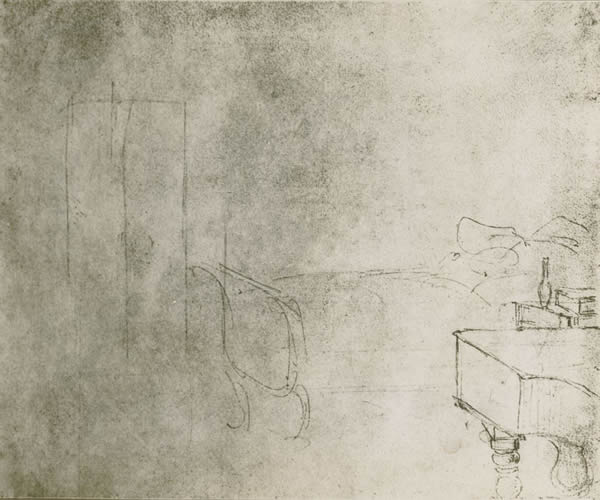
Beethoven’s Bed, charcoal sketch by Joseph Teltscher


… and to the side the piano with the window open onto the spires of St. Stephen’s Cathedral


The famous lock of hair taken by Ferdinand Hiller on March 27, 1827 and preserved at the Beethoven Center in San José, California.


Invitation to the funeral of Ludwig van Beethoven; the words were written by Stephan von Breuning


Watercolor by Franz Stoeber: Entrance of the coffin into the Church of the Holy Trinity.


La processione al funerale di Beethoven, quadro di Franz Stoeber


Casa degli Spagnoli Neri in Vienna, dove Beethoven morì (stampa del 1853)


1874 daguerreotype of the House of the Black Spaniards


Angustiana Church where one of the first memorials was celebrated, on April 3, 1827


The first biography of Beethoven, printed in Prague in 1827 (and not 1828) as reported on the title page by Johann Aloys Schlosser.


The first biography of Beethoven, printed in Prague in 1827 (and not 1828) as reported on the title page by Johann Aloys Schlosser.

In Memoriam: 1827 – Music Written in Honour of Ludwig van Beethoven

In Memoriam: 1827 – On the Death of Ludwig van Beethoven

After Beethoven’s death on 26 March 1827, several musicians and poets felt the need to write odes or compose music in response to this sad event. On this page, we aim to make accessible some virtually untraceable music by composers who have also faded into history. This will be an open publication, so many pieces of music, images, and documents will be added as they become available. Article available from July 2015.

In Memoriam: 1827 – Music Written in Honour of Ludwig van Beethoven – from March 1827

Carl Czerny

Funeral March on the Death of Ludwig van Beethoven (composed by Carl Czerny, Op. 146) – 26 March 1827, for solo pianoforte, Op. 146, April 1827; published in Vienna by Anton Diabelli; plate no. 2609. (No. 2610 is the same piece arranged for two pianos)

MARCE FUNEBRE / sur la Mort de / Louis van Beethoven / (+ 26 Mars 1827) / Composée et arrangée / POUR LE PIANOFORTE / à quatre mains / par / C. CZERNY. / [l.:] Op. 146. – HAMBURG,: Chez Auguste Cranz., [ca. 1827]. – 7 pp.; Landscape format

RAK-Musik title: Marche funèbre sur la mort de Louis van Beethoven, version for piano four hands.

(The frontispiece can be consulted at the foot of the page; the MIDI and MP3 will soon be available—our thanks go to our friend Luigi Bellofatto for his—as always—indispensable and extremely precise research.)

Joseph Drechsler

Bey Ludwig van Beethoven’s Leichenbegängnisse am 29ten Marz 1827, set to music by J. F. Castelli for a solo voice with piano accompaniment by Jos. Drechsler. April 1827; published in Vienna by Anton Diabelli; no plate number. Arrangement for voice and piano of the poem by Ignaz Castelli.

Ignaz Ritter von Seyfried

Trauer-Gesang bey Beethoven’s Leichenbegängnisse in Wien den 29. Marz 1827
Four-part male choir, with optional accompaniment by four trombones or piano. Arranged from Beethoven’s manuscripts for the above occasion with text by Ignaz Ritter von Seyfried.
No. 1 Miserere, No. 2 Amplius lava me. June 1827; published in Vienna by Tobias Haslinger; plate no. 5034. Arrangement for voices of the Equale, WoO 30, nos. 1 and 3.

Libera, welches bey Beethoven’s Leichenbegängnisse vor der Einsegnung des entseelten Körpers…
Performed by the singer choir accompanying the funeral procession in the church of the P. P. Minoriten in the Alservorstadt, Vienna, on 29 March 1827. Composed and arranged for this occasion by Ignaz Ritter von Seyfried. June 1827; published in Vienna by Tobias Haslinger; plate no. 5035.

Beethoven’s Begräbniss. Gedicht von Jeitteles
After a composition by the deceased: “Funeral March on the Death of a Hero”, arranged for four voices with piano accompaniment by Ignaz Ritter von Seyfried. June 1827; published in Vienna by Tobias Haslinger; plate no. 5036.

Trauerklänge bei Beethoven’s Grabe
Four-part male choir, after an original melody by the deceased. Text by Franz Grillparzer. 21 March 1829; published in Vienna by Tobias Haslinger as a supplement to the Allgemeiner Musikalischer Anzeiger, No. 12 (21 March 1829). Vocal arrangement of the Equale, WoO 30, no. 2.

Anselm Hüttenbrenner

Nachruf an Beethoven in Akkorden am Piano-Forte von seinem innigsten Verehrer.nObituary for Beethoven in chords on the pianoforte by his most devoted admirer. June 1827; published in Vienna by Tobias Haslinger; plate no. 5039.

Simon Seechter

Bei den Leichenbegängnissen des Ludwig van Beethoven von J. E. Castelli. June–July 1827; published in Vienna by Ferdinand Kettner; no plate number. Arrangement for voice and piano of the poem by Ignaz Castelli.

August Swoboda

Am Grabe Beethoven’s. Poem by Freyherr C. von Schlechta. Vocal quartet for two basses with piano or guitar accompaniment. Published in Vienna by the composer; no plate number. Arrangement for four voices and piano of the poem by Franz Xaver Freyherr von Schlechta.

Carl Czerny (Vienna, 21 February 1791 – Vienna, 15 July 1857) was a distinguished Austrian pianist, composer, theorist, and teacher. The son of a pianist who introduced him to the world of music, he studied pedagogy and, by the age of 15, was already a highly respected teacher. He lived in Vienna teaching piano (among his pupils was a young Franz Liszt) and was himself a student of Beethoven from 1801 to 1803 (with some interruptions); after hearing him play, Beethoven apparently offered to give him private lessons.

Czerny was a musician with an extraordinary memory, which also enabled him to perform the complete works of Beethoven’s sonatas. He devoted himself to piano pedagogy, composing numerous exercises (over 1,000) that still form the basis of piano instruction today: 40 Daily Studies, Op. 337; School of Embellishments, Op. 355; School of the Virtuoso, Op. 365; School of the Left Hand, Op. 399; School of Articulation and Polyphony, Op. 400; 6 Octave Studies, Op. 553; The First Master of the Piano, Op. 599; 24 Studies for Small Speed, Op. 636; The Art of Finger Agility, Op. 740; 25 Studies for Small Hands, Op. 748, etc.

He also composed symphonies, overtures, cantatas, and chamber music. During his life and after Beethoven’s death, he transcribed many of Beethoven’s works.

Joseph Drechsler (Wällischbirken, 26 May 1782 – Vienna, 27 February 1852) was a composer and music educator. He received his first musical instruction from his father, a singer and teacher in his hometown of Wällischbirken. At the age of 10, he became an altar boy in Passau and later studied harmony and basso continuo at the Benedictine monastery Benediktinerkloster Florenbach. In Passau, he studied philosophy, then went to Prague for theological studies and possibly to receive holy orders, while also studying law.

During his time in Prague, he continued his work as a composer; from this period date a Missa Solemnis (1804), several works for piano, and a lied for voice and piano. Drechsler did not complete these studies, however, and in 1807 he received an offer from theatre director Karl Friedrich Hensler in Vienna to serve as chapel master at the Leopoldstadt Theater. When this opportunity fell through, he decided to live for a time by giving private music lessons.

In 1810 he joined the Hofoperntheater and in 1812 became Kapellmeisteradjunkt. From this year dates his first Singspiel, Die Feldmühle, performed at the Kärntnertortheater on 29 September. Due to restrictions at the Hofoperntheater, Drechsler lost this position and moved as orchestra director to theatres in Baden and Pressburg.

In 1815, he served as organist at the Servitenkirche in Vienna. In the same year, he opened a music school. The following year he became chapel master at St. Anna’s Church, and a few years later (1823) chapel master at the University Church and parish in the Hof. He authored numerous works, including a theoretical teaching text and an organ school.

In 1844, after the death of the previous Kapellmeister Johann Baptist Gänsbacher, Drechsler succeeded him as chapel master at St. Stephen’s Cathedral, a position he held until his death on 27 February 1852 at the age of 70. He was buried at the St. Marx Cemetery in Vienna.

Anselm Hüttenbrenner (13 October 1794 – 5 June 1868) was an Austrian composer. On good terms with Beethoven, he was remarkably one of the few people present at both Beethoven’s and Franz Schubert’s deaths. His memoirs provide an interesting, though probably unreliable, source for Schubert biographical studies.

He was born in Graz, the son of a wealthy landowner. He attended the Graz Lyzeum and studied law at the University of Graz, while simultaneously becoming a composer. Count Moritz von Fries (1777–1826), impressed by his skill as a pianist, advised him in 1815 to go to Vienna to study with Antonio Salieri. As mentioned, by pure coincidence he was with Salieri on 26 March 1827 when Beethoven died. In Hüttenbrenner’s memory, the Johann Joseph Fux Conservatory in Graz cut a lock of Beethoven’s hair, now preserved in Graz at the Universalmuseum Joanneum.

His first published works (for piano and Lieder) began to appear shortly after 1815, and his String Quartet (Op. 3) was published in 1816. After a brief return to Graz in 1818, he went back to Vienna the following year to earn a living in a government office. In 1821, Hüttenbrenner inherited the family estate and married.

One of the most remarkable biographical notes is that Schubert entrusted him with the manuscript of the Unfinished Symphony, which remained with Hüttenbrenner until 1865. Hüttenbrenner served as director of the Steiermärkischer Musikverein from 1825 to 1829. His Requiem in C minor was performed at Schubert’s funeral on 23 December 1828. He died in Ober-Andritz at the age of 73.

Simon Sechter (Frymburk, 11 October 1788 – 10 September 1867) was an Austrian organist, composer, theorist, teacher, and orchestra conductor. He moved to Vienna in 1804 and succeeded Jan Václav Voříšek as court organist in 1824. In 1810, he began teaching piano and singing at the Academy for Blind Students. In 1828, Franz Schubert took lessons in counterpoint with him.

In 1851, he was appointed professor of composition at the Universität für Musik und darstellende Kunst Wien. In the last years of his life, due to his great generosity, he fell into poverty and died in absolute destitution. His position was taken by Anton Bruckner, one of his students, who based his teaching on Sechter’s methods.

Other students of Sechter who later became famous include the composer Henri Vieuxtemps, conductor Franz Lachner, teacher Eduard Marxsen (who taught Johannes Brahms piano and counterpoint), composers Johann Nepomuk Fuchs, Gustav Nottebohm, Carl Umlauf, conductor Béla Kéler, and pianists and composers Sigismond Thalberg and Adolf von Henselt, to name only the most notable.

Ignaz Joseph Ritter von Seyfried (15 August 1776 – 27 August 1841) was an Austrian musician, orchestra conductor, and composer. He was born and died in Vienna. According to a statement in his handwritten memoirs, he was a pupil of both Wolfgang Amadeus Mozart and Johann Albrechtsberger. After his teacher’s death, he published and revised Albrechtsberger’s complete works.

Among his students were notable musicians such as Franz von Suppé, Heinrich Wilhelm Ernst, Antonio Casimiro Cartellieri, Joseph Fischhof, and Eduard Marxsen. In his youth, Seyfried served as assistant director for Emanuel Schikaneder’s opera at the Theater auf der Wieden in Vienna, becoming musical director in 1797, and served in the same role (under its new name, Theater an der Wien) until 1826.

His memoirs offer insights into Viennese musical life, Schikaneder, Mozart’s The Magic Flute, as well as the curious and famous anecdote concerning the death of the celebrated composer. In 1805, Seyfried conducted the premiere of the original version of Beethoven’s Fidelio.

Seyfried’s memoirs also contain some surprising stories and anecdotes about Beethoven. The information he provides on Beethoven in the appendix to Studien im Generalbasse is described as, in his own words, “of great biographical value,” indeed containing “everything known about the events concerning the beloved master and [is] genuinely authentic.”

Regarding his musical works, the Grove Dictionary notes: “His versatility won him a unique place in Vienna’s musical life; however, almost none of his music is marked by real originality or distinction.”