
Unv.14 – Fragment of Piano Variations
(Fischhof, folios 25/26 verso)
Sketched at the end of 1794 or the beginning of 1795. The sketches are contained on three leaves of the Fischhof sketchbook and probably represent a theme, eight variations, and a coda.
On folio 25 recto of the notebook, immediately after the variations, there is a brief sketch for the first movement of the Piano Sonata in A major, Op. 2 No. 2. This has led some to suppose that Beethoven may have considered a set of variations as the finale of that sonata. Both this hypothesis and the alternative hypothesis of an independent set of variations remain plausible.
Further variations in A major — therefore in the same key and with the same tempo indication — appear in the “Kafka” miscellany (GB‑Lhl, Add. Ms. 29801, fol. 158v), although they probably refer to “Là ci darem la mano” from Mozart’s Don Giovanni, which is certainly not the subject of the variations in the Fischhof.
Unv.14 – Fragment of Piano Variations
Study of a Possible Reconstruction – by Maestro Graziano Denini
INTRODUCTION
Attempting to reconstruct a coherent musical idea from a Theme with 8 Variations and a final Coda — whose sketches are scattered across three pages of Beethoven’s manuscript — is no simple task. I wish therefore to clarify that my reworking can only be considered a hypothesis of transcription, and that many other, perhaps better, interpretations could be proposed.
One of the difficulties I always encounter when analysing Beethoven’s manuscripts is the absence of key signatures at the beginning of the staves. Beethoven rarely wrote the key signature at the start of each system; more often he simply implied it. At times this practice makes deciphering difficult — even more so in a Theme and Variations where the character and mood shift frequently. Occasionally I have identified a minor mode solely from the otherwise unnecessary presence of a G‑sharp.
I will therefore share my working method.
First, I transcribed — as faithfully as possible — all the sketches that could relate to this work and that appear on three leaves of the Fischhof sketchbook (facsimiles are reproduced on this page).
Second, I sought the fragments closest to one another in character or motion; I then began positioning them within a hypothetical Variation, adding missing notes here and there (below I illustrate, Variation by Variation, the results I obtained), while trying to use as much of the material as possible.
At this point, having a clearer view of the Variations and their thematic idea, I asked myself what the original Theme might have been. I believe the answer is that they refer to the Bagatelle in A major, WoO 213 No. 4, which should be slightly earlier. The key is the same, and the first six notes of the Bagatelle correspond exactly to those of Variation No. 6 (except that they are written in doubled values and in 4/4). The figure E–F♯–E in the middle of the Bagatelle also appears among the fragments of the minor‑mode Variation.
(For our work on this composition and the other three forming WoO 213: Four Bagatelles in D‑flat major, G major, A major, and A major.)
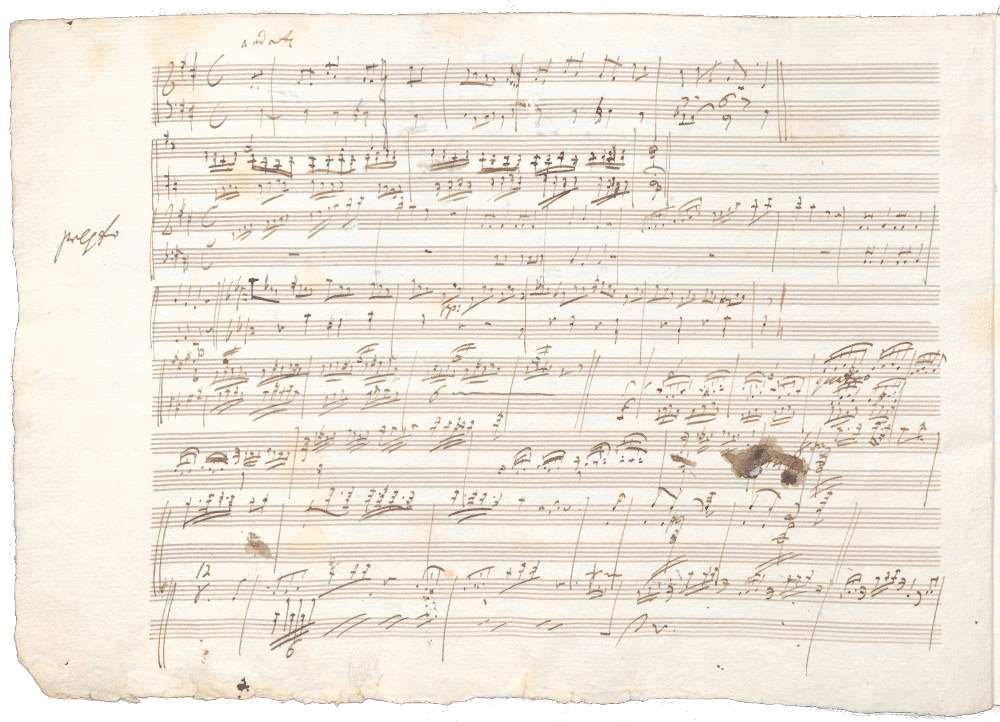
I therefore rewrote the entire Bagatelle in 2/4, halving all note values so that it would correspond more closely to Beethoven’s sketches for the Variations. The Bagatelle includes a Da Capo but has no ending; I therefore repeated the first eight measures (ABA form) and added a concluding bar derived from the ending of Variation 6, which is the closest to the Theme.
Finally, I redistributed the Variations in an order that seemed to me the most coherent.
I hope that my work — again, a hypothetical reconstruction of the eight Variations — will not prove disagreeable to Beethoven enthusiasts. In any case, it has been a valuable “exercise in style.”

RECONSTRUCTION OF THE VARIATIONS
Theme
As stated in the introduction, I believe the Theme of these Variations derives from the Bagatelle in A major, WoO 213 No. 4. These four Bagatelles, dating from 1793, have recently been included in the new Kinsky–Halm catalogue. They are sketches already catalogued by Giovanni Biamonti in 1968, though erroneously dated to 1800. Beethoven used a type of paper associated with compositions from 1793 (I thank my friend Luigi Bellofatto for this valuable historical‑analytical contribution).
Mark Zimmer informs us that these Bagatelles are found together with the Allemande WoO 81, the Anglaise WoO 212, the Bagatelle Hess 60, two nearly complete Bagatelles (Biamonti 269 and 277), and numerous sketches (Biamonti 268–270, 271–274, 276, 278–281) on two leaves in the Beethoven‑Archiv in Bonn, SBH 631 (SV 88).
