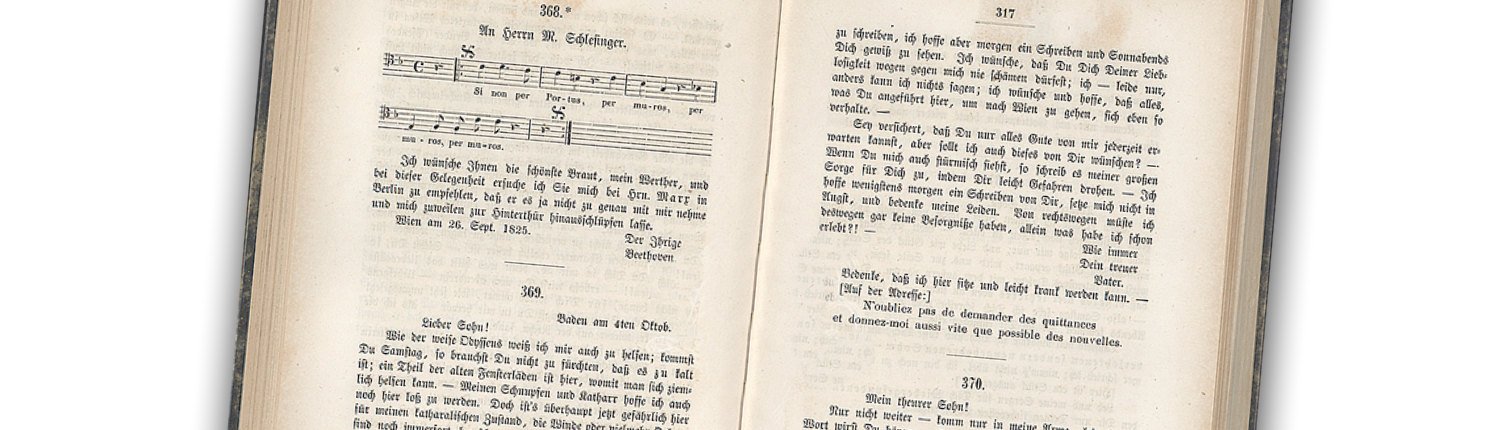
WoO 194 Si non per portas, per muros, Canon
“Si non per portas, per muros”, Canon for Schlesinger, late september 1825, pubblished by Nohl in Briefe Beethovens, 1865, page 316, number 368.G.A. No. 256/17 (serie 23, page 200) – B. 221 – KH. (WoO)194 – L. IV, Page 366/u Nottebohm page 162 – T. 252.
The original manuscript is unknown. The canon was written for the private collection of Moritz Schlesinger (son of the publisher Adolf Martin), to which a few years earlier the other canon, “Glaube und Hoffe!”, had also been addressed, and which had acquired the printing rights for the quartets Op. 132 and 135. For the solution (this is an enigmatic canon), see M.A., pages 126 and 128.
[By Biamonti Giovanni – Catalogo cronologico e tematico delle opere di Beethoven comprese quelle inedite e gli abbozzi non utilizzati, Torino, ILTE 1968]
Official title: WoO 194 Si non per portas Rätselkanon (F-dur) nach einem eigenen Text Widmung: — NGA XII/2 AGA 256/17 = Serie 23/S. 200
Creation and publication: Written on 26 September 1825 in Vienna on the occasion of the farewell dinner with the Parisian publisher Maurice Schlesinger. The first edition appeared posthumously in Ludwig Nohl’s 1865 edition of Beethoven’s letters, although as early as 1859 Adolph Bernhard Marx had published a facsimile of the autograph in his biography of Beethoven. Apparently, Beethoven had already promised the canon before Schlesinger’s visit on 4 September 1825, since Schlesinger wrote in a conversation book: “Wie steht’s denn mit dem Liedchen oder Canon, den Sie so gut waren, mir für meine Privatsammlung in Ihrem letzten Briefe zu versprechen?”
The autograph of the canon was probably destroyed during the Second World War. Schlesinger had received two canons from Beethoven, WoO 174 and 194. It is said that the transcription of WoO 174, framed under glass, was hung above Schlesinger’s desk and was burned in Stuttgart in 1944. Since this transcription was sold in 1907 with the Schlesinger estate, Grita Herre suspects that the sheet that was burned may in fact have been the second piece, namely the canon WoO 194.
The sketches will be featured in an article specially created for the Beethoven Music Research Center, www.lvbeethoven.org