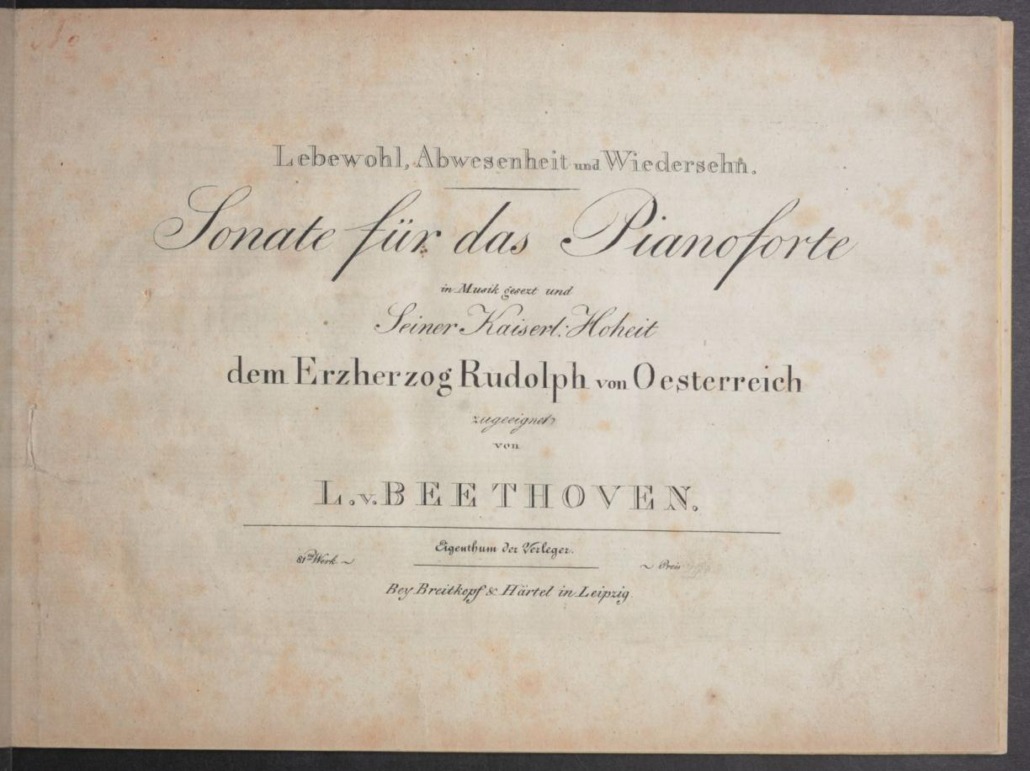
Opus 81a – Sonata in B flat major for piano
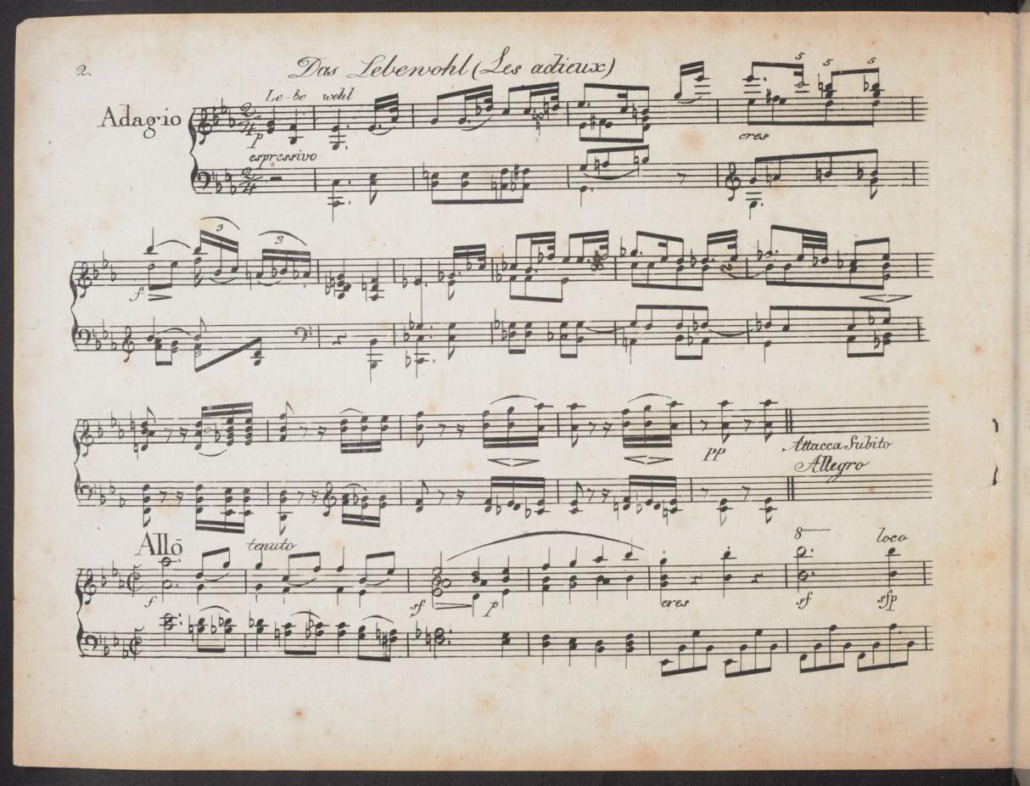
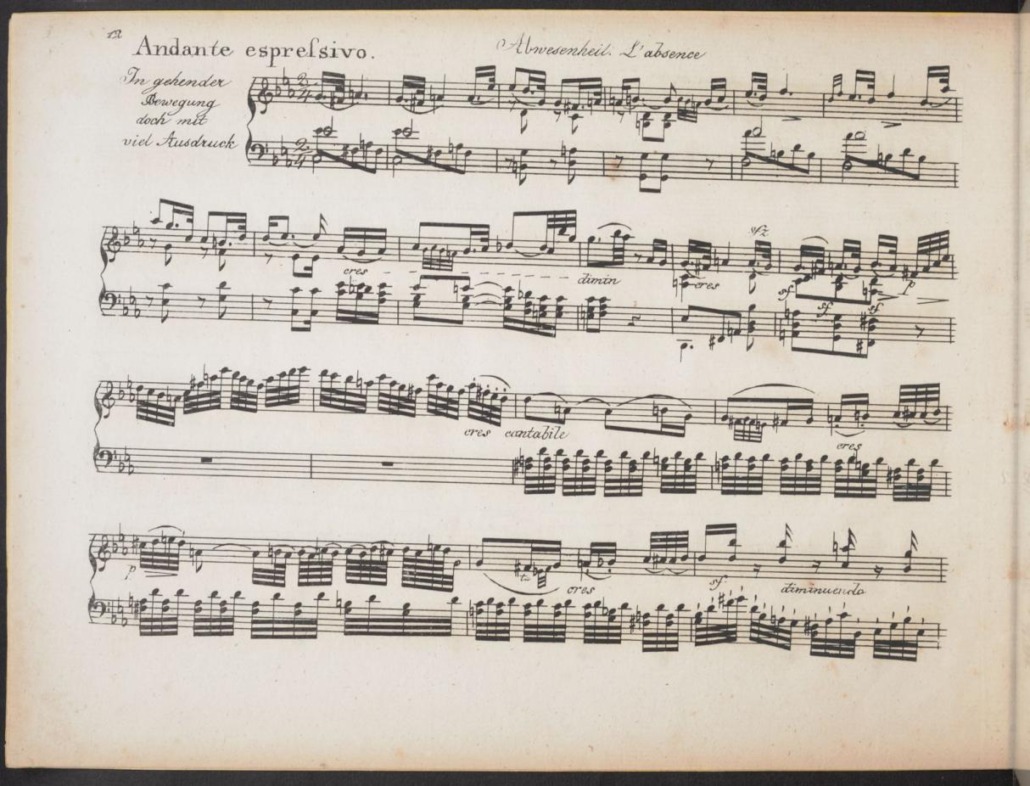
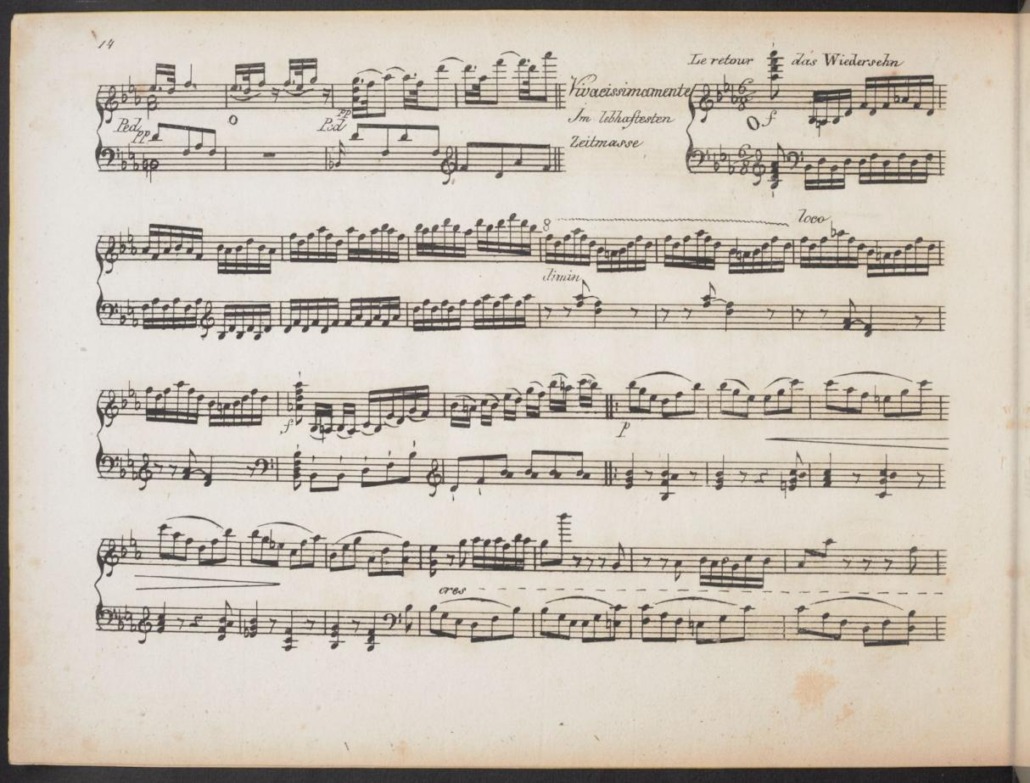
I) Lebewohl. Adagio – Allegro – II) Abwesenheit. Andante espressivo – attacca: – III) Wiedersehn. Vivacissimamente
OPUS 81a – Piano Sonata in E-flat major, Op. 81a (Lebewohl, Abwesenheit und Wiedersehn), dedicated to Archduke Rudolf of Austria, May 1809 – January 1810, published in Leipzig, Breitkopf and Härtel, July 1811. GA. No. 149 (series 16/26) – B. 81ìz – KH. 81 a – L. III, p. 201 – N. 81 a – T. 143
The manuscript of the first movement is in the archives of the Society of Friends of Music in Vienna. Those of the other two are now lost. The sketches were briefly described by Nottebohm.
The period during which the Sonata was mostly composed coincides with the Austro-French war of April-October 1809. As for the final movement, it is likely that it was completed between November-December 1809 and January 1810 (the imperial family, along with Archduke Rudolf, to whom the work is dedicated, returned to Vienna on 30 January 1810). This is the only one of Beethoven’s sonatas to have a title and a programme explicitly defined by him.
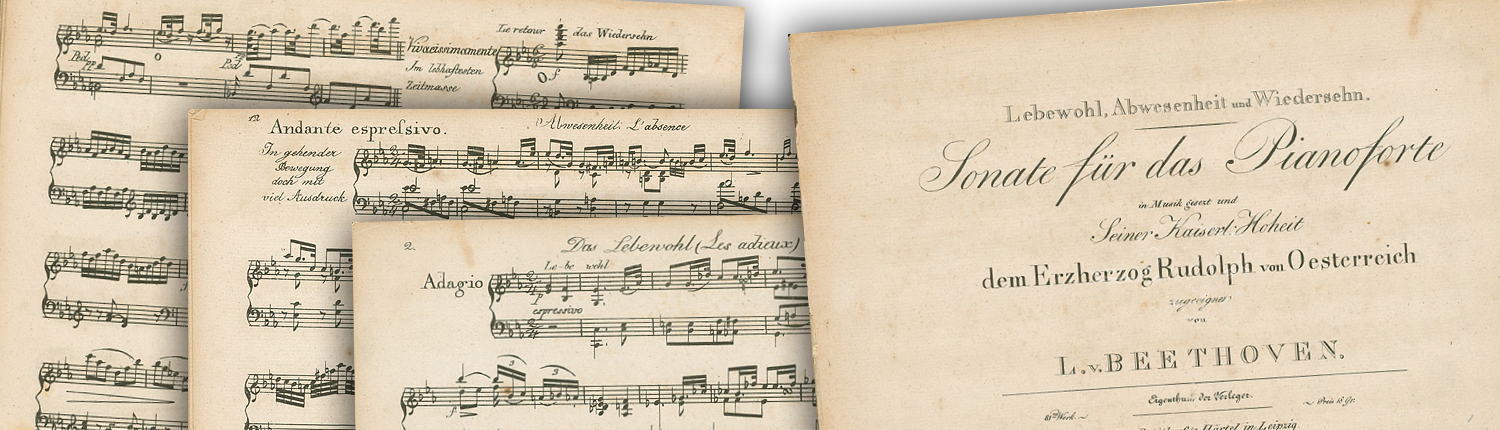
In a letter to Breitkopf & Härtel on 4 February 1810, he specifies the titles of the three movements: “Abschied” (departure), “Abwesenheit” (absence), “Das Wiedersehen” (the return). In another letter dated 9 October 1811, he complains that these titles had been translated into French, emphasising the difference in meaning between “Lebewohl” (farewell) and “Les adieux”, since “the former is only used when addressing a person with heartfelt emotion, while the latter is directed to an assembly, to whole cities.”
Officially, the work was meant to express the composer’s sorrow at the departure of his noble friend and patron; however, the underlying idea may stem from a deeper emotional state influenced by the complex events of war, beyond the personal affections or individual characters involved. The word “Lebewohl” (farewell) offers us the key to the first movement. The theme of the introduction, woven underneath, as noted at the top of the first page of the score, is identical to the motif of Florestano’s aria in Fidelio: “In des Lebens Frühlingstagen” (In the springtime of life). It pervades the movement, emerging in the inactivity of the various musical elements, and ultimately reappears in its original form, overlapping with itself, filled with anxious harmonic freedom.
The development of all these elements, as will later be the case in the subsequent Sonata in E minor, Op. 90 , is characterised by lightness and flexibility, guided by an intention to achieve more refined and exquisite expressive details. The second movement (Absence) (Andante espressivo) is based on a phrase to be played, as indicated by Beethoven’s German annotation alongside the Italian movement marking, “in gehender Beilegung, doch mit Ausdruck” (in a walking pace, yet with expression).
The opening theme repeats the rhythm of a motif from the introduction and is followed by another, whose melody, more fully developed, retains the same character. In its static form, mirroring the sense of sorrow from which it is inspired, the two themes follow and repeat without any development.
In the end, a fragment of the first theme rises, stretches, and remains suspended: and immediately the Finale (The Return) (Vivacissimamente) enters, a tumultuous ascent of notes that blossoms into the joyful movement of a defined theme. This is alternated and intertwined with another theme in detached, accented notes; and towards the end, a return of the first theme, in a slightly slower tempo, “of an almost religious character, which strongly recalls the passage before the last Presto in the Finale of the Eroica Symphony”, leads Casella to remark that “it is not far-fetched to hypothesise that Beethoven took the idea for both variations from the popular tradition of the French Revolution, according to which one of the couplets in certain revolutionary hymns — generally the last one — was sung slowly and in a subdued voice. Thus, for instance, the final stanza of La Marseillaise was often intoned adagio and pianissimo: Amour sacré de la patrie, etc. Anyone who has heard La Marseillaise interpreted in this way by Rouget de Lisle cannot fail to have been struck by the profound identity of feeling that unites the aforementioned Beethovenian fragments with the famous French song.”
[By Biamonti Giovanni – Catalogo cronologico e tematico delle opere di Beethoven comprese quelle inedite e gli abbozzi non utilizzati, Torino, ILTE 1968]

Official title: ,,Opus 81a“ Sonate (Es-dur) „Lebewohl, Abwesenheit und Wiedersehn“ „Les Adieux, l’Absence et le Retour“ für Klavier Widmung: Erzherzog Rudolph von Österreich NGA VII/4 AGA 149 = Serie 16/26
Origin and publication: The autograph of the first movement is dated 4 May 1809, while the other sketches were probably made in April of the same year in Vienna. The remaining movements were only drafted in September/October 1809. The exact date of completion of the entire sonata remains unclear, as at the beginning of November 1810 the publishers of the first edition, Breitkopf & Härtel, had still not received the engraving model. The original editions were published in January 1811 by Clementi & Co. in London and in July by Breitkopf & Härtel in Leipzig (one edition with a French title and one with a German title). Works Opp. 73–81a and 82, as well as WoO 136, 137 and 139, were the subject of an agreement between Beethoven and Muzio Clementi (probably during Clementi’s stay in Vienna, 1805–1810) with the aim of publishing the works as original editions in London and in Leipzig or Vienna. Beethoven wrote to Breitkopf & Härtel concerning the publication details: “Der dritte [Transport] besteht aus der charakteristischen Sonate der Abschied, Abwesenheit, das Wiedersehn – sodann aus 5 italienischen Arietten [Op. 82], sodann aus Partitur von Egmont [Op. 84 welcher nicht in England heraus kommt und sie können erscheinen lassen, wie sie wollen. Diese: können am 11ten Februar 1811 erscheinen” (BGA 451). As always, Beethoven promised to deliver these manuscripts within the following two weeks, but in reality, the publisher was still awaiting the engravings on 11 November 1810. According to the registration in Stationers’ Hall, the original edition was published by Clementi in London on 28 November 1811, thus within the deadline requested by Beethoven.
At the end of May, Beethoven returned to a further revision, taking up the manuscripts that were kept by Archduke Rudolf (BGA 496, 498). Perhaps the publication was complicated by Beethoven’s somewhat ambiguous statements? On the one hand, in his offer of “3 Klavier Solo Sonaten” to Breitkopf & Härtel (BGA 423 of 4 February 1810): “Nb. wovon die 3te aus 3 stücken, Abschied, Abwesenheit; das widersehn besteht, welche man allein heraus geben müste.” The publisher, learning of this wish, thought to apply it to three supposed sonatas rather than to a single one, and thus planned two instalments, the second of which was to contain the “Lebewohl – Les adieux.” These sonatas were announced in this form in February 1811 (AmZ 13, Intelligenzblatt 14, together with Opp. 82 and 85) and again in July (Intelligenzblatt 9, col. 35).
The sonata actually appeared as a single volume, but the plate numbers 1588 and 1589 were retained for the two supposed instalments. Even the copies of the first edition traced so far show that both parts were meant to be paginated separately. On 20 May 1811, however, Beethoven sent the corrected proofs of Op. 80 to Breitkopf & Härtel (BGA 499) with the instruction: “machen sie den Titel, wie ich ihn aufenschrieben, Französisch und Deutsch, ja nicht Französisch allein – und so die übrigen überschriften –”. This instruction was followed for the movement headings, but both a French and a German version of the main title were made, resulting in two editions differing only in the title. Based on surviving copies, it can be assumed that, from the outset, the French-titled version was given prominence by the publisher. This can be verified by the fact that the advertisements for the first edition mention the French title.
To this must be added Beethoven’s complaint to the publisher on 9 October 1811 after the publication of his work (BGA 523): “eben erhalte ich das Lebe wohl etc ich sehe dass sie doch auch andere E.[xemplare] Mit französischem Titel, warum denn, lebe wohl ist was gar: anders als les adieux das erstere sagt man nur einem Herzlich allein, das andere einer ganzen Versammlung ganzen Städten – da sie mich so schändlich recensiren laßen, so sollen sie auch herhalten, viel weniger Platen hätten sie auch gebraucht, und das so sehr jezt erschwerte Umkehren wäre dadurch erleichtert worden damit Basta.”
As for the opus number: all contemporary editions bear the opus number 81, the same as that of the Sextet for string quartet and two horns, which had been published by Simrock in Bonn shortly before – in the spring of 1810. (So also in Hofmeister/Index 1819; in Artaria’s “Catalogue des Oeuvres” of the same year, in Op. 106, the sonata is listed as “Op. 81,” the Sextet as “No. 81.”) The distinction between the two works as Opp. 81a and 81b first appeared in Breitkopf & Härtel’s catalogue of 1851.
Title: As shown by the autograph inscription on the sources from Archduke Rudolf’s musical collection, this is a composition whose origin is directly connected to the Archduke’s hasty departure from Vienna. At the end of April 1809, the French troops had crossed the Austrian border. In order not to witness the inevitable siege and conquest of Vienna, the members of the imperial family, including Rudolf, fled to Hungary. Rudolf left Vienna on 4 May 1809 and returned on 30 January 1810 (for the placement of the sonata within a broader historical context, see Burstein/Op. 81a). For the dedication, see Op. 58.
First performance unknown.
The sketches will be featured in an article specially created for the Beethovenian Music Research Center, www.lvbeethoven.org