
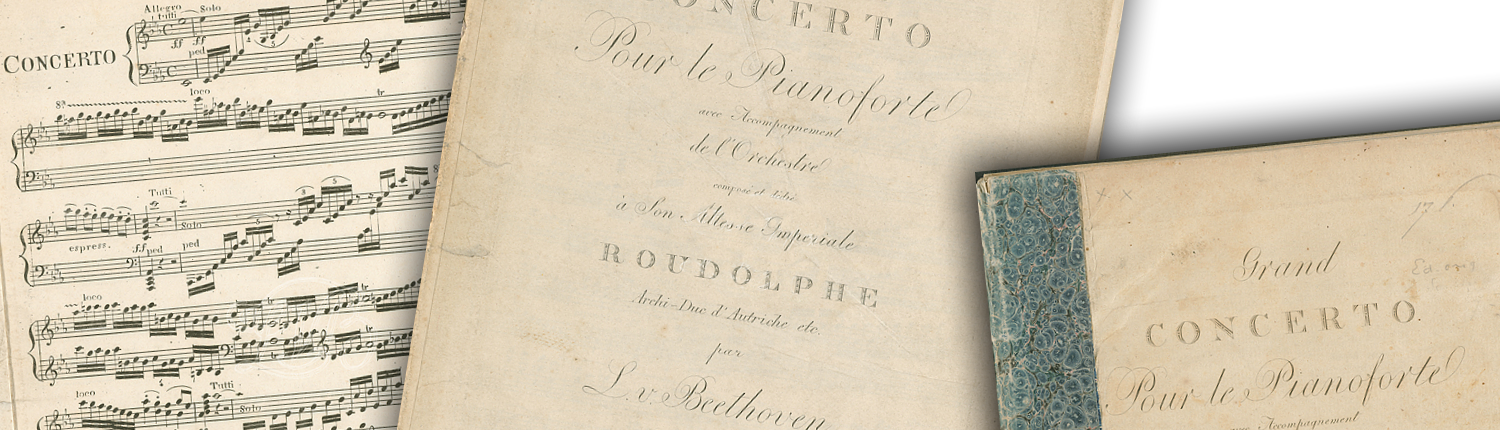
Opus 73, Concerto No. 5 in E flat major for piano and orchestra
I) Allegro – II) Adagio un poco mosso – III) Rondo – Allegro
Opus 73 – Concerto No. 5 in E-flat major for Piano and Orchestra, Op. 73, dedicated to Archduke Rudolf of Austria, 1809, published in Leipzig, Breitkopf and Härtel, in orchestral parts: February 1811; in score: March 1857. GA. No. 69 (series 9/5) – B. 73 – KH. 73 – L. III, p. 159 – No. 73 – T. 144.
The original manuscript is held in the Deutsche Staatsbibliothek in Berlin; the sketches are contained in the notebook for the Fantasia Op. 80. Without any intention of establishing a hierarchy of absolute values—which would, in any case, be extremely difficult—we must acknowledge the pre-eminence of this concerto over the previous four for the breadth of its design, the mastery of its technical skill employed for expressive purposes, and the beauty of its instrumental melodic discourse, even in the absence of those dramatic and passionate elements that so often animate Beethoven’s works.
Here, too, the soloist—just as in the Fourth Concerto—opens the Allegro, though not in the manner of a thematic “statement of intent”, but rather as a grand introductory cadenza supported by a succession of orchestral chords. In this passage, it is the overall spirit of the movement that is established: one of radiant, celebratory character. The first tutti theme has the character of a martial hymn, and in the clarity and directness of its line it recalls other, though less ambitious, themes from the Second Symphony or the Triple Concerto for piano, violin, cello, and orchestra. The second theme is likewise a characteristic march motif: at first presented in the minor, in detached notes, and then gently softened in its repetition in the major, legato, by the horns.
The conclusion brings back the opening theme, broadening and glorifying it. Particularly original is the soloist’s entry on the rhythmic pedal of the suspended cadential chord, so powerfully accentuated by the orchestra, and the freer restatement that follows. The way in which the second theme reappears—this time in the piano—is undoubtedly one of the most captivating moments of the entire work, producing, through the special interplay of rhythmic and timbral elements, a completely new effect of imaginative grace and expressive tenderness. With the same freedom and inventiveness, the first movement unfolds and concludes.
The development section, governed primarily by the first theme and above all by its rhythm, reaches the height of tension in the striking confrontation between orchestra and soloist. From this arises the formidable—one might say heroic—passage of piano octaves, followed by the orchestra’s ascent built upon the “rolling” impulse of the same theme, which leads to the recapitulation.
An annotation by the composer, written in Italian at the end of this section, notes that “no cadenza is to be played, but the following is to begin immediately”: that is, a brief summarising episode in which the two main themes return in their characteristic form—another striking invention that once more encapsulates the spirit of the movement and drives it towards the impetuous conclusion.
A melody that reveals, in its inward stillness, a certain intimate fervour is introduced at the opening of the Adagio un poco mosso by the muted strings. At the close of their phrase, the soloist enters, intertwining with descending, gently gliding figures, whose softness is enhanced by occasional woodwind touches—somewhat reminiscent of the Larghetto of the Violin Concerto or the Benedictus of the Missa Solemnis (though the latter is more ethereal). The piano then takes possession of the theme (the strings, now in the background, repeat it in pizzicato), developing it in full harmonies, lightly embellishing its melody, and finally enveloping its further repetition, in which the flute, clarinet, and bassoon take the principal roles.
In this increasingly intense lyrical animation, the Adagio attains its highest expressive power, then gradually dissolves into a kind of halo of gentle, diffused light. A sudden modulation to E-flat hints, as if from afar yet already clearly defined in rhythm and melodic outline, at the germ of a new theme: that of the Rondo. This bursts forth immediately after a brief pause on a held note, into an energetic and brilliant dance movement (Allegro), whose rhythmic character closely resembles—at times even literally—that of the first movement of the Seventh Symphony; and, as in that work, the same pulsating vitality pervades not only the principal theme but all its varied episodes.
A particularly striking instrumental effect comes at the end in the alternation between timpani and piano, where the timbres of the two instruments almost merge as they gradually fade away. From this final moment of stillness, the soloist’s suddenly rekindled impetus drives the music to its swift conclusion, affirmed by the full orchestra.
[By Biamonti Giovanni – Catalogo cronologico e tematico delle opere di Beethoven comprese quelle inedite e gli abbozzi non utilizzati, Torino, ILTE 1968]
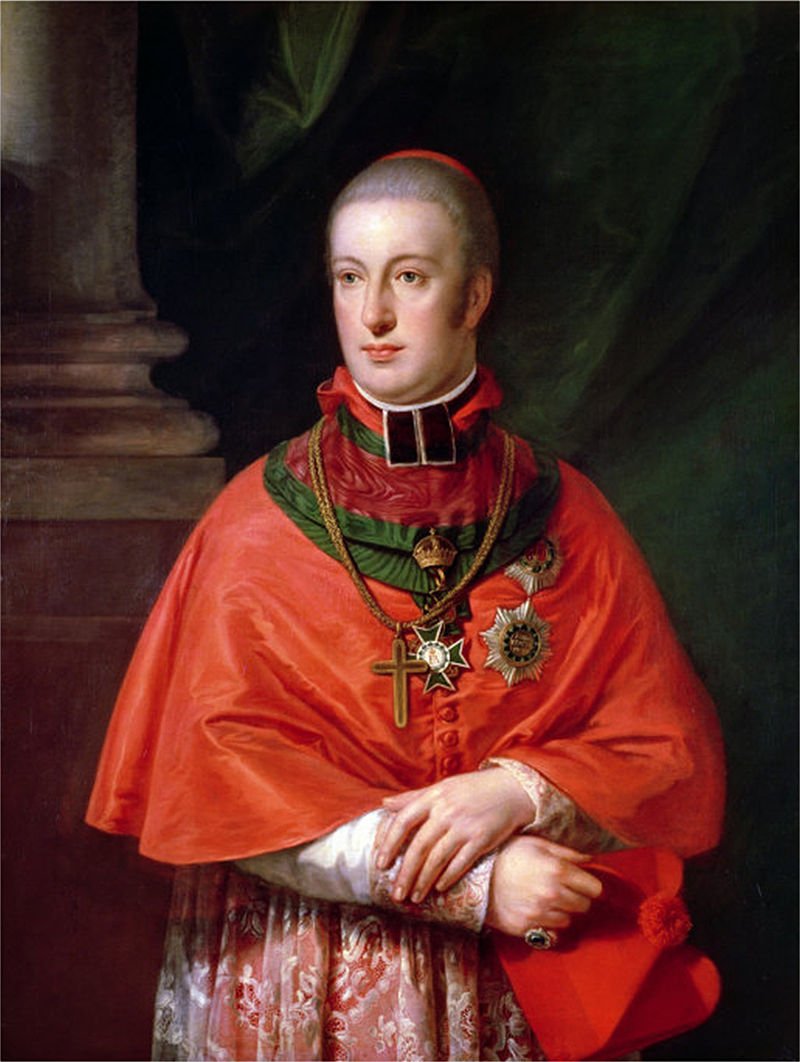
Official title: Opus 73 Konzert Nr. 5 (Es-dur) für Klavier und Orchester Widmung: Erzherzog Rudolph von Österreich NGAIII/3 AGA 69 = Serie 9/5 Beiname: Emperor Concerto
Creation and publication: Sketched between the end of December 1808 and April 1809 in Vienna. In his correspondence with Breitkopf & Härtel, Beethoven described the piano concerto as an earlier composition than the String Quartet Op. 74 (conceived between August and September 1809). By the summer of 1809, an autograph score of Op. 73 probably already existed. However, a corrected score was only ready in August 1810 and sent to the publishers Breitkopf & Härtel. The original London edition was published by Clementi & Co. in November 1810. The original Leipzig edition appeared in the publisher’s printed catalogue in February 1811. Beethoven likely turned to new projects immediately after his academy concert of 22 December 1808, during which, among other works, the Choral Fantasy Op. 80 was premiered. The main stage of work on the concerto followed in the first months of 1809. After the final sketches for Op. 73, contained in the sketchbook known as “Landsberg 5”, the first ideas for the Sonata Op. 81a appear, probably written down in April 1809. Hans-Werner Küthen suggests that Beethoven added only eight bars to the first movement (bars 173–180) at the beginning of 1810. The figured-bass notation contained in the autograph score and in the solo part copy was likely added only a few months later.
Opp. 73–81a and 82, as well as WoO 136, 137 and 139, were part of an agreement between Beethoven and Muzio Clementi (probably during Clementi’s stay in Vienna from 1808 to 1810) aimed at publishing these works simultaneously as original editions in London and in Leipzig (or Vienna). The intended publication date for Op. 73 was probably November 1810, which Clementi demonstrably met. After reaching an agreement with Breitkopf & Härtel, Beethoven sent the engraving model to Leipzig in August 1810 as part of a second group of works. On 21 August, he asked the publisher to assign opus numbers:
„Die lezte Nummer von den lezten Wercken [Op. 71] welche bey ihnen heraus gekommen mag ihnen zum Leitfaden dienen diese Werke gehörig zu Numeriren / das quartett [Op. 74] ist Früher als die ändern – das Konzert ist noch Früher als das quartett, wenn sie die Nummern chronologisch ordnen wollen da beyde von einem Jahr, so brauchts eben nicht […] – sie werden nun bald alles was zur zweiten Lieferung gehört empfangen haben“ (BGA 465).
On 24 September, Breitkopf & Härtel received the second shipment and communicated the opus number (BGA 469). In two letters from October (BGA 472, 474), Beethoven requested the proofs and the engraver’s copy in order to correct the engraving: „sorgen sie ja und gehn sie doch ein, weswegen ich sie oft gebeten, schiken sie ein probe exemplar, aber auch die Manuskripte, man klagt über die Unrichtigkeit des Stichs, und ich habe bemerkt, daß auch die klärste schrift gemißdeutet wird […] — warum ich die Manuskripte begehre mit dem probe exemplar ist, weil ich beynahe keins besize, weil wohl hier und da ein guter Freund mich darum begehrt, so hat die Partitur vom Konzert der Erzherzog und gibt sie mir nicht mehr wieder“ (BGA 474, 15 October). The publisher apparently did not bother to comply.
The nickname “Emperor Concerto” commonly used in English-speaking countries implies that Beethoven composed this concerto in an “heroic” spirit in honour of Napoleon, thus creating a musical monument to him. There is no biographical evidence to support this notion. On the contrary, at the time of its composition, Beethoven was already distancing himself from Napoleon. The author of the nickname is unknown. Freda Berkowitz suspects that it may have been the publisher and pianist Johann Baptist Cramer. For the dedication, see Op. 58.
The first performance took place on 13 January 1811 at one of the subscription concerts organised by Prince Lobkowitz in his palace on Sunday evenings. This performance was recorded by Johann Nepomuk Chotek, who noted in his diary: “Abends gingen wir in das Concert bey Lobkowitz welches bis 10 Uhr währte, das vorzüglichste was producirt wurde war eine schöne Overture von Righini, ein außerordentlich schweres und künstliches aber gar nicht angenehmes neues Concert von Beethoven von E. H. Rudolph gespielt, ich hörte ihn heute zum ersten male spielen er hat wirklich sehr viel Fertigkeit und Ausdruck.”
On 28 November 1811, the concerto was performed at the Gewandhaus concerts in Leipzig, with Friedrich Schneider as soloist and Philipp Christian Schulz conducting. With Carl Czerny at the piano, the concerto was played on 12 February 1812 at the Kärntnertortheater in Vienna during a charity concert. The Allgemeine musikalische Zeitung wrote of the Leipzig concert: “Beethovens neuestes Concert für das Pianoforte (aus Es dur, bei Breitkopf und Härtel) folgte. Es ist dies ohne Zweifel eines der originellesten, phantasiereichsten, effectvollesten, aber auch schwierigsten, von allen existirenden Concerten.” The reviewer of the Viennese performance, however, complained about “the excessive length of the composition.” On 21 May 1824, Beethoven asked Carl Czerny to perform the second and third movements of Op. 73, but Czerny declined (BGA 1838f).
The sketches will be featured in an article specially created for the Beethovenian Music Research Center, www.lvbeethoven.org
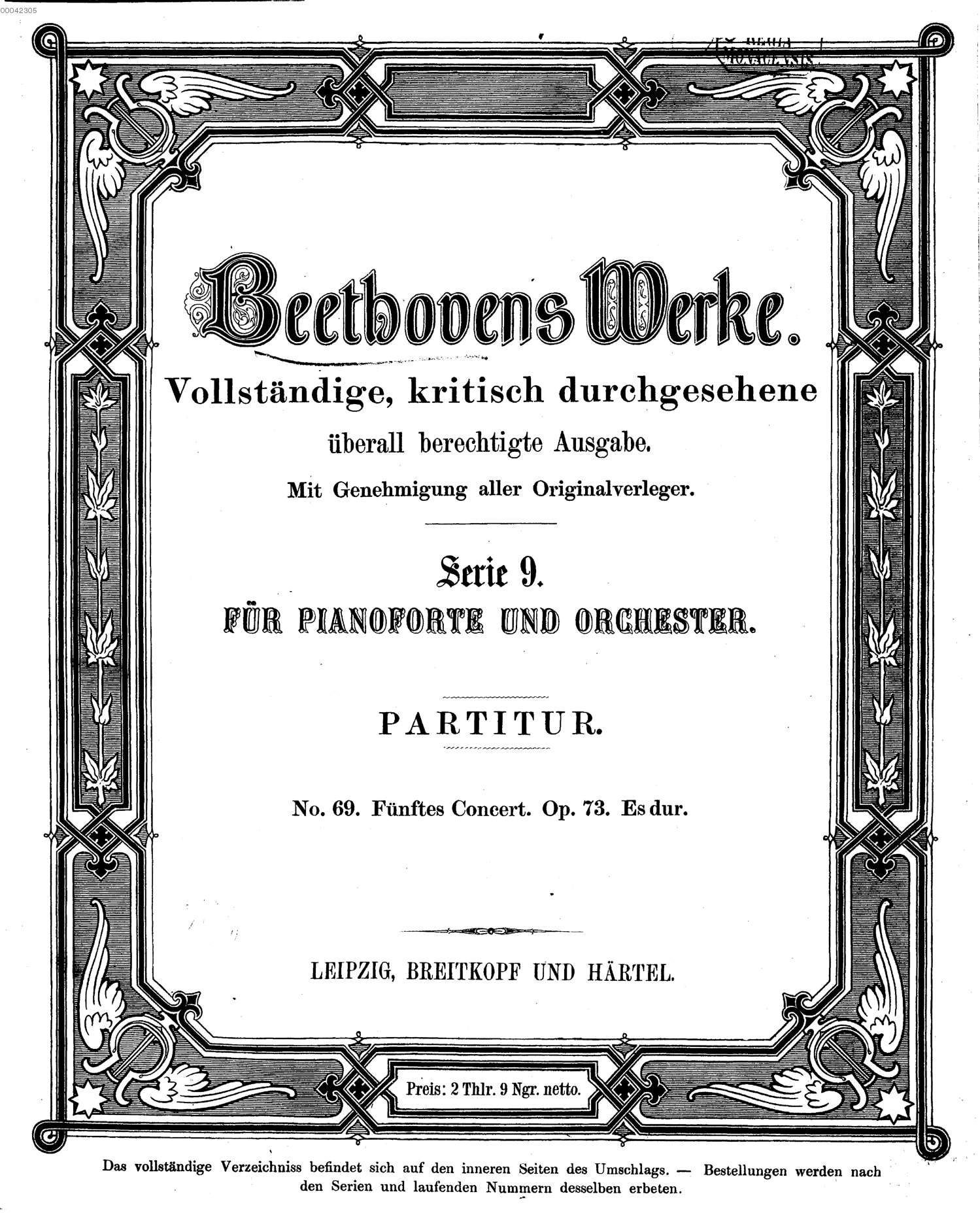
Opus 73 Concerto n. 5
in mi bemolle maggiore per pianoforte e orchestra
Tantum Ergo in B major, for four solo voices and organ.
Adagio un poco mosso
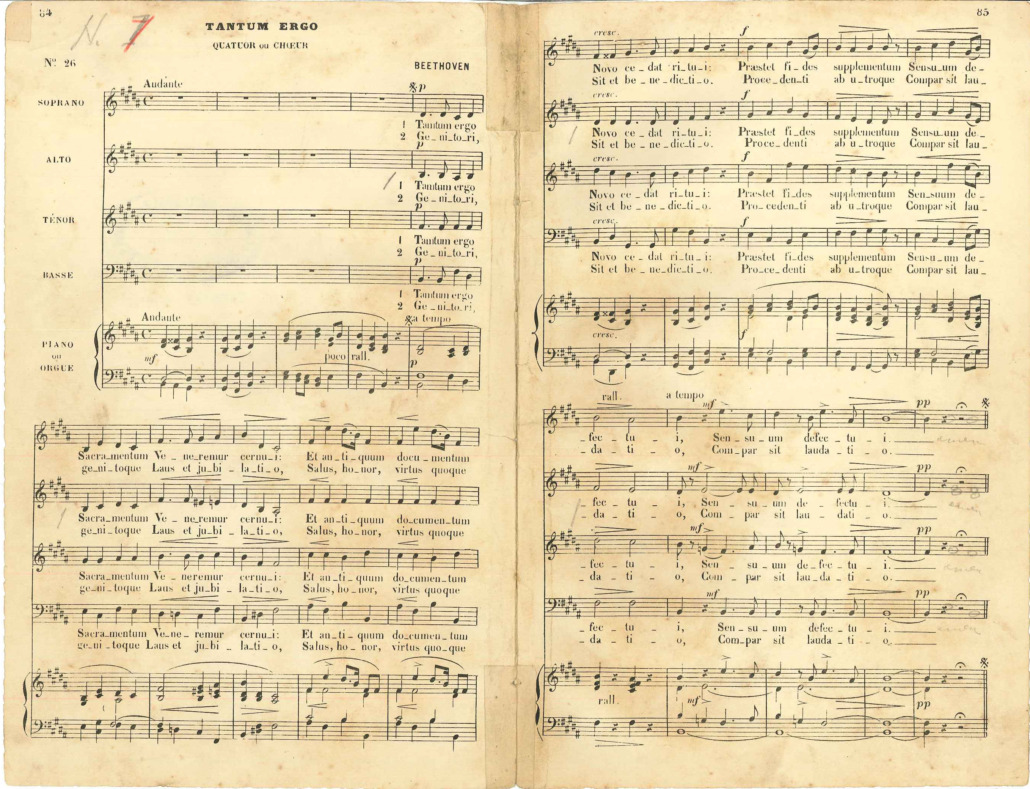
A short composition for organ (or piano) and four solo voices (or choir). A French publication from the late 19th century, it is a free transcription of the second theme from the slow movement of the Piano Concerto No. 5, Opus 73. The piece spans two pages (pp. 84–85) and is numbered as No. 26. Special thanks to Luigi Bellofatto for this valuable discovery.
THE TEXT:
Tantum ergo sacramentum
veneremur cernui
et antiquum documentum
novo cedat ritui.
Praestet fides supplementum
sensuum defectui.
Genitori genitoque
laus et jubilatio
salus, honor, virtus quoque
sit et benedictio.
Procedenti ab utroque
comparsit laudatio.
Amen.
(So great a sacrament, therefore, let us venerate, bowed in reverence, and let the old rite give way to the new. Let faith provide a supplement for the weakness of the senses. To the Father and the Begotten be praise and rejoicing, acclamation, honour, power, and blessing. To Him who proceeds from both, let equal praise be given. Amen.)
Here is what the researcher Michel Rouch says about this and other similar pieces:
“Ce Tantum ergo pour Quatuor ou Chœur est l’exacte photocopie de : Échos du Monde religieux (volume III, p. 84 & 85, n° 26) paru en 1885 à Paris, chez Durand, Schœnewerk et Cie – 3058 (anciennement Gustave Flaxland). Le premier volume était paru en 1851 ; il y en eut au moins 8 ! Cette collection contient 14 pièces de Beethoven adaptées pour la liturgie (Sanctus, Agnus Dei, Salutaris, etc.) Ce Tantum ergo se sert de l’Adagio un poco mosso du Klavierkonzert n° 5 Opus 73″ .

