
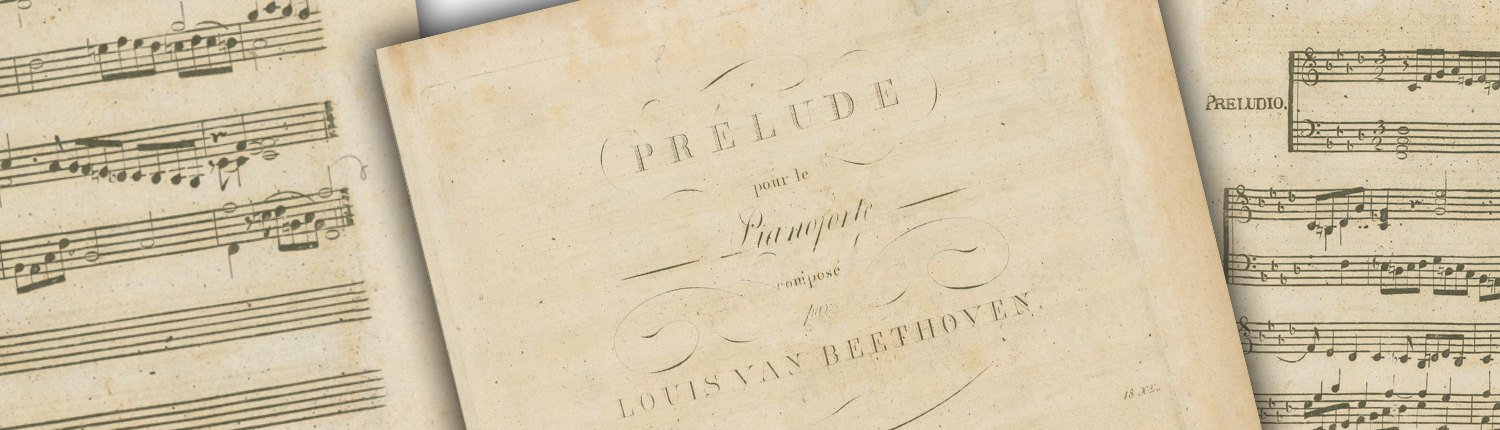
WoO 55 – Prelude in F Minor for Piano (or Organ)
WoO 55 – Prelude in F Minor for Piano (or Organ).
Composed between 1787 and 1803, published in Vienna by the Bureau d’arts et d’industrie, January 1805. GA No. 195 (Series 18/13) BRUERS 166 KH (WoO) 55 L. IV, pages 322/29 Nottebohm page 149 P. 13 Schunemann page 216/13 Thayer 121 Biamonti 374.
The original manuscript is lost. According to Nottebohm, an old copy of the first edition bore the annotation, in an unknown hand: “à l’âge de 15 ans”. But the reliability of this dating—similar to what has been observed for the Minuet listed as Biamonti 373—is highly questionable. In any case, the Prelude must have undergone significant revisions during the planned but unrealized 1803 edition mentioned by Ries in a letter to Simrock dated September 13, 1803. According to Thayer-Riemann, who attributes the work to 1787, it represents “the most significant testimony of Beethoven’s study of Bach’s style.”
Due to the lack of autograph sources, it is extremely difficult to determine when this Prelude was written. What is certain is that the piece was revised in September 1803, as Ferdinand Ries offered it for sale to Simrock in a letter dated the 13th of that month: „Auch können Sie jetzt 8 Lieder von Beethoven und ein Präludium, die er seinem jüngsten Bruder für einige erwiesene Gefälligkeiten schenkte, kaufen.“ “You can now purchase 8 songs by Beethoven and a Prelude, which he gave to his youngest brother in gratitude for certain favors.” (BGA 155)
On a fragmentary copy handwritten by a copyist of Op. 52 No. 2, there is also the following declaration of ownership by Beethoven: „Ich erkläre diese 8 Lieder und das preludium aus f moll für das Eigenthum meines Bruders Johann van Beethoven. Ludwig van Beethoven Wien am 7ten 8bre 1803“. “I declare these 8 songs and the Prelude in F minor to be the property of my brother Johann van Beethoven. Ludwig van Beethoven, Vienna, October 7, 1803.”
A much earlier revision of the piece, as suggested by Kinsky/Halm (KH p. 501) based on stylistic considerations, in relation to a non-materialized printed edition prior to the Simrock edition of 1803, cannot be justified in more detail. Biographical reasons (lessons with Neefe and studies of Bach’s Well-Tempered Clavier) could date this composition to the Bonn period (Cholopow / WoO 55 p. 431). Nottebohm’s suggestion that a copy of the original edition bore the note “à l’âge de 15 ans” (Nottebohm / Studien p. 12) points in this direction. This copy has not yet been found. On January 30, 1805, the original edition—not published by Simrock but by the Kunst- und Industrie-Comptoir Wien—was advertised as “brand new” in the Wiener Zeitung.
WoO 55 is one of the shorter works which, according to Beethoven’s original testament, should not be assigned an opus number, but could be numbered at the publisher’s discretion. In this sense, the Wiener Kunst- und Industrie-Comptoir assigned it No. 29, starting from the second advertisement on February 13, 1805, in the Wiener Zeitung and on the cover of the second edition by Steiner & Comp.
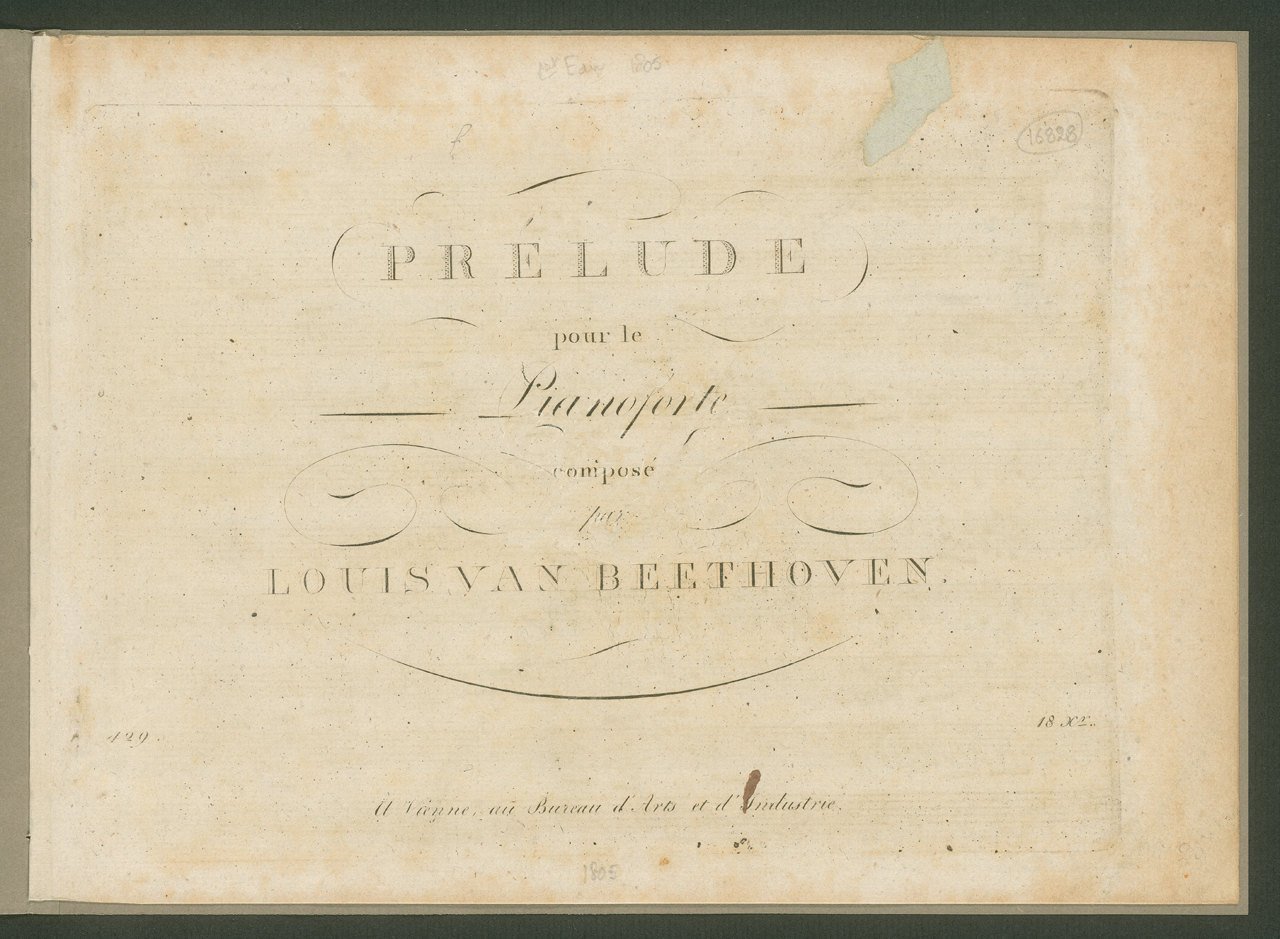
The publisher began numbering works from March 1804: No. 24 for the song “Der Wachtelschlag” (WoO 129). Continued up to No. 29. Then—skipping some numbers—up to No. 38 (“Sehnsucht”, WoO 134, 1810). This number usually appeared on the title page of the original edition (see appendix Publishing / Art and Industry Comptoir). First performance: unknown. Sketches and autographs: lost. Original edition: January 1805, Vienna, Kunst- und Industrie-Comptoir (Bureau d’Arts et d’Industrie). VN / PN: 429 Title: “PRELUDE / pour le / Pianoforte / composé / par / LOUIS VAN BEETHOVEN. / [1st:] 429. [r.:] 18 Xr. / A Vienne, au Bureau d’Arts et d’Industrie. ” Format: horizontal. Pages: 3 (p. 1 title). Advertisements: Wiener Zeitung, January 30, 1805 (“brand new”, together with WoO 82); February 13, 1805 (“No. 29”)
Curiosities: In a letter dated September 13, 1803, Ferdinand Ries refers to this Prelude as a work Beethoven gifted to his brother Kaspar Anton Karl, stating it was a composition from the Bonn period. In letter No. 158, written in the second half of September 1803, Beethoven wrote to Breitkopf & Härtel, referring also to this Prelude: “(…) unfortunately, many of my old abandoned works are being sold and stolen.” This suggests not only that the Prelude does not date from that year, but also that Beethoven did not revise it. Nonetheless, the publication occurred in January 1805, by the Bureau d’Arts et d’Industrie in Vienna. Initially, it was assigned Opus number 29, which was later reassigned to the String Quintet in C Major. Among the various hypotheses regarding its date of composition—1787, 1803, and 1795—Luigi della Croce leans toward 1787, asking: “(…) from whom could Beethoven have already learned so well the rules of music and especially the Bachian style, which in this clear page has a devotee far from a beginner?” The thought inevitably turns to Christian Gottlob Neefe, who had the young pupil study The Well-Tempered Clavier.

WoO 55 is part of the “Research Becomes Art” project.
A New Life for the Unknown Works of Ludwig van Beethoven: An Artistic Exploration by pianists maestros Emanuele Stracchi and Francesco Gussago