WoO 110 Elegie auf den Tod eines Pudels: Stirb immerhin, for Voice and Piano
Maestoso
WoO 110 Elegie auf den Tod eines Pudels: Stirb immerhin, for Voice and Piano,
1787 (It is currently believed to date back to around 1806), published in the Supplement to the GA 1888. (We do not exclude that there is an old and earlier edition, which is impossible to find today). GA. no. 284 (series 25/21) – Boett. 1/4 – Bruers 271 – KH. (WoO)11O – L. IV, p. 350/q – Petters 16 – Sch. p. 216/12 -Thayer 272.
Official title: WoO 110 Elegie auf den Tod eines Pudels Lied (f-moll) für Singstimme und Klavier Widmung: — NGA XII/1 Nr. 29 AGA 284 = Series 25/21
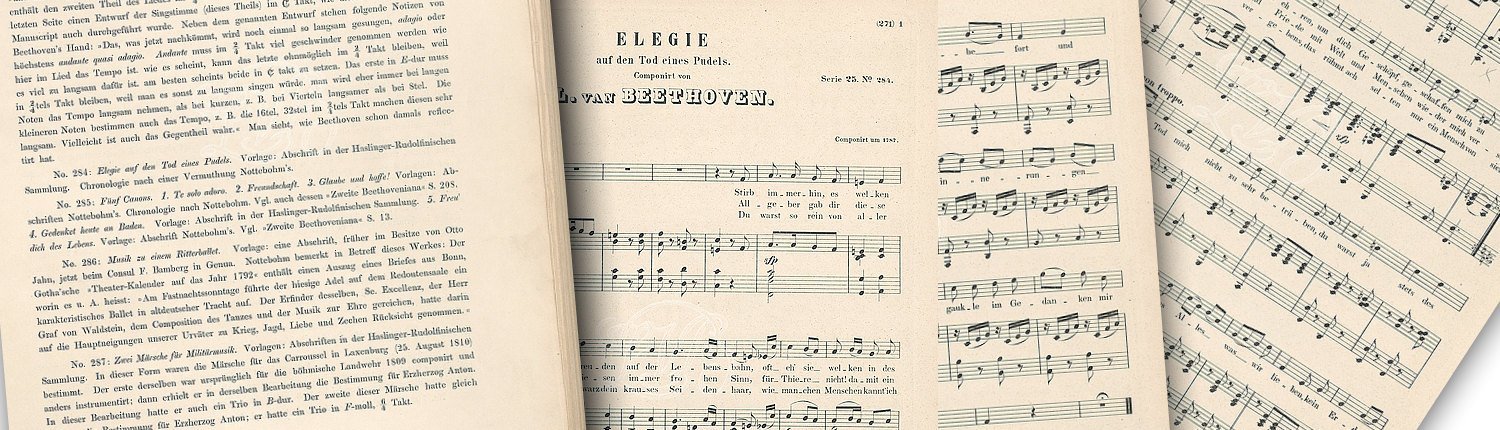
The original manuscript is unknown. The basis of the publication of the G A. was a manuscript preserved in the Rudolphinum (the collection of beautiful copies of Beethoven’s compositions, for private and exclusive use made for Archduke Rudolf in 1822 and on the basis of which, subsequently, Haslinger tried to draw up a general edition of the Master’s works, stopping after the first fascicles). The text, by an unknown author, sometimes appears sentimental, plaintive and philosophizing, it has given a double aspect of the music: mourning death (F minor, modulating, in the middle, in A flat major) in the first three stanzas, to which they respond in the last, in F major, we find thoughts of resignation and comfort supported by a theme that reproduces the first somewhat modified, with a more moving and lighter arpeggio accompaniment.
Beyond the occasion for which it was composed, all the salient points typical of Beethoven’s way of thinking emerge from this text: the adverse fate, the priority importance of fidelity as an absolute value, the composer’s need to isolate himself associated with contempt for the baseness of men and, in the end, however, in the face of so much negativity, the triumph of optimism. We report the entire text by an anonymous author:
Il testo:
1. Stirb immerhin, es welken ja so viele
der Freunden auf der Lebensbhan Oft,
eh’ sie welken in des Mittags Schwüle,
fangt schon der Tod sie abzumahen an.
2. Auch meine Freude du! dir fließen Zahren,
Freude selten Freunden weihn;
der Schmerz um dich kann nicht mein Aug’ entehren,
dich, Geschopf, geschaffen mich zu freun.
3. Allgeber gab dir diese feste Treue,
Dir diesen immer frohen Sinn;
Für Tiere nicht, damit ein Mensch sich freue,
Schuf er dich so, und mein war der Gewinn.
4. Du warst so rein von aller Tück’ und Fehle
Als schwarz dein krauses Seidenhaar;
Wie manchen Menschen kannt’ ich, dessen Seele
So schwarz als deine Außenseite war.
5. Oft, wenn ich des Gewühles satt und müde
Mich gern der eklen Welt entwöhnt,
Hast du, das Äug’ voll Munterkeit und Friede,
Mit Welt und Menschen wieder mich versöhnt.
6. Trüb sind die Augenblicke unsers Lebens,
Froh ward mir mancher nur durch dich!
Du lebtest kurz und lebtest nicht vergebens;
Das rühmt, ach! selten nur ein Mensch von sich.
7. Doch soll dein Tod mich nicht zu sehr betruben;
du warst ja stets des Lachens Freund;
geliehen ist uns alles, was wir lieben;
kein Erden gluck bleibt lange unbeweint
8. Mein herz soll nicht mit dem Verhangnis
zanken um eine Lust, die es verlor;
du, lebefort und gaukle in Gedanke
mir fröliche Erinnerungen vor.
The music faithfully follows the text: a sad and funereal introduction followed by notes that give a good idea of the consideration for the prestigious role that this noble creature has been able to play and, at the end, a theme of explicit joy.
Creation and publication: Probably composed between 1806 and 1809. The first edition was published posthumously in 1888 as part of the AGA by Breitkopf & Härtel in Leipzig.
Helga Lühning’s work was based on the position of the song in the volume of the Haslinger-Rudolphiniana copy and in Artaria’s “Catalogue des Oeuvres”. She assumes that it was probably written in the same period of composition of the songs WoO 132, 133 and 137 -139. It follows that this song may have been the first composition that Beethoven published in an almanac (Lühning/NGA XII/1 KB p. 31f). To date, it has not been possible to clarify any of these questions. Earlier dating attempts indicate that it was composed in Bonn around 1787 (Nottebohm, see revision in AGA Series 25 page V) or in the years 1794/95 (Erich Prieger). Origin and author of the text unknown. First execution unknown. Autographs that did not survive. In the A-Wgm there are two copies of the song entitled “Elegie auf den Tod eines Pudels” (XVII 67000 from Haslinger-Rudolphinischen and VI 3743/Q 4251; description see Lühning/NGA XII/1 KB page 30 ). The copy from the Haslinger-Rudolphin collection served as a model for the first edition (AGA series 25 p. V; according to Lühning, the other copy was also used, but selectively). First edition in the AGA. Further edition (first separate edition): 1894. Cologne, PJ Tonger, VN “771-773”. – Title: “ELEGIE / auf den Tod eines Pudels. / Nachgelassenes Lied / für eine Singstimme mit Klavierbegleitung / von / Ludwig van Beethoven. / hoch, F moll / (Original) [under vocal range in notes] – mittel, E moll [under vocal range in notes] – tief, C moll [darunter Stimmumfang in Noten] / P. J. TONGER, KÖLN. / Hoflieferant Seiner Majestät des Kaisers und Königs. / 771-773. / 1894. / Oscar Brandstetter, Leipzig.” – Portrait format. 5 pages (p. 1 title). At the top of the second page is a brief introduction by the publisher (Erich Prieger, Bonn). — Ex: A-Wn (Hoboken). – D-BNba. Bibliography : Lühning/NGA XII/1 KB pp. 30-32. Indexes: Thayer/1865 no. 272 (p. 166). Hoboken No. 679.