
WoO 206 – (Hess 12) Concerto in F major for oboe and orchestra
I) Allegro moderato – II) Largo – III) Rondò – Allegretto
WoO 206 – (Hess 12) Concerto in F major for oboe and orchestra, 1792-1793. B. 338 – H. 12 – T. 281.
On November 23, 1793, Haydn wrote from Vienna to Bonn to Archbishop-elector Maximilian Franz:
“I take the liberty of sending Your Grace several pieces of music, namely, a Quintet, a Partita, an Oboe Concerto, Variations for Piano, and a Fugue, composed by my dear pupil Beethoven, which Your Grace has kindly entrusted to me, in the hope that Your Grace will accept them as a commendable example of diligent application outside the realm of actual studies. Connoisseurs and non-connoisseurs alike will impartially recognize that Beethoven will in time occupy one of the highest places among European musicians, and I will be proud to have been his teacher. I only wish he could remain with me for a long time to come.”.
The letter went on to ask for subsidies for Beethoven, since he had not had many, in order to live Viennese life in a dignified way; the young Maestro, in an added letter of the same date, wrote that he had dedicated himself to music “with all the strength of his soul” and that he felt ready for the following year to present something more worthy to his noble protector.
The answer was not the most satisfactory: the elector said that the music in question, with the exception of the Fugue, had been composed before Beethoven left Bonn and therefore could not constitute evidence of the progress he had made in Vienna; that Beethoven had always had a special subsidy and also the normal salary of a court musician; he concluded by saying that staying in the Austrian capital would not improve and it was better for him to return to his homeland.
But Beethoven stayed in Vienna. Moreover, returning to his homeland was not his intention, given the war and political events, which should have led in October 1794 to the establishment of a republican government, marking the definitive collapse of the old regime and consequently also of the court, the theater and the electoral orchestra. It remains unclear which four Beethoven pieces the elector previously knew in Bonn, as they were later sent from Vienna in revised form for his evaluation.
According to Reinöhl, a musicologist who has been particularly interested in the topic, the Quintet could be a first sketch of the one in E flat major for 2 violins, 2 violas and cello which later became op. 4 (reduction of the Octet for 2 oboes, 2 clarinets, 2 horns and 2 bassoons, published only in 1830 with opus no. 103), or of the other for piano, oboe, clarinet, horn and bassoon, later published as op. 16; the Partita probably consisted of a reworking of the Octet op. 103; the Variations were perhaps those on Mozart’s “Se vuoi ballar”, with violin accompaniment, or on a theme by Count Waldstein for piano four hands, or on an original theme for piano, violin and cello op. 44.
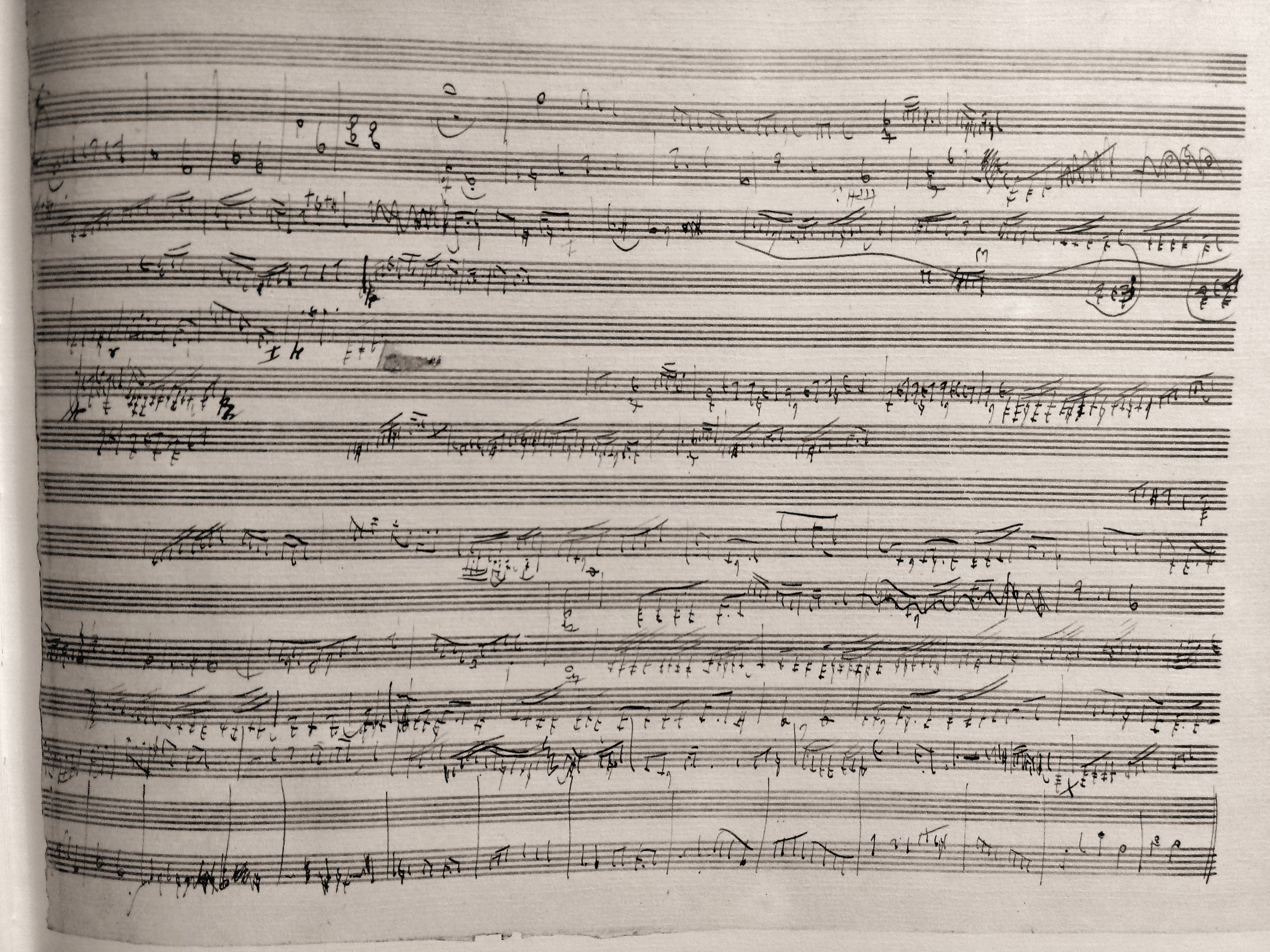
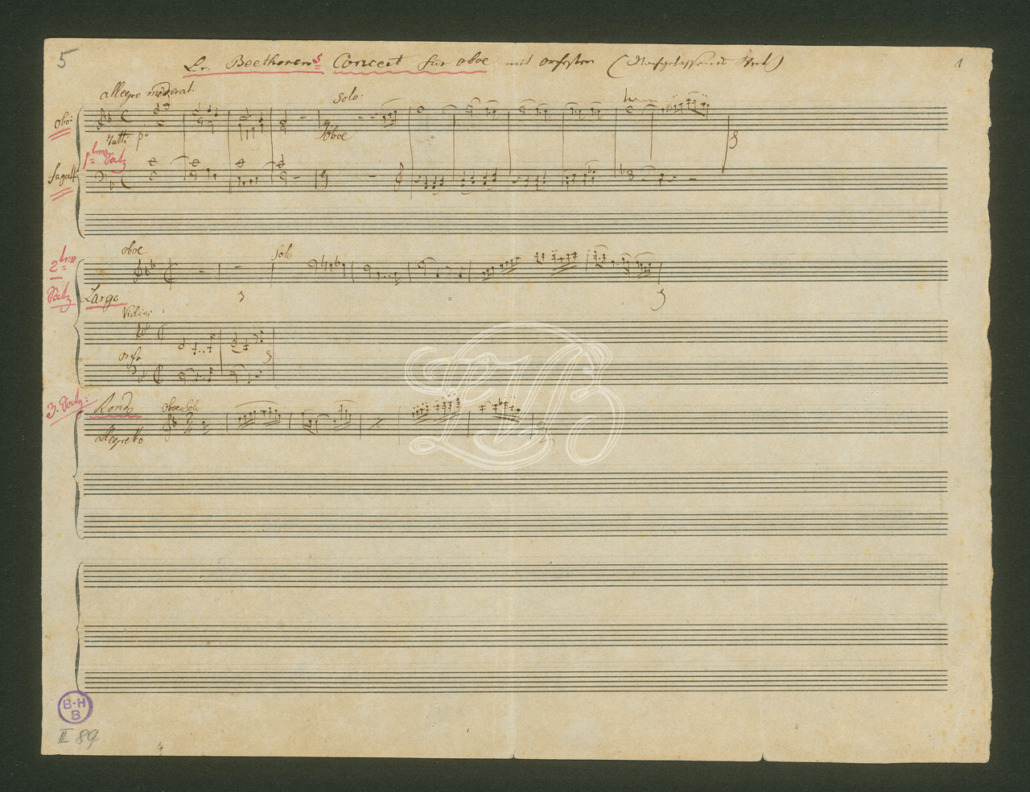
Of the Concerto in F major for oboe and orchestra, now lost, the Thayer catalogue says that it was once owned by the publisher Diabelli; currently only the initial bars of the three movements are known, in a sheet preserved in the Beethovenhaus. Of the Fuga, the only composition among the five sent to him that the voter said he did not know, we have no other news.
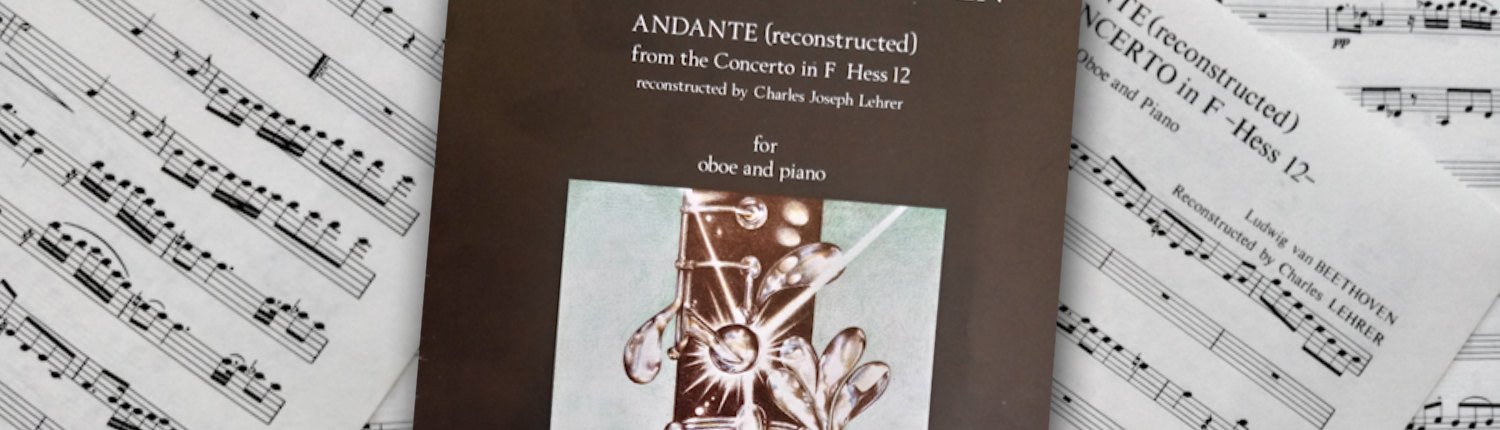
(Editor’s note: In 1981 the oboist Charles Lehrer proposed – and published – a version of the Andante for Piano and Oboe. Recently three musicians have tried to reconstruct the median tempo for oboe and orchestra: Albert Willem Holsbergen, Jos van der Zanden and, even more interesting, the conjectural reconstruction of the First Movement by Cees Nieuwenhuizen. Here you can listen to his beautiful version: Reconstruction of Beethoven Oboe Concerto in F major WoO 206 Hess 12: 1st movement – YouTube and again the Second Movement: Beethoven Oboe Concerto in F major – 2nd movement (Largo, Hess 12) – (reconstr. Cees Nieuwenhuizen) – YouTube
While waiting to find the entire concert, here are all the sketches, incipits and reconstructions available. Somewhere the mysterious oboe concerto must be found, at least in two copies…. that of Diabelli and the one sent to the Prince Elector… The search has just begun!
By Dorfmüller/Gertsch/Ronge catalog: Ludwig van Beethoven – Thematisch-bibliographisches Werkverzeichnis
Origin and publication: composed in Bonn before Beethoven’s departure for Vienna in November 1792, probably revised the following year. Lost. Only the sketches for the second movement have survived. Never appeared in print.
The oboe concerto was among the works that Joseph Haydn sent to Elector Maximilian Franz in Bonn on 23 November 1793 as proof of the progress of his pupil Beethoven (BGA 13). However, the Elector was very critical in his letter of reply:„Da indessen diese Musik, die Fuge ausgenommen, von demselben schon hier zu Bonn komponirt und produzirt worden, ehe er diese seine zweyte Reise nach Wien machte, so kann mir dieselbe kein Beweis seiner zu Wien gemachten Fortschritte seyn” (BGA 14).
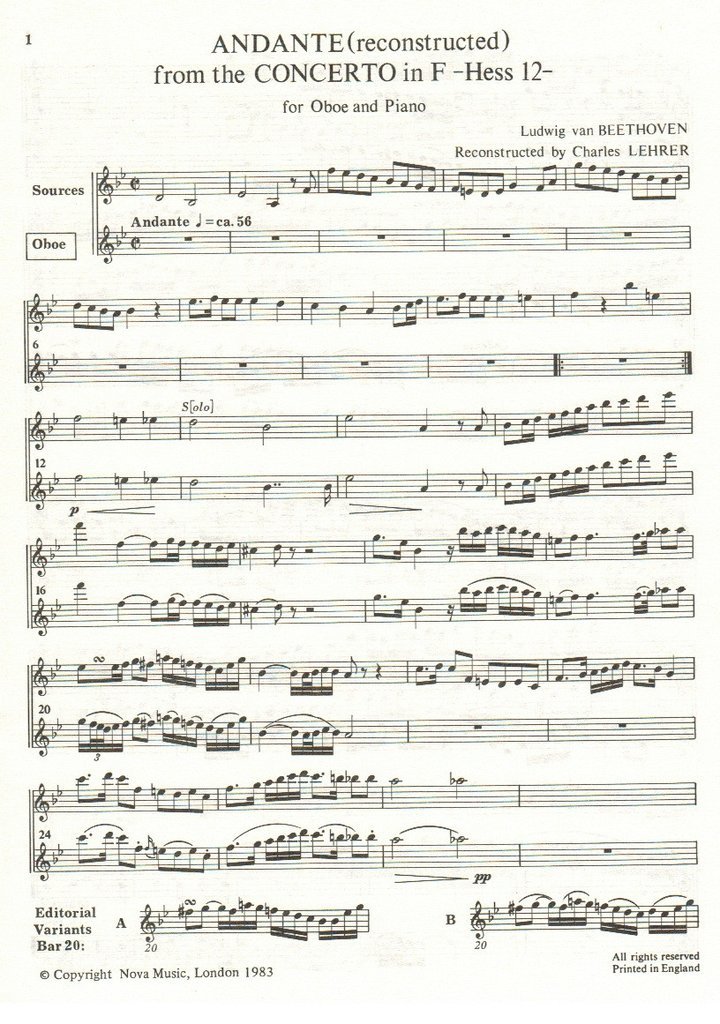
The Elector’s assertion that these works had already been conceived, written and executed in Bonn is supported by the lists in the inventory of the Chapel of the Court of Bonn (I-MOe, Cat. 53. I-II), which also includes this oboe concerto (Riepe / Hofkapelle S1), which also contains the incipit of the beginning of the concerto). However, Beethoven’s sketches (source 1.1) were written on Viennese paper. They refer to a “second theme” and do not give the impression of a revision. So Haydn may have sent a revised version to Bonn, for which Beethoven composed the second movement from scratch, maintaining the extreme tempos. (Cifr. Zanden / Wo0206 page II). On the sketches, several reconstructions of the second movement were undertaken: one for oboe and piano by Charles Joseph Lehrer (Nova Music, London 1983), two for oboe and orchestra by A. Willem Holsbergen (www.unheardbeethoven.org) and by Cees Nieuwen-huizen and Jos van der Zanden (Raptus Editions, Almere 2002).
First execution not known. It may have taken place in Bonn before Beethoven’s departure for Vienna in November 1792.
Sketches: second movement: GB-Lbl, Ms. 29801 (“Miscellanea Kafka”), page 50 versus. Facsimile and transcription: Kerman / Kafka. Alexander W. Thayer states “Ein Concert für Oboe und Orchester früher im Besitz der Firma Diabelli u. Co.” (“A concerto for oboe and orchestra formerly owned by Diabelli & Co.) “(Thayer / 1865 page 168), but it could refer only to the manuscript with its incipits (see Source II).
The D-BNba preserves a manuscript by Anton Diabelli containing the incipits of all three movements of the concerto, in piano reduction (BH 135). Jos van der Zanden dates the writing to 1840 (Zanden / Wo0206 S. I). The folio is entitled “L. v. Beethoven Concert für Oboe mit Orchester (Nachgelassenes Werk)” and probably derives from the manuscript in the possession of Aloys Fuchs, who made insertions in red ink (facsimile and description: DBH / online). Letter references: BGA 13f. Bibliography: Bibliography: Lehrer/Wo0206. – Riepe/Hofkapelle. J Zanden/Wo0206. Catalogues: Thayer/1865 No. 281 (page 168). Hess 12.
Composer Ryan Wilk has given us permission to publish his work on this page. Visit his personal YouTube channel.
WoO 206 – Hess 12 is part of the “Research Becomes Art” project.
A New Life for the Unknown Works of Ludwig van Beethoven: An Artistic Exploration by compositore Ryan Wilk
