

WoO 210 String Quartet in B minor “Pencarrow Quartet”
Allegretto
WoO 210 String Quartet in B minor “Pencarrow Quartet” Allegretto.
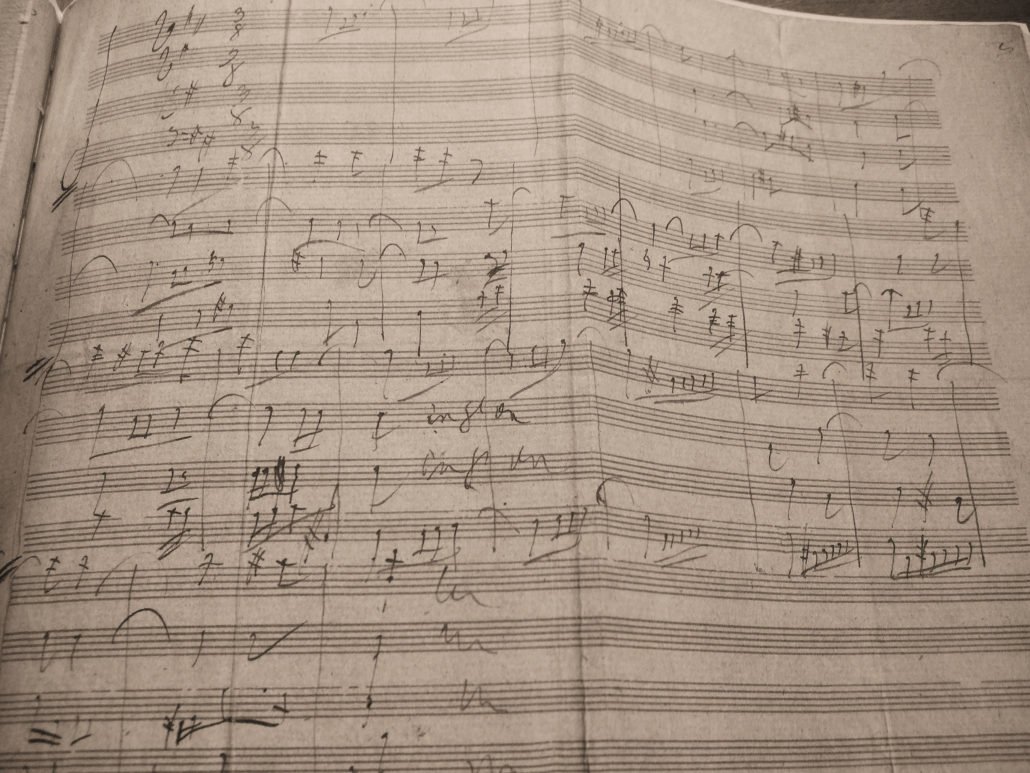
In 1817, Beethoven was working on small fugal movements intended to be included in a hypothetical complete collection of his works. This led to the Fugue for String Quintet Opus 137, as well as to this recently discovered manuscript for string quartet. Beethoven wrote this short “Allegretto” for a visitor from England, Richard Ford, who evidently took it away with him, leaving no other trace of its existence. The manuscript came to light again during an auction sale in 2000. At only 22 bars in length, it is nonetheless a very interesting little composition. Since it was – so to speak – rediscovered, it has become generally known as the “Pencarrow Quartet”, taking its name from Pencarrow House in Cornwall, where it was found in 1999. Ford wrote on the manuscript: “this quartet was composed for me in my presence by Ludwig v. Beethoven, on Friday, in Vienna, 28 November 1817.”
This short quartet in B minor has very close affinities with fugal works. This affinity is clarified by the date written by Ford on the autograph: Friday, Vienna, 28 November 1817. That was the year in which the Fugue for String Quintet, op. 137, was composed, created precisely to be included in the merely planned series of the “Complete Works of Ludwig van Beethoven”, which were to be published by his friend and publisher Tobias Haslinger.
An interesting and unique detail is that the manuscript of the quintet, preserved at the Bibliothèque Nationale de France in Paris, bears the date 28 November 1817. Thanks to Gustav Nottebohm’s account of the contents of the now-lost sketchbook known as “Boldrini”, we know that the sketches for op. 137 were conceived almost simultaneously with the Prelude and Fugue for String Quintet in D minor, Hess 40, specifically on pages 1, 2 and 7 of the lost notebook, which also contained the final four bars of op. 137 on page 5.
As the musicologist Richard Kramer points out on page 291 of his book “Unfinished Music”, the Gesellschaft der Musikfreunde (or Musikfeinde) in Vienna owns a manuscript, marked Beethoven Sig. Autogr. 81, consisting of two grouped bifolia, of which only three pages were used by Beethoven. Folio 1v and folio 2r contain a copy of the Fugue in B minor from J.S. Bach’s Das Wohltemperierte Clavier, and the final two lines at the bottom of folio 2r contain sketches for Hess 40. The fact that Beethoven was studying Bach’s Fugue in B minor and wrote Ford’s fugue in the same key — a very unusual tonality for Beethoven — cannot be mere coincidence.
In fact, the Vienna manuscript is written on the same type of paper, the so-called “Johnson watermark type 33”, exactly the same as that of the Pencarrow manuscript. We can therefore state with certainty that all these materials were written during the month of November 1817, and that, in all likelihood, part of their preparation intersects with the fugue studies for the Hammerklavier Sonata. The remainder of the Boldrini sketchbook was largely devoted to sketches for op. 106, which arose from the same source of inspiration as this quartet.
Anyone who is interested may contact us to obtain a photographic copy of this composition.
Alongside this is another manuscript of the Allegretto.
The auction house description is as follows:
Autograph manuscript of the “Allegretto” in B minor for string quartet WoO 210, composed for an English visitor to Vienna in 1817. ink on paper. the complete piece twenty-three bars long, a fair copy notated in dark brown ink, on four systems of four staves each, with a contemporary attestation written at the bottom of the page (“composed &written by Beethoven himself November 29th 1817 at Vienna.”) 1 page, oblong 4to (c.24 x 30.5cm), 16-stave paper, watermark letter “K” in lower corner of integral blank, uncut, [Vienna], 29 November 1817, foxing, creasing along folds,
Provenance: Rev. John Abbiss (c.1790-1883): his inscription at the foot of the page (1817). Frances Celia Blomefield (who married Dr Arnold van Niekirk in Cape Town in 1922); from whom the manuscript has come down to the present owner by direct descent.
Literature: K. Dorfmüller, N. Gertsch & J. Ronge, Ludwig van Beethoven, Thematisch-bibliographisches Werkverzeichnis, 2 volumes (Munich, 2014); volume 2, pages 549 (“Allegretto” WoO 210), 640 (re Bach BWV 869) and 588 (re LvB Hess 40); cf also volume 1, p.905 (re op.137).
- Johnson, A. Tyson & R. Winter, The Beethoven Sketchbooks (Oxford 1986), pages 347-350 (re the string quintets Hess 40 & op.137) & 535-538 (re op.106).
- van Beethoven, Allegretto in h-moll. Faksimile des Autographs und Erstausgabe eines bisher unbekannten Werks, edited by the Biblioteca Bodmeriana Cologny, with an introduction by S. Roe (Munich, 2001)

Catalogue Note:
This is a complete albeit brief work dating from the beginning of Beethoven’s “Late” period. It is a second and unrecorded autograph manuscript of Beethoven’s farewell present given to one of three Englishmen who visited Beethoven in Vienna in November 1817. This bagatelle for string quartet was completely unknown until another copy, written the previous day for Richard Ford, was discovered at Pencarrow House in Cornwall in 1999 (see Sotheby’s sale, London 8 December 1999, lot 189), now in the Bodmer Library in Geneva-Cologny. Ford’s attestation on that manuscript is similar to the one found here: “This quartet was composed for me in my presence by Ludwig v Beethoven at Vienna Friday 28th November 1817”. Ford’s two compatriots on his Beethovenian pilgrimage were John Abbiss and the book dealer David Constable, but there is nothing here to indicate which received this parting gift from the composer. It was apparently Constable who, through several letters of introduction, secured the agreement of Beethoven to this visit.
Although this is primarily an occasional work, it also forms part of Beethoven’s intensive studies in fugue, undertaken during his work on the “Hammerklavier” Sonata op.106. It fits neatly into a nexus of pieces that evolved from these studies in late November 1817, including transcriptions of Bach fugues and fugal chamber music of his own. The whole period from the end of 1816 until the spring of 1819 was largely devoted to the “Hammerklavier” Sonata, arguably Beethoven’s most substantial new project since the Seventh and Eighth Symphonies. This monumental sonata has contrapuntal writing throughout, with a fugue dominating the final movement. On the days immediately preceding this “Allegretto”, Beethoven produced several short works and unfinished sketches, including a transcription of the B minor fugue in Book 1 of J.S. Bach’s Das Wohltemperierte Clavier BWV 869; B minor is otherwise very rare in Beethoven’s output and it seems unlikely to be merely coincidental that the present “Allegretto” is in the same key. The Bach copy is written on the same manuscript, now in Vienna, as his sketch for an unfinished Prelude & Fugue for String Quintet in D minor (Hess 40). We know that this quintet was sketched alongside the String Quintet in D major op.137, the fair copy of which is dated 28 November 1817, ie the very same day as the Bodmer manuscript of the “Allegretto”, and the day before this one.
Beethoven’s slightly more polished script here, compared with the Bodmer copy of the “Allegretto”, confirms that this is the later of his two autographs. Musically identical, the two manuscripts are also physically very similar, both being written on a bifolium with an integral blank. The paper here is not recorded by The Beethoven Sketchbooks, or by Schmidt-Görg (1977); it is rather similar to Tyson type 41, but lettered “K” rather than “GK”. It probably comes from the Kiesling mill in Bohemia, whereas the Bodmer copy bears a “Welhartiz” watermark (both have 16 staves with a total span of 194.5mm). Beethoven did not keep a desk sketchbook whilst engaged on the “Hammerklavier” Sonata and used a variety of paper-types, including type 41. The small pocket sketchbook (“Boldrini”) that he habitually took on his walks around Vienna is lost. However, from Gustav Nottebohm’s description (1879), we know that it included sketches for the “Hammerklavier”, excerpts from Bach’s fugues (including the B minor fugue mentioned above), and the two string quintets Hess 40 and op.137.
After careful analysis, the manuscript was judged not to be original.
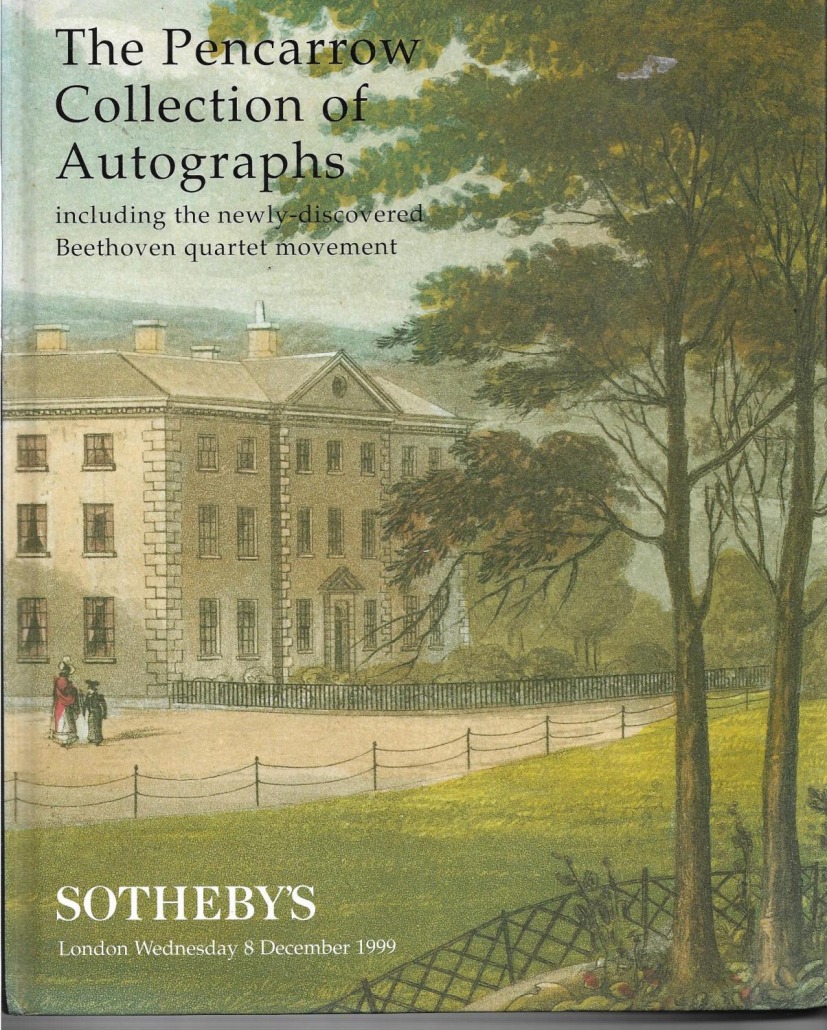
The Pencarrow Collection of Autographs Including the Newly Discovered Beethoven Quartet Movement: December 8,1999 Hardcover – January 1, 1999
Official title: WoO 210 Allegretto (h-moll) für zwei Violinen, Viola und Violoncello Widmung: – NGAVI/5 AGA-SBG –
Creation and Publication: Composed on 28 November 1817 in Vienna. The first edition was published posthumously in 2001, including the full score and parts, as an appendix to the facsimile by Verlag K. G. Saur in Munich. The autograph score bears the following owner’s inscription: “This quartette was composed for me in my presence by Ludwig v Beethoven at Vienna / Friday, 28— November 1817. Richard Ford.” The author, travel and art writer and critic Richard Ford (1796–1858), after graduating from Trinity College, Oxford, travelled between June 1817 and May 1818 through Germany, Switzerland, Austria, and Italy. His stay in Vienna is documented in late autumn 1817, arriving on 12 October 1817 (noted in the Wiener Zeitung of 15 October 1817). Along with the manuscript, Ford received a portrait signed by Beethoven (engraving by Blasius Höfel after Louis Letronne; published in 1814 by Artaria in Vienna; illustration as frontispiece in Roe/Wo0210). Apart from self-referential sources, there is no evidence of an encounter between Beethoven and Ford. His name does not appear in letters or conversation books. Ford was travelling with fellow countrymen John Abbiss and David Constable. Constable, a bookseller, possessed many letters of recommendation, one of which may have paved the way to Beethoven. Ford left Vienna on 29 November 1817.
However, the passport date (Illustration Roe/Wo0210 p. 8) appears to have been corrected. Apparently, Ford had intended to depart on 28 November but met Beethoven on the same day. The Allegretto was therefore likely a farewell composition, a personal tribute from Beethoven. The sketches for WoO 210 are unknown. Beethoven sketched the autograph score of the Fugue for String Quintet, op. 137, on the same day. This connection and the numerous similarities between the Allegretto and op. 137 led Sieghard Brandenburg to describe it as “fast als ein Abfallprodukt des Quintetts” (Brandenburg/Wo0210, p. 57).
First performance unknown. The official premiere took place on 3 March 2001 by the Hagen Quartet as part of the festival “Les Sommets musicaux de Gstaad”. The Allegretto had previously been performed on 7 October 1999 (Eroica String Quartet at Sotheby’s, London) and on 23 November 1999 (Orion String Quartet in New York). Immediately after Gaspard Bodmer acquired the autograph score, a private performance was held on 1 April 2000 at Bodmer’s residence by the Concertante Quartet Carl Stamitz.
Lost sketches (but possibly written in the now-lost sketchbook known as “Boldrini”). Score: CH-CObodmer. Dating: 28 November 1817. Title: Richard Ford’s inscription on folio 1 verso: “This quartette was composed for me in my presence by Ludwig v Beethoven at Vienna / Friday, 28— November 1817. Richard Ford.” 2 folios; one page of musical text on 2 recto (originally the first page of the bifolium), folio 1 recto and 2 verso blank. Paper: oblong format, 24 x 30.5 cm, 16 staves. Provenance: Album of Mary Ford – passed into the possession of the Molesworth-St Aubyn family of Pencarrow, Cornwall, in 1910 – Sotheby’s, London (auction 8 December 1999, lot 189) – acquired by Gaspard Bodmer in 1999. Facsimile and description: Roe/Wo0210. First edition (score and parts) 2001. Supplement to: Roe/Wo0210. Bibliography: Roe/Wo0210 – Brandenburg/Wo0210 – Cooper/Wo0210.
WoO 210 is part of the “Research Becomes Art” project.
A New Life for the Unknown Works of Ludwig van Beethoven: An Artistic Exploration by Arconauti Quartet.
