Biamonti 821 – Other Unused Sketches (February–August 1825)
Biamonti 821 Other unused sketches, some related to the finale of the String Quartet Opus 130, February–August 1825. (De Roda, pages 102–104). New information from the Beethoven Music Research Center www.lvbeethoven.it (July 2024)
All these sketches are scattered throughout the manuscript known as the De Roda Sketchbook, named after its last owner; this sketchbook is currently preserved at the Beethoven-Haus in Bonn. In his analytical volume devoted to the entire sketchbook, Un Quaderno di autografi di Beethoven del 1825 (Fratelli Bocca Editori, 1907), De Roda associates these sketches with the finale of the Quartet Op. 130. He writes: “For the final movement a few ideas are noted down.”
Let us now examine each sketch separately:
Biamonti 821a
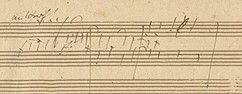
Folio 14 recto (p. 27), staves 11–12
It appears on folio 14 recto, staves 11–12. At the beginning of the sketch we find the inscription: “Letzte Stück des Quartettes in B” [Last piece (movement) of the quartet in B-flat major]. The notes are written in pencil, in a small and hurried hand, and the entire sketch is located on the right side of the page. Curiously, the first quaver seems to be dotted. We should immediately note that this is a very early idea for the Finale’s theme: while the definitive version of the Finale is in duple meter, this sketch is in triple meter; and while the final version contains no fugues or fugal passages, here a fugal theme appears at the end, clearly indicated above the subject. An interesting detail: the beginning of the theme can be superimposed on the fugue subject.
Biamonti 821b
Folio 25 recto (p. 49), staves 6–9
This too is a primordial idea for the finale of Quartet Op. 130. It appears on folio 25 recto, staves 6–9, and is written on two staves. This sketch is also preceded by the indication “Finale”. The meter is 2/4. It is a complete theme consisting of two groups of eight measures each. The opening is imitative, with the second voice entering at the fourth measure.
Biamonti 821c
Folio 27 verso, staves 4–5
Here again, at the beginning of the staff, we find the indication “Finale”. I do not agree with the transcription made by De Roda, and consequently by Biamonti, regarding the last two measures of the first part of the sketch. In the second part of the sketch—mentioned by De Roda but not by Biamonti (“two more measures follow”)—De Roda does not mention the second theme that can be glimpsed superimposed on the main one. From the fourth measure of this second part we find more quarter notes than the meter allows; I have chosen to interpret them as quarter‑note triplets.
Biamonti 821d
Folio 22 recto (p. 43), staves 9–10
The incipit is marked “Presto”. This sketch too appears to be a study for a fugue, complete with Subject and Answer. Considering that it was likely conceived for the Finale of Op. 130, in my transcription I added the two key signatures, which also justify the occasional naturals written by Beethoven—naturally, since these were personal working sketches, he had no need to write them consistently. In the transcription I also added the octave doubling in the bass clef.
Biamonti 821e
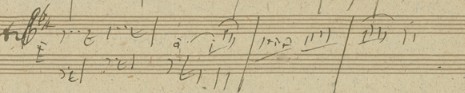
Folio 34 verso (p. 68), staves 1–4
This is also an idea for the finale of the quartet, as clearly indicated by the incipit “Finale”. These are four separate fragments, very different from one another, found on folio 34 verso, staves 1–6. They are written in pencil, in a hurried and imprecise hand; notes are often written after the barline, or the barline is missing altogether.
Biamonti 821f
Folio 35 recto (p. 69), staves 1–2
Four measures of a theme which, according to De Roda, are “the beginning of a fugue [on a bass] which, although lacking the indication ‘Finale’, could very well, by character and tonality, have been conceived for the finale of this quartet.” According to Beethoven’s own marking, it is to be played mit Kraft (with force) and with an “f”. Note the syncopations in the subject.
Biamonti 821g
Folio 25 recto, staves 10–11
Sixteen measures written—at least the first ten—on two staves. It is not in F major, as De Roda suggests, but conceived in B-flat major, and was probably written for the Finale of Quartet Op. 130. Since this is also a simple sketch, Beethoven did not bother to write the accidentals for the leading tone, although he does indicate them at the beginning (second measure in the melody, sixth measure in the bass). It is a beautiful eight-measure melody with a slightly varied repetition over an arpeggiated bass with harmonic function; the final note is missing, and so are the slurs, although the lyrical character is clear. Naturally, the missing portion of the bass, from measure 11 to the end, should follow the pattern already established at the beginning of the sketch.
Biamonti 821h
Folio 27 (p. 53), staves 3–4
According to Biamonti, this fragment could also refer to the Finale of Quartet Op. 131, which has the same rhythmic figuration.