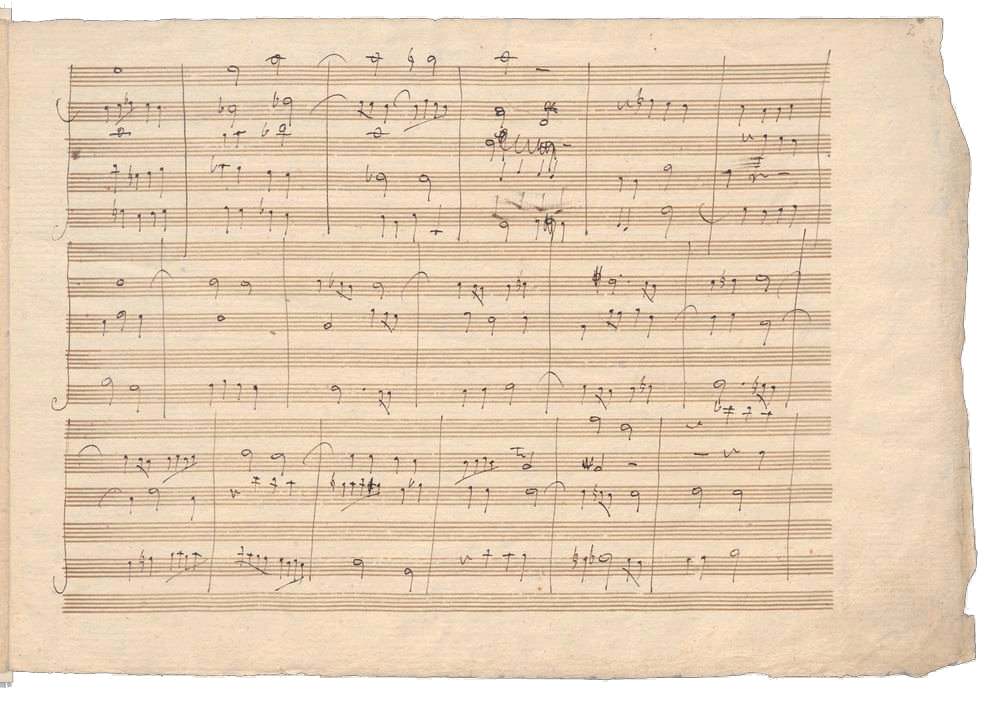
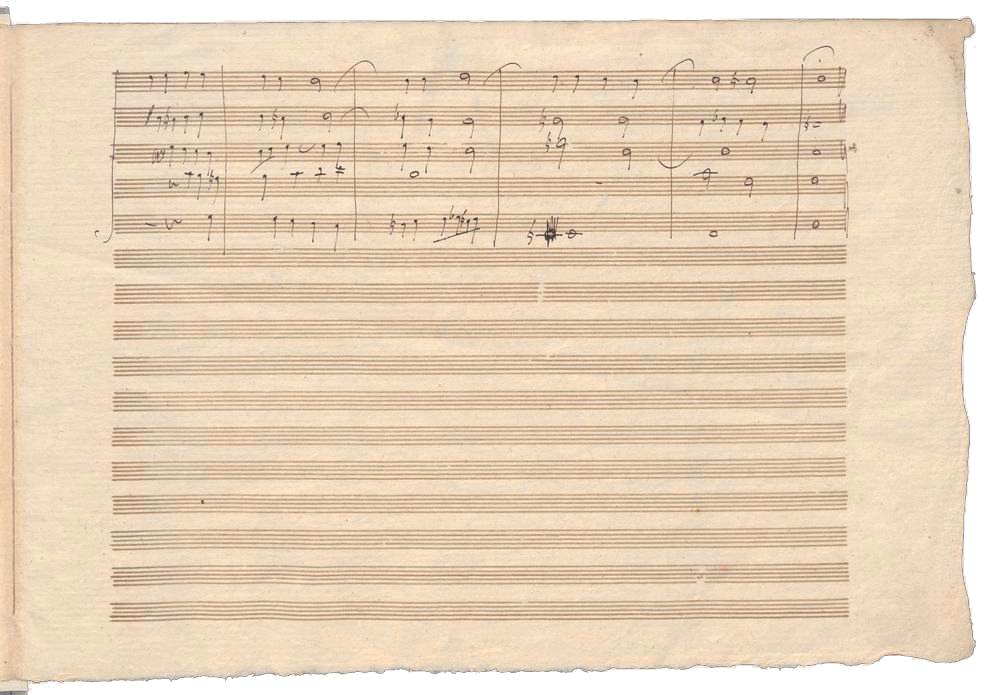
Hess 38 Transcription of the fugue in B flat minor, from the first part of Bach’s “The Well-Tempered Clavier”
for two violins, viola and two cellos
Hess 038 – Transcription of the Fugue in B-flat Minor from Bach’s The Well-Tempered Clavier, Book I
Arranged for two violins, viola, and two cellos – Composed between 1801 and 1802 Published in facsimile by Willy Hess in Schweizerische Musikzeitung, Zurich, October 1953
Origin and Context
This transcription by Ludwig van Beethoven is based on the Fugue No. 22 in B-flat minor, BWV 867, from the first book of Johann Sebastian Bach’s The Well-Tempered Clavier. Composed in 1722, this monumental collection of 24 preludes and fugues explores every major and minor key, serving as both a pedagogical tool and a masterclass in contrapuntal writing.
Beethoven’s transcription reflects his deep admiration for Bach and his engagement with contrapuntal technique, especially during the early 1800s—a period when he was intensively studying fugue and canon. This arrangement is part of a broader effort by Beethoven to internalize and reinterpret the structural rigor of Bach’s music through the lens of his own evolving style.
Instrumentation and Adaptation
Beethoven scored this transcription for two violins, viola, and two cellos, although some sources mention a variant with two violins, two violas, and one cello. This expanded string ensemble allows for a fuller realization of Bach’s five-voice fugue texture, which is rare even within The Well-Tempered Clavier—only two fugues in Book I are written for five voices.
Rather than a literal transcription, Beethoven’s version is a creative reimagining that adapts the keyboard fugue to the expressive and timbral possibilities of strings. The use of two cellos adds depth to the lower voices, enhancing the polyphonic clarity and resonance.
Analytical Insights
The original fugue in B-flat minor is one of the most emotionally intense and structurally complex pieces in the collection. Its somber key and dense counterpoint evoke a sense of introspection and gravitas. Beethoven’s transcription preserves these qualities while subtly reshaping the texture to suit the ensemble.
This work can be seen as a dialogue between two musical minds: Bach’s architectural precision and Beethoven’s expressive dynamism. It also foreshadows Beethoven’s later use of fugue in his own compositions, such as the Grosse Fuge and the final movement of the Hammerklavier Sonata.
Publication and Legacy
The transcription remained unpublished during Beethoven’s lifetime. It was first made available in facsimile form by Willy Hess, a leading scholar of Beethoven’s lesser-known works, in the October 1953 issue of Schweizerische Musikzeitung. The autograph manuscript is preserved in Berlin (Grasnick 14).
This transcription is part of a small but significant group of Beethoven’s arrangements of works by earlier composers, including fugues by Handel (see Hess 36 and 37). These efforts were not intended for public performance but rather served as private studies, helping Beethoven refine his contrapuntal technique.
Additional Notes
- The fugue BWV 867 is notable for its five-voice structure, a rarity in Bach’s keyboard works.
-
Beethoven’s interest in Bach was likely influenced by Gottfried van Swieten, who also inspired Mozart to arrange fugues from The Well-Tempered Clavier for string ensembles.