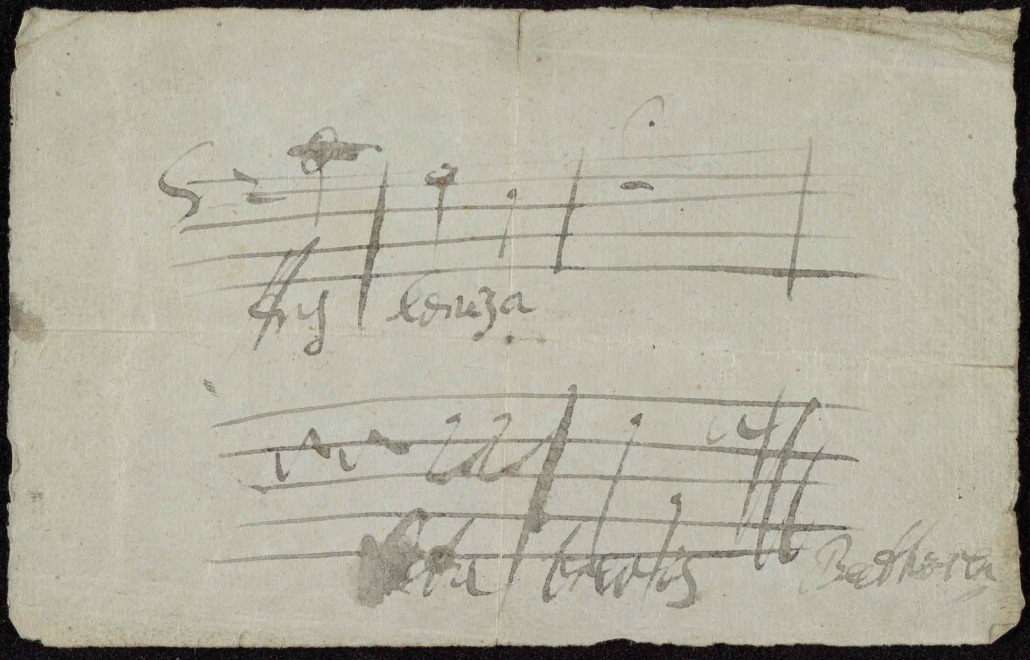
WoO 193 Ars Longa, vita brevis, third version, Canon
The musical examples on this page are by Graziano Denini.
WoO 193 “Ars Longa, vita brevis”, third version, canon for an unknown recipient, circa 1825, was first published in facsimile in the auction catalog CXX (17 and 28 May 1927) of K. E. Henrici in Berlin; it was more recently published in print by W. Hess in the fifth fascicle of the Supplemente zur GA, 1962 – Hess 269 – KH (WoO) 193.
Official title: WoO 193 Rätselkanon Ars longa vita brevis (Dritte Komposition, C-Dur 1825) Nach Worten des Hippocrates. NGA XII/2 AGA – SBG V/50 (2 Auflage 51; Hess 269).
It is the last of three canons Beethoven wrote on the same text. The original is preserved at the Heinemann Foundation in New York. For the solution, see Hess, Supplemente, page 95 of the fifth fascicle of the Supplemente zur GA. For the other two canons Beethoven wrote on the same words, see WoO 170 and WoO 192.
It is held in New York at the Pierpont Morgan Library, Heinemann Collection, MS 19 (B4155 – T834). It is a small card, 18 × 11.5 cm, without a designated recipient. Biamonti lists it in his catalog as 833; for W. Hess it is 269. According to R. Klein:
“The canon, which can be attributed to the year 1825 solely on the basis of the manuscript evidence, is notated in this form: a five-part unison solution is possible if the (autograph) corona is taken as an optional sign for the final point, so that all voices end with ‘ars longa’. No dedicatee is known…”
For J. Green, it is “an enigmatic canon in C major. Not yet solved, and the date of composition is still unknown.” Beethoven did not indicate the key; Hess assumed it to be in bass clef and C major, but it could also be in treble clef and A minor. A symbol shaped like an S appears at the beginning of the canon, before the opening rest; it might be a kind of bass clef, but it is not placed on the second line as in the bass, nor on the third line as in the baritone; rather, it appears on the first line (from the top).
BIBLIOGRAPHY
Rudolf Klein – Beethoven – Sämtliche Kanons, Musikverlag Doblinger, 1970
J. Green – The New Hess Catalog of Beethoven’s Works, Vance Brook Publishing, West Newbury, Vermont (translated into Italian as Il nuovo catalogo Hess delle opere di Beethoven, Zecchini Editore, 2006, Varese)