

The Apocryphal Waltzes of Beethoven: A Curious American Legacy
Texts and documents on this page curated by Luigi Bellofatto.
Between admiration and attribution, the 19th century saw a proliferation of piano waltzes published in the United States under Beethoven’s name—some sincere tributes, others opportunistic inventions. This page gathers a selection of these “apocryphal” works: charming, sometimes naïve, often revealing the transatlantic fascination with Beethoven’s aura. Whether genuine arrangements or speculative homages, each piece offers a glimpse into how Beethoven’s legacy was reimagined in popular music publishing. Curated by Luigi Bellofatto, this collection invites reflection on authorship, imitation, and the myth-making of musical genius.
Azalia Waltz
Beethoven‘s Admired Waltzes: Almak’s or Azalia Waltz

Beethoven’s Admired Waltzes: Almak’s or Azalia Waltz
Saint Louis, published by Compton & Doan, 205 Ntm Fourth Street. Circa 1850.
In this collection of twenty-four waltzes, the second is this Almak’s or Azalia Waltz.
What more can we add? Nothing, I believe, except to suppose that the author may be American and composed this simple waltz around 1845–1855.
Beethoven’s Waltz Number 2
Rose Waltz
Beethoven’s Waltz No. 2 – Rose Waltz
New York, published by ATWILL, 201 Broadway. (1834?) Also known as Rose Waltz.
Beethoven Waltz Number 3
New York Published by ATWILL. 201 Broadvay. (1834?)

Beethoven Waltz Numero 3; New York Published by ATWILL. 201 Broadvay. (1834?)
Beethoven Waltz Number 4
New York Published by ATWILL. 201 Broadvay. (1834?)

Beethoven Waltz Numero 4; New York Published by ATWILL. 201 Broadvay. (1834?)
Beethoven Waltz Number 5
New York Published by ATWILL. 201 Broadvay. (1834?)

Beethoven Waltz Numero 5; New York Published by ATWILL. 201 Broadvay. (1834?)
“Bouquet (Le) ”, a much admired waltz
for the Piano-Forte by LV Beethoven.
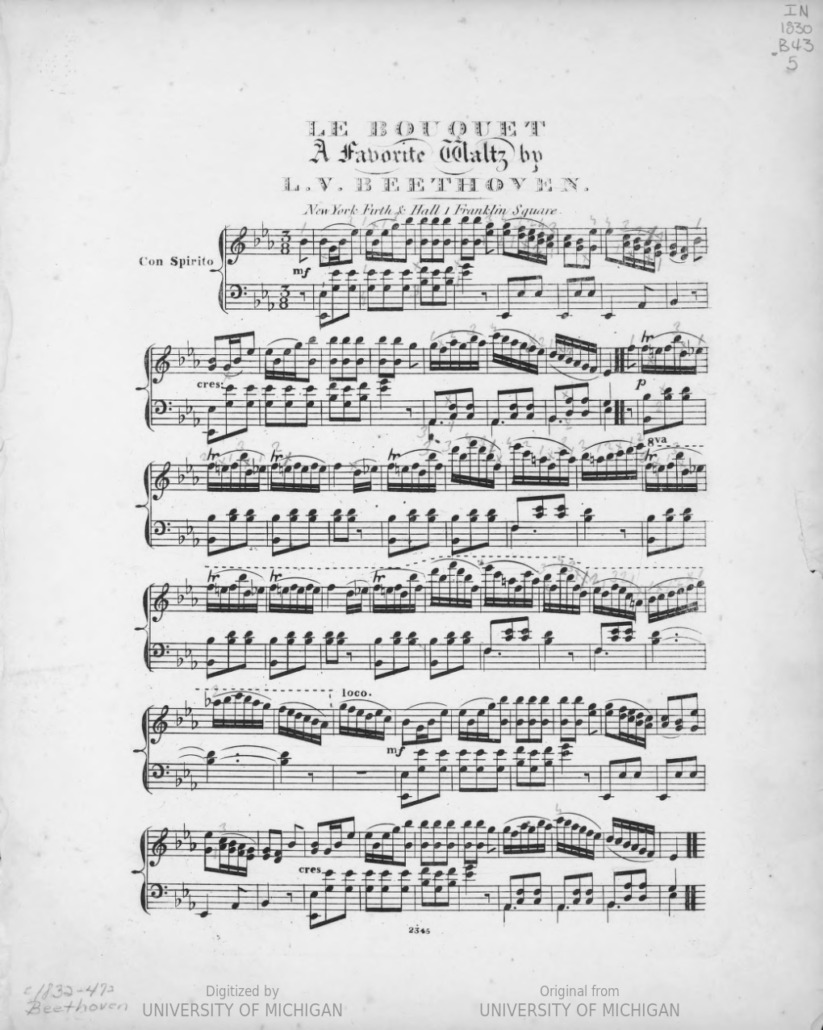
“Le Bouquet” A Much Admired Waltz for the Piano-Forte by L.V. Beethoven.
Published in Baltimore, U.S.A., under the title A Much Admired Waltz for the Piano Forte.
John Cole & Son, undated (probably 1870–1890).
Apocryphal waltz, likely by an American composer, echoing the style of the Anhang 14 and 16 waltzes.
Don Miguel’s Waltz –
Composed and arranged for the Piano Forte to which is added a favourite Waltz composed by Beethoven

Don Miguel’s Waltz. Composed and arranged for the Piano-Forte, with the addition of a favorite waltz composed by Beethoven. Willis & Co., Egyptian Hall, Piccadilly, London and 7, Westmorland St. Dublin. Pre-1840. Based on the second of the six apocryphal waltzes Anhang 14.
Favorite New Waltz for the Piano – Forte
by Charler Gilfert and A Waltz by Beethoven

Favorite New Waltz for the Piano – Forte by Charler Gilfert and A Waltz by Beethoven. New York Published by Dubois.
Japonica Waltz
Composed for the pianoforte by L.V. Beethoven

Japonica Waltz Composed for the piano by L.V. Beethoven. Published in Louisville by G.W. Brainard & Company, Fourth Street. Possibly composed between 1830–1845. (Collection of Dr. Luigi Bellofatto)
Laurel (The) – Waltz
In imitation of L van Beethoven Philadelphia, Geo. W. Hewitt & C°.

The Laurel Waltz. In imitation of L. van Beethoven. Philadelphia, Geo. W. Hewitt & Co. (Well, at least they admit it’s “in imitation.”)
Odiorne Walzer
Composed for the pianoforte by L.V. Beethoven (H. Bates)

Odiorne Walzer. Composed for the piano by L.V. Beethoven (H. Bates).
Developed as a waltz, this small composition also includes a hymn-like vocal line beneath the piano’s right hand.
Text: Hymn 1221
The Saviour waits!
His presence now
My thankful heart elates:
I hasten at His feet to how,
Within the temple gates.
He proffers gifts aurpassing all
The wealth of heart or sea.
Music by W.A. Bates, lyricist unknown. Print preserved at the Washington Library of Congress.
Petunia Waltz
composed fot the Piano Forte by L.V. Beethoven

Petunia Waltz. Composed for the Piano-Forte by L.V. Beethoven.
St. Louis: published by Balmer & Weber. Actually (published under another name) the Anhang 16 No. 1 waltz – Jubelwalzer (Jubilation Waltz) in C-sharp major, for piano. Nottebohm, pages 190–197. Published in 1847 by Heckel, Mannheim.
Rose Waltz
Beethoven’s Waltz number 2
Beethoven’s “Rose Waltz”; New York Published by ATWILL. 201 Broadvay. (1834?) (Also know “Waltz Number 2”)
Spirit Waltz for piano

Spirit Waltz For piano. Published in Boston by Bradlee, 184 Washington Street.
Apocryphal composition, published alongside the Tulip Waltz, in the United States, probably around 1850–1860. Not without some interest.
Tulip Walzer for piano
composed for piano forte By L.V. Beethoven

Tulip Waltz For piano, composed by L.V. Beethoven. Published in Boston by Bradlee, 184 Washington Street. Apocryphal composition, published alongside the Spirit Waltz, in the United States, probably around 1850–1860. Not without some interest.
Verbena Waltz
composed for piano forte By L.V. Beethoven

Verbena Waltz Composed for piano-forte by L.V. Beethoven. Theme taken from the third minuet of the WoO 7 series, or rather, its piano counterpart Hess 101. (Another “thank you” to Luigi Domenico Bellofatto.)
Willow Waltz
composed for piano forte By L.V. Beethoven

Willow Waltz Composed for piano-forte by L.V. Beethoven. Published in Boston by C. Bradlee, 135 Washington Street (circa 1855).
Louis van Beethoven. Valses célèbres pour le piano-forte. No. 2: Un souvenir.
Two-page score published in Amsterdam by the local publisher Theune et C., with plate number T.C. 765.
Texts and score are property of Luigi Bellofatto.

This piece is part of a publication from 1862 entitled “Louis van Beethoven / Valses Célèbres”, together with two other waltzes: La Douler and L’Espèrance. The small piano score was later published a few years afterwards by the Amsterdam publisher Brix von Wahlberg, who had acquired it.
Theune & Co., a music shop and publisher in Amsterdam, was first mentioned in 1828. Its address was Kalverstraat 66. In the 1850s, the business was located at Kalverstraat E, 274a, near Bagijnhofsteeg. In May 1873, Theune announced a merger with a competitor, W.C. Brix von Wahlberg. The firm Brix von Wahlberg had been founded at the end of 1837 at Kalverstraat, corner of Osjessluis, 181. Subsequent addresses were: Kalverstraat 211 (1852), Kalverstraat E, 31 (1854/56), Kalverstraat D, 11 (1857–1873), and Kalverstraat 153 (1885–1896). The business presented itself as a music shop, but in its early years customers could also find embroidery, children’s games, maps, stationery, and more. Brix von Wahlberg published a wide collection of sheet music by Dutch composers. The owners are listed as Mrs. Wilhelmina Catharina Brix von Wahlberg (1791–1865) and later her son Willem Carabain Brix von Wahlberg (1820–1911). The aforementioned merger with Theune & Co. did not last long, since only six months later (November 1873), Brix von Wahlberg, together with the music shop Boshart & Osthoff of The Hague, acquired Theune & Co.