
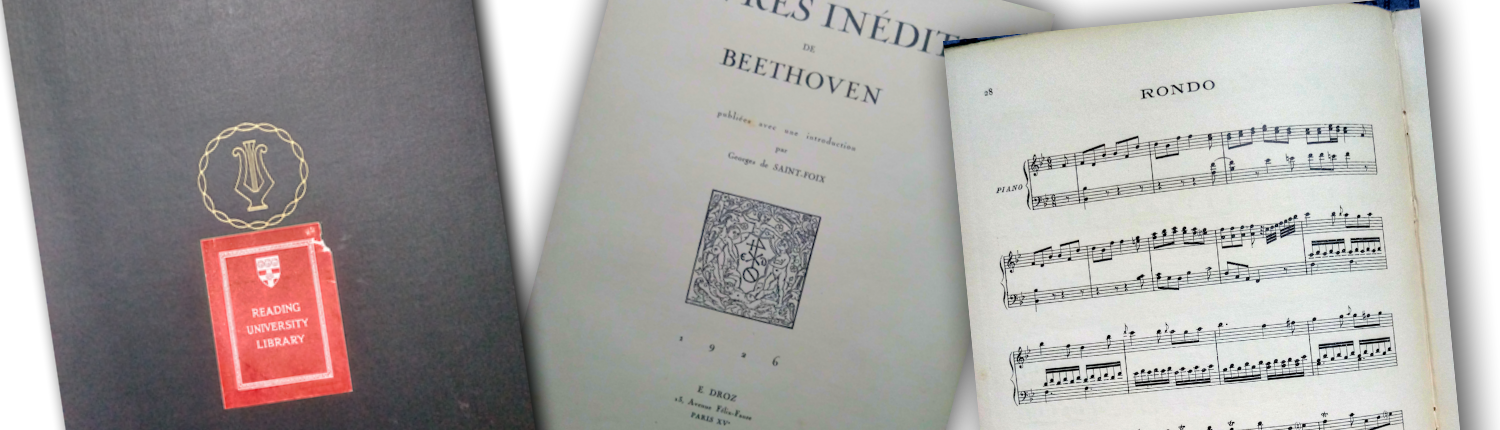
Anhang 6
Rondo in B flat major for piano
Hess Anhang 20 – Kinsky Halm Anhang 6.
The manuscript can be found, along with the trio Anhang 3 and the three pieces Anhang 8, in a manuscript held at the British Library (Add. Ms. 31748, Bl 13-14). Kojima identified the handwriting of the London source manuscript as that of Kaspar Karl van Beethoven, who copied not only his own compositions, but also dances by his brother Ludwig (WoO 12) and those from a ballet by Leopold Kozeluch, “La ritrovata figlia di Ottone II” studied on our website (Kojima / Karl van Beethoven, see also the observations on the trio for piano, violin, and cello Anhang 3 and the three pieces for piano four hands Anhang 8).
With this 1978 study, Augustinus Kojima was able to prove that the rondo was in the hand of Kaspar Karl van Beethoven, but not its authorship. Recent studies seem to lead it back to Ludwig (2014). The first edition under the name of Ludwig Van Beethoven appeared in 1926 in “Oeuvres inedites de Beethoven” by Georges de Saint-Foix in Paris. First edition under the name of Ludwig van Beethoven: 1926. Oeuvres inedites de Beethoven, published by Georges de Saint-Foix, Paris: E. Droz (Pubblications de la Société Francaise de Musicologie 2), pp. 28-37.

Anhang 6 is part of the “Research Becomes Art” project.
A New Life for the Unknown Works of Ludwig van Beethoven: An Artistic Exploration by Our Collaborating Artists.