

Editors and Editions
In this new section we will place multimedia files of rare and unobtainable scores from our own collection. These may range from first editions—Beethovenian and otherwise—to variants, transcriptions, and paraphrases. The section does not intend to be “self‑contained”, but rather to complement the others. Whenever necessary, we will therefore refer to the pages dedicated to the individual works for further clarification or in‑depth information.
Artaria – Publishing House – (Artaria & Co., Mathias and Domenico Artaria)
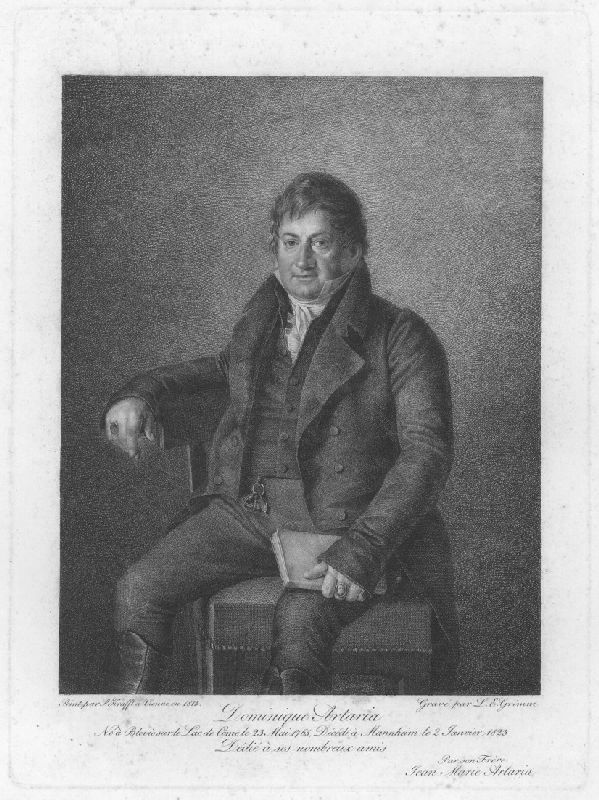
Artaria & Co. An Italian family of publishers originally from Blevio (Como). Under their direction the firm carried out extensive activity, publishing a great number of works by Haydn (about 300), Mozart, Stamitz, Cannabich, and naturally Beethoven. The Beethoven publications were handled in particular by Domenico (1775–1842), son of Francesco.
Another member of the family, Matthias Artaria (1770–1835), who lived in Mannheim, moved to Vienna in 1817 and opened his own independent publishing house in 1822, which published—only after Beethoven’s death—Opp. 130, 133, and 134.
First editions issued by Artaria & Co.: 1795 Three Piano Trios Op. 1 1796 Three Piano Sonatas Op. 2 1796 String Trio Op. 3 1796 String Quintet Op. 4 1797 Two Sonatas for Cello and Piano Op. 5 1797 Piano Sonata for Four Hands Op. 6 1797 Piano Sonata Op. 7 1797–1802 Serenade for String Trio Op. 8 1797 Rondo for Piano Op. 51 1799 Lied Adelaide Op. 46 1802 Three Sonatas for Violin and Piano Op. 12 1803 The Creatures of Prometheus, in their piano arrangement, Op. 43 1806 Six Lieder Op. 48 1814 Wind Trio Op. 87 1814 Fidelio Op. 72 (1814 version) 1819 String Quintet Op. 104 1819 Six Variations for Piano Op. 105 1830 Piano Sonata Op. 106 1793 Wind Octet Op. 103 1795 Variations for Violin and Piano WoO 40 1795 Twelve Minuets WoO 7 1796 Twelve German Dances WoO 8 1797 Six Minuets WoO 10 1802 Seven Ländler 1797 Six Ländler 1796 Twelve Variations for Cello and Piano WoO 45 1797 Twelve Variations for Piano WoO 68 1799 Twelve Variations for Piano WoO 71 1797 Ten Variations for Piano WoO 73 1797 Lied Abschiedgesang an Wiens Bürger WoO 121 1810 Lied Kriegslied der Österreicher WoO 122 1810 Lied Der Jüngling in der Fremde WoO 138 1816 Lied Der Liebende WoO 139 Lied Sehnsucht WoO 146
First editions issued by Matthias Artaria: 1827 String Quartet Op. 130 1827 Grosse Fuge for String Quartet Op. 133 1827 Grosse Fuge for Piano Four Hands Op. 134


Boston Händel e Haydn Society Collection of Sacred Music – Boston 1821

The Handel and Haydn Society promoted a series of significant American premieres, among them Handel’s Messiah in 1818 and Haydn’s Creation in 1819. The Society also sponsored the first American publication of an edition of the Messiah in 1816, presenting in the United States for the first time music by many Baroque and Classical composers, including Mozart and Bach. The volume presented here is the first edition (many further editions were reprinted later) and the first of three volumes.
The second volume was published in 1823 and contains another piece by Beethoven (reproduced here), and the third and final volume appeared in 1827. This piece from 1821 is one of the earliest examples of Beethoven’s music printed in the United States. It is important to note that in 1823 many members of the Society asked Beethoven to compose an oratorio, apparently with an English text, which however remained at the project stage.
Boston at that time was a city of culture, being part of New England, where many Europeans had emigrated, and it was precisely here that in 1817 the greatest Beethoven biographer, Alexander Wheelock Thayer (1817–1897), was born. Thayer began listening to Beethoven’s music by attending these Society concerts, and, loving this music more and more, decided to move to Europe to devote his entire life to writing the monumental biography of the master of Bonn.
For the projected oratorio for Boston, Beethoven considered using the libretto Der Sieg des Kreuzes, translated into English as The Victory on the Cross, which the Gesellschaft der Musikfreunde in Vienna had commissioned from him in 1819. Moreover, in 1823 Beethoven contacted Grillparzer to ask him for a libretto on this subject.
In 1823 Samuel Richardson, a member of the Handel and Haydn Society of Boston, and other gentlemen of Boston sent a request through a Boston banker to one in Vienna, Herr Geymüller, asking whether the Society might commission an oratorio from Beethoven. Beethoven was astonished that the fame of his music had reached across the ocean. The newspaper Morgenblatt für gebildete Leser of 5 November 1823 reported this commission, and in a note by Beethoven contained in the conversation book of early April 1823 Dr. Johann Bihler writes: “The oratorio for Boston?” and Beethoven replies: “I cannot write what I would like to write. Only what money obliges me to write. This does not mean that I write only for money; when this period is over, I hope to write what for me and for art is sublime: the Faust.” (See Schünemann, III, p. 149)

The Bird Let Loose Boston Handel and Haydn Society Collection of Sacred Music, consisting of Songs, Duetts, Trios, Choruses, Anthems, &c., selected from the works of the most celebrated authors, arranged for the organ or piano forte by the Handel and Haydn Society. Vols. 1 and 2.
This piece is taken from the book The Boston Handel and Haydn Society Collection of Sacred Music, published in Boston in 1821 (see title page). The Handel and Haydn Society was founded in Boston on 24 March 1815 by a group of Boston merchants and musicians “to promote the love of good music and its better performance”, and in particular the music of Handel and Haydn. Here is the Society’s charter.
Clementi, Collard & Collard, Cheapside, London.

The firm Longman & Co. fell into commercial difficulties in 1799, and a new company, composed of John Longman, Muzio Clementi, Frederick Augustus Hyde, F. W. Collard, Josiah Banger, and David Davis, took over the business.
On 28 June 1800 Longman and Hyde retired, and the company took the name Muzio Clementi & Co. Shortly afterwards William Frederick Collard was admitted into the partnership, and on 24 June 1817 Banger withdrew.
On 24 June 1831 the partnership between F. W. Collard, W. F. Collard, and Clementi expired, and the two brothers continued the business until 24 June 1842, when W. F. Collard retired and, in the same June, his two nephews Frederick William Collard and Charles Lukey Collard entered the firm.
The company suffered two major fires: on 20 March 1807 the manufactory in Tottenham Court Road was razed to the ground, and on 10 December 1851 the new printing works in Oval Road near Camden Town was also completely destroyed.
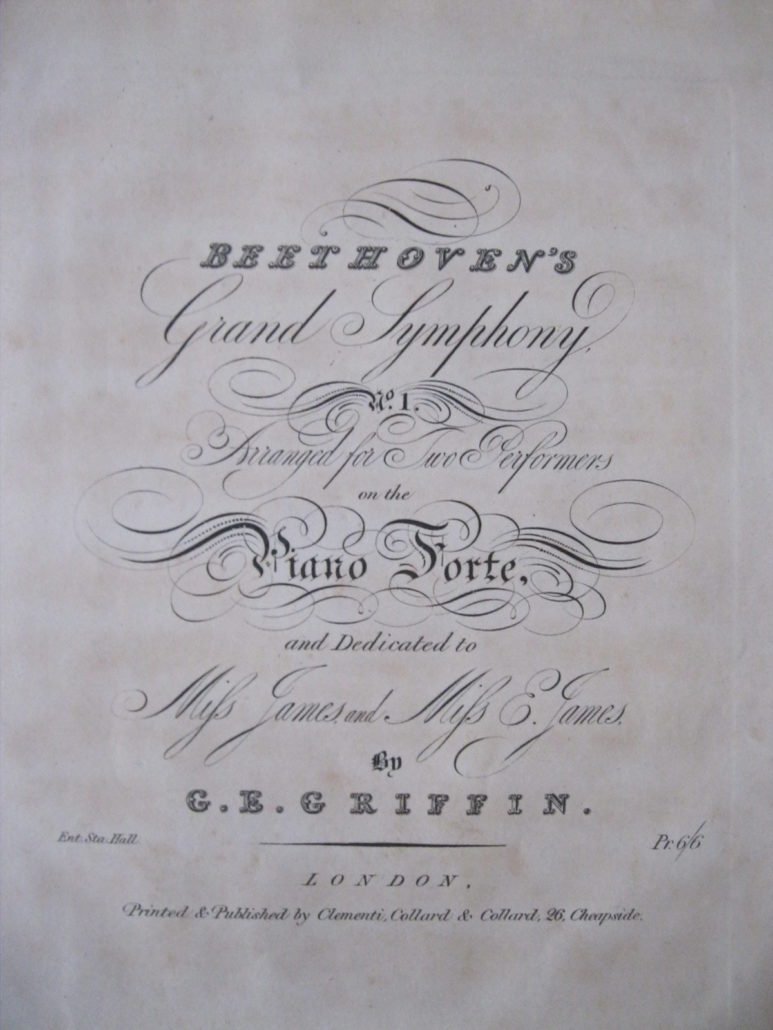
1825 – Opus 21 – Beethoven’s Grand Symphony N°1 Arranged for two performers on the Piano Forte and Dedicated to Miss James and Miss E. Jasmes by G.E. Griffin* Ent. Sta. Hall London. Printed & Published by Clementi, Collard & Collard 26 Cheapside.Prix 6/6..
(*) GRIFFIN, George Eugene, pianist and composer, was born on 8 January 1781. At sixteen he made his debut as a composer with a concerto for piano and orchestra. His compositions, with the exception of three string quartets, are all for piano, either solo or in combination with other instruments. They include two concertos for piano and orchestra; a piano and string quartet; four sonatas; divertimenti for five instruments; four rondos; six marches; six airs; a capriccio. Griffin was one of the founding members of the Philharmonic Society of London. Griffin was struck by a fatal illness while attending one of the concerts, and died a few days later, in May 1863. His compositions are formed on classical models and were highly esteemed in his time, although they are practically forgotten today. Griffin transcribed for four hands symphonies by Mozart and Beethoven, and the Septet Opus 20.
Cranz, Rudolph – (Hamburg and Altona in Hamburg) and subsequently August
The company was founded in 1814 in Hamburg. The firm also purchased the publishing house Friedrich Schreiber in 1879, after a merger in 1876 – and thus effectively became the principal publisher of the Strauss family. The Schreiber acquisition made it possible to access the older Viennese catalogues of Diabelli & Cappi, C. A. Spina, and Pietro Mechetti, all of whom had previously published Beethoven.
Cranz also absorbed the Hamburg publishing house Boehme in 1886, thereby acquiring a large catalogue built up since 1795 and a library of about 300,000 volumes. Offices were opened in Brussels (1883) and London (1890). In 1897 the headquarters were moved to Leipzig, the same year in which August Alwin Cranz (Hamburg 1834 – Vevey 1923) succeeded his father in the management of the company. Many famous musicians published by Cranz included Johann Strauss, Josef Strauss, Clara Schumann, and Max Bruch. Finally, in 1949 the company moved to Wiesbaden in Hesse. The last transfer of ownership occurred in 1992, to Schott, which still uses the Cranz logo, especially for works of the Strauss family. The works discussed here were published earlier, in Hamburg and Altona (nowadays a suburb of the city), by the predecessor Rudolph Cranz.

Simrock Nikolaus

Simrock, Nikolaus (1752–1833). Of Bohemian origin, he lived in Bonn, where he played the horn in the Elector’s orchestra and where he met Beethoven. He engaged in the book trade and in 1793 founded his own publishing house in Bonn.
He published several works by the Master, above all relating to Beethoven’s very earliest compositional years, and, in the period of the Master’s maturity, some highly important works.
Let us list them (also because some of these works will be presented in this section of the site): Violin Sonata Op. 47 Sextet for Strings and Horns Op. 81b Sonatas for Cello and Piano Op. 102 Variations for Piano Op. 107 Thirteen Variations on a Theme by D. von Dittersdorf WoO 66 Eight Variations on a Theme of Count Waldstein WoO 67, for piano four hands Six Variations for Harp on a Swiss Lied WoO 64 Lied Der freie Mann WoO 117 Lied Opferlied WoO 126 Rondo for Violin and Piano WoO 41 Lied An die Geliebte WoO 140 Lied Das Geheimnis WoO 145 Lied So oder so WoO 148


1798 – WoO 64 – Six easy Variations on a Swiss air for Harp or Forte‑Piano by L. van Beethoven, No. 6 – Published by Simrock in Bonn. Price 24. Marked in pen as No. 17 (No. 78 cancelled) and again A.F. 297. (Mp3 for fortepiano and for harp).


NB: This edition has a peculiarity; in the eighth variation there is a small difference in the “little cadenza” of the first part, in the last three bars before the close. Here the eighth variation is shown in its original version and in the final version of the G.A.


1802 – Opus 17 Sonata for the Piano‑Forte with accompaniment of Horn, Viola, or Violoncello, composed and dedicated to Madame la Baronne de Braun by Louis van Beethoven. Opus 17 – Price 4 Francs – Published by Simrock in Bonn (Plate 159).


