

Hess 89 – Musik zur ein Ritterballet, piano reduction
I) Marsch – II) Deutscher Gesang. Allegro moderato – III) Jagdlied. Allegretto (Deutscher Gesang. Allegro moderato). – IV) Romanze. Andantino (Deutscher Gesang. Allegro moderato) – V) Kriegslied. Allegro assai con brio (Deutscher Gesang. Allegro moderato) – VI) Trinklied. Allegro con brio (Deutscher Gesang. Allegro moderato) – VII) Deutscher Tanz. Walzer (Deutscher Gesang. Section breve)) – VIII) Coda. Allegro vivace – Andantino
The musical examples on this page are by Graziano Denini and Sebastiano Mazzoleni
Hess 89 – Musik zur ein Ritterballet, piano reduction, winter 1790 – 1791. H. 89.
It is an autograph manuscript, preserved in the Beethovenhaus. Separate facsimile reproductions of the individual numbers, except the eighth, exist in publications of the Beethovenhaus itself, in “Der junge Beethoven of the Schiedermair” and in the “Jeunesse de Beethoven” of the Prod’homme. Complete printed publication in the eighth booklet of the Supplemente zur GA. by W. Hess, 1964. Another thing is the piano reduction by Ferdinand Dulcken, published by J. Rieter-Biedermann, Leipzig und Winterthur, 1872.
The piano reduction of this work, written by Beethoven himself, has not yet been fully published. No. 1 of this work was reproduced in facsimile in the hall program of the 12th edition of the Chamber Music Festival 33 of the Beethoven-Haus in Bonn in 1913; nos. 2 and 3 have been reproduced in facsimile in the booklet Beethovens Handschrift, edited by Max Unger, Veröffentlichung der Beethovenhauses Bonn, vol. 4, Quelle & Meyer, Leipzig 1926; nos. 4 to 7 have been added in facsimile to Schiedermair’s work Der junge Beethoven; No. 8 has never been published. The autograph manuscript of the entire work is in the Beethoven-Haus in Bonn.
The orchestral version is catalogued in Kinsky/Halm as WoO 1. The piano reduction is cited on p. 428, where No. 4, the “Minnelied”, is described as the work of an unknown hand.


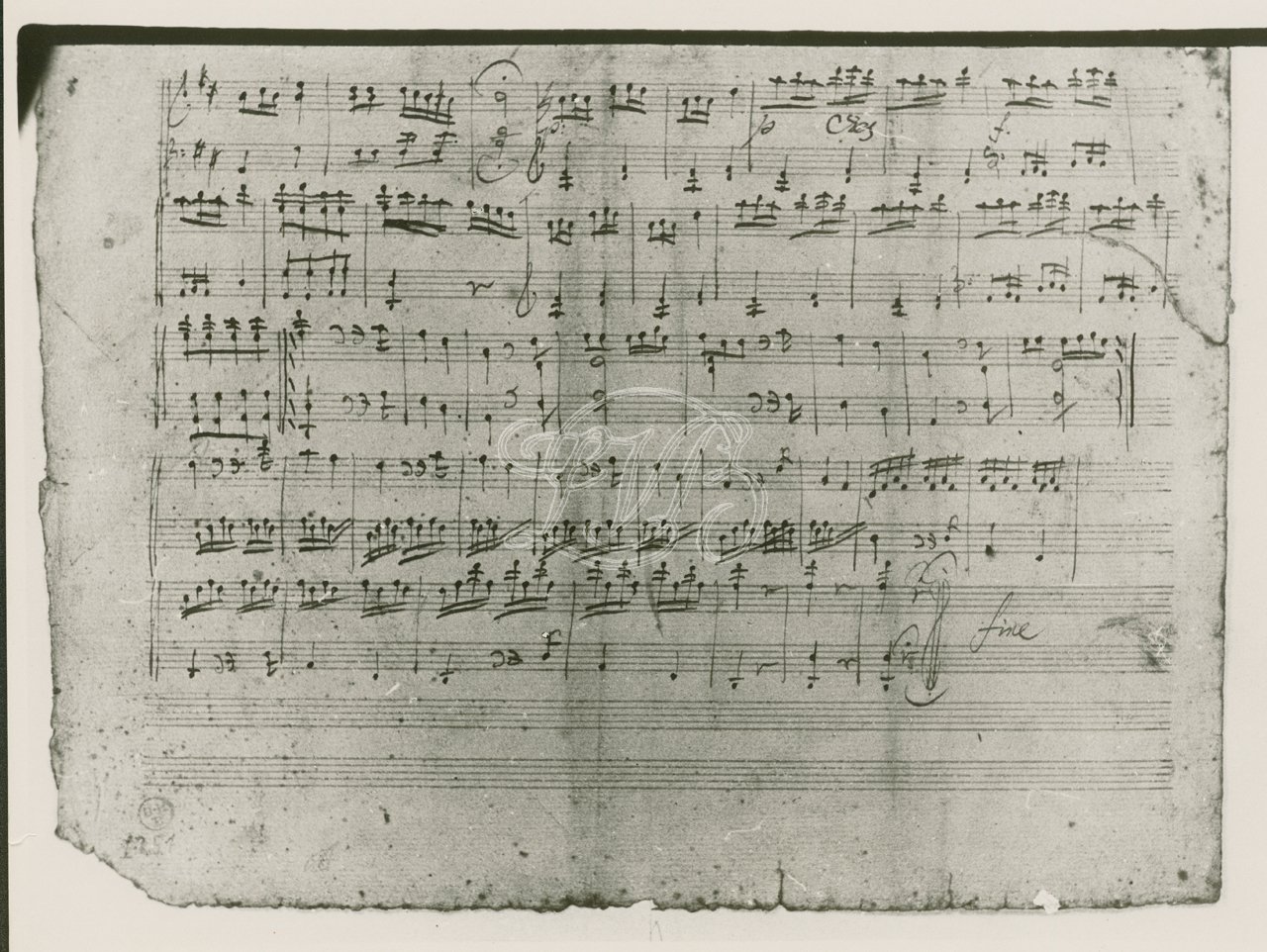
Alan Tyson, in his article “Notes on Five of Beethoven’s Copyists”, published in the Journal of the American Musicological Society, XXIII, No. 3, Autumn 1970, p. 466, claims that the “Minnelied” was written in the handwriting of Ferdinand Ries. The original autograph was destroyed following a fire that accidentally broke out in a room of the Beethoven-Haus warehouse in 1960. Photocopies of the original exist. The complete transcription for piano was published by Rieter-Biederman, Leipzig/Winterthur 1872, and more recently by Hess in SBG, voI. VIII, 1964, p. 7.
Giovanni Biamonti in the Chronological and thematic catalogue of Beethoven’s works, ILTE, Turin, 1968, p. 31, says that the Rieter-Biederman edition had been reduced for piano by Ferdinand Dulcken. In fact, it cannot be a reduction made by Beethoven. According to Thayer, there were once vocal parts for this work, which have now been lost. Hess classified these “lost” parts with number 116 in this catalog. In 1927 the Beethoven-Haus published the piano reduction of the piece, as “Musik zu einem Ritterballett mit Gesang”, without any explanation of how, and in what places it contained vocal parts. Cf. Das Beethoven-Haus in Bonn und seine Sammlungen, by F.A. Schmidt and Fr. Knickenberg, Bonn 1927, p. 94.]
Hess 89 is part of the “Research Becomes Art” project.
A New Life for the Unknown Works of Ludwig van Beethoven: An Artistic Exploration by Our Collaborating Artists.