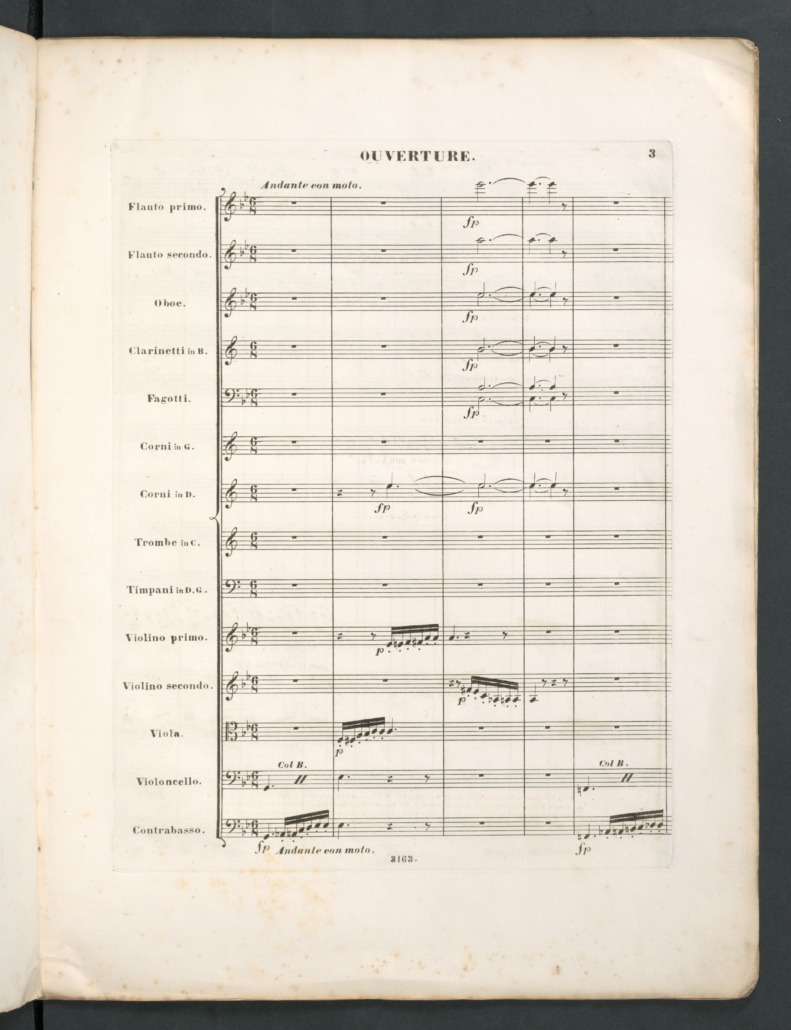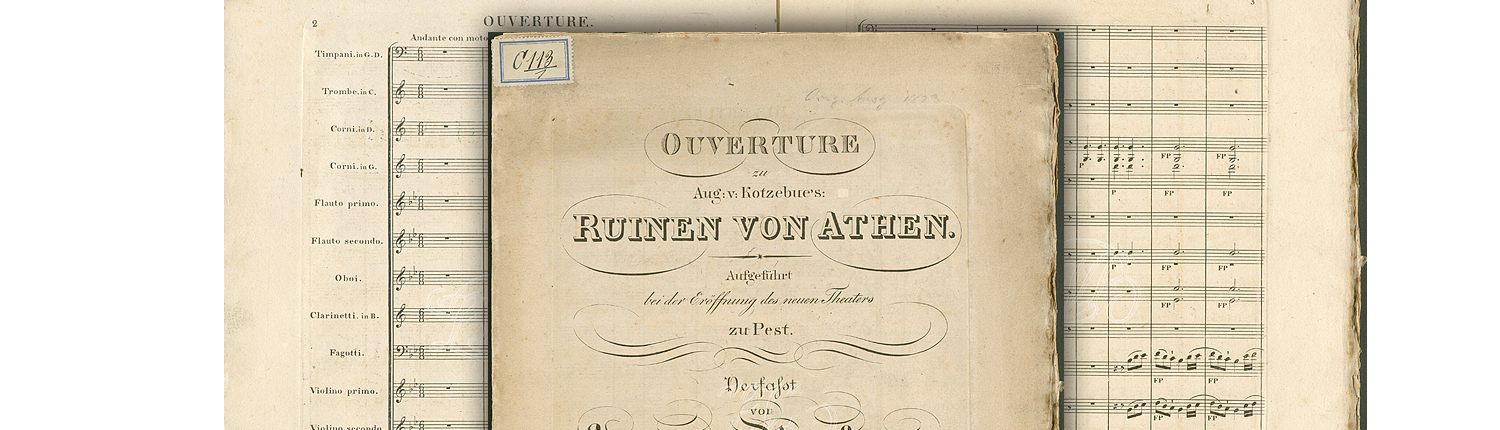
Opus 113 – “Die Ruinen von Athen”, overture and incidental music for spoken voice, chorus, and orchestra
Ouverture (Andante con moto – Allegro ma non troppo) – I) Chor (Andante poco sostenuto) – II) Duett (Andante con moto) – III) Chor der Derwische (Allegro ma non troppo) – IV) Marcia alla turca (Vivace) – V) Harmonie auf dem Theater (Allegro assai ma non troppo) – VI Marsch und Chor (Assai moderato) – VII) Rezitatif – VIII) Chor (Allegro ma non troppo) – IX) Arie mit Chor (Adagio) – X) Chor (Allegro con fuoco)
Opus 113 – The Ruins of Athens: overture and incidental music for spoken voice, chorus, and orchestra. Epilogue (Nachspiel) for the celebratory performances marking the opening of the new German theatre in Pest, composed between 20 August and mid-September 1811. The overture was published in full score and orchestral parts (in two fascicles) in Vienna by Steiner in February 1823; the complete work appeared in full score in Vienna by Artaria in 1846. GA no. 207 (series 20/2-2) (the overture also listed as no. 28, series 3/11) – B. 113 – KH. 113 – L. IV, p. 116 – N. 113 – T. 166.
The original manuscript is preserved in the Deutsche Staatsbibliothek, Berlin. Numerous sketches are held in the British Museum and are briefly described by Nottebohm. The work was conceived together with King Stephen and for the same occasion. The text by August von Kotzebue is a fanciful and bombastic allegory celebrating art, but even more the city of Pest and, naturally, Emperor Francis I of Austria. The music reflects both the function for which it was intended and the spontaneity of its conception.
I. Overture. Orchestra: 2 flutes, 2 oboes, 2 clarinets, 2 bassoons, 2 horns, 2 trumpets, timpani, and strings. It corresponds to the same decorative intention as that of King Stephen, though it is of lesser interest. The introduction (Andante con moto – Marcia moderato) is based on thematic material drawn from two episodes of the stage work: the duet of the Greek and the Greek girl (No. II) and the march (No. VI). The themes of the Allegro, however, are independent: the first rhythmic, the second gentle, both belonging to a more general category of liveliness and musical spirit, though handled with elegance. The recapitulation halts at the first theme, concluding the overture with a cadence in the tonic key.
I. Chorus (invisible): “Tochter des mächtigen Zeus”. Orchestra: flute, 2 oboes, 2 clarinets, 2 bassoons, 2 horns, strings. An invisible chorus awakens Minerva, whom Jupiter had condemned to a sleep of twenty centuries for failing to protect Socrates.
A gentle yet majestic invocation, in which the wind instruments play an important expressive role. Recitative: Minerva asks Mercury—who has come to bring her her father’s greeting and to serve her—to accompany her to Athens. But the city is now a desolation. Among the ruins of the ancient monuments, the goddess sees two Greeks: a man cleaning rice and a girl selling figs.
II. Duet between the Greek and the Greek girl (bass and soprano): “Ohne Verschulden Knechtschaft dulden”. Orchestra: 2 flutes, 2 oboes, 2 clarinets, 2 bassoons, 4 horns, strings. The two lament the miserable state of their homeland.
The music develops the themes of the Andante con moto from the overture. Recitative: In response to Minerva’s question, Mercury explains that the city is no longer the blessed seat of the arts and of classical civilisation; it is now dominated by barbarians—namely, the Turks. A group of dervishes then enters, engaged in their ritual practices.
III. Chorus of the Dervishes (tenors and basses): “Du hast in deines Ärmels Falten den Mond getragen”. Allegro, ma non troppo. Orchestra: 2 horns, 2 trumpets, alto and bass trombones, strings. A colourful page, perhaps with a touch of caricature. A note added by Beethoven to the score reads: “Alle mögliche hierber lärmende Instrumente wie Castagnetten, Schellen, etc.” (“Introduce here all possible noisy instruments, such as castanets, tambourines, etc.”). Worth noting is the recurring accentuation of the word “Kaaba!” and the sudden fortissimo on the invocation “Mahomet!”
This is followed by IV. Turkish March (The Turks, with drawn sabres, cross the stage during the Janissary music, as noted in the score). Vivace. Orchestra: piccolo, 2 oboes, 2 clarinets, 2 bassoons, contrabassoon, 2 horns, 2 trumpets, triangle, cymbals, bass drum, strings. Another colourful page: Turkish music par excellence. The theme is the same as that of the Piano Variations, Opus 76 (Biamonti 494), composed by Beethoven a few years earlier. Recitative: Disillusioned by what she has seen and heard in Athens, Minerva wishes to go to Rome, hoping to find her temple still standing and the cult of art flourishing there. But Mercury tells her that Rome too has been ravaged by the barbarians; the Muses have now sought refuge in northern lands. On the banks of the Danube, a great and civilised people are paying them worthy homage and preparing to crown them once more with laurel. The scene changes to a square in the city of Pest, filled with a joyous crowd.
V. Musica interna. Orchestra: 2 oboes, 2 clarinets, 2 horns, 2 bassoons. A page of gentle, pastoral character. Minerva and Mercury enter disguised as pilgrims. Recitative: An old man explains to Minerva that she is now in a land endowed with the richest gifts of nature, where prosperity and virtue dwell among a people most loyal to their king, who are today celebrating the inauguration of a new temple of the Muses. At the sound of a solemn march, a splendid procession approaches, escorting two flower-adorned chariots: the first bearing the statue of Thalia, the second that of Melpomene surrounded by celebrated tragic figures.
[To Biamonti Giovanni – Catalogo cronologico e tematico delle opere di Beethoven comprese quelle inedite e gli abbozzi non utilizzati, Torino, ILTE 1968]
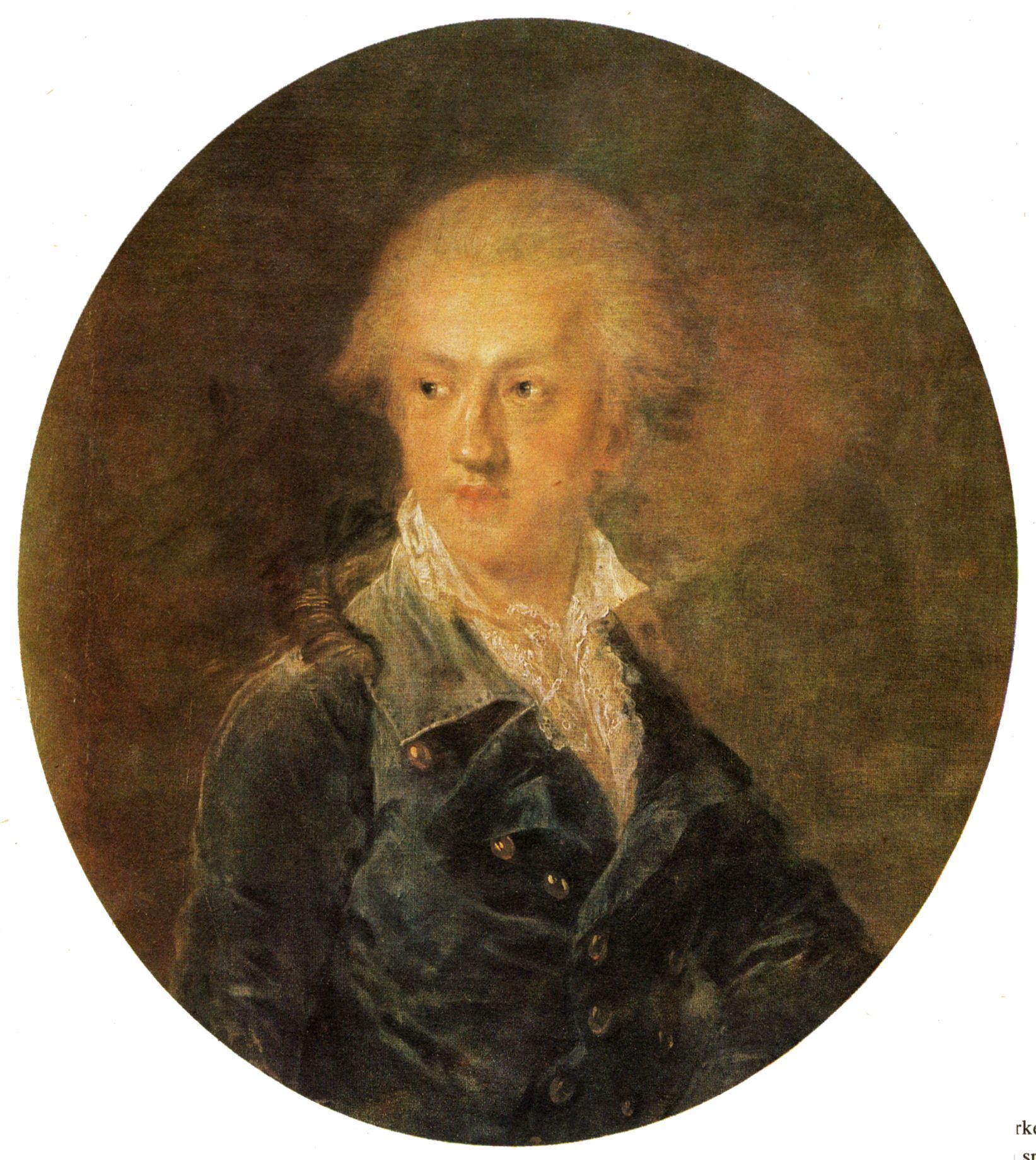
VI. March. The orchestra (piccolo, 2 flutes, 2 oboes, 2 clarinets, 2 bassoons, 2 horns, 2 trumpets, timpani, 3 trombones, strings) develops the march theme already hinted at in the introduction to the Overture. Recitative: As the procession passes, Mercury points out to Minerva the various tragic figures surrounding Melpomene: Wallenstein, William Tell, Egmont, Mary Stuart, Coriolanus, and others. “Forget your Greece; it is gone, and for art a new age is now beginning.”
Change of scene: the interior of a magnificent temple is revealed, with two altars dedicated respectively to Thalia and Melpomene. Antiphonal chorus of priests and virgins: “Schmückt die Altäre!”. The statues of Melpomene and Thalia are placed upon the altars, and the people crowd around them. The march unfolds with growing instrumental splendour, culminating in a passage of great sonority.
Recitative: The High Priest (bass): “Mit reger Freude”. Orchestra: 2 oboes, 2 clarinets, 2 horns, 2 trumpets, alto and tenor trombones, strings. Priests and people offer homage to Melpomene and Thalia.
VII. Chorus: “Wir tragen empfängliche Herzen im Busen”. Orchestra: 2 flutes, 2 clarinets, strings. The tribute of homage to the Muses continues.
VIII. Aria of the High Priest: “Will unser Genius noch einen Wunsch gewähren, durch eines Volkes fromme Bitten bewegt”. Adagio. Orchestra: 4 horns, 3 bassoons, strings. The High Priest prays to Jupiter to raise another altar, bearing the statue of him “whom the people love and revere as a father.” The music is imbued with a certain majestic gravity, strongly supported by the instrumental ensemble, in which the horns and bassoons are especially prominent.
A peal of thunder is heard; the stage is suddenly flooded with light; a third altar appears between the other two, bearing the statue of Emperor Francis I and the inscription “Unserem Vater”.
X. Chorus: “Er ist’s! er ist’s!” . Orchestra: 2 flutes, 2 oboes, 2 clarinets, 2 bassoons, 2 horns, 2 trumpets, timpani, 3 trombones, strings. The people fall to their knees in a chorus of jubilation. Recitative: Minerva and Mercury reveal themselves. Minerva crowns the Emperor’s head with an olive branch, hailing his greatness and kindness and the faithfulness of the Hungarian people.
Official title: Opus 113 Musik zum Fest-Nachspiel „Die Ruinen von Athen“ von August Friedrich Ferdinand von Kotzebue für Sopran, Bariton, Bass, Chor und Orchester Widmung: — NGA IX/8 AGA 207 = Serie 20/2, Ouvertüre nochmals 28 Serie 3/11 SBG VIII/4 (Nr. 1 mit neuem Text, Hess 118).
Composition and publication: composed together with Op. 117 between the end of August and mid-September 1811 in Teplice. Pieces 4 and 5 were written in Vienna, probably a few days later. The original edition of the overture, in full score and parts, was published in February 1823 by Steiner & Comp. in Vienna; the first edition of the complete work, in full score, appeared posthumously in 1846, published by Artaria in Vienna. For the origin of the Fest-Nachspiel Op. 113, see the Fest-Vorspiel Op. 117. Beethoven completely revised Op. 113 (Hess 118) and wrote a new overture and chorus, WoO 98 (see Op. 124). Contrary to earlier assumptions, he probably did not revise the march and chorus, Op. 113 No. 6, for the performance at Meisl’s festival, but rather for the publication of Op. 113 No. 6 (see Op. 114). Beethoven began this revision in 1822/23.
He initially planned to adapt the two-act libretto Die Apotheose im Tempel des Jupiter Ammon by Johann Chrysostom Sporschil, incorporating the music for Die Ruinen von Athen (or the adaptation Die Weihe des Hauses). Sketches are found in D-B, Mus. ms. autogr. Beethoven Artaria 201, page 11; Sporschil’s manuscript in D-B, Mus. ms. autogr. Beethoven 37,30 (see BGA 1518, 1520). In any case, this reworking never took place.
In 1826, the director of the Mannheim Court Theatre, Wilhelm Ehlers, approached Beethoven, asking him to rework Op. 113 and the music for Die Weihe des Hauses for a one-act opera entitled Simson. Beethoven replied: “ich bin mit allem einverstanden, was sie in rücksicht der Ruinen von Athen bewerkstelligen, nur vergeßen sie nicht die Wahrheit, welche durch die Meißnerische Bearbeitung sehr gelitten hat, wiederherzustellen, die natürlich mehr im Kozebuisch. ursprüngl. Text nur zu finden ist” (BGA 2178). In 1827 Ehlers unsuccessfully offered the work to the publishing house B. Schott’s Söhne in Mainz.
Text: August Friedrich Ferdinand von Kotzebue (1761–1819). The libretto was printed for the inauguration of the new German theatre in Pest on 9 February 1812: “Die Ruinen von Athen. / Ein Nachspiel / mit Chören und Gesängen. / Zur Eröffnung des neuen Theaters / in Pesth / verfaßt / von / August von Kotzebue. / In Musik gesetzt / von / Ludwig van Beethoven. / Aufgeführt den 9. Febr. 1812. / Pesth 1812.” For the origin of the text, see Op. 117.
The poetic subject glorifies the city of Pest as a renewed Athens, a city of the Muses even more ideal than its Greek model. After a long sleep, the goddess Minerva awakens and returns to her native city, Athens, now occupied by the Turks. Both Athens and Rome, the two spiritual metropolises of antiquity, have fallen into cultural decay. Mercury appears to Minerva and sends her to Pest, the only place where science and culture still flourish.
The first performance took place on 9 February 1812 at the inauguration of the new German theatre in Pest. Repeat performances were given on 10 and 11 February, owing to the great success of the premiere. The March and Chorus (No. 6) were performed on 22 March 1812 at a concert by Franz Clement at the Theater an der Wien. The Leipziger Allgemeine Musikalische Zeitung wrote: “Diese Composition, sowol nach der Anlage, als nach der Ausführung und Wirkung betrachtet, ist von hoher Schönheit, und hielt uns schadlos für das übrige Unbedeutende in diesem Concerte.”
According to Ignaz von Seyfried, the overture was also performed on 23 May 1814 for the first performance of Fidelio (third version), since the opera’s overture had not yet been completed. Although Georg Friedrich Treitschke and Anton Schindler mention other overtures, Seyfried’s account is supported by the newspaper Der Collector, which reported that the overture had originally been written for the Pest Theatre.
The sketches will be featured in an article specially created for the Beethovenian Music Research Center, www.lvbeethoven.org