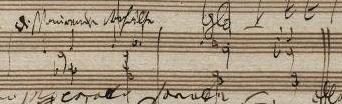
Biamonti 481 – “Dissonirende Vorhälte” (Dissonant Suspensions), two bars, Spring 1809.
The musical examples, analyses, and texts on this page are curated by Graziano Denini.
Biamonti 481 – “Dissonirende Vorhälte” (Dissonant Suspensions), two bars, Spring 1809. Fragments included in the group of sheets referenced under the preceding numbers. Nottebohm reports the following (Nottebohm, Zweite Beethoveniana, II, page 267). (The sketchbook cited by both Biamonti and Nottebohm is Landsberg 5.)
The Landsberg 5 sketchbook dates from 1809 and is preserved in the Beethoven Collection of the Music Department of the German State Library in Berlin. The Beethovenhaus in Bonn published an excellent edition in 1993, edited by Dr. Clemens Brenneis. Unfortunately, the first pages are missing. However, several sheets have been added that originate from the Peters and Willmot sketchbooks.
The sketches in this notebook concern Opus 69, 70, 73, 74, 75-5, 75-6, 76, 77, 79, 80, 81a, 82-2, 85, 86, 115. It contains an impressive number of unpublished fragments.
These are located in Berlin, in the State Library, within the sketchbook known as Landsberg 5, specifically on page 54, staves 11–12, right at the bottom of the unfinished sketch for the Sanctus referenced in Biamonti’s Addendum Note II 49. Nottebohm mentions it in his Zweite Beethoveniana (page 266), although he indicates no fewer than five pages where other examples of “Dissonirende Vorhälte” (dissonant suspensions) may be found—even though he actually cites only one. Contrary to what Nottebohm writes, the third suspension, which he identifies in the chord D–G–F–B♭ resolving to D–G–F–B♮, in my opinion, should resolve instead to D–G–F–A♮.
While awaiting the discovery of further dissonant passages in the subsequent pages, for now we indicate only the example reported by Nottebohm.