Opus 61a, Concerto in D major for piano and orchestra
(Piano transcription of the solo violin part in the Violin Concerto, Op. 61)
I) Allegro ma non troppo – II) Larghetto – III) Rondo
Opus 61a – Transcription for piano of the solo violin part in the Violin Concerto in D major, Op. 61, dedicated to Mrs. Julie von Breuning (the first wife of Stephan Breuning, Beethoven’s devoted friend since their days in Bonn, to whom the original Violin Concerto had been dedicated; a skilled pianist, with whom the composer also enjoyed playing four-hand piano music), summer of 1807, published in Vienna by the Bureau d’arts et d’industrie, August 1808. GA. no. 73 (series 9/10) – KH. 61 (p. 148) – L. III, p. 58 – N. 61 – T. 130 (p. 71).
The original manuscript is unknown. A revised copy is preserved in the British Museum. Beethoven made this transcription at the request of Muzio Clementi, granting him the right to publish it in the Anglo-Saxon countries along with the original Violin Concerto, the three quartets Opus 59, the Coriolan Overture, the Fourth Symphony, and the Fourth Piano Concerto. One cannot claim that the piano transcription of such a work, originally written for the violin and so profoundly intertwined with the character and expressive uniqueness of the original instrument, has achieved anything equal to its beauty, and perhaps not even that it has come close, despite the author’s technical skill and careful adjustments. In 1809, Beethoven composed four cadenzas for the concerto: one for the first movement, one for the transition from the second to the third, and two others within the course of the third movement.
The concerto has also been recorded by Inedita, our partner and supporter, in volume 2 of the series, with Roberto Diem Tigani conducting the Sassari Orchestra, and Maurizio Paciariello at the piano.
Official title: Konzert (D-dur) nach dem Violinkonzert op. 61 für Klavier und Orchester Widmung: Juliana (Julie) von Breuning NGA III/5 AGA 73 = Serie 9/10
Composition and Publication: The version for piano and orchestra was created at the suggestion of Muzio Clementi between late April and July 1807. The original Viennese edition, in separate parts, was published in August 1808 by the Kunst-und Industrie-Comptoir of Vienna and Pest; the original London edition in parts was published by Clementi, Banger, Collard, Davis & Collard in August/September 1810. On 22 April, Muzio Clementi wrote to his business partner in London, Collard: “In short, I agreed with him to take in MSS. […] a concerto for the violin, which is beautiful, and which, at my request, he will adapt for the pianoforte with and without additional keys […] Remember that the violin concerto he will adapt himself and send it as soon as he can” (Shedlock/Clementi p. 143). While the engraving models for London were sent in September 1807 (Cooper/Clementi), the Journal des Luxus und der Moden (January 1808, p. 29) reported, in a report presumably dated late August/early September 1807, that the Violin Concerto in Vienna was already “im Stiche” (in the process of engraving).
In the autograph score of the violin version, Beethoven sketched some passages for the piano arrangement, but the complete autograph transcription of the piano part has not survived. The authenticity of the piano version has been repeatedly questioned, mainly due to stylistic and aesthetic reasons (including Nottebohm/Beethoveniana II, pp. 586-590, Kaiser/Op. 61, and Tyson/Op. 61 piano version). However, Clementi, Ferdinand Ries, and Carl Czerny all named Beethoven as the arranger (Wegeler/Ries p. 93f and Czerny/Beethoven p. 15), a claim confirmed by the investigations of Robert Förster (Forster/Op. 61). Moreover, based on corrections made to the engraving plates and variations in the model, it can be demonstrated that Beethoven at least reviewed the proofs of the piano part, authorising its publication (Herttrich/NGA III/4 KB p. 10). Hans-Werner Küthen sees the authenticity of the piano version as “unequivocally confirmed” by the sources (Küthen/NGA III/5 p. 169). The piano version of Op. 61 was offered to the publishers alongside the violin version. According to an announcement on 10 August 1808, published in the Wiener Zeitung, the piano version was already available. In any case, the work, along with the violin version, had already been printed in August 1807.
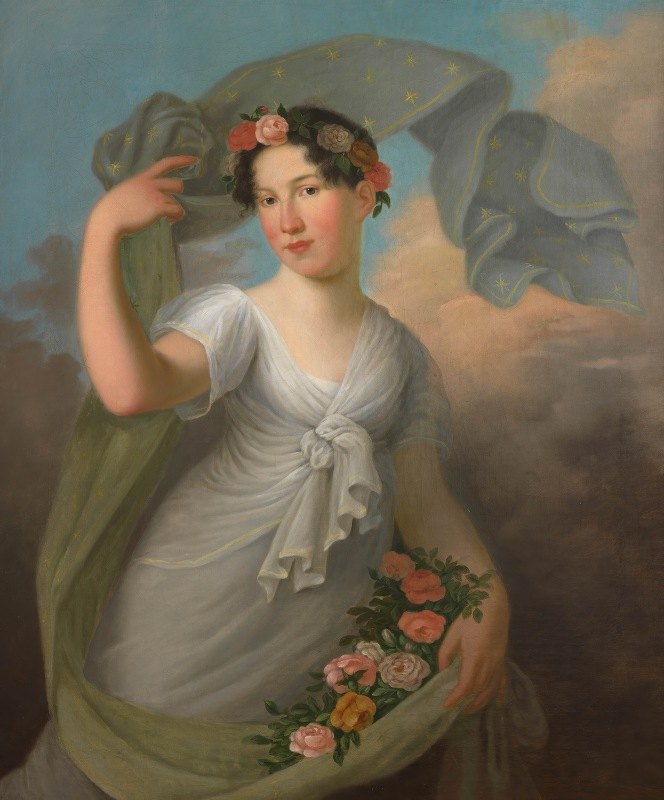
Dedication: Juliana (Julie) von Breuning, née von Vering, born on 26 November 1791 in Vienna and died there on 19 March 1809, was the daughter of the military doctor Gerhard von Vering (1755-1823; Beethoven’s physician in 1801). Julie von Breuning was a student of Johann Baptist Schenk (1753-1836) and an accomplished pianist. “Thus, it was natural that Beethoven soon became deeply interested in the talented 18-year-old wife of Steffens, and we see him, as he had done a few years earlier with Lenz, not only united with Julie for four-hand piano playing, but also especially paying homage to her artistic striving, by adapting the violin concerto—already dedicated to Stephan—for piano alone, and dedicating it to ‘Julie von Breuning, née von Wering’ (correctly Vering)” (Breuning/Schwarzspanierhaus p. 23). The dedication was Beethoven’s wedding gift to Julie von Vering and Stephan von Breuning. Stephan received the violin version (the “masculine” instrument), while Julie received the piano version (the “feminine” instrument) of the concerto.
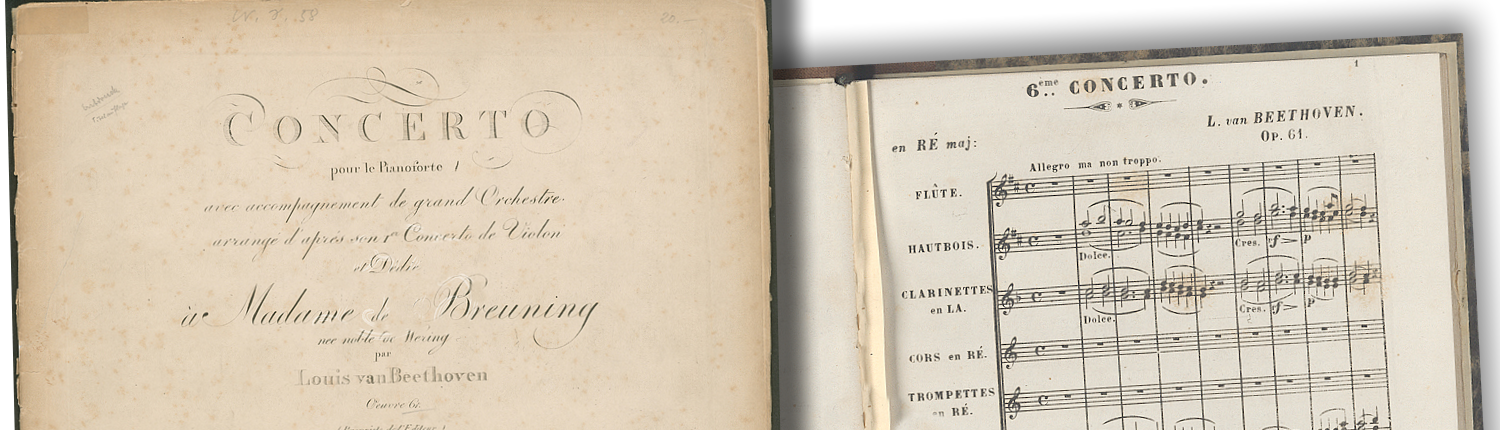
First performance unknown. For a possible performance on 20 January 1811 in Vienna conducted by Beethoven, with Archduke Rudolf as soloist, see Steblin/Chotek p. 119. Sketches: see violin version. First edition in parts, Vienna: 1808 (August). Vienna and Pest, Kunst- und Industrie-Comptoir (Bureau des arts et d’industrie), VN/PN 583. Title: “CONCERTO / pour le Pianoforte / avec accompagnement de grand Orchester / arrange d’apres [!] son Ier Concerto dE Violon / et Dedié / à Madame de Breuning / par / Louis van Beethoven / Oeuvre 61.”