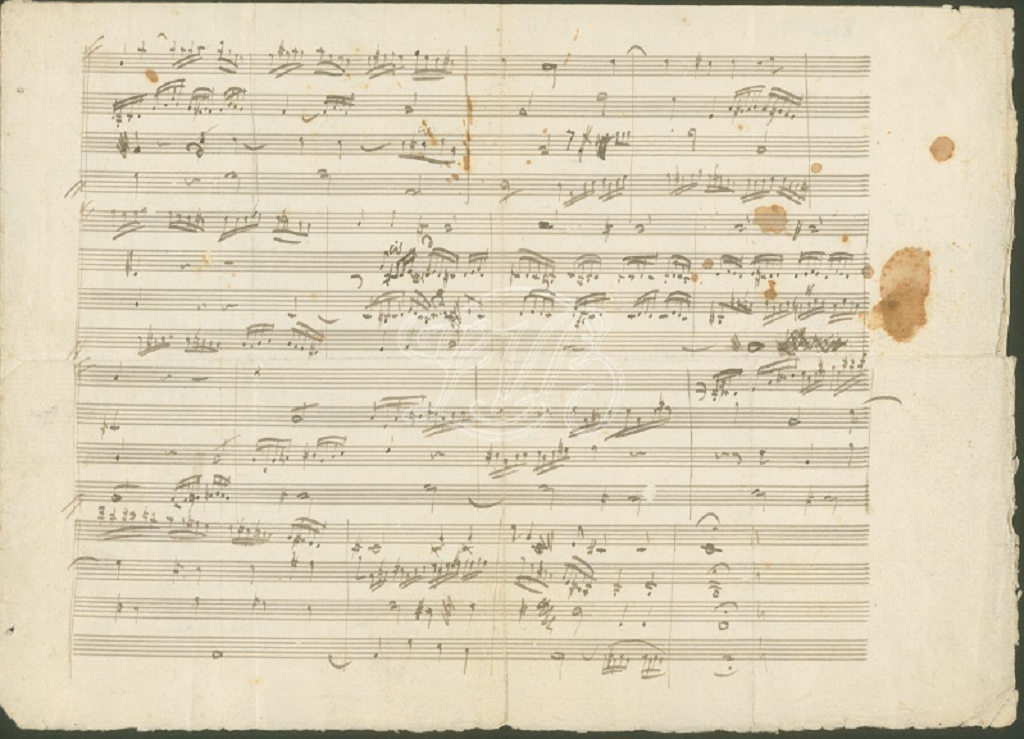

Biamonti 100 – Finale of a Prelude in D minor for string quartet, circa 1795
Biamonti 100 – Finale of a Prelude in D minor for string quartet, c. 1795. The original manuscript (15 bars) is found on the first page of a sheet containing sketches for the Adelaide on the reverse and is now preserved in the Beethovenhaus (Bodmer collection). Described at the time by M.U.S. (p. 166/62), which considers it composed during the period of Albrechsberger’s teachings, it is published by W. Hess in the sixth issue of the Supplemente zur GA, 1963. The almost total lack of corrections, says the latter scholar, is proof that it is the closure of a work already completed.
Biamonti, in his catalogue, indicates the same piece with 2 different numbers: in the first case, Biamonti 82, defines it as “Fugue for string quartet in D minor”, in the second “Finale of a Prelude in D minor for string quartet”. A beautiful explanation of this enigma can be found in the Green “The new Hess catalogue of Beethoven’s works” Zecchini Editore, which writes about the manuscripts in which Beethoven had copied and studied Albrechsberger’s Fugues.
“Johnson wrote [Johnson, “Beethoven’s Early Sketches in the Fischhof Miscellany” – University of California, Berkeley, 1978] “the quartet’s score in manuscript SBH 614 [HCB Mh 62] is probably the conclusion of a Prelude to a Fugue in D minor (not the fugue itself, as Hess believes) When Hess wrote this catalogue, in 1955, he called the fragment “fugue” (probably following Nottebohm’s terminology), but when he republished it in 1963 in SBG, vol VI, p. 52, he rightly called it “conclusion of a prelude to a fugue”. At this point the right numbering as far as the Biamonti catalog is concerned is BIAMONTI 100. Both Nottebohm and Biamonti (and I also add Green) make a mistake in counting the number of bars of this prelude finale, in fact Nottebohm and Green indicate 17, Biamonti 15; In fact, and we can clearly see it in the copy of the manuscript, the lines are 16.