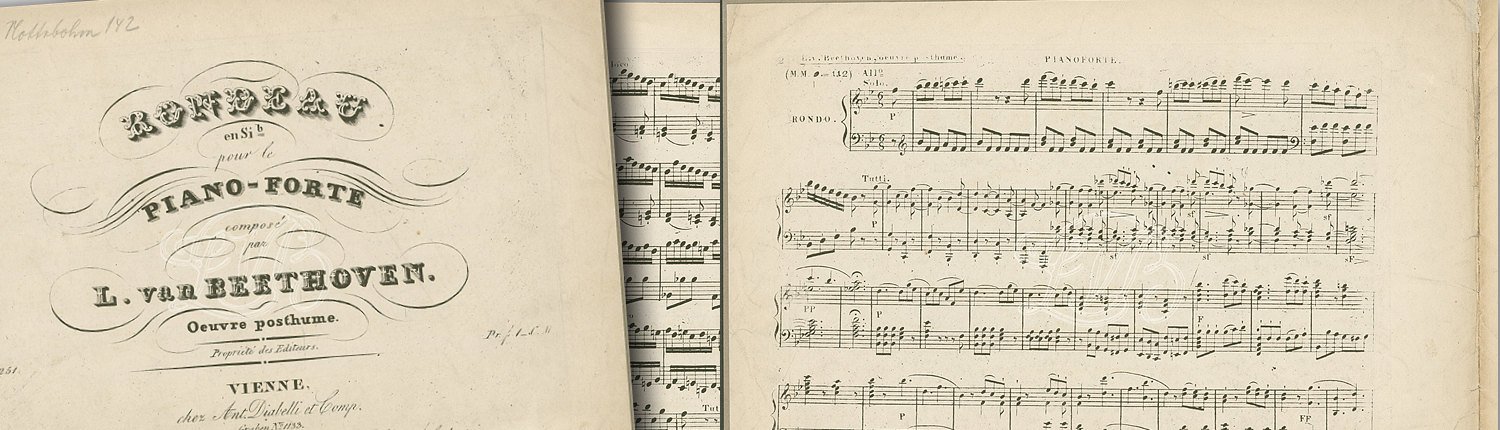
WoO 6 Rondo in B flat major for Piano and Orchestra
Rondo : Allegro
WoO 6 – Rondo in B-flat Major for Piano and Orchestra, published in Vienna in separate parts by Diabelli, June 1829; based on these, in score form in the GA. A more recent modern edition of the score, based on the original manuscript, was produced by W. Hess in the third volume of the GA., 1960. GA. No. 72 (series 9/9) – B. 151 – KH. (WoO)6 – L. IV, p. 362// – No. p. 141 – P. 112 – T. 280.
This composition, found among Beethoven’s papers after his death, was included in the catalogue compiled for the auction on 5 November 1827, under the category of abandoned, unfinished, and autograph works (Interlassene, nicht Wollstandige und Eigenhandig), as No. 177 with the title: Rondò für Orchester fürs P. F., unbekannt (Rondo with orchestra for piano, unknown). The original manuscript was not discovered until 1898 and is now kept in the archive of the Society of Friends of Music in Vienna. The sketch of the central Andante is reproduced by Nottebohm along with that of the Romance for harpsichord, flute, and bassoon. An annotation, made in a manuscript catalogue by L. Sonnleithner, based on a statement by Diabelli that the Rondo was left unfinished by Beethoven and completed for accompaniment by Czerny, is inaccurate, as clarified by Mandyczewsky after the discovery of the score and subsequent comparison with the version published by the GA. Czerny in fact only added the cadenzas and completed some solo passages that Beethoven had merely outlined. The recent publication of the score by Hess gives us the opportunity to assess with accuracy, including in light of Mandyczewsky’s conclusions, Czerny’s work, which, while within the noted limits, appears to follow virtuosic principles and does not account for the keyboard range of pianos of that time. Some, including Jahn, have suggested that this Rondo was originally intended as the finale of the Piano Concerto in B-flat Major, and Mandyczewsky pointed out several passages that might seem like early sketches for what was later realised in the Finale of that concerto; however, this remains a supposition, unsupported by decisive evidence. Orchestra: flute, 2 oboes, 2 bassoons, 2 horns, strings.
The Rondo has also been recorded by ByInedita, our partner and supporter, in volume 2 of the series, with Roberto Diem Tigani conducting the Sassari Orchestra and Maurizio Paciariello at the piano.
In the context of the compositional crisis that struck Beethoven in the first year of his arrival in Vienna, the revision into a second version of the “Piano Concerto in B-flat Major” also fits, a piece that had already been conceived in Bonn during the period 1787/89.
Unfortunately, due to the eight years of gestation and all the changes the composer made, it is impossible to know exactly the differences between the various drafts, as only the final version has come down to us. As Luca Chiantore states: “The sketchbooks allow us to reconstruct different moments in the gestation… And the multiplicity of sources offers musicologists and performers the opportunity to compare a vast amount of data directly related to interpretation… however, it is practically impossible to know what the pianistic transformation was…” [1]
The only thing that seems fairly certain is that this version had as its finale the Rondo WoO 6. The Rondo certainly shares with the Piano Concerto in B-flat Major the same key and a strong Mozartian influence. Moreover, the first sketches can be found alongside the Romanza cantabile in E-flat Major for harpsichord, flute, bassoon, with accompaniment of 2 oboes and strings WoO 207, dating from around 1787, the year in which the first approaches to this Concerto probably also began. Luigi Della Croce writes about this movement: “The undulating and melodious refrain is presented by the soloist, who then, throughout the piece, indulges in more than one passage of pure digital virtuosity.” [2]
It is not known whether this concerto was ever performed in the version with the original rondo instead of the final one.
[1] Luca Chiantore: Beethoven al pianoforte. Improvvisazione, composizione e ricerca sonora negli esercizi tecnici. Il Saggiatore Editore
[2] Luigi Della Croce: Ludwig van Beethoven. La musica sinfonica e teatrale. L’Epos Editore