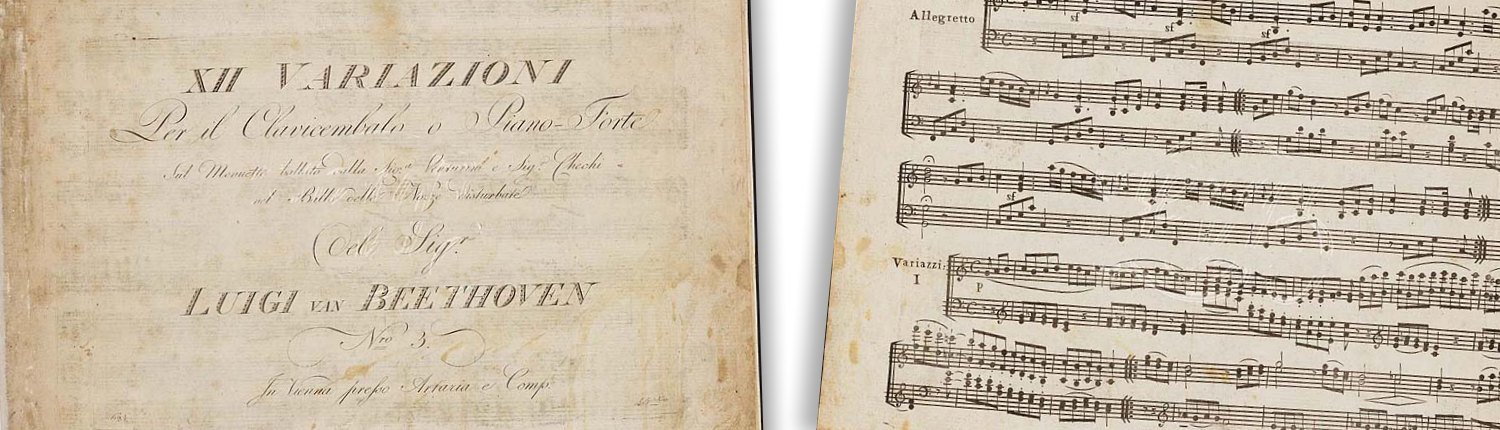
WoO 68 – Variations (12) in C major for piano on the “Minuetto alla Viganò” from the ballet “Le nozze disturbate” by Haibel
Thema – Allegretto
WoO 68: Twelve variations in C major for piano on the “Minuetto alla Viganò” from the ballet Le nozze disturbate by Haibel, composed in 1795 and published in Vienna by Artaria in February 1796. Catalog references: GA. No. 169 (series 17/8) – B. 181 – KH. (WoO)68 – L. IV. p. 316/4 – N. p. 156 – P. 66 – T. 34.
Historical Context: The Neapolitan dancer Salvatore Viganò was already receiving great acclaim in Vienna between 1793 and 1795. A few years later, he would begin his career as a choreographer—staging, among other works, Beethoven’s ballet The Creatures of Prometheus, for which his name is still remembered today.
The ballet Le nozze disturbate by Jakob Haibel premiered in Vienna on May 18, 1795. The “Minuetto alla Viganò” (i.e., in the style or manner of Viganò), danced by Signora Venturini and Signor Chechi (or Checchi), provided Beethoven—like other popular themes from operas and operettas—a motif for a set of variations.
These variations do not depart from the general framework of this particular period in Beethoven’s artistic development. In this genre, he addressed the elegant and carefree world, entertaining it while simultaneously promoting his name. Occasionally, he revealed glimpses or edges of his emerging personality. (Giovanni Biamonti)
Official Title: WoO 68 – Twelve Variations (C major) on the “Menuett à la Viganò” from the ballet Le nozze disturbate by Jakob Haibel for piano.
Dedication: None specified. Catalog: NGA VII/5 – AGA 169 = Series 17/8
Origin and Publication: Composed in 1795/96. The original edition was published by Artaria in Vienna in February 1796. The premiere of Haibel’s ballet Le nozze disturbate occurred on May 18, 1795, in Vienna. The advertisement for the original print of WoO 68 appeared in the Wiener Zeitung on February 27, 1796. These two dates serve as key markers for the genesis of the work.
The variations were first published by Artaria with plate number 623. However, this number had already been assigned to Hasselbeck’s nine Ländler, announced on January 27, 1796, in the Wiener Zeitung. The number was likely changed to 637 shortly thereafter.
Curiously, Artaria re-announced the variations in the Wiener Zeitung on February 8 and 11, 1797 (alongside Opp. 3–5 and 46), as “completely new,” with identical features and price (45 Kreuzer) as the original edition. This may refer to a revised edition with the updated plate number (see also Op. 3 announcement).
According to the Wiener Zeitung of August 23, 1800, the variations were also “available” from Viennese publisher Franz Anton Hoffmeister. However, it is debatable whether this was an original edition from his publishing house. So far, no copy has been found—only a later edition by his Leipzig partner and successor Ambrosius Kühnel, published in 1810.
Theme Origin: The “Minuetto à la Viganò” is named after dancer and choreographer Salvatore Viganò (1769–1821), creator of the Prometheus Ballet (see Op. 43).
On May 18, 1795, the ballet Le nozze disturbate premiered at Schikaneder’s Theater auf der Wieden in Vienna. Choreography was by Giovanni Chechi; music by Jakob Haibel, Mozart’s brother-in-law.
Besides Beethoven, other composers also created variations on this minuet:
- J. H. C. Bornhardt (Spehr, Braunschweig)
- J. Gelinek (Artaria, Vienna)
- H. Köhler (Boehme, Hamburg)
- G. Lickl (Maisch, Vienna)
- W. Schneider (Kuhn, Berlin)
First Performance: Unknown. Sketches preserved in the Berlin State Library (D-BNba, NE 121). Probable date: 1795 (Johnson/Fischhof vol. 1, pp. 138–141) Facsimile available via DBH/online.
Original Edition. Published February 1796, Vienna, Artaria & Co., plate number 623 (see origin and publication). Title on Original Edition: “XII VARIAZIONI / For Harpsichord or Piano-Forte / On the Minuet danced by Mrs. Venturini and Mr. Chechi / in the ballet Le nozze disturbate / by Mr. LUDWIG VAN BEETHOVEN / No. 3 / In Vienna at Artaria & Co.”