
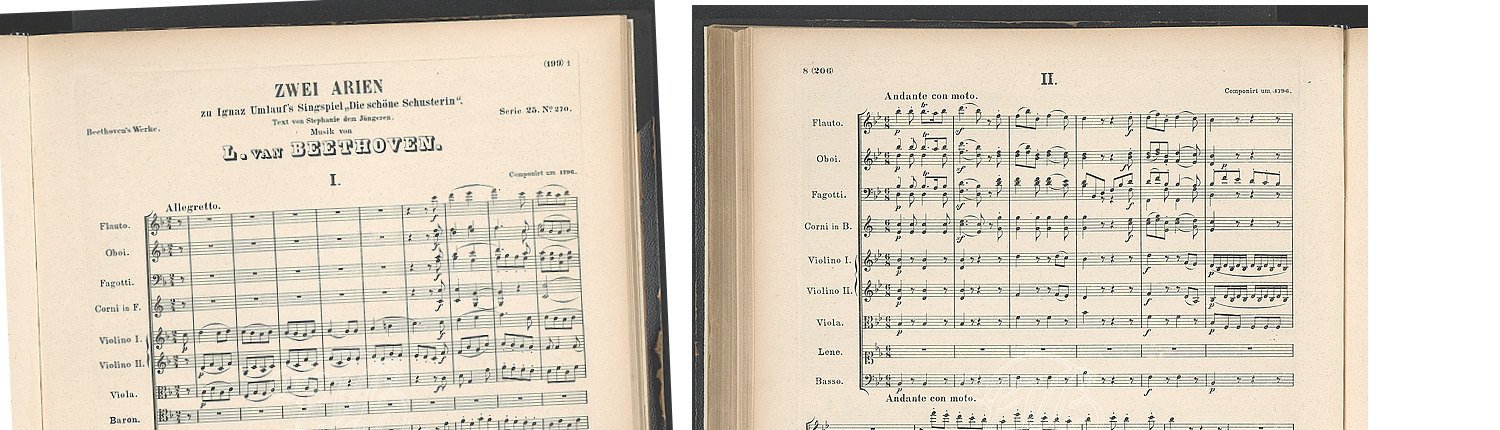
WoO 91, 2 Arias for the comic Singspiel: “Die schöne Schusterin” by Umlauf, for voice and orchestra
I) O welch ein Leben! (Allegretto) – II) Soll ein Schuh nicht drücken (Andante con moto)
WoO 91, 2 Arias for the comic Singspiel: “Die schöne Schusterin” by Umlauf, for voice and orchestra, 1796, first published in the Supplement to the GA., 1888. “O welch ein Leben!”, tenor; “Soll ein Schuh nicht drucken”, soprano. GA. no. 270 (series 25/7) – B. 261 – KH. (WoO)91 – P. 55 – T. 14.
The original manuscript is lost. Sketches of the second aria are found in some folios described by Nottebohm (II, p. 41), together with those for the Sonata op. 10 n. 1, the Sextet op. 71, the Variations on “Là ci darem la mano” for two oboes and English horn, and those for piano on “Une fièvre brûlante” by Grétry. The comic Singspiel: “Die schone Schusterin” by Ignatius Umlauf, to a libretto (from French) by Stephanie the Younger, had been performed in Vienna in 1779, in Bonn in 1789 and 1790. It was revived in Vienna in 1795 and 1796. Of these two Arias, only the text of the Second had been set to music in Umlauf’s Opera. Beethoven composed it again, in all probability, as cat. KH., for the singer Anna Maria Weiss, who had played the part of Frau Lene in the 1795 performance, but the text of the premiere was also intended to be introduced into the Opera. The melody of the First Aria is the same as that of the Maigesang (op. 52 no. 4) and is repeated with each of the three stanzas; in the last it is followed by a slightly more developed tail. The Orchestra (1 flute, 2 oboes, 2 bassoons, 2 horns and strings) becomes richer and more elaborate each time, with the gradual spread of the euphoric feeling. The Second Aria, with the orchestra equally formed, has a completely different character: like a caricature, like “Prüfung des Küssens” and “Mit Mädeln sich vertragen”.
[By Biamonti Giovanni – Catalogo cronologico e tematico delle opere di Beethoven comprese quelle inedite e gli abbozzi non utilizzati, Torino, ILTE 1968]
Official title: WoO 91 Zwei Arien (F-dur, B-dur) Einlagen zum Singspiel „Die schöne Schusterin“ von Ignaz Umlauf für Tenor bzw. Sopran und Orchester Widmung: – NGA X/3 AGA 270 = Serie 25/7
Origin and publication: probably composed in 1795 in Vienna using older material. The first edition of the score was published posthumously in 1888 as part of the AGA by Breitkopf & Härtel in Leipzig. Aria No. 1 is a transformation of the song “Maigesang” Op. 52 No. 4, although the date of its origin is not certain and can only be dated approximately to the early 1790s. Based on the sketches and types of paper used, Douglas Johnson assumes that No. 2 was created in 1795. If this hypothesis is correct, Beethoven may have thought of both arias for the Theater auf der Wieden, where Ignaz Ronde’s Singspiel Die Schöne Schusterin premiered on April 27, 1795, or for the Hoftheater am Kärntnertor. According to Ernst Hertrich, the fact that Magdalena Willmann (1771-1801) performed the role of the shoemaker there in 1795 suggests this as the correct date.
Text:
No. 1: Unknown, possibly Gottlieb Stephanie (1741-1800); No. 2: Gottlieb Stephanie. Stephanie was responsible for the lyrical transformation of the opera-comique Les souliers mordorés ou La cordonnière allemande (libretto by Marquis A. de Ferneres, music by Alessandro Fridzeri, first performed in Paris at the Comédie-Italienne on 11 January 1776) into a German Singspiel. Titled Die pücefarbnen Schuhe oder Die schöne Schusterin, it was first performed on 22 June 1779 at the Hofburgtheater in Vienna, with music by Ignaz Runde (1746-1796). In 1802, it was performed 61 times in both court theatres in Vienna, and there were numerous other performances in various Viennese theatres. The lyrics of the aria in WoO 91 No. 2 are almost identical to those in the libretto of the premiere.
The date of the first performance is unknown, but both arias were likely performed in 1795 during Runde’s Singspiel performances in Vienna, either at the Theater auf der Wieden or the Kärntnertortheater.
The sketches will be discussed in a dedicated article prepared for the Beethoven Music Research Centre at www.lvbeethoven.org