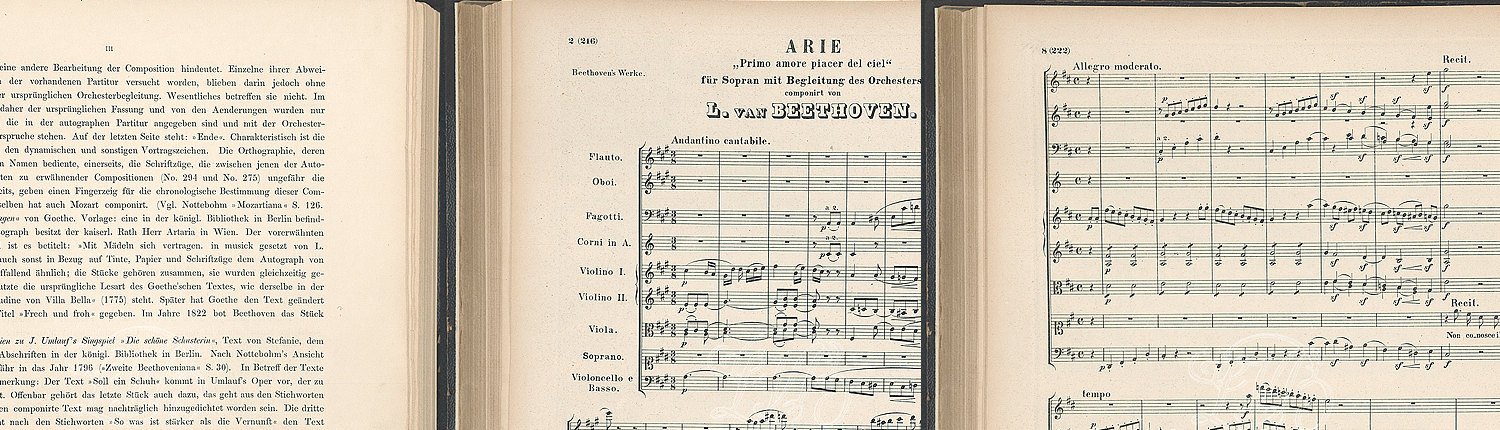
WoO 92 Primo amore, piacere del ciel, Scene and Aria for soprano and orchestra
I) Andantino cantabile – II) Allegro con brio
WoO 92 Primo amore, piacere del ciel, Scene and Aria for Soprano and Orchestra, 1795 – 1800, first published in the Supplement of the G.A. 1888. GA. no. 271 (series 25/8) – B. 262 – KH. (WoO)92 -T. 264/32.
The original manuscript is unknown. A revised copy with Beethoven’s name at the bottom is preserved in the Deutsche Staatsbibliothek in Berlin. The Italian verses by an unknown author, which we report in full out of curiosity, are rather lame and disproportionate. The orchestra, quite large and alive in its task of introducing, following, commenting and concluding the song, consists of flute, 2 oboes, 2 bassoons, 2 horns and strings. The first part, (Andantino cantabile): “Another jokes with love when loved abandons him, seeks a new love and mocks each one. First love, pleasure of Heaven penetrated my heart. I found my beloved, oh! but more is not for me.” has a “loving” musical physiognomy, which we will find, more exquisite, in the duet: “Nei giorni tuoi felici”, and, ideally elevated, in the Larghetto of the Second Symphony. The second (Recitative, Allegro moderato). “He does not know true love who does not feel great pain when the idol of the heart flees in the arms of another lover”, is a piece of movement, in words as in music: anxious, colorful, until the last words repeated: he does not know … does not know … true love, calming down, do not bring back the instrumental prelude of the first part, whose movement is now referred to as Larghetto, and the repetition, with the same music, of the first two stanzas of singing. The third (same tempo: the minor): “But if the dart quilted both hearts of the lovers and then comes division or only death consoles”, is the most significant of the whole aria for the variation of the tonal light, the melodic phrasing, the pauses, the support and the commentary of the orchestra. To the desolate image: “and then comes division”, the word of the end shabbily corresponds: “death, death, death…”. The fourth (Allegro con brio): “Such love, pleasure of heaven, penetrated my heart; I found the dear, oh! but more is not for me”, takes up the same verses, or almost, of the second stanza of the Andantino cantabile, the music is in the form and character of an Allegro finale of aria, with reiteration of melodic and rhythmic procedures, cadences, vocalizations (simple, however), notes held for a long time in the high note: in necessary dependence on a whole conventional association of words and phrases repeated to satiety, where the impetus collapses in the emphasis and fashion of melodramatic vocality. Only at the end does a breath of sincere poetry breathe again, when the two bars of Adagio, 3/8, repeat again the last phrase of the Andantino with the sloping of its melody in which the words, elsewhere so cloying: “but more is not for me”, sound with such sincere grace of sigh. The vocal and instrumental conclusion (Tempo I) that follows immediately after the crown, returns to pay its tribute to fashion.
[By Biamonti Giovanni – Catalogo cronologico e tematico delle opere di Beethoven comprese quelle inedite e gli abbozzi non utilizzati, Torino, ILTE 1968]
Official title: WoO 92 Erste Liebe, Himmelslust (Primo amore, piacer del ciel) Szene und Arie (A-dur) nach einem Gedicht von Gerhard Anton von Halem für Sopran und Orchester Widmung: — NGA X/3 AGA 271 = Serie 25/8
Origin and publication: Aria composed in 1791/92 in Bonn. The first edition of the score was published posthumously in 1888 as part of the AGA by Breitkopf & Härtel in Leipzig. The type of paper and the calligraphic characteristics of the autograph score suggest that Beethoven composed this aria in Bonn and not, as is often assumed, during his apprenticeship with Antonio Salieri in Vienna. Depending on the type of map, the age of origin can be restricted to the beginning of 1791 until August 1792. According to Ernst Herttrich, Beethoven may have composed this aria for the soprano Magdalena Willmann (1771-1801), who had been the first singer at the National Theatre in Bonn since 1791 and whose family knew Beethoven’s family well. Evidence of this are some passages in the remarkably grave register, which correspond to the ambitus of a soprano with unusual depth. Beethoven sold the aria to Artaria at an unknown date. On 27 September 1814 the publisher sent him the autograph score for further revision.
Despite Artaria’s repeated requests to return it, on May 24, 1824 and January 1826, the publisher did not receive the original score back. Text: Gerhard Anton von Halem (1752-1819), unknown publisher of texts in Italian. Von Halem’s poem, a translation of an English original, appeared in the Hamburg Musen Almanach of 1786 under the title “Die Liebe. Rondeau. Nach dem Englischen”. While Beethoven’s surviving sketch still contains a quotation from the German text, the autograph score – by someone else – has only the Italian text, added later. The publisher and date of the change are unknown. However, the rewriting of the Italian text must have taken place before 27 September 1814, as Artaria’s advertisement list mentions an Italian aria. Of the original nine stanzas, only six (1-3, 6, 8-9) were used for the aria, some of which have been translated quite loosely; Ernst Herttrich considers the English text “sprachlich und grammatikalisch so miserabel, daß er kaum von einem Italiener stammen kann” (from Italian, I confirm!). First execution unknown. It is not clear whether the “Arie von Hrn. v. Beethoven, gesungen von Madame Willmann” was about WoO 92, in the concert given by Ignaz Schuppanzigh on 6 April 1797 in the hall of the Hoftraiteur Jahn in Vienna.